Type
Knitting
Difficulty
beginner
Category
socks
AI Thinking Process
Planning
Verification
Pattern
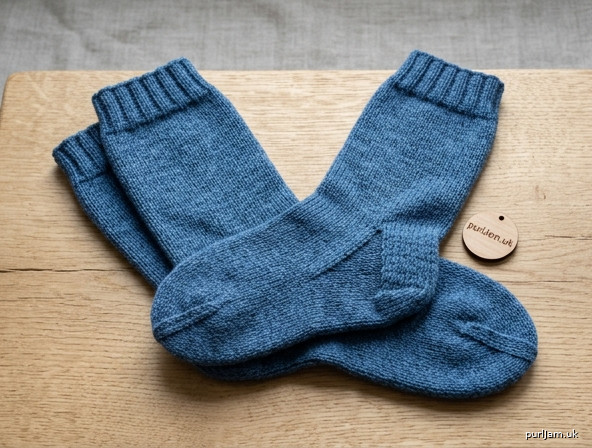
Easy Cuff-Down Worsted Socks
A beginner pair of socks worked from the cuff down with a traditional heel flap. You can try them on as you knit. Instructions are for the Small size, with Medium and Large in parentheses.
Sizes
| Small | Medium | Large | |
|---|---|---|---|
| To fit foot circumference | 19–20.5 cm (7½–8 in) | 21.5–23 cm (8½–9 in) | 24–25.5 cm (9½–10 in) |
| Finished sock circumference | 18 cm (7 in) | 20 cm (8 in) | 22 cm (8¾ in) |
| Suggested foot length | 21 cm (8¼ in) | 23 cm (9 in) | 26 cm (10¼ in) |
Foot length is a guide only. Stop the foot when the sock, tried on, is 5 cm (2 in) short of the end of the toes.
Finished circumference is slightly smaller than the foot (negative ease) so the sock stays up. Worsted fabric stretches.
Yarn
Aran / worsted weight yarn (UK 10-ply), preferably a sock yarn with some nylon.
- Small: 150 g / 300 m (330 yds)
- Medium: 175 g / 350 m (383 yds)
- Large: 200 g / 400 m (437 yds)
These amounts make one pair (two socks).
Needles and notions
- 4 mm (US 6) double-pointed needles (set of 5), or a 4 mm circular needle, 80 cm (32 in) or longer, for magic loop
- Optional: 3.5 mm (US 4) needles in the same style, for a firmer cuff
- Stitch marker
- Tapestry needle
- Spare needle or stitch holder for the Kitchener stitch
Tension (gauge)
20 stitches and 28 rounds = 10 cm (4 in) in stocking stitch, measured after a gentle wash and block.
Knit a swatch in the round. If you have more than 20 stitches in 10 cm, use a larger needle. If you have fewer, use a smaller needle. A loose sock wears out and slips; a tight sock will not fit.
Abbreviations
- k — knit
- p — purl
- sl 1 — slip 1 stitch purlwise
- k2tog — knit 2 stitches together (1 stitch decreased, leans right)
- ssk — slip 2 stitches knitwise one at a time, knit them together through the back loops (1 stitch decreased, leans left)
- p2tog — purl 2 stitches together (1 stitch decreased)
- RS / WS — right side / wrong side
- st(s) — stitch(es)
- rnd(s) — round(s)
Notes
- This pattern makes two socks. Repeat every section for the second sock.
- Cast-on counts: 36 (40, 44) stitches. Each is divisible by 4, so k2, p2 rib joins evenly (36 ÷ 4 = 9, 40 ÷ 4 = 10, 44 ÷ 4 = 11 ✓).
- Double-pointed needles: divide the stitches as evenly as you can over 4 needles. Example for Medium: 10 stitches on each of 4 needles (10 × 4 = 40 ✓). Knit with the 5th needle.
- Magic loop: place half the stitches on each half of the needle — 18 (20, 22) stitches per side.
- Join to work in the round, being careful not to twist the cast-on. Place a marker for the start of the round if you are using magic loop or a circular needle.
Cuff
With 4 mm needles (or 3.5 mm if you prefer a firmer cuff), cast on 36 (40, 44) stitches. Join to work in the round.
Rib round: *K2, p2; repeat from * to end.
Repeat the rib round until the cuff measures 4 cm (1½ in).
If you used 3.5 mm needles, change to 4 mm needles now.
Leg
Work stocking stitch (knit every round) until the piece measures 15 cm (6 in) from the cast-on edge, or the length you prefer. End at the start of the round.
Try the sock on. The rib should sit where you want the top of the sock.
Heel flap
The heel is worked flat on half the stitches: 18 (20, 22) stitches. Leave the remaining 18 (20, 22) stitches on hold for the instep (on one needle, or on the cable of a circular needle). Do not knit them until the gusset.
Row 1 (RS): *Sl 1 with yarn held at the back, k1; repeat from * to end. Row 2 (WS): Sl 1 with yarn held at the front, p to end.
Repeat Rows 1 and 2 until you have worked 18 (20, 22) rows in total, ending with a WS row.
You should have 9 (10, 11) slipped edge stitches along each side of the flap (one for every RS row: 18 ÷ 2 = 9, 20 ÷ 2 = 10, 22 ÷ 2 = 11 ✓). You will pick these up later.
Heel turn
Continue on the 18 (20, 22) heel stitches only. You will have 12 (12, 14) stitches left when the turn is complete.
Row 1 (RS): Sl 1, k10 (11, 12), ssk, k1, turn. Row 2 (WS): Sl 1, p5, p2tog, p1, turn.
Row 3 (RS): Sl 1, k to 1 stitch before the gap, ssk, k1, turn. Row 4 (WS): Sl 1, p to 1 stitch before the gap, p2tog, p1, turn.
Repeat Rows 3 and 4 until every heel stitch has been worked. On the last row, if there is no stitch left after the decrease, omit that k1 or p1 and finish the row. This happens on some sizes; it is correct.
12 (12, 14) stitches remain. Cut a short tail only if you wish; do not break the working yarn.
Gusset
Return to working in the round. The start of the round is now at the centre of the heel.
With RS facing:
- Knit across 6 (6, 7) heel stitches (half of the remaining heel: 12 ÷ 2 = 6, 12 ÷ 2 = 6, 14 ÷ 2 = 7 ✓). This is the new start of the round.
- With a free needle, knit the other 6 (6, 7) heel stitches, then pick up and knit 9 (10, 11) stitches along the first side of the heel flap (one in each slipped edge stitch).
- Knit the 18 (20, 22) held instep stitches.
- Pick up and knit 9 (10, 11) stitches along the other side of the flap, then knit the remaining 6 (6, 7) heel stitches.
Stitch count: 48 (52, 58). Check: instep 18 (20, 22) + heel 12 (12, 14) + pick-ups 18 (20, 22) = 48 (52, 58) ✓.
Suggested needle layout
| Small | Medium | Large | |
|---|---|---|---|
| Needle 1 (sole) | 15 | 16 | 18 |
| Needles 2 and 3 (instep) | 18 | 20 | 22 |
| Needle 4 (sole) | 15 | 16 | 18 |
Needle 1 is 6 (6, 7) heel stitches + 9 (10, 11) pick-ups. Needle 4 is the matching side. On magic loop, keep the sole stitches (Needles 1 and 4) on one half and the instep on the other.
Decrease round: Knit to the last 2 stitches of Needle 1, k2tog, knit across the instep, ssk at the start of Needle 4, knit to end. (2 stitches decreased.) Plain round: Knit.
Repeat these two rounds 6 (6, 7) times in total (12 (12, 14) stitches decreased: 6 × 2 = 12, 6 × 2 = 12, 7 × 2 = 14 ✓).
36 (40, 44) stitches remain — the same number you cast on. Sole needles now hold 9 (10, 11) stitches each; the instep still holds 18 (20, 22). 9 + 18 + 9 = 36, 10 + 20 + 10 = 40, 11 + 22 + 11 = 44 ✓.
Foot
Knit every round until the foot measures 5 cm (2 in) less than the desired finished length, measured from the back of the heel.
Suggested length before the toe: 16 (18, 21) cm (6¼ (7, 8¼) in), for a finished foot of about 21 (23, 26) cm. Trying the sock on is more reliable than the tape measure.
Toe
Rearrange stitches if needed so the instep half and the sole half are separate: 18 (20, 22) stitches each.
Decrease round:
- Instep: K1, ssk, knit to the last 3 instep stitches, k2tog, k1.
- Sole: K1, ssk, knit to the last 3 sole stitches, k2tog, k1. (4 stitches decreased.)
Plain round: Knit.
Repeat these two rounds until 20 (20, 24) stitches remain.
- Small: 36 − 20 = 16 stitches decreased, 16 ÷ 4 = 4 decrease rounds ✓
- Medium: 40 − 20 = 20, 20 ÷ 4 = 5 decrease rounds ✓
- Large: 44 − 24 = 20, 20 ÷ 4 = 5 decrease rounds ✓
Then repeat the decrease round only (no plain round) until 16 (16, 16) stitches remain: 8 on the instep and 8 on the sole.
Cut the yarn, leaving a tail about 40 cm (16 in) long.
Close the toe (Kitchener stitch)
Hold the instep stitches on one needle and the sole stitches on another, with the working yarn coming from the sole needle at the right. Graft the two sets of 8 stitches together.
Set-up, with the tapestry needle:
- Insert into the first instep stitch as if to purl, pull the yarn through, leave the stitch on the needle.
- Insert into the first sole stitch as if to knit, pull the yarn through, leave the stitch on the needle.
Repeat these two steps until 1 stitch remains on each needle:
- Instep: insert as if to knit, slip the stitch off; insert into the next instep stitch as if to purl, leave it on.
- Sole: insert as if to purl, slip the stitch off; insert into the next sole stitch as if to knit, leave it on.
Slip the last two stitches off and weave the end through them. If this is your first graft, follow a photo tutorial for “Kitchener stitch” alongside these steps — the path is always knit-off, purl-stay on the front needle, and purl-off, knit-stay on the back needle.
Finishing
Weave in the ends on the wrong side. Make the second sock the same.
Wash both socks in lukewarm water with a wool wash, squeeze gently (do not wring), and dry flat, easing them to the finished measurements. The rib should spring back; do not stretch the cuff while it dries.
Quick size card
| Small | Medium | Large | |
|---|---|---|---|
| Cast on / foot / after gusset | 36 | 40 | 44 |
| Heel flap stitches and rows | 18 | 20 | 22 |
| Stitches after heel turn | 12 | 12 | 14 |
| Pick up each side | 9 | 10 | 11 |
| Stitches after pick-up | 48 | 52 | 58 |
| Gusset decrease rounds | 6 | 6 | 7 |
| Stitches at start of final toe rounds | 20 | 20 | 24 |
| Stitches before grafting | 16 | 16 | 16 |
Disclaimer: This pattern was generated by AI and should be reviewed for accuracy before use. While we strive for quality, AI-generated content may contain errors. Please verify measurements, stitch counts, charts, and instructions before beginning your project. Generated by purlJam.uk
Love this pattern?
Save this pattern to your free PurlJam libraryAccess your pattern anytime
Bookmark this page to access your pattern anytime