Type
Knitting
Difficulty
beginner
Category
socks
AI Thinking Process
Planning
Pattern
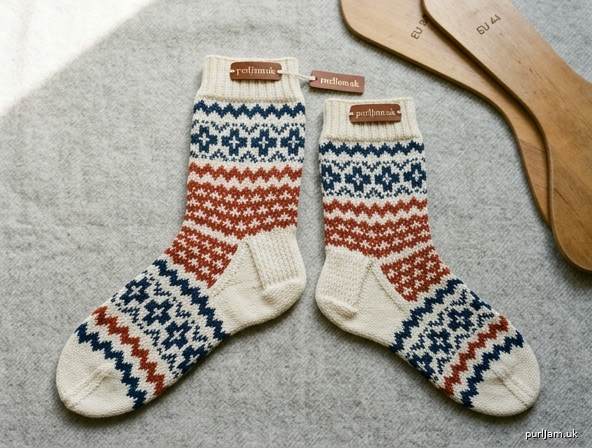
Easy Nordic Fjord Socks
Cuff-down Norwegian colorwork socks in two sizes (EU 36 & EU 44)
A beginner-friendly pair of cuff-down socks with small all-over Norwegian motifs. Three colors are used, but only two colors are ever worked in the same round, and no float is longer than 3 stitches — you do not need to catch or lock the second color. Ribbing, heel, and toe are worked in a single color for comfort and durability. Colorwork runs down the leg and around the foot.
This pattern makes one pair (2 socks). Work both socks alike. To make a matching pair for a partner, knit one pair in each size.
Skill level: Easy / first colorwork project
Construction: Cuff down, traditional heel flap and gusset, wedge toe
Sizes
EU 36 (EU 44) — shown as 36 (44) throughout.
To fit foot circumference about 8¼ (10¾)" / 21 (27.5) cm and foot length about 9 (11)" / 23 (28) cm.
Finished sock circumference (unstretched): 7½ (9¾)" / 19 (25) cm.
Colorwork fabric has less stretch than plain knitting; this ease is intentional. Try the sock on as you go.
Finished Measurements
- Foot / leg circumference: 7½ (9¾)" / 19 (25) cm
- Leg length (adjustable): 6½ (7½)" / 16.5 (19) cm from cast-on to start of heel
- Foot length (adjustable): 9 (11)" / 23 (28) cm from back of heel to tip of toe
Yarn
Sport-weight sock yarn, 3 colors. A wool/nylon blend is best for heels and toes (durability and bounce). Alpaca may be used as one or more of the colors for softness, but alpaca has less elasticity and the socks may stretch with wear — mix it with wool/nylon if you can, and keep all three yarns a similar thickness.
Suggested palette (classic Norwegian):
- MC (background): cream, natural, or light gray
- CC1: navy or charcoal
- CC2: red or rust
Yardage per pair (2 socks):
| EU 36 | EU 44 | |
|---|---|---|
| MC | 175 yd / 160 m | 240 yd / 220 m |
| CC1 | 95 yd / 87 m | 130 yd / 119 m |
| CC2 | 85 yd / 78 m | 115 yd / 105 m |
If you are making both pairs (36 and 44): MC 415 yd / 380 m; CC1 225 yd / 206 m; CC2 200 yd / 183 m.
Needles
- US 2 / 2.75 mm — cuff ribbing
- US 3 / 3.25 mm — colorwork, heel, foot, and toe (or size needed to obtain gauge)
Use a set of 5 double-pointed needles (DPNs), two circular needles, or one long circular for magic loop. A 9" / 23 cm circular can work for the leg and foot of size 36; switch to DPNs or magic loop for heel and toe.
Notions
- Stitch marker (beginning of round)
- Spare needle or stitch holder
- Tapestry needle
- Scissors
- Optional: sock blockers
Gauge
26 stitches and 32 rounds = 4" (10 cm) in stranded colorwork on US 3 / 3.25 mm needles, after blocking.
Swatch in the round with two colors (Charts are 8-st repeats; a 32-st swatch = 4 repeats). Colorwork gauge is the gauge that matters.
- Too few stitches per inch → sock will be loose and wear out faster. Use smaller needles.
- Too many stitches per inch → sock will be tight. Use larger needles.
Notes
- Instructions are for one sock. Make two alike for a pair.
- Only two colors per round. MC is in every colorwork round; CC1 and CC2 never meet in the same round.
- Floats are 1–3 stitches. Do not catch or lock the unused color. Spread the stitches on the right needle each time you change color so the float stays relaxed and the fabric does not pucker.
- Hold the contrast color slightly to the left (or “under” the MC) if you want the motifs to stand out. Optional; consistency matters more than which hand you use.
- When a contrast color is not needed for more than 4 rounds, break it, leaving a 6" / 15 cm tail, and join the next contrast color. Weave tails in as you go or at the end.
- Carry-up of unused yarn at the beginning of the round is fine for 2–4 rounds; twist it with MC every other round so the carry is tidy.
- Do not twist the work when joining in the round.
- Alpaca and wool/nylon may knit to slightly different gauges. Check that your three balls look even in a two-color swatch.
Abbreviations (US)
BOR — beginning of round
CC1, CC2 — contrast colors 1 and 2
CO — cast on
k — knit
k2tog — knit 2 together (right-leaning decrease)
MC — main color
p — purl
pm — place marker
rep — repeat
rnd(s) — round(s)
RS — right side
sl — slip stitch purlwise
ssk — slip, slip, knit (left-leaning decrease): slip 1 knitwise, slip 1 knitwise, insert left needle into the front of both and knit them together
st(s) — stitch(es)
WS — wrong side
wyib — with yarn in back
wyif — with yarn in front
How to Read the Charts
All colorwork is knit in the round (every round is a right-side round).
- Each chart is an 8-stitch repeat. Repeat it 6 (8) times around the sock: 8 × 6 = 48 ✓; 8 × 8 = 64 ✓.
- Charts are shown left to right in the order you knit. The leftmost symbol is the first stitch of the repeat. Work each round from left to right as written.
- Round 1 is at the bottom. Work upward.
- Brackets
[ ]mark one full repeat. - □ = MC, ■ = CC1, ● = CC2.
On the instep-only section (gusset), work the 8-st repeat 3 (4) times across the 24 (32) instep stitches only: 8 × 3 = 24 ✓; 8 × 4 = 32 ✓.
Charts
Color key
□ = MC (background)
■ = CC1
● = CC2
CHART A: Norwegian Crosses (8 sts × 8 rnds)
Work with MC + CC1. Repeat 6 (8) times around.
Rnd 8: [ □ ■ □ □ □ ■ □ □ ]
Rnd 7: [ ■ □ ■ □ ■ □ ■ □ ]
Rnd 6: [ □ ■ □ □ □ ■ □ □ ]
Rnd 5: [ □ □ □ ■ □ □ □ ■ ]
Rnd 4: [ □ ■ □ □ □ ■ □ □ ]
Rnd 3: [ ■ □ ■ □ ■ □ ■ □ ]
Rnd 2: [ □ ■ □ □ □ ■ □ □ ]
Rnd 1: [ □ □ □ ■ □ □ □ ■ ]
Written (each line is one 8-st repeat):
Rnd 1: K3 MC, k1 CC1, k3 MC, k1 CC1.
Rnd 2: K1 MC, k1 CC1, k3 MC, k1 CC1, k2 MC.
Rnd 3: K1 CC1, k1 MC, k1 CC1, k1 MC, k1 CC1, k1 MC, k1 CC1, k1 MC.
Rnd 4: K1 MC, k1 CC1, k3 MC, k1 CC1, k2 MC.
Rnd 5: K3 MC, k1 CC1, k3 MC, k1 CC1.
Rnd 6: K1 MC, k1 CC1, k3 MC, k1 CC1, k2 MC.
Rnd 7: K1 CC1, k1 MC, k1 CC1, k1 MC, k1 CC1, k1 MC, k1 CC1, k1 MC.
Rnd 8: K1 MC, k1 CC1, k3 MC, k1 CC1, k2 MC.
Max float: 3 sts.
CHART B: Tiny Stars (8 sts × 8 rnds)
Work with MC + CC2. Repeat 6 (8) times around.
Rnd 8: [ ● □ □ □ ● □ □ □ ]
Rnd 7: [ □ ● □ ● □ ● □ ● ]
Rnd 6: [ □ □ ● □ □ □ ● □ ]
Rnd 5: [ □ ● □ ● □ ● □ ● ]
Rnd 4: [ ● □ □ □ ● □ □ □ ]
Rnd 3: [ □ ● □ ● □ ● □ ● ]
Rnd 2: [ □ □ ● □ □ □ ● □ ]
Rnd 1: [ □ ● □ ● □ ● □ ● ]
Written:
Rnd 1: K1 MC, k1 CC2, k1 MC, k1 CC2, k1 MC, k1 CC2, k1 MC, k1 CC2.
Rnd 2: K2 MC, k1 CC2, k3 MC, k1 CC2, k1 MC.
Rnd 3: K1 MC, k1 CC2, k1 MC, k1 CC2, k1 MC, k1 CC2, k1 MC, k1 CC2.
Rnd 4: K1 CC2, k3 MC, k1 CC2, k3 MC.
Rnd 5: K1 MC, k1 CC2, k1 MC, k1 CC2, k1 MC, k1 CC2, k1 MC, k1 CC2.
Rnd 6: K2 MC, k1 CC2, k3 MC, k1 CC2, k1 MC.
Rnd 7: K1 MC, k1 CC2, k1 MC, k1 CC2, k1 MC, k1 CC2, k1 MC, k1 CC2.
Rnd 8: K1 CC2, k3 MC, k1 CC2, k3 MC.
Max float: 3 sts.
CHART C: Zigzag Peerie (8 sts × 4 rnds)
Work with MC + the contrast color named in the instructions (CC1 or CC2). Repeat 6 (8) times around.
Rnd 4: [ □ □ ■ ■ □ □ ■ ■ ]   (or ● for CC2)
Rnd 3: [ □ ■ ■ □ □ ■ ■ □ ]
Rnd 2: [ ■ ■ □ □ ■ ■ □ □ ]
Rnd 1: [ ■ □ □ ■ ■ □ □ ■ ]
Written (CC = the active contrast):
Rnd 1: K1 CC, k2 MC, k2 CC, k2 MC, k1 CC.
Rnd 2: K2 CC, k2 MC, k2 CC, k2 MC.
Rnd 3: K1 MC, k2 CC, k2 MC, k2 CC, k1 MC.
Rnd 4: K2 MC, k2 CC, k2 MC, k2 CC.
Max float: 2 sts.
Colorwork sequence (24-round super-repeat)
Work this sequence on the leg and again on the foot:
- Chart C with MC + CC1 (4 rnds)
- Chart A with MC + CC1 (8 rnds)
- Chart C with MC + CC2 (4 rnds)
- Chart B with MC + CC2 (8 rnds)
Then return to step 1. One full sequence = 4+8+4+8 = 24 rounds ✓.
Pattern Instructions
Cast On and Cuff
With smaller needles (US 2 / 2.75 mm) and MC, cast on 48 (64) stitches loosely using a long-tail cast-on.
Divide stitches onto DPNs as follows (4 holding needles):
- EU 36: 12 / 12 / 12 / 12 (12 × 4 = 48 ✓)
- EU 44: 16 / 16 / 16 / 16 (16 × 4 = 64 ✓)
Or use magic loop: 24 (32) sts on each half.
Join to work in the round, being careful not to twist. Place marker for BOR.
Ribbing: *K2, p2; rep from * around.
Work until cuff measures 1½" / 4 cm.
Leg
Change to larger needles (US 3 / 3.25 mm).
Join CC1. Begin the Colorwork sequence, starting with Chart C (MC + CC1).
Work in sequence until the piece measures 6½ (7½)" / 16.5 (19) cm from the cast-on edge, or desired leg length. End after completing any full individual chart (A, B, or C) so the colorwork stops on a clean round.
Break CC1 and CC2. Continue with MC only.
Stitch count remains 48 (64) ✓.
Heel Flap
The heel is worked flat, back and forth, in MC only, on half the stitches.
Knit the first 24 (32) sts onto one needle — these are the heel stitches.
Place the remaining 24 (32) instep sts on a holder or leave them on spare needle(s). You will not work them again until the gusset.
Work the slipped-stitch flap (durable, beginner-friendly):
Row 1 (RS): *Sl 1 wyib, k1; rep from * to end.
Row 2 (WS): Sl 1 wyif, purl to end.
Repeat Rows 1–2 until you have worked 24 (32) rows in total, ending with a WS (purl) row.
You will have 12 (16) slipped “chain” stitches along each side of the flap (24 ÷ 2 = 12 ✓; 32 ÷ 2 = 16 ✓).
Heel Turn
Continue in MC. Short rows shape the cup of the heel. You will always slip the first stitch, work to 1 stitch before the gap, decrease across the gap, work 1 stitch, and turn.
EU 36 (24 heel sts)
Row 1 (WS): Sl 1, p13, p2tog, p1, turn.
Row 2 (RS): Sl 1, k5, ssk, k1, turn.
Row 3: Sl 1, p6, p2tog, p1, turn.
Row 4: Sl 1, k7, ssk, k1, turn.
Row 5: Sl 1, p8, p2tog, p1, turn.
Row 6: Sl 1, k9, ssk, k1, turn.
Row 7: Sl 1, p10, p2tog, p1, turn.
Row 8: Sl 1, k11, ssk, k1, turn.
Row 9: Sl 1, p12, p2tog, p1, turn.
Row 10: Sl 1, k13, ssk, k1. Do not turn.
5 WS decreases + 5 RS decreases = 10 sts decreased → 24 − 10 = 14 sts remain ✓.
EU 44 (32 heel sts)
Row 1 (WS): Sl 1, p17, p2tog, p1, turn.
Row 2 (RS): Sl 1, k5, ssk, k1, turn.
Row 3: Sl 1, p6, p2tog, p1, turn.
Row 4: Sl 1, k7, ssk, k1, turn.
Row 5: Sl 1, p8, p2tog, p1, turn.
Row 6: Sl 1, k9, ssk, k1, turn.
Row 7: Sl 1, p10, p2tog, p1, turn.
Row 8: Sl 1, k11, ssk, k1, turn.
Row 9: Sl 1, p12, p2tog, p1, turn.
Row 10: Sl 1, k13, ssk, k1, turn.
Row 11: Sl 1, p14, p2tog, p1, turn.
Row 12: Sl 1, k15, ssk, k1, turn.
Row 13: Sl 1, p16, p2tog, p1, turn.
Row 14: Sl 1, k17, ssk, k1. Do not turn.
7 WS decreases + 7 RS decreases = 14 sts decreased → 32 − 14 = 18 sts remain ✓.
Gusset
You will pick up stitches along both sides of the heel flap, then return to working in the round. Colorwork resumes on the instep only; the sole and gusset are MC so the contrast yarn is never carried across the bottom of the foot.
Pick up (MC, RS facing):
With the needle holding the 14 (18) heel sts, pick up and knit 13 (17) sts along the left side of the flap: 1 st in each of the 12 (16) chain sts, plus 1 extra in the corner between flap and instep to close the gap.
Work across the 24 (32) instep sts in knit (this is a setup round; colorwork starts on the next round).
Pick up and knit 13 (17) sts along the right side of the flap the same way (12 (16) chains + 1 corner).
Knit across the 14 (18) heel sts.
Stitch count:
EU 36: 14 + 13 + 24 + 13 = 64 sts ✓
EU 44: 18 + 17 + 32 + 17 = 84 sts ✓
Rearrange if needed:
- Needle 1 (left gusset / half heel): 20 (26) sts
- Needle 2 (instep): 24 (32) sts
- Needle 3 (right gusset / half heel): 20 (26) sts
20+24+20 = 64 ✓; 26+32+26 = 84 ✓.
Place BOR at the start of the instep (Needle 2). Join CC1 (or whichever contrast the sequence needs — a fresh start with Chart A is simplest).
Instep colorwork rule (read once, use every gusset and optional-sole round):
Work the chart across the 24 (32) instep stitches. At the end of the instep, drop CC. Work the sole and gusset stitches in MC only. When you reach the instep again, pick up CC, twisting it around MC once to close the gap, and resume the chart. Do not carry CC across the sole.
Begin instep colorwork with Chart A, Round 1 (or continue the sequence from the leg if you noted your last round).
Gusset decrease round:
Work instep in chart as set.
On the sole: k1, ssk, knit to last 3 sole sts, k2tog, k1.
(2 sts decreased ✓)
Even round:
Work instep in chart. Knit all sole/gusset sts.
Repeat these 2 rounds until 48 (64) sts remain:
- EU 36: 64 − 48 = 16 sts to decrease, 2 per decrease round → 8 decrease rounds ✓ (15 gusset rounds total with the even rounds between them)
- EU 44: 84 − 64 = 20 sts to decrease, 2 per decrease round → 10 decrease rounds ✓
You now have 24 (32) instep sts and 24 (32) sole sts. 24+24 = 48 ✓; 32+32 = 64 ✓.
Foot
Resume colorwork all the way around on all 48 (64) sts (6 (8) repeats of the 8-st chart). Continue the Colorwork sequence.
Work even until the foot measures 2 (2¼)" / 5 (5.5) cm less than the desired finished length, measured from the back of the heel.
Target total foot length: 9 (11)" / 23 (28) cm.
So begin the toe when the foot measures about 7 (8¾)" / 18 (22.5) cm from the back of the heel.
End after a complete chart if you are close. Break CC1 and CC2. Toe is MC only.
Optional smoother sole: If you prefer a solid, more durable sole, keep using the instep colorwork rule (chart on 24 (32) instep sts, MC on 24 (32) sole sts) for the whole foot. The top of the foot will still match the leg.
Try the sock on. The unworked toe will add about 2 (2¼)" / 5 (5.5) cm.
Toe
With MC and larger needles, arrange stitches so 24 (32) are on the instep needle(s) and 24 (32) are on the sole needle(s). BOR at the start of the instep.
Rnd 1 (decrease):
Instep: K1, ssk, knit to last 3 instep sts, k2tog, k1.
Sole: K1, ssk, knit to last 3 sole sts, k2tog, k1.
(4 sts decreased ✓)
Rnd 2: Knit.
Repeat Rnds 1–2 until 24 (32) sts remain (half of 48 (64) ✓).
Then work Rnd 1 only (decrease every round) until 12 (16) sts remain.
EU 36 path: 48 → 24 (6 alt-round decrease rnds) → 12 (3 every-round decrease rnds) ✓
EU 44 path: 64 → 32 (8 alt-round decrease rnds) → 16 (4 every-round decrease rnds) ✓
Cut yarn, leaving a 12" / 30 cm tail. Divide the remaining sts onto two needles, 6 (8) instep and 6 (8) sole.
Finishing — Kitchener Stitch
Graft the toe closed with MC.
Set-up (once only):
- Front needle: go through the first st purlwise, leave it on.
- Back needle: go through the first st knitwise, leave it on.
Repeat until 2 sts remain, then work the last two as “front knitwise off, back purlwise off”:
- Front needle: Knitwise, slip off. Purlwise, leave on.
- Back needle: Purlwise, slip off. Knitwise, leave on.
Snug the stitches as you go so the join matches the knit fabric. Weave in the tail to the inside.
Weave in all remaining ends on the WS, following the same color path so they do not show. Do not pull colorwork ends tight or you will pucker the motifs.
Block: Soak in lukewarm water with a little wool wash for 15–20 minutes. Squeeze (do not wring). Roll in a towel. Lay flat or place on sock blockers. Do not stretch hard — blocking evens the stranded fabric; overstretching grows the sock. Let dry completely.
Make the second sock the same way for a pair.
Needle Methods (choose one)
DPNs (4 holding + 1 working):
Cuff/leg: 12 (16) sts on each of 4 needles. Work with a 5th. The “join” between needles is just where you switch needles; keep it snug to avoid ladders (give the first 2 sts of each needle a slightly firmer tug).
Magic loop (one long circular, 32–40" / 80–100 cm):
Split 24 (32) / 24 (32). Pull a loop of cable out between the two halves. Knit one half, turn, slide, repeat. Same stitch counts as DPNs.
Fit and Length Cheatsheet
| EU 36 | EU 44 | |
|---|---|---|
| Cast on | 48 sts | 64 sts |
| Finished circumference | 7½" / 19 cm | 9¾" / 25 cm |
| Cuff | 1½" / 4 cm k2p2 | 1½" / 4 cm k2p2 |
| Leg to heel (including cuff) | 6½" / 16.5 cm | 7½" / 19 cm |
| Heel flap sts × rows | 24 × 24 | 32 × 32 |
| Sts after heel turn | 14 | 18 |
| Sts after pickup | 64 | 84 |
| Sts after gusset | 48 | 64 |
| Begin toe when foot measures (from back of heel) | 7" / 18 cm | 8¾" / 22.5 cm |
| Total foot length | 9" / 23 cm | 11" / 28 cm |
| Sts at Kitchener | 12 (6+6) | 16 (8+8) |
Lengths are adjustable. Try on before the toe: the sock should be snug but not strained, and should reach the base of the toes when you are ready to start decreasing.
Colorwork Reminders (quick list)
- Two colors per round only.
- Floats never longer than 3 sts — no catching.
- Spread stitches on the right needle at every color change.
- Fabric should lie flat, not draw in. If it puckers, your floats are too tight.
- Jog at BOR is hidden at the inner leg if you keep BOR at the side after the heel; on the leg it sits at your join. Do not worry about it on an all-over motif.
Enjoy your matching Fjord socks.
Disclaimer: This pattern was generated by AI and should be reviewed for accuracy before use. While we strive for quality, AI-generated content may contain errors. Please verify measurements, stitch counts, charts, and instructions before beginning your project. Generated by purlJam.uk
Love this pattern?
Save this pattern to your free PurlJam libraryAccess your pattern anytime
Bookmark this page to access your pattern anytime