Type
Knitting
Difficulty
beginner
Category
mittens
AI Thinking Process
Planning
Verification
Pattern
Five-Petal Flower Mittens
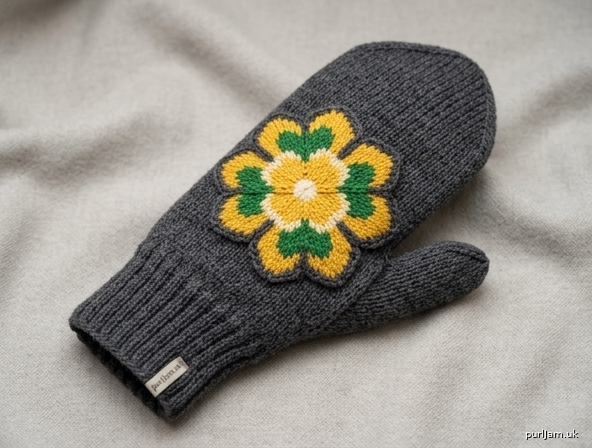
Intermediate knitted mittens with a ribbed cuff, a simple thumb gusset, and a small five-petal flower sewn to the back of each hand. Worked in the round from the cuff up. The flower is fully written below, so no chart is required. If you are using a separate flower chart, placement notes are given in the hand section.
Sizes: Child S (Child L, Adult S, Adult M, Adult L) To fit approx. age / hand: 4–6 years (7–10 years, adult small, adult medium, adult large)
Figures are given for Child S first, then Child L, Adult S, Adult M and Adult L in brackets. Where only one figure is given, it applies to all sizes.
Finished measurements
| Child S | Child L | Adult S | Adult M | Adult L | |
|---|---|---|---|---|---|
| To fit hand circumference | 15 cm (6 in) | 17 cm (6¾ in) | 19 cm (7½ in) | 21 cm (8¼ in) | 23 cm (9 in) |
| Finished circumference | 14 cm (5½ in) | 16 cm (6¼ in) | 18 cm (7 in) | 20 cm (8 in) | 22 cm (8¾ in) |
| Finished length, cuff to tip (approx.) | 16 cm (6¼ in) | 19 cm (7½ in) | 24 cm (9½ in) | 26.5 cm (10½ in) | 28.5 cm (11¼ in) |
| Cuff length | 5 cm | 6 cm | 7 cm | 7.5 cm | 8 cm |
| Thumb length (approx.) | 4 cm | 4.5 cm | 5.5 cm | 6 cm | 6.5 cm |
Finished circumference has about 1 cm of negative ease. Stocking stitch and rib are elastic; if you are between sizes, or want a roomier mitten, choose the larger size.
Yarn
Worsted weight yarn (some UK labels say Aran; match the tension, not the ball band). A wool or wool-blend fibre is recommended for warmth and elasticity. Amounts below assume about 180 m per 100 g.
Main colour (MC): 50 (60, 90, 100, 120) g / 90 (110, 165, 180, 220) m Contrast colour (CC), petals: 10 (10, 15, 15, 15) g / 18 (18, 27, 27, 27) m Oddments: about 5 m of a centre colour, and about 5 m of a leaf colour. The centre may be worked in MC. The leaf may be omitted.
Suggested colouring, not obligatory: MC charcoal grey or deep green; CC rose, cream or gold for the petals; a small gold centre and a softer green leaf.
Needles
- 4 mm (UK 8) double-pointed needles, or a circular needle 80 cm long for magic loop — cuff and flower
- 4.5 mm (UK 7) double-pointed needles, or a circular needle 80 cm long for magic loop — hand and thumb
Use the same needle type throughout if you prefer. Change size if needed to obtain tension.
Notions
Two stitch markers, waste yarn or a stitch holder, tapestry needle.
Tension (gauge)
20 stitches and 28 rounds = 10 cm (4 in) over stocking stitch using 4.5 mm needles, measured after a gentle block.
Knit a square of at least 12 cm before you begin. If you have more than 20 stitches to 10 cm, try a larger needle; if fewer, try a smaller needle. Rib is worked on the smaller needle and will draw in, which is correct.
Pattern notes
- The two mittens are knitted the same. Left and right are made when you sew each flower to the back of the hand.
- The start of the round sits at one side of the hand, beside the thumb. Side decreases at the tip run up the thumb side and the little-finger side.
- Cast on loosely enough for the cuff to pass over the hand.
- For child sizes, sew the flower and leaf on very securely all round, and check the stitching from time to time. This appliqué is intended for children of about 4 years and over, not for babies or toddlers.
Abbreviations
- k — knit
- p — purl
- st(s) — stitch(es)
- rnd(s) — round(s)
- RS / WS — right side / wrong side
- pm — place marker
- sm — slip marker
- k2tog — knit 2 stitches together
- ssk — slip 2 stitches knitwise one at a time, knit them together through the back loops
- kfb — knit into the front and back of the next stitch (1 stitch increased)
- sk2po — slip 1, knit 2 together, pass the slipped stitch over (2 stitches decreased)
- M1L — make 1 left: lift the bar between the stitches from front to back and knit it through the back loop
- M1R — make 1 right: lift the bar between the stitches from back to front and knit it through the front loop
- st st — stocking stitch (in the round: knit every round)
Special technique
Backwards-loop cast-on: twist a loop in the working yarn so it sits on the needle without pulling tight. Used for the single stitch that closes the thumb gap.
Cuff (make 2)
With MC and 4 mm needles, cast on 28 (32, 36, 40, 44) sts. Join to work in the round, being careful not to twist. Place a marker for the start of the round.
Rib round: (K2, p2) to end.
Repeat the rib round until the cuff measures 5 (6, 7, 7.5, 8) cm.
Hand and thumb gusset
Change to 4.5 mm needles.
Setup round: Pm, k1, pm, k to end. 28 (32, 36, 40, 44) sts; 1 gusset stitch between the markers.
Increase round: Sm, M1L, k to marker, M1R, sm, k to end. 2 gusset stitches increased. Plain round: Knit, slipping markers.
Work the increase round and the plain round 5 (6, 8, 9, 10) times in total.
11 (13, 17, 19, 21) gusset stitches (1 + 2 × 5 (6, 8, 9, 10) increases ✓). 38 (44, 52, 58, 64) stitches in total (28 (32, 36, 40, 44) + 10 (12, 16, 18, 20) ✓).
You should have just worked a plain round.
Separate the thumb
Remove the start-of-round marker. Slip the next 11 (13, 17, 19, 21) gusset stitches to waste yarn. Remove the second marker. Cast on 1 stitch using the backwards loop method. Knit to the end of the round.
28 (32, 36, 40, 44) stitches restored (gusset removed, 1 stitch cast on ✓).
The cast-on stitch is the new start of the round. Place a marker on it if your needles do not already mark the start.
Upper hand
Knit every round until the hand measures 8.5 (10, 14, 15.5, 16.5) cm from the end of the cuff (the top of the rib).
Top shaping will add about 2.5 (3, 3.5, 3.5, 4) cm.
Place a midpoint marker after 14 (16, 18, 20, 22) stitches. The start-of-round marker and this midpoint marker are the two side markers.
Colourwork, if you are using it
If you are working a flower from a separate chart, work that motif during these plain rounds, in CC on an MC ground. Centre it on the stitches that will lie on the back of the hand, a short distance above the thumb split, and keep it clear of the thumb and of both side markers. The stitch count does not change. Keep floats loose enough that the fabric is not pulled in.
If you are not using a chart, continue in MC only. The knitted flower later in this pattern is a complete motif on its own.
Shape top
Decrease round: *K1, ssk, knit to 3 stitches before the next marker, k2tog, k1, sm; repeat from * once more. 4 stitches decreased. Plain round: Knit.
Work a decrease round and a plain round 2 (2, 3, 3, 3) times in total. 20 (24, 24, 28, 32) stitches (each pair removes 4 stitches; 28 − 8 = 20, 32 − 8 = 24, 36 − 12 = 24, 40 − 12 = 28, 44 − 12 = 32 ✓).
Work the decrease round every round a further 3 (4, 3, 4, 5) times, until 8 (8, 12, 12, 12) stitches remain (20 − 12 = 8, 24 − 16 = 8, 24 − 12 = 12, 28 − 16 = 12, 32 − 20 = 12 ✓).
On the last decrease round there may be no stitches between the ssk and the k2tog. That is correct. Do not decrease below 8 (8, 12, 12, 12) stitches: each side would then be too narrow for this decrease.
Cut the yarn, thread it through the remaining stitches, pull tight, and fasten off. Weave in the end on the wrong side.
Thumb
Return the 11 (13, 17, 19, 21) held stitches to a 4.5 mm needle.
With the right side facing, join MC at the right-hand side of the gap. Pick up and knit 1 stitch in the corner before the cast-on stitch, 1 stitch in the cast-on stitch itself, and 1 stitch in the corner after it. Knit the held stitches. 14 (16, 20, 22, 24) stitches.
Join to work in the round. Place a marker for the start of the round.
Next round (close the gaps): K2tog, knit to the last 2 stitches, ssk. 12 (14, 18, 20, 22) stitches (14 − 2 = 12, 16 − 2 = 14, 20 − 2 = 18, 22 − 2 = 20, 24 − 2 = 22 ✓).
Knit every round until the thumb measures 3 (3.5, 4.5, 5, 5.5) cm from the picked-up stitches. The decreases add about 1 cm, bringing the thumb to about 4 (4.5, 5.5, 6, 6.5) cm.
Decrease round 1: (K2tog) to end. 6 (7, 9, 10, 11) stitches. Decrease round 2: (K2tog) to end, knitting the final stitch if one remains. 3 (4, 5, 5, 6) stitches.
Cut the yarn, thread it through the remaining stitches, pull tight, and fasten off. Close any small hole at the thumb crotch with the yarn tail, then weave in the end.
Make the second mitten the same.
Flower (make 2)
Each flower has five petals, one centre, and one leaf. Use 4 mm needles. Petals and leaf are worked flat in garter stitch (knit every row) so they lie calmly and do not curl.
Petal (make 5 per flower)
Child S and Child L
With CC, cast on 3 stitches, leaving a 20 cm tail for sewing.
- Row 1 (RS): Kfb, k1, kfb. 5 stitches.
- Row 2: Knit.
- Row 3: Ssk, k1, k2tog. 3 stitches.
- Row 4: Knit.
- Row 5: Sk2po. 1 stitch.
Fasten off, leaving a 20 cm tail.
Adult S, Adult M and Adult L
With CC, cast on 3 stitches, leaving a 20 cm tail.
- Row 1 (RS): Kfb, k1, kfb. 5 stitches.
- Row 2: Knit.
- Row 3: Kfb, k3, kfb. 7 stitches.
- Row 4: Knit.
- Row 5: Ssk, k3, k2tog. 5 stitches.
- Row 6: Knit.
- Row 7: Ssk, k1, k2tog. 3 stitches.
- Row 8: Knit.
- Row 9: Sk2po. 1 stitch.
Fasten off, leaving a 20 cm tail.
Centre (make 1 per flower)
With the centre colour (or MC), cast on 1 stitch.
- Row 1 (RS): (K1, yo, k1, yo, k1) all into the same stitch. 5 stitches.
- Row 2: Knit.
- Row 3: Ssk, k1, k2tog. 3 stitches.
- Row 4: Sk2po. 1 stitch.
Fasten off, leaving a tail long enough to sew the centre down and to close the little eye at the cast-on.
Leaf (make 1 per flower)
Use the leaf colour, or MC for a tonal leaf. Cast on 3 stitches.
Child S and Child L
- Row 1 (RS): Kfb, k1, kfb. 5 stitches.
- Row 2: Knit.
- Row 3: Knit.
- Row 4: Ssk, k1, k2tog. 3 stitches.
- Row 5: Knit.
- Row 6: Sk2po. 1 stitch.
Fasten off, leaving a sewing tail.
Adult S, Adult M and Adult L
- Row 1 (RS): Kfb, k1, kfb. 5 stitches.
- Row 2: Knit.
- Row 3: Kfb, k3, kfb. 7 stitches.
- Row 4: Knit.
- Row 5: Knit.
- Row 6: Ssk, k3, k2tog. 5 stitches.
- Row 7: Knit.
- Row 8: Ssk, k1, k2tog. 3 stitches.
- Row 9: Knit.
- Row 10: Sk2po. 1 stitch.
Fasten off, leaving a sewing tail.
Sew the flower
Arrange the five petals in a circle, right sides up, with the bases overlapping slightly. Sew the bases together with the tails so the join is flat and secure.
Sew the centre over the join, covering the raw bases. Tuck the base of the leaf under one petal and sew it in place so it peeks out to one side.
The finished child flower is about 4.5 cm across; the adult flower is about 6.5–7 cm across. If your flower is much larger, you are using a heavier yarn or a looser tension than the hand — that is acceptable if you like the scale, but check that it still sits on the back of the hand.
Making up
Weave in all mitten ends before sewing on the flowers.
Try each mitten on and mark the centre of the back of the hand with a pin: the face that has no thumb when the mitten is worn. The thumb of the right mitten sits to the left of that back panel when you look at your own right hand, back facing you; the left mitten is the reverse.
Sew each flower to the back of the hand, with the centre about 2 (2, 3, 3.5, 4) cm above the thumb opening and centred between the thumb side and the little-finger side. Stitch around the base of the flower so the petal tips stay free. On child sizes, stitch each petal base down firmly as well.
Block the mittens gently under a damp cloth, or wet-block and dry flat, easing them to the finished measurements. Do not press the flowers flat if you want them to keep a little texture.
Care
Follow the ball band. Wool mittens are best washed by hand in cool water and dried flat, away from direct heat.
Disclaimer: This pattern was generated by AI and should be reviewed for accuracy before use. While we strive for quality, AI-generated content may contain errors. Please verify measurements, stitch counts, charts, and instructions before beginning your project. Generated by purlJam.uk
Love this pattern?
Save this pattern to your free PurlJam libraryAccess your pattern anytime
Bookmark this page to access your pattern anytime