Type
Knitting
Difficulty
intermediate
Category
custom
AI Thinking Process
Planning
Verification
Pattern
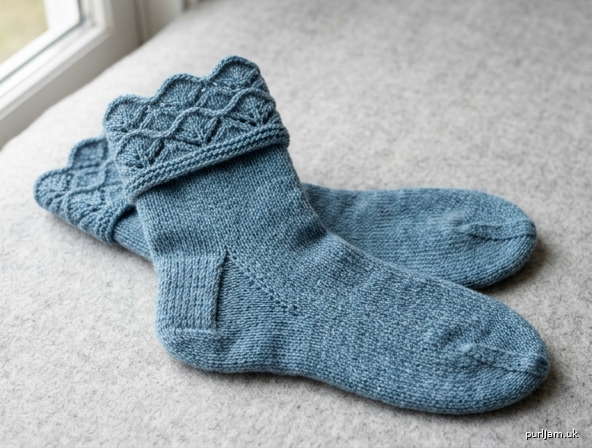
Folded Scallop Worsted Socks
Size EU 40 (Advanced)
A sturdy pair of worsted-weight boot socks featuring a refined folded scalloped lace cuff worked on a 5-stitch repeat. Cuff-down construction with reinforced heel flap, gusset, and classic wedge toe. Designed for a snug, negative-ease fit.
Materials
- Yarn: Worsted weight wool or wool-blend (approx. 220 yd / 200 m). Sample uses a smooth, lightly spun worsted for clear stitch definition.
- Needles: US 5 (3.75 mm) and US 6 (4 mm) — DPNs, 2 circulars, or long circular for magic loop. Use the needle type you prefer for small-circumference knitting.
- Notions: 3 stitch markers (one unique for beginning of round), tapestry needle, scrap yarn or stitch holder, scissors.
- Optional: Cable needle (not required).
Gauge
20 sts and 28 rnds = 4″ (10 cm) in stockinette stitch with larger needles, worked in the round, blocked.
Adjust needle size if necessary to obtain gauge. Fit depends on accurate gauge.
Size
One size: EU 40 (approx. US Women’s 9 / Men’s 7–7.5)
- Finished sock circumference: 8″ (20.5 cm) unstretched
- Finished sole length: 10″ (25.5 cm)
- Leg length from top of heel to top of cuff: approx. 6½″ (16.5 cm) after fold
Designed with ~10% negative ease. Foot circumference of wearer approx. 9″ (23 cm).
Abbreviations (US)
- BO: bind off
- CO: cast on
- k: knit
- k2tog: knit 2 together (right-leaning decrease)
- p: purl
- pm: place marker
- rep: repeat
- rnd(s): round(s)
- RS: right side
- sl: slip stitch purlwise unless noted
- sm: slip marker
- ssk: slip, slip, knit (left-leaning decrease)
- st(s): stitch(es)
- St st: stockinette stitch (knit every rnd in the round)
- WS: wrong side
- wyib: with yarn in back
- wyif: with yarn in front
- yo: yarn over
Pattern Notes
- Socks are worked cuff-down in the round.
- The scalloped edge is a folded hem: lace is worked, a turning ridge is created, plain fabric is worked to match, then the cast-on edge is joined to the live stitches for a clean, double-layer cuff. This is an advanced technique; take time on the join round.
- Scallop pattern is a multiple of 5 stitches and must remain unbroken.
- Heel flap is worked back and forth on half the stitches; gusset is resumed in the round.
- Two identical socks are required. Instructions are for one sock.
- When slipping stitches for heel, always slip purlwise wyib on RS and wyif on WS unless otherwise stated.
- Inline stitch-count checks appear as (count → result ✓).
Instructions
Cuff – Folded Scalloped Edge
With smaller needles and using a long-tail or cable cast-on for elasticity, CO 40 sts. Carefully join to work in the round, being careful not to twist. Pm for beginning of rnd.
Setup rnd: Knit. (40 sts)
Scallop Lace (multiple of 5 sts)
Rnd 1: *K2tog, yo, k1, yo, ssk; rep from * to end. (40 sts — 8 full repeats ✓)
Rnd 2: Knit.
Rep Rnds 1–2 three more times (8 lace rnds total), then work Rnd 1 once more. (9 lace rnds; 40 sts ✓)
Turning ridge: Purl 1 rnd.
Change to larger needles.
Inner hem: Knit 9 rnds even. (These plain rnds match the depth of the lace section so the fold sits cleanly.)
Join fold (advanced):
Fold the work along the purl ridge so WS are together and the cast-on edge meets the live stitches (lace is on the outside). With left needle tip or a spare DPN, pick up the first cast-on stitch from the inside. Knit it together with the first live stitch (k2tog). Continue around, picking up each successive cast-on stitch and knitting it together with the next live stitch. (40 sts remain ✓)
Tip: Work loosely and evenly; the join becomes the top edge of the finished cuff. If the cast-on edge is tight, use a spare circular needle to hold all picked-up CO sts before joining.
Cuff is now complete and folded. (40 sts)
Leg
With larger needles, continue in St st (knit every rnd) until leg measures 5½″ (14 cm) from the top of the folded cuff (i.e., from the join round), or desired length before heel.
End ready to begin heel flap. (40 sts ✓)
Heel Flap
The heel flap is worked flat over the next 20 sts. Remaining 20 sts are held for the instep.
Setup: K20. These 20 sts are the heel sts. Turn. Place the remaining 20 instep sts on hold (scrap yarn or spare needle).
Working only on the 20 heel sts:
Row 1 (WS): Sl 1 wyif, p to end. Turn.
Row 2 (RS): Sl 1 wyib, k to end. Turn.
Rep Rows 1–2 until heel flap measures 2¼″ (5.5 cm), ending after a WS row. Approx. 16–18 rows total; count slipped edge sts if preferred (you will pick up 1 st in each slipped st). (20 heel sts ✓)
Heel Turn
Continue on the 20 heel sts only:
Row 1 (RS): Sl 1, k11, ssk, k1, turn. (18 sts on needle, 1 unworked gap)
Row 2 (WS): Sl 1, p5, p2tog, p1, turn.
Row 3: Sl 1, k to 1 st before gap, ssk (1 st from each side of gap), k1, turn.
Row 4: Sl 1, p to 1 st before gap, p2tog, p1, turn.
Rep Rows 3–4 until all heel sts have been worked, ending with a WS row. (12 heel sts remain ✓)
(Final RS row will end with ssk, k1 without a following turn if counts land evenly; final WS row ends with p2tog, p1.)
Gusset
Resume working in the round.
Rnd 1: With RS facing, knit across the 12 heel sts. Pick up and knit 10 sts along the left side of the heel flap (1 st in each slipped st plus 1 extra at the top corner if needed for a hole-free join). Pm (gusset marker). Knit across the 20 held instep sts. Pm (second gusset marker). Pick up and knit 10 sts along the right side of the heel flap. Knit to end of heel sts; this is the new beginning of round (center of heel). Pm for BOR if desired, or keep mental note.
Stitch count check: 12 heel + 10 left pick-up + 20 instep + 10 right pick-up = 52 sts ✓
Rnd 2: Knit.
Rnd 3 (decrease): K to 3 sts before first gusset marker, k2tog, k1, sm, k20 instep, sm, k1, ssk, k to end. (2 sts decreased)
Rnd 4: Knit.
Rep Rnds 3–4 until 40 sts remain. (6 decrease rnds × 2 sts = 12 sts decreased; 52 – 12 = 40 sts ✓)
Remove gusset markers on the final decrease rnd. 20 sts for sole, 20 sts for instep. (40 sts ✓)
Foot
Work even in St st on all 40 sts until foot measures 7¾″ (19.5 cm) from the back of the heel (or 2¼″ / 5.5 cm shorter than desired total finished length).
For EU 40, target total sole length after toe is 10″ (25.5 cm). (40 sts ✓)
Toe (Wedge)
Redistribute sts if needed so you have 20 instep sts and 20 sole sts, with BOR at start of sole (or side if preferred; instructions assume BOR between sole and instep for clarity — place markers at each side).
Rnd 1 (decrease):
- Sole: K1, ssk, k to 3 sts before side marker, k2tog, k1;
- Instep: K1, ssk, k to 3 sts before next marker, k2tog, k1.
(4 sts decreased)
Rnd 2: Knit.
Rep Rnds 1–2 until 24 sts remain (3 full decrease pairs).
Then rep Rnd 1 only (decrease every rnd) until 16 sts remain. (40 → 24 → 16 sts ✓)
Finishing
Cut yarn, leaving a 12″ (30 cm) tail. Thread tail onto tapestry needle and graft the remaining 16 sts closed with Kitchener stitch (8 sole sts to 8 instep sts) for a seamless toe.
Weave in all ends securely on the WS.
Block socks gently over sock blockers or by dampening and shaping to measurements (8″ circumference, 10″ sole length). Allow to dry completely.
Make second sock identically.
Tips for Success
- Try the sock on after the gusset if possible (or measure carefully) — worsted fabric has less give than fingering.
- If the folded join feels tight, go up one needle size only for that rnd.
- Reinforce the heel flap further if desired by working a slipped-stitch pattern (e.g., Row 2: *sl 1, k1; rep from *), keeping total flap sts at 20.
- Scallop lace looks best after blocking; the yo’s open into soft points along the fold.
Enjoy your scalloped worsted socks!
Disclaimer: This pattern was generated by AI and should be reviewed for accuracy before use. While we strive for quality, AI-generated content may contain errors. Please verify measurements, stitch counts, charts, and instructions before beginning your project. Generated by purlJam.uk
Love this pattern?
Save this pattern to your free PurlJam libraryAccess your pattern anytime
Bookmark this page to access your pattern anytime