Type
Crochet
Difficulty
intermediate
Category
shawl
AI Thinking Process
Planning
Verification
Pattern
Forest Witch Sampler Shawl
Bottom-Up Textured Triangle (US Terms)
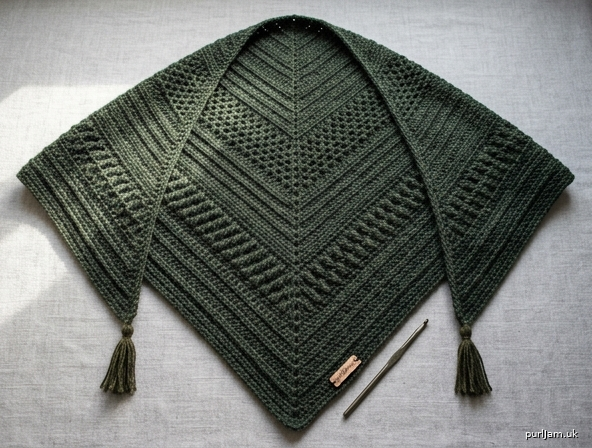
A dark, organic, mismatched-sampler triangle worked from the wide wingspan up to the point. Four rotating texture rows (ridged BLO double crochet, airy moss, solid half double crochet, and deep alpine) sit inside a stable 2-DC border that absorbs every decrease, giving a clean flat triangle with a woodland, hand-spun feel.
Difficulty: Intermediate
Materials
- Yarn: Worsted weight (#4), approximately 1000 yd (915 m). Solid or lightly variegated deep forest shades (moss, charcoal, bottle green, blackberry) suit the aesthetic; a single colorway keeps the stitch sampler readable.
- Hook: 5.0 mm (H-8), or size needed to obtain gauge
- Notions: Tapestry needle, scissors, locking stitch markers (optional, for borders), blocking mats and pins/wires
Gauge
14 stitches and 8 rows = 4" (10 cm) in double crochet, unblocked
(3.5 sts/in; 2 rows/in)
Gauge is measured in plain DC. Moss, HDC, and alpine rows have slightly different heights; final depth is set at blocking.
Finished Measurements (after wet blocking)
- Wingspan (bottom edge): 60" (152 cm)
- Depth (center point to bottom edge): approximately 26–30" (66–76 cm), depending on how aggressively the mixed-row fabric is blocked
- Shape: flat isosceles triangle
Abbreviations (US)
- ch – chain
- st(s) – stitch(es)
- sc – single crochet
- hdc – half double crochet
- dc – double crochet
- fpdc – front post double crochet
- dc2tog – double crochet 2 together (decrease)
- BLO – back loop only
- sk – skip
- sp – space
- rep – repeat
- RS / WS – right side / wrong side
Special Stitches
Moss / Granite stitch (body only): *sc in next st, ch 1, sk 1 st; rep from * across body, ending with sc if needed to keep edges aligned.
Alpine (body only): *dc in next st, fpdc around next st; rep from * across body. On following alpine rows, alternate the start as needed so fpdc sits over previous dc (and dc over previous fpdc) for classic staggered texture. Work fpdc around the post of the stitch in the previous row.
dc2tog: Yo, insert hook in next st, yo, pull up loop, yo, pull through 2 loops (2 loops on hook); yo, insert hook in following st, yo, pull up loop, yo, pull through 2 loops (3 loops on hook); yo, pull through all 3.
Pattern Notes
- Shawl is worked bottom-up: foundation is the full 60" wingspan; every row decreases to the top point.
- Edge border (every row): 2 plain DC at the beginning and 2 plain DC at the end. Borders are never worked BLO, moss, or alpine.
- Shaping (every row until the final section): Inside the borders, work dc2tog twice at the start of the body and dc2tog twice at the end of the body (−4 sts per row total, symmetrical).
- Turning ch-3 at start of each row counts as the first DC of the left border.
- The 4-row texture cycle applies only to the body between the decrease pairs. When the body becomes too narrow for the full decrease set, follow the Finishing section.
- Place a marker on the RS if desired. Texture cycle is visible on RS.
- Stitch counts in (parentheses) are total stitches at the end of the row.
- Inline validation uses the form (start − 4 = end ✓).
Instructions
Foundation
With worsted yarn and 5.0 mm hook:
Foundation Row (WS): Ch 212. Dc in 4th ch from hook (3 skipped chs count as first dc) and in each ch across.
(210 dc)
Turn.
This is the bottom wingspan edge (60" at gauge).
Texture Cycle with Shaping
Work the following 4-row cycle. Maintain borders and decreases exactly as written on every row; only the body stitches change.
Setup for each row (shaping frame):
Ch 3 (counts as first dc), dc in next st (left 2-dc border made), dc2tog, dc2tog,
work body in the stitch pattern for this row of the cycle across until 6 sts remain,
dc2tog, dc2tog, dc in each of last 2 sts (right 2-dc border).
Turn.
(−4 sts)
Body stitch count at the start of Row 1 of pattern = 200 and remains even every row.
Row 1 (RS) — Ridged DC BLO
Work shaping frame as above; body = dc BLO in each body st.
(206 sts) (210 − 4 = 206 ✓)
Row 2 (WS) — Moss / Granite
Work shaping frame; body = *sc in next st, ch 1, sk 1 st; rep from * across body, ending with sc in last body st (body has even count). Note: ch-1 spaces count as stitches in the next row’s count only when you work into them or skip them as directed—here next row works into each sc and each ch-1 sp as needed for HDC density, treating each sc and each ch-1 as one position so body positions remain consistent (200 − 4 = 196 positions → total sts 202 after this row’s decs… see count rule below).
Count rule for moss rows: Each sc and each ch-1 sp counts as 1 stitch position for the purpose of the following row and the −4 total. End count: (202 sts) (206 − 4 = 202 ✓).
Row 3 — Solid HDC
Work shaping frame, but work the body in hdc (borders and all dc2tog remain dc as written). Work 1 hdc into each sc and 1 hdc into each ch-1 sp of the moss row.
(198 sts) (202 − 4 = 198 ✓)
Row 4 — Alpine
Work shaping frame; body = *dc in next st, fpdc around next st; rep from * across body (even body).
(194 sts) (198 − 4 = 194 ✓)
Rows 5–48:
Rep Rows 1–4 of the texture cycle eleven more times (12 full cycles total from Row 1).
Continue the same shaping frame every row (−4 sts per row).
After Row 48 (end of 12th alpine row):
(210 − 4 × 48 = 18 sts ✓)
Rows 49–51 (continue cycle, still −4 per row):
Row 49 — DC BLO (Row 1 of cycle): shaping frame, body dc BLO. (14 sts) (18 − 4 = 14 ✓)
Row 50 — Moss: shaping frame, body moss. (10 sts) (14 − 4 = 10 ✓)
Row 51 — HDC: shaping frame, body hdc in each st/sp. (6 sts) (10 − 4 = 6 ✓)
Body is now gone; only border/decrease stitches remain.
Finishing the Point
Row 52: Ch 3 (counts as dc), dc2tog over next 2 sts, dc2tog over next 2 sts, dc in last st.
(4 sts) (6 − 2 = 4 ✓)
Turn.
Row 53: Ch 2, dc2tog over next 2 sts (working the ch-2 and first st as needed to close), dc in last st — or simply: ch 2, yo, insert into first st, pull up, yo pull through 2, yo insert into last st, pull up, yo pull through 2, yo pull through all 3 (dc2tog-style close), fasten.
(2 sts effectively closed to a point)
Fasten off. Weave in ends securely on WS.
Finishing & Blocking
- Weave in all ends with tapestry needle.
- Wet block for drape (essential for mixed-stitch depth and clean triangle edges):
- Soak in lukewarm water with a drop of wool wash for 15–20 minutes.
- Press out water (do not wring); roll in a towel.
- Pin to a 60" base × 28–30" depth isosceles triangle on blocking mats. Use wires along the two long sides for straight edges if available. Gently open the moss rows and alpine texture without overstretching the HDC rows.
- Dry completely before removing pins.
- Optional: add short fringe or tiny crocheted “twig” tassels at the two base corners for a forest-witch finish.
Stitch-Count Quick Reference
| Stage | Total sts |
|---|---|
| Foundation | 210 |
| After each row | −4 |
| After 12 cycles (Row 48) | 18 |
| After Row 51 | 6 |
| After Row 52 | 4 |
| Point closed | — |
(210 − 4 × 51 = 6 ✓) before final close.
Design Tips (Forest Witch Aesthetic)
- One moody color keeps the four textures legible; a slow-changing variegated worsted reads like moss and bark.
- Do not work post stitches or BLO into the 2-st DC borders—borders stay smooth so the triangle edges dry straight.
- If your row gauge runs short of 30" depth after blocking, add one extra full 4-row cycle early (before the body gets small), accepting a slightly wider wingspan, or block more firmly in the vertical direction.
Enjoy your sampler shawl—wrap it points-forward or drape the wingspan across the shoulders for full woodland coverage.
Disclaimer: This pattern was generated by AI and should be reviewed for accuracy before use. While we strive for quality, AI-generated content may contain errors. Please verify measurements, stitch counts, charts, and instructions before beginning your project. Generated by purlJam.uk
Love this pattern?
Save this pattern to your free PurlJam libraryAccess your pattern anytime
Bookmark this page to access your pattern anytime