Type
Crochet
Difficulty
advanced
Category
blanket
AI Thinking Process
Planning
Verification
Pattern
Highland Cow Textured Blanket
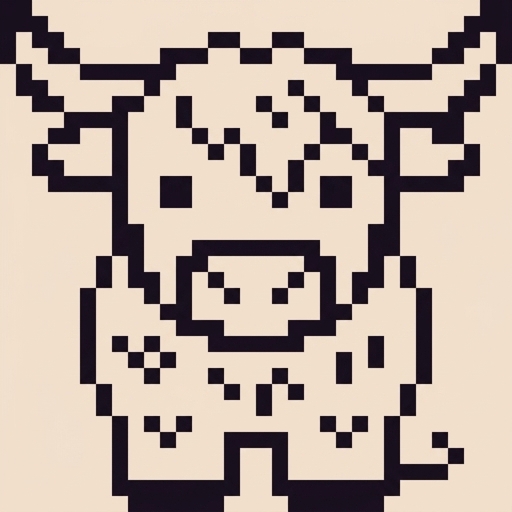
An intermediate pictorial lap blanket. The highland cow is worked as a single centered motif: single crochet draws the outline and facial features, bobbles build the shaggy coat and forelock, and half double crochet fills the body and background. Right-side rows follow the attached stitch chart; wrong-side rows are half double crochet only so every bobble sits on the front.
Skill level: Intermediate (chart reading, bobbles, optional color changes)
Finished Size
Body: 35¼" wide × 28¼" tall (89.5 × 72 cm), measured in hdc before border
With border: about 37" × 30" (94 × 76 cm)
Stitch grid: 123 stitches × 85 rows
Size is determined by the requested grid. For a larger throw, use a bulkier worsted or a larger hook and re-check gauge; do not add extra stitches or the chart will not fit.
Materials
Yarn: Worsted weight (medium 4)
Recommended 3-color highland cow palette (approximate yardage includes bobble extra):
| Role | Color | Amount |
|---|---|---|
| A (background) | Cream, oatmeal, or light heather | 550 yd (505 m) / about 10 oz (280 g) |
| B (cow body and coat) | Ginger, rust, or golden brown | 400 yd (365 m) / about 7.5 oz (210 g) |
| C (outline, eyes, nose, horns, hooves) | Dark brown or espresso | 75 yd (70 m) / about 1.5 oz (40 g) |
Total: about 1,025 yd (935 m)
A one-color version uses about 900 yd (825 m) of Color A; the cow is then read entirely in stitch texture.
Hook: US I/9 (5.5 mm), or size needed to obtain gauge
Also: US H/8 (5.0 mm) optional, for a firmer picture and denser bobbles (finished size will be slightly smaller)
Notions:
- Stitch markers (6 or more)
- Yarn needle
- Scissors
- Blocking pins and steam iron (hover only)
Gauge
14 hdc and 12 rows = 4" × 4" (10 × 10 cm) in hdc with I/9 (5.5 mm), unblocked.
Swatch: Ch 22. Hdc in 3rd ch from hook and in each ch across (20 hdc). Ch 1, turn. Hdc in each st across for 16 rows. Measure the center 14 sts and 12 rows.
Bobble rows are denser and slightly taller than plain hdc. Do not change hook to “fix” bobble height; the extra loft is the highland coat.
If your swatch is larger than 4", go down a hook size. If smaller, go up a hook size. A 1-stitch gauge error becomes about 8¾" (22 cm) over 123 stitches.
Abbreviations (US)
- bo — bobble (see Special Stitches)
- ch — chain
- hdc — half double crochet
- lp(s) — loop(s)
- MC / CC — main color / contrasting color
- rep — repeat
- rnd — round
- RS — right side
- sc — single crochet
- sl st — slip stitch
- st(s) — stitch(es)
- WS — wrong side
- yo — yarn over
Special Stitches
Bobble (bo) — 5-dc bobble, counts as 1 stitch
[Yo, insert hook in indicated st, yo, pull up a lp, yo, draw through 2 lps] 5 times (6 lps on hook), yo, draw through all 6 lps.
Push the bobble to the RS after completing it. Do not chain to close; the next stitch locks the bobble.
On the following WS row, work 1 hdc into the top of the bobble (the stitch that closed the 6 loops).
Single crochet outline — 1 sc in the indicated st. Sc sits shorter than hdc and reads as a drawn line for the cow’s silhouette, horns, ears, eyes, muzzle, and hooves.
Half double crochet fill — 1 hdc in the indicated st. Used for background, muzzle planes, and smooth body areas.
Notes
- Blanket is worked flat, turning at the end of every row.
- Turning chain: Ch 1 at the start of every row. It does not count as a stitch. Work the first st of the row into the first stitch.
- Stitch count is 123 at the end of every row. A bobble = 1 st. If you have 122 or 124, stop and find the missed or extra bobble close.
- RS (odd rows 1, 3, 5, …, 85): Follow the attached chart for stitch type and, if shown, color.
- WS (even rows 2, 4, 6, …, 84): Hdc in each st across in the matching color(s). Do not work bobbles or sc on WS, even if the chart cell on that row shows a textured stitch.
- Work Row 85 (RS) as a charted pattern row, then begin the border.
- Keep the first and last stitch of each row consistent with the chart (they are included in the 123). Do not add extra selvedge stitches.
- When changing color, work the last yarn-over of the previous stitch with the new color. For a clean pictorial, use intarsia (separate balls or bobbins for each color area) rather than long tapestry floats. Drop unused color to the WS.
- Mark every 20 stitches on Row 1 (after sts 20, 40, 60, 80, 100, and 120). Move markers up every few rows so they line up with the chart’s 20-stitch grid lines. Remaining edge = 3 sts (120 + 3 = 123 ✓).
Attached Stitch Chart
Use the separate attached chart panel that accompanies this pattern for the visual grid. Do not work from a sketched copy of the cow; the attached panel is the stitch-for-stitch source.
Where to find it: The chart sits in the attached chart panel beside or directly below these written instructions (the panel labeled for this highland cow blanket). Written rows below tell you when to read it; the panel tells you which stitch to place.
How to read the chart (crochet, worked flat):
- Each square = 1 stitch. Chart width = 123 squares = 123 stitches. Chart height = 85 squares = 85 rows.
- Row 1 is at the bottom of the chart and is a RS row. Read Row 1 from right to left.
- Odd (RS) rows: read right to left and work hdc, sc, or bobble as the legend shows.
- Even (WS) rows: read left to right for color placement only. Work hdc in every stitch. Ignore bobble and sc symbols on WS rows so all bobbles pop to the front.
- After Row 85, stop. Do not repeat the chart.
Legend (match the attached panel): Typical keys are hdc (open or blank square) = background and smooth fill; sc (X or filled square) = outline and features; bobble (dot, filled circle, or “bo”) = shaggy coat, ears, and forelock. If the panel uses colors, Color A = background, Color B = cow body/coat, Color C = outline and features. Follow the panel’s printed legend if it differs.
Color and yarn management:
- Change color on RS in the last yarn-over of the stitch before the new color area.
- On WS hdc rows, keep the same color columns as the chart so the picture does not drift. Do not carry Color C across long spans; snip and restart or use a bobbin.
- Bobbles eat yarn. Wind extra bobbins of Color B (and cream Color A if the forelock is charted in A) before starting the head.
Stitch-count integration:
There is no pattern multiple and no extra edge chain beyond the turning chain.
Foundation: ch 125. Skip 2 ch, work 123 sts into the remaining chains (125 − 2 = 123 ✓).
Every row: 123 chart squares = 123 stitches (123 = 123 ✓).
Do not add a turning-chain stitch at the beginning of the row (ch 1 does not count).
Do not work a stitch into the turning chain at the end of the row.
Pattern
Foundation
With A (or the background color on chart Row 1), ch 125.
Row 1 (RS): Hdc in 3rd ch from hook (skipped 2 ch = turning ch, not a st), then work the remaining 122 sts of chart Row 1 from right to left, using hdc, sc, and bo as shown, and changing color where the chart indicates. (123 sts ✓)
Place markers after stitches 20, 40, 60, 80, 100, and 120.
Row 2 (WS): Ch 1, turn. Hdc in each st across, matching chart colors column by column. Work 1 hdc in each bobble top and in each sc. (123 hdc ✓)
Row 3 (RS): Ch 1, turn. Work chart Row 3 from right to left in hdc, sc, and bo. (123 sts ✓)
Row 4 (WS): Ch 1, turn. Hdc in each st across. (123 hdc ✓)
Rows 5–84: Continue in this manner:
- Odd rows (RS): Ch 1, turn. Work the matching odd chart row from right to left with hdc, sc, and bo.
- Even rows (WS): Ch 1, turn. Hdc in each st across (123 hdc ✓).
Row 85 (RS): Ch 1, turn. Work chart Row 85 from right to left in hdc, sc, and bo. (123 sts ✓)
Do not fasten off if the border uses the same color as the last stitch; otherwise fasten off and join border color in the first st of Row 85.
Row check: 43 RS rows + 42 WS rows = 85 rows ✓.
Reading the cow (what you should see)
Use this only as a progress check against the attached chart; do not substitute it for the grid.
- Lower rows: Open hdc field (pasture/background). Hooves and legs appear in sc outline, with optional Color C.
- Body: Broad oval of Color B hdc, ringed with sc. Bobbles cluster along the back and chest for the highland coat.
- Head: Set on a short neck, slightly left- or center-weighted as charted. Muzzle is smoother hdc; nostrils and mouth are sc.
- Forelock and ears: The densest bobble field. Ears sit out from the head; a few bobbles at the tips read as tufts.
- Horns: Two sc (or Color C) curves rising from the crown, usually with no bobbles on the horn itself.
- Eyes: Small sc (or Color C) marks, often 1–2 sts, with a stitch or two of background showing as a highlight if the chart provides it.
If the silhouette drifts left or right, a marker has moved off its 20-stitch column—realign before continuing.
Border
Work in the round with RS facing. Do not turn.
Rnd 1: Ch 1. Sc in each st across the top (123 sc). Work 3 sc in the corner. Sc evenly down the left side: place 3 sc per 2 row-ends of hdc (for 85 rows: 3 sc × 42 + 3 extra at corners/adjustment = 129 side sc, or work 127–131 sc so the edge lies flat—aim for one sc in each row-end plus 2 extra near the corners if the side pulls). Work 3 sc in the corner. Sc in each remaining loop across the foundation edge (123 sc). Work 3 sc in the corner. Sc evenly up the right side to match the left. Work 2 sc in the same st as the first sc to complete the last corner. Sl st to first sc.
Count target: Top 123 + bottom 123 + 3 sc in each of 4 corners (12) + matching side counts. Sides should be equal.
Rnd 2: Ch 1, sc in each sc around, working 3 sc in the center sc of each 3-sc corner. Sl st to first sc. Fasten off.
Optional Rnd 3 (for a wider frame): Repeat Rnd 2 in Color C to underline the outline, or in Color A for a quiet edge.
Finishing
- Weave in all ends on the WS. For intarsia tails at color changes, weave along the same-color column, not across the outline.
- Tug each bobble from the RS so the coat stands up. If a bobble collapsed to the WS, push it through and gently stretch the surrounding hdc.
- Check that eyes, nostrils, and horn tips (Color C / sc) are distinct. If an outline st was worked as hdc by mistake, it cannot be retrofitted; note it and keep going—small misses hide in the coat.
Blocking
Steam block only. Do not wet-block and pin the bobbles flat.
- Lay the blanket RS up on a blocking surface.
- Pin the edges and corners to 37" × 30" (94 × 76 cm), or to the size your gauge produced, keeping sides straight.
- Hover a steam iron 1–2" (2.5–5 cm) above the hdc background and outline. Do not rest the iron on the fabric.
- Do not steam the bobble fields directly. Shape the forelock with your fingers while the neighboring hdc is warm.
- Let dry fully before moving.
Care
Hand wash cold, lay flat to dry. Do not tumble dry. Do not iron. Bobbles will bloom again after washing if you reshape them while damp—press them to the RS, then dry flat without weight on the head.
Stitch math summary (final)
Ch 125 → skip 2 → 123 sts (125 − 2 = 123 ✓)
123 sts × 85 rows, count unchanged every row (bobble = 1 st) ✓
43 patterned RS rows + 42 hdc WS rows = 85 ✓
14 hdc = 4" → width 35¼"; 12 rows = 4" → length 28¼" ✓
Disclaimer: This pattern was generated by AI and should be reviewed for accuracy before use. While we strive for quality, AI-generated content may contain errors. Please verify measurements, stitch counts, charts, and instructions before beginning your project. Generated by purlJam.uk
Love this pattern?
Save this pattern to your free PurlJam libraryAccess your pattern anytime
Bookmark this page to access your pattern anytime