Type
Knitting
Difficulty
intermediate
Category
shawl
AI Thinking Process
Planning
Verification
Pattern
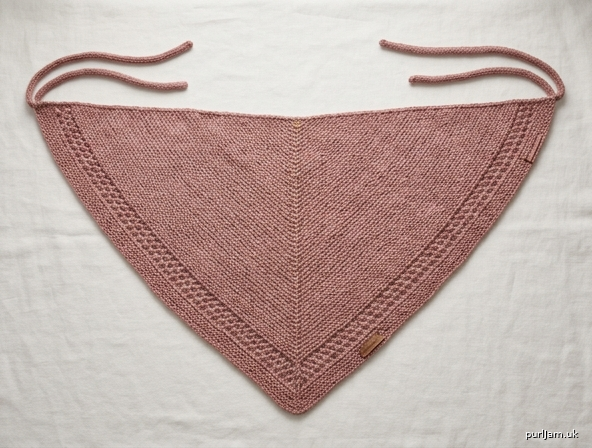
Hip Wrap Triangle Shawl
Easy garter & lace triangle — wear as shawl or tie at the waist as a hip warmer
A simple center-top-down triangle in soft garter stitch with a light eyelet lace border. The long edge wraps comfortably around the waist or hips; tie the two corners (or the optional I-cord ties) to keep your hips warm. One generous size.
Skill Level: Easy
Skills used: knit, yarn over, k2tog, garter-tab cast-on, basic binding off, wet blocking
Finished Measurements (after blocking)
- Wingspan (long edge): approximately 70 inches (178 cm)
- Depth (center spine to border edge): approximately 20 inches (51 cm)
One size fits most as a waist/hip wrap; longer edge gives overlap for tying.
Yarn
Worsted weight yarn: approximately 500 yards (457 m)
Example: 3 skeins of a smooth wool or wool-blend worsted (approx. 170–200 yd / 100 g each). Solid or gently tonal colors show the lace best.
Needles
- US 8 / 5 mm circular needle, 32 inches (80 cm) or longer (to hold the growing stitches comfortably)
- Optional: US 8 / 5 mm double-pointed needles or same circular for I-cord ties
Notions
- 2 stitch markers
- Tapestry needle
- Blocking mats, wires or pins
- Optional: spare yarn for provisional ties or measuring tape
Gauge
18 stitches and 36 rows = 4 inches (10 cm) in garter stitch, blocked.
Row gauge is important for depth. Change needle size if needed to obtain gauge. A slightly looser fabric is fine for drape.
Notes
- Shawl is worked flat from the center of the top edge downward.
- Garter stitch = knit every row.
- Increases: Every RS row you work 4 yarn overs (one at each outer edge and one on each side of the center spine stitch). Stitch count rises by 4 every RS row.
- Markers sit on either side of the single center spine stitch and are slipped as you come to them.
- Lace border continues the same 4-increase shaping so the triangle stays even.
- The two outer corners of the long bound-off edge are the tie points for wearing as a hip wrap.
- US English terminology and imperial measurements (metric in parentheses).
Abbreviations (US)
| Abbrev. | Meaning |
|---|---|
| BO | bind off |
| CO | cast on |
| k | knit |
| k2tog | knit 2 stitches together |
| pm | place marker |
| rep | repeat |
| RS | right side |
| sm | slip marker |
| st(s) | stitch(es) |
| WS | wrong side |
| yo | yarn over |
Pattern Instructions
Garter Tab Cast-On (center top)
CO 3 sts.
Knit 6 rows (3 garter ridges).
Do not turn after the last row. Rotate work 90° clockwise; pick up and knit 3 sts along the long side edge of the tab (1 st in each ridge).
Rotate 90° clockwise again; pick up and knit 3 sts along the original cast-on edge.
9 sts now on needle. (3 + 3 + 3 = 9 ✓)
Setup
Next row (WS): K3, pm, k3, pm, k3.
(Markers enclose the center 3 sts; the middle stitch of those 3 will become the permanent spine.)
Next row (RS) — first increase row: K3, yo, sm, k1, yo, k1, yo, sm, k1, yo, k3.
13 sts. (9 + 4 = 13 ✓)
Next row (WS): Knit all sts (including the yarn overs), slipping markers.
Garter Body
Row 1 (RS): K3, yo, knit to marker, yo, sm, k1, yo, sm, knit to last 3 sts, yo, k3.
(+4 sts)
Row 2 (WS): Knit all sts, slipping markers.
Rep Rows 1–2 until you have 301 sts and the piece measures approximately 16 inches (40.5 cm) along the center spine from the cast-on tab to the needle, ending after a WS row.
Check: Starting from 13 sts, each RS row adds 4. After 72 additional RS increase rows: 13 + (72 × 4) = 13 + 288 = 301 ✓.
(If your row gauge differs, work until the spine measures 16 inches; note your stitch count — it should be near 301 and an odd number so the center spine remains 1 st between markers. Adjust by one RS row if needed to keep markers flanking a single center st.)
Lace Border
Continue the same edge-and-spine increases while working the easy eyelet pattern.
Lace Row 1 (RS): K3, yo, *k2tog, yo; rep from * to 1 st before marker, k1, yo, sm, k1, yo, sm, k1, *yo, k2tog; rep from * to last 3 sts, yo, k3.
(+4 sts)
Lace Row 2 (WS): Knit all sts, slipping markers.
Lace Row 3 (RS): K3, yo, knit to marker, yo, sm, k1, yo, sm, knit to last 3 sts, yo, k3.
(+4 sts)
Lace Row 4 (WS): Knit all sts, slipping markers.
Lace Row 5 (RS): Rep Lace Row 1.
(+4 sts)
Lace Row 6 (WS): Knit all sts, slipping markers.
Lace Row 7 (RS): Rep Lace Row 3.
(+4 sts)
Lace Row 8 (WS): Knit all sts, slipping markers.
Lace Row 9 (RS): Rep Lace Row 1.
(+4 sts)
Lace Row 10 (WS): Knit all sts, slipping markers.
Lace Row 11 (RS): Rep Lace Row 3.
(+4 sts)
Lace Row 12 (WS): Knit all sts, slipping markers.
325 sts. (301 + 6 RS rows × 4 = 301 + 24 = 325 ✓)
Center spine measures approximately 17½–18 inches (44–46 cm) before blocking.
Bind Off
On the next RS row, bind off loosely knitwise as follows (still working the increases so the edge stays soft and full):
K3, yo, *k1, pass previous st over; rep from * while working the usual yo increases at the markers and edges (treat each yo as an ordinary stitch to bind off).
Alternatively, bind off loosely knitwise on a plain RS increase row without further patterning: K3, yo, knit toward marker working yo increases exactly as Body Row 1, and bind off each stitch as you go. Keep the bind-off very loose (use a larger needle if needed) so the long edge can stretch in blocking and wrap easily.
Fasten off. Weave in ends loosely; final weaving after blocking.
Optional I-Cord Ties (recommended for secure waist fastening)
With US 8 / 5 mm needles and remaining yarn, work two 14–16 inch (35–40 cm) I-cords:
CO 3 sts. *K3, do not turn, slide sts to other end of needle; rep from * until cord measures 14–16 inches. BO.
Sew one I-cord securely to each outer corner of the long bound-off edge. Weave in ends.
(Twisted cord or purchased ribbon ties may be substituted.)
Finishing & Blocking
- Weave in all remaining ends on the WS.
- Soak the shawl in lukewarm water with a little wool wash for 15–20 minutes. Gently squeeze (do not wring).
- Roll in a towel to remove excess water.
- Lay flat on blocking mats. Shape into a neat isosceles triangle:
- Pin the center top (garter tab) first.
- Stretch the long bound-off edge to approximately 70 inches (178 cm).
- Pull the center spine to approximately 20 inches (51 cm) depth.
- Pin the two side edges evenly so they are straight and equal.
- Open the lace eyelets gently with pins or wires.
- Allow to dry completely.
- Remove pins. Trim any stray ends.
Wearing
As a hip warmer / wrap “skirt”:
Place the long bound-off edge around your waist or high hips with the center point hanging down over the seat or one hip. Bring the two corners (or I-cord ties) to the front or side and tie securely. The garter fabric has enough stretch and grip to stay put for light wear.
As a classic shawl:
Drape the center top at the back of the neck; wrap the wings forward. The lace border falls at the lower edge.
Inline count summary (for reference)
- Garter tab + pick-ups = 9 sts ✓
- First RS inc → 13 sts ✓
- Body ends at 301 sts (13 + 72 × 4 = 301) ✓
- 6 lace RS increase rows → 325 sts (301 + 24 = 325) ✓
- Blocked target: ~70" wingspan × 20" depth ✓
Enjoy your warm hips (and shoulders)!
Disclaimer: This pattern was generated by AI and should be reviewed for accuracy before use. While we strive for quality, AI-generated content may contain errors. Please verify measurements, stitch counts, charts, and instructions before beginning your project. Generated by purlJam.uk
Love this pattern?
Save this pattern to your free PurlJam libraryAccess your pattern anytime
Bookmark this page to access your pattern anytime