Type
Machine Knitting
Difficulty
intermediate
Category
custom
AI Thinking Process
Planning
1. **Design Strategy**: Beginner-friendly baby blanket for a boy using the garter carriage on a standard gauge machine. Since the garter carriage only knits plain stockinette/garter (no cables), I'll create a garter stitch blanket with decorative "mock cable" panels worked by hand-manipulated twisted stitches at intervals — simple enough for beginners. Actually, better approach: use the garter carriage for a fully garter-stitch blanket with a seed/textured border, and include optional hand-manipulated mock cables in side panels worked before/after garter carriage passes. To keep it truly beginner, I'll do all-garter-stitch with a stockinette border frame and skip cables (note that cables aren't compatible with garter carriage).
2. **Construction Plan**: Single flat rectangular panel knit in one piece on the main bed using the garter carriage (G-carriage) for the body, with short stockinette borders at top/bottom and slipped-stitch selvedges for neat edges.
3. **Quality Assurance**:
- Garter carriage is SLOW — set realistic expectations
- Garter carriage cannot do cables; clarify to user and offer alternative texture
- Edges curl less with garter, but borders still need to be wide enough
4. **Final Calculations**:
- DK gauge at T8: ~6 sts & 12 rows per inch (garter is rows-per-inch ≈ stocking stitch when using G-carriage producing garter fabric, roughly 10 rows/inch in garter)
- Target size: 28" wide × 32" long (71 × 81 cm) — standard stroller blanket
- Gauge swatch assumption: 24 sts × 40 rows = 4" × 4" in garter stitch at T8
- Cast on: 28 × 6 = 168 sts → use 170 sts (85-0-85) for centering
- Rows for 32": 32 × 10 = 320 rows total
- Border: 10 rows stockinette top & bottom; 6-st garter border each side built in
Verification
1. **Completeness**: Title, materials, gauge, abbreviations, notes, step-by-step with RC, finishing — all included.
2. **Consistency**: 170 sts ÷ 6 spi = 28.3" ✓. 320 rows ÷ 10 rpi = 32" ✓.
3. **Constraints**: Beginner level ✓, DK yarn ✓, standard gauge ✓, garter carriage ✓. Cables noted as incompatible with G-carriage — alternative provided.
4. **Safety**: Math verified. Garter carriage limitation clearly explained up front.
Pattern
# Little Explorer Baby Blanket
### A Beginner's Garter Carriage Baby Blanket (with Optional Mock-Cable Borders)

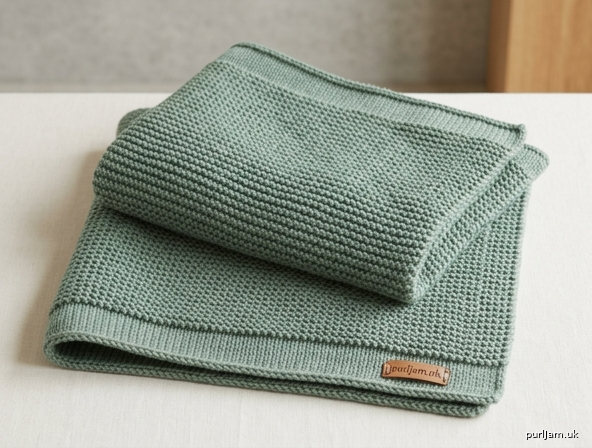
A soft, squishy garter-stitch baby blanket perfect for a little boy. Designed specifically for the garter carriage (G-carriage) on standard gauge machines. Finished size: **approximately 28" × 32" (71 × 81 cm)** — an ideal stroller/pram blanket.

---

## ⚠️ Important Note About Cables
The **garter carriage (G-carriage) cannot knit cables** — it only produces plain knit and purl stitches (that's what creates garter fabric). True cables require hand-manipulated stitch transfers, which interrupt the G-carriage's automated operation.

**Two solutions are offered below:**
- **Version A (True Beginner):** All-over garter stitch with a tidy stockinette border frame. Recommended for first-time G-carriage users.
- **Version B (Adventurous Beginner):** Same blanket with two columns of hand-manipulated **mock cables** (simple 2×2 twists) down the sides, worked on the main carriage between G-carriage sections.

Choose the version that suits your confidence level.

---

## Materials

- **Yarn:** DK weight, machine-knit friendly (wool, merino, cotton blend, or acrylic)
  - **Main Color (MC):** approx. **500 g / ~1100 yards (1000 m)** — soft blue, sage green, soft grey, or cream
  - Optional CC for border stripe: 50 g
- **Machine:** Standard gauge (4.5 mm), e.g., Brother KH-series, Silver Reed SK-series
- **Accessories required:**
  - Garter carriage (G-carriage) — e.g., Brother KG-95 / KG-93
  - Main knit carriage (K-carriage)
  - Cast-on comb and claw weights
  - Waste yarn (contrasting color) and ravel cord
  - 1-prong and 2-prong transfer tools (Version B only)
  - Latch tool
  - Tapestry needle for finishing

---

## Tension / Gauge

- **Main tension:** **T8** for DK yarn on standard gauge
- **Gauge swatch (worked in garter stitch with G-carriage at T8):**
  - **24 stitches × 40 rows = 4" × 4" (10 × 10 cm)**
  - That is **6 sts per inch** and **10 rows per inch**
- **IMPORTANT:** Knit and measure a swatch before starting. If your gauge differs, adjust tension by ½ number up (looser) or down (tighter) as needed.

---

## Abbreviations & Machine Terms

| Abbr. | Meaning |
|---|---|
| MC | Main color |
| CC | Contrast color |
| RC | Row counter |
| COL | Carriage on left |
| COR | Carriage on right |
| K-carriage | Main knitting carriage |
| G-carriage | Garter carriage |
| NWP | Needle out of work (non-working position) |
| WP | Needle in working position |
| T8 | Tension dial set to 8 |
| st(s) | Stitch(es) |
| MB | Main bed |
| e-wrap | E-wrap cast-on |

---

## Pattern Notes

- This pattern uses **main bed only**. No ribber required.
- The **G-carriage is slow** — expect the body of the blanket to take several hours of machine run time. Be patient and check on it periodically (every 20–30 rows) to ensure stitches are clearing properly.
- Always park the G-carriage **off the bed** (far left or right rail) when swapping to the K-carriage.
- Keep weights evenly distributed and move claw weights up every 30–40 rows.
- Center zero (0) is the middle of the bed. Cast-on range: **L85 to R85 = 170 needles**.

---

## Dimensions & Stitch Math

- Cast-on: **170 sts** → 170 ÷ 6 sts/inch = **28.3" wide** ✓
- Total rows: **320 rows** → 320 ÷ 10 rows/inch = **32" long** ✓
- Stockinette borders: 10 rows top + 10 rows bottom = 20 rows stockinette
- Garter body: 300 rows

---

## Instructions

### 1. Set-Up & Cast-On

1. Bring **170 needles** into working position: **L85 — 0 — R85**.
2. With **K-carriage at T8**, thread waste yarn and knit **10–12 rows** of waste yarn, COL to COR and back. Hang cast-on comb and 2 claw weights after 2 rows.
3. With COR, lay in **ravel cord** across all 170 needles; knit 1 row to COL.
4. Break waste yarn. Thread **MC** in feeder 1.
5. **Set RC to 000.**

### 2. Bottom Stockinette Border (K-carriage)

6. With MC at **T8**, COL, knit **10 rows** of stockinette. **RC = 010**, COL.
   - *Tip: this border prevents the bottom edge from flipping and provides a firm base for seaming in the hem later if desired.*

### 3. Transition to Garter Carriage — Body of Blanket

7. Remove K-carriage to the far right rail (park it off the bed).
8. Place the **G-carriage on the left** side of the bed per your machine's G-carriage set-up instructions (engage the belt/rails and feed MC into the G-carriage yarn feeder at **T8**).
9. Ensure all 170 needles are in **B position (WP)**. Weights in place.

**Version A (All Garter — recommended for beginners):**

10. Run the **G-carriage across the bed repeatedly** until **RC = 310** (that is, 300 garter rows).
    - Each G-carriage pass = 1 row. The carriage will automatically perform the purl/knit sequencing to create garter fabric.
    - **Checkpoint RC = 050:** fabric should measure ~4" from top of stockinette border. Adjust tension if off-gauge.
    - **Checkpoint RC = 160:** ~half done (~15" of garter). Move weights up.
    - **Checkpoint RC = 260:** ~25" of garter. Re-check weights.
    - **Checkpoint RC = 310:** 300 garter rows complete. G-carriage should be parked at the **left (COL)**.

**Version B (With Hand-Manipulated Mock Cables):**

Position two mock-cable panels at **L60 and R60** (each panel is 4 sts wide: e.g., needles L58–L61 and R58–R61).

Work sequence: **20 rows G-carriage → 1 cable twist row (hand) → repeat**.

10B. **G-carriage rows 1–20:** Run G-carriage for 20 passes. RC advances by 20.
11B. **Cable twist row (worked with K-carriage at T8):**
   - Bring K-carriage back onto the bed.
   - At **left cable panel (L58–L61):** using a 2-prong transfer tool, lift the 2 leftmost sts (L61, L60) onto one tool, and the 2 rightmost sts (L59, L58) onto another. Cross **front-to-back** (left pair goes over right pair). Replace on empty needles.
   - Repeat at **right cable panel (R58–R61)** using the same twist direction for symmetry, or mirror if preferred.
   - Knit **1 row** with K-carriage to set the twist. RC +1.
   - Remove K-carriage off the bed.
12B. Resume with G-carriage for next 20 rows.
13B. Repeat steps 10B–12B until **RC = 310** total (you will have completed **14 cable twists** — every 21 rows). Final section may be partial; end after a G-carriage segment, not a twist row.

### 4. Top Stockinette Border

14. Park G-carriage off the bed. Bring **K-carriage** back with MC at **T8**, COL.
15. Knit **10 rows** stockinette. **RC = 320**, COL.

### 5. Bind-Off

16. With COL, knit **1 loose row at T10** (optional — eases the bind-off).
17. Using a **latch tool**, work a **latch-tool bind-off** across all 170 sts from right to left:
    - Remove the first st onto the latch tool.
    - *Hook the next st through the loop on the tool; push the new loop onto the latch tool.*
    - Repeat across all 170 sts.
    - When 1 loop remains, break yarn (leaving a 12" tail) and pull through.

### 6. Remove Waste Yarn from Cast-On Edge

18. Locate the ravel cord on the bottom edge.
19. Pick up **170 live sts** just above the ravel cord onto a length of smooth waste yarn or a long transfer bar.
20. Pull out the ravel cord and waste yarn. You now have a live bottom edge.
21. Work the **same latch-tool bind-off** across these 170 sts to match the top edge. *Alternative: use a crochet hook and chain bind-off.*

---

## Finishing

1. **Weave in ends** with a tapestry needle along the edges, burying tails in the stockinette borders for invisibility.
2. **Side edges:** The selvedge may have small loops from the G-carriage. If desired, work a single row of slip-stitch crochet along each long side in MC to tidy the edge — this is optional and adds a subtle frame.
3. **Blocking:**
   - Hand wash gently in lukewarm water with wool-safe detergent (or follow yarn ball band).
   - Roll in a towel to remove excess water.
   - Lay flat on a blocking mat; pat to **28" × 32"** with blocking pins or weights at the corners.
   - Allow to air dry completely (24–48 hours).
4. **Optional steam finish:** hover a steam iron 2" above the surface (do NOT press) to relax the garter fabric and even out stitches. Do not steam acrylic yarns — block with pins only.

---

## Row Counter Summary (Version A)

| Section | RC Start | RC End | Rows | Carriage |
|---|---|---|---|---|
| Waste yarn & ravel cord | — | — | ~12 | K-carriage |
| Bottom stockinette border | 000 | 010 | 10 | K-carriage, T8 |
| Garter body | 010 | 310 | 300 | G-carriage, T8 |
| Top stockinette border | 310 | 320 | 10 | K-carriage, T8 |
| Bind-off row | 320 | 321 | 1 | K-carriage, T10 |

---

## Tips for Success

- **Run a test swatch** of at least 40 rows with the G-carriage first. The G-carriage behaves differently than the K-carriage, and dropped stitches are the #1 issue.
- **Keep weights balanced.** Uneven weight is the top cause of stitches slipping off in the G-carriage.
- **Don't rush the G-carriage.** Let it move at its own pace; forcing it will jam the mechanism.
- **Yarn:** Choose a smooth, non-splitty DK. Avoid mohair, boucle, or slubby yarns — the G-carriage will struggle.
- **For a boy's blanket:** soft sage, dusty blue, warm grey, cream, or soft mustard all work beautifully. Consider a 2-row CC stripe at RC 160 for a subtle accent (carry MC up the side).

Enjoy knitting this heirloom blanket — it will be treasured for years! 💙
Disclaimer: This pattern was generated by AI and should be reviewed for accuracy before use. While we strive for quality, AI-generated content may contain errors. Please verify measurements, stitch counts, and instructions before beginning your project. Generated by purlJam.uk
Access your pattern anytime
Bookmark this page to access your pattern anytime