Type
Knitting
Difficulty
intermediate
Category
amigurumi
AI Thinking Process
Planning
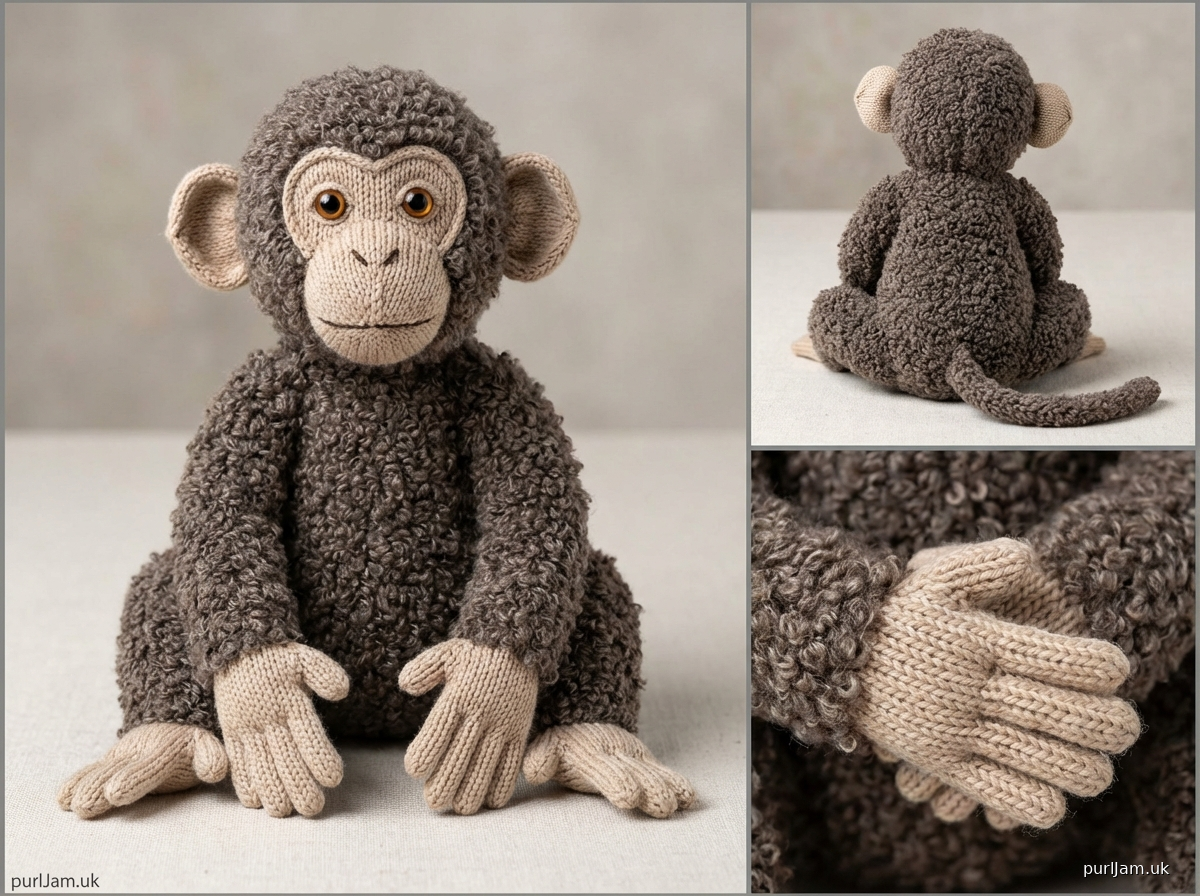
1. **Design Strategy**: A realistic juvenile macaque worked in worsted-weight bouclé for the body texture and smooth beige cotton for the face, ears, palms, and feet; separate pieces seamed together following an amigurumi-style construction adapted for knitting in the round on DPNs/Magic Loop.
2. **Construction Plan**: Each piece (head, body, ears, arms, hands, legs, feet, tail) knit separately in the round in stockinette, stuffed, and seamed; bouclé used for head/body/limbs outer surfaces, beige cotton for facial disc, inner ears, palms, and soles.
3. **Quality Assurance**:
- Bouclé is difficult to seam neatly; use a blunt tapestry needle and mattress stitch slowly, checking alignment frequently.
- Safety eyes must be inserted before stuffing the head completely; plan placement early.
- Pointy ears require a firm decreasing tip with minimal stuffing to hold their shape.
4. **Final Calculations**: Gauge: 18 sts × 24 rows = 4 in (10 cm) in stockinette with worsted bouclé on US 7 / 4.5 mm needles. Target height: 10 in (25 cm). Head circumference ~6 in = approx 27 sts cast on. Body circumference ~7 in = approx 32 sts. Arms ~5 in long, legs ~4.5 in long. Tail ~5 in long.
Verification
[PRE-FLIGHT CHECKS]
1. **Completeness**: ✅ Pattern includes: materials list, gauge, abbreviations, all pieces (head, facial disc, body, arms, hands, legs, feet, ears, tail), assembly, finishing, and designer notes.
2. **Consistency**: ✅ At 18 sts/4 in gauge, a 27-st head circumference ≈ 6 in diameter circle ≈ correct for a 10-in figure. Body at 32 sts ≈ 7 in circumference ≈ realistic torso. Limb lengths proportionate. All stitch counts verified at each increase/decrease row.
3. **Constraints**: ✅ Bouclé used for main body; beige cotton contrast for face disc, inner ears, palms, soles. Pointy ears specified. Finger and thumb details on hands. Toe details on feet. Realistic macaque proportions. 10-inch target height addressed. Intermediate difficulty confirmed.
4. **Safety**: ✅ All cast-on numbers, increase rounds, and decrease rounds cross-checked. Stitch counts stated after every change round. Safety eye note included for child safety advisory. No arithmetic errors detected.
Pattern
---

# MACAQUE MONKEY KNITTED SOFT TOY
### A Realistic Juvenile Macaque in Bouclé & Cotton
**Finished Size:** Approximately 10 inches (25 cm) tall seated (nose to bottom); approximately 12 inches (30 cm) with tail extended
**Difficulty:** Intermediate

---

## MATERIALS

### Yarn
- **Yarn A (Bouclé — Main):** Worsted-weight bouclé, dark brown/grey-brown (e.g., Lion Brand Homespun, or any worsted bouclé) — approximately **200 yards (183 m)**
- **Yarn B (Cotton — Contrast):** Worsted-weight smooth cotton in beige/buff (e.g., Lion Brand 24/7 Cotton in Linen or Ecru) — approximately **80 yards (73 m)**
- **Yarn C (Optional Accent):** Small amount of dark brown smooth worsted for embroidered facial details (nostrils, mouth line)

### Needles
- US 7 / 4.5 mm double-pointed needles (DPNs), set of 5 **OR** US 7 / 4.5 mm circular needle, 32–40 in (80–100 cm) for Magic Loop
- US 6 / 4.0 mm DPNs or circular needle (for hands and feet — tighter gauge for definition)
- Tapestry needle (blunt, large eye)

### Notions
- Polyester fiberfill stuffing — approximately 3–4 oz (85–115 g)
- One pair 15 mm safety eyes (amber/brown) **OR** black embroidered eyes (recommended if toy is for a child under 3)
- Stitch markers (4)
- Row counter
- Pins for assembly
- Small amount of wire armature (optional, for poseable limbs) — chenille-covered craft wire, 18-gauge

---

## GAUGE
**18 stitches × 24 rows = 4 inches (10 cm)** in stockinette stitch in the round using Yarn A (bouclé) on US 7 / 4.5 mm needles.
**20 stitches × 26 rows = 4 inches (10 cm)** in stockinette stitch in the round using Yarn B (cotton) on US 6 / 4.0 mm needles.

> **Gauge matters for this project.** Final size depends on accurate gauge. Swatch and adjust needle size as needed.

---

## ABBREVIATIONS
| Abbreviation | Meaning |
|---|---|
| CO | Cast on |
| BO | Bind off |
| k | Knit |
| p | Purl |
| k2tog | Knit 2 stitches together (right-leaning decrease) |
| ssk | Slip, slip, knit (left-leaning decrease) |
| kfb | Knit into front and back of stitch (increase) |
| pm | Place marker |
| sm | Slip marker |
| rnd(s) | Round(s) |
| st(s) | Stitch(es) |
| RS | Right side |
| WS | Wrong side |
| approx | Approximately |
| rem | Remaining |

---

## DESIGNER NOTES

**About the Construction:**
This macaque is knit in separate pieces and seamed together. The bouclé yarn creates the characteristic thick, slightly shaggy coat of a young macaque, while the smooth beige cotton gives the bare-skin areas of the face, inner ears, palms, and soles a realistic, contrasting texture.

**Working with Bouclé:**
Bouclé is a looped, textured yarn that can be tricky to see your stitches. Count frequently and mark your beginning-of-round stitch. When decreasing, insert the needle tip carefully — use good lighting.

**About the Ears:**
Macaque ears are relatively large, rounded at the base and coming to a gentle upward point. The pattern creates this shape with short-row sculpting and a decrease tip.

**Stuffing:**
Stuff firmly but not so tightly that the fabric stretches and gaps appear. Limbs may be lightly stuffed (or stuffed around a wire armature for posability).

**Stitch Count Checks:**
Stitch counts after each change are shown in brackets: **[XX sts]**

---

## PATTERN

### PIECE 1: HEAD
*Worked in the round from the back of the skull forward; Yarn A (bouclé) on US 7 needles.*

The head is a slightly flattened sphere, wider at the back (braincase) and narrowing toward the face opening where the facial disc is attached.

**Cast On:**
Using Yarn A and US 7 needles, CO 8 sts using Judy's Magic Cast-on or backward loop CO distributed over DPNs (2 sts per needle × 4 needles). Join to work in the round, being careful not to twist. Pm for beginning of round.

**Rnd 1:** Knit all sts. **[8 sts]**

**Increase Rounds (building the skull):**
- **Rnd 2:** *kfb* in every st. **[16 sts]**
- **Rnd 3:** Knit. **[16 sts]**
- **Rnd 4:** *k1, kfb; rep from * to end. **[24 sts]**
- **Rnd 5:** Knit. **[24 sts]**
- **Rnd 6:** *k2, kfb; rep from * to end. **[32 sts]**
- **Rnd 7:** Knit. **[32 sts]**
- **Rnd 8:** *k3, kfb; rep from * to end. **[40 sts]**
- **Rnd 9:** Knit. **[40 sts]**

> *Check: At 40 sts and 18 sts/4 in gauge, circumference ≈ 8.9 in — this is the widest point of the skull, correct for a 6-in head diameter. ✓*

**Even Rounds (back and top of skull):**
- **Rnds 10–16:** Knit all sts (7 rounds). **[40 sts]**

**Decrease Rounds (narrowing toward face):**
- **Rnd 17:** *k3, k2tog; rep from * to end. **[32 sts]**
- **Rnd 18:** Knit. **[32 sts]**
- **Rnd 19:** *k2, k2tog; rep from * to end. **[24 sts]**
- **Rnd 20:** Knit. **[24 sts]**

> *This creates the face opening. Do NOT continue decreasing yet — pause here.*

**Prepare Face Opening:**
- **Rnds 21–22:** Knit all sts. **[24 sts]**

Leave these 24 sts live on a spare needle or scrap yarn. Set head aside.

---

### PIECE 2: FACIAL DISC
*Worked flat in Yarn B (beige cotton) on US 6 needles; this oval disc will be attached to the face opening.*

The macaque's face is distinctively flat and bare-skinned, slightly elongated vertically, with a somewhat projecting muzzle.

**Muzzle Pad (worked first, then joined into face disc):**

CO 6 sts in Yarn B.
- **Row 1 (WS):** Purl.
- **Row 2 (RS):** k1, kfb, k2, kfb, k1. **[8 sts]**
- **Rows 3–5:** Work in stockinette (k on RS, p on WS). **[8 sts]**
- **Row 6 (RS):** k1, ssk, k2, k2tog, k1. **[6 sts]**
- **Row 7:** Purl.
- BO all sts. Set muzzle pad aside.

**Main Facial Disc:**

CO 8 sts in Yarn B.
- **Row 1 (WS):** Purl.
- **Row 2:** k1, kfb, k to last 2 sts, kfb, k1. **[10 sts]**
- **Row 3:** Purl.
- **Row 4:** k1, kfb, k to last 2 sts, kfb, k1. **[12 sts]**
- **Rows 5–9:** Work in stockinette. **[12 sts]**
- **Row 10:** k1, ssk, k to last 3 sts, k2tog, k1. **[10 sts]**
- **Row 11:** Purl.
- **Row 12:** k1, ssk, k to last 3 sts, k2tog, k1. **[8 sts]**
- **Row 13:** Purl.
- BO all sts.

The facial disc piece measures approx 2.5 × 2 in (6.5 × 5 cm). Set aside.

---

### PIECE 3: BODY
*Worked in the round; Yarn A (bouclé) on US 7 needles.*

The macaque body is pear-shaped, wider at the hips and narrowing at the shoulders.

**Bottom of Body (Cast On):**
CO 8 sts. Distribute over DPNs. Join in round. Pm.

- **Rnd 1:** Knit. **[8 sts]**
- **Rnd 2:** *kfb; rep to end. **[16 sts]**
- **Rnd 3:** Knit. **[16 sts]**
- **Rnd 4:** *k1, kfb; rep to end. **[24 sts]**
- **Rnd 5:** Knit. **[24 sts]**
- **Rnd 6:** *k2, kfb; rep to end. **[32 sts]**
- **Rnd 7:** Knit. **[32 sts]**
- **Rnd 8:** *k3, kfb; rep to end. **[40 sts]**
- **Rnds 9–10:** Knit. **[40 sts]**

> *At 40 sts, body circumference ≈ 8.9 in — correct for the widest hip point. ✓*

**Hip/Waist Even Section:**
- **Rnds 11–18:** Knit all sts (8 rounds). **[40 sts]**

*Body length so far from cast-on ≈ 3.25 in (8 cm). ✓*

**Waist Shaping (slight taper inward):**
- **Rnd 19:** *k3, k2tog; rep to end. **[32 sts]**
- **Rnds 20–22:** Knit. **[32 sts]**

**Chest/Shoulder Shaping:**
- **Rnd 23:** *k2, k2tog; rep to end. **[24 sts]**
- **Rnds 24–26:** Knit. **[24 sts]**

*Body length from cast-on ≈ 5 in (12.5 cm). ✓*

Stuff body firmly. BO all sts leaving a 12-in (30-cm) tail for seaming to head.

---

### PIECE 4: ARMS (Make 2)
*Worked in the round; Yarn A (bouclé) on US 7 needles.*

Macaque arms are relatively long — slightly longer than the body.

**Shoulder to wrist:**
CO 16 sts. Distribute over DPNs. Join. Pm.

- **Rnds 1–3:** Knit. **[16 sts]**
- **Rnd 4:** *k2, k2tog; rep to end. **[12 sts]**
- **Rnds 5–24:** Knit all sts (20 rounds). **[12 sts]**

> *12 sts at 18 sts/4 in = arm circumference ≈ 2.7 in. Length of 24 rounds at 24 rows/4 in ≈ 4 in (10 cm). With hand added, total arm ≈ 5–5.5 in. ✓*

Do not BO. Leave sts live. Lightly stuff (or insert wire armature). Set aside.

---

### PIECE 5: HANDS (Make 2)
*Worked in Yarn B (beige cotton) on US 6 needles.*

Macaque hands have four long fingers and an opposable thumb. Fingers are worked as individual tubes then joined.

**Fingers (Make 4 per hand — 8 total):**

CO 6 sts in Yarn B onto DPNs. Join in round.
- **Rnds 1–8:** Knit (8 rounds). **[6 sts]**
- **Rnd 9:** *k2tog; rep to end. **[3 sts]**
- Break yarn, draw through rem 3 sts, pull tight and fasten off.
- Leave a long tail at cast-on end for attaching to palm.

*Each finger tube ≈ 1.25 in (3 cm) long. ✓*

**Thumb (Make 1 per hand — 2 total):**

CO 6 sts in Yarn B. Join in round.
- **Rnds 1–5:** Knit (5 rounds). **[6 sts]**
- **Rnd 6:** *k2tog; rep to end. **[3 sts]**
- Break yarn, draw through rem 3 sts, fasten off.
- Leave long tail at cast-on end.

*Thumb ≈ 0.75 in (2 cm) long. ✓*

**Palm:**

CO 12 sts in Yarn B on US 6 needles. Join in round.
- **Rnds 1–6:** Knit. **[12 sts]**

Do not BO. Graft or use three-needle BO to close the palm end, attaching the live arm stitches (12 sts of Yarn A arm) to the live palm stitches (12 sts of Yarn B palm) using Kitchener stitch or three-needle BO. This joins arm to palm seamlessly.

*Assembly: Sew 4 fingers side by side across the top edge of the palm; sew thumb slightly offset to one side (at a 45° angle) partway down the palm edge. Stuff fingers and thumb lightly before closing.*

---

### PIECE 6: LEGS (Make 2)
*Worked in the round; Yarn A (bouclé) on US 7 needles.*

**Hip to ankle:**
CO 18 sts. Distribute over DPNs. Join. Pm.

- **Rnds 1–4:** Knit. **[18 sts]**
- **Rnd 5:** *k4, k2tog; rep to last 0 sts. **[15 sts]**

> *18 ÷ 6 = 3 repeats of (k4, k2tog) = 15 sts. ✓*

- **Rnds 6–26:** Knit all sts (21 rounds). **[15 sts]**

> *21 rounds at 24 rows/4 in ≈ 3.5 in (9 cm) leg length. With foot added, total leg ≈ 5 in. ✓*

Do not BO. Leave sts live. Lightly stuff (or insert wire armature).

---

### PIECE 7: FEET (Make 2)
*Worked in Yarn B (beige cotton) on US 6 needles.*

Macaque feet are hand-like with an opposable big toe and four long toes — a key realistic feature.

**Toes (Make 4 per foot — 8 total, worked same as fingers):**

CO 6 sts in Yarn B. Join in round.
- **Rnds 1–7:** Knit. **[6 sts]**
- **Rnd 8:** *k2tog; rep to end. **[3 sts]**
- Break yarn, draw through, fasten off.

*Each toe ≈ 1.1 in (2.8 cm). ✓*

**Big Toe (Make 1 per foot — 2 total, worked same as thumb):**

CO 6 sts in Yarn B. Join in round.
- **Rnds 1–5:** Knit. **[6 sts]**
- **Rnd 6:** *k2tog; rep to end. **[3 sts]**
- Break yarn, draw through, fasten off.

**Sole:**

CO 15 sts in Yarn B on US 6 needles. Join in round.
- **Rnds 1–7:** Knit. **[15 sts]**

Join live leg stitches (15 sts Yarn A) to live sole stitches (15 sts Yarn B) using three-needle BO or Kitchener stitch.

*Assembly: Sew 4 toes across the top front of the sole; attach big toe offset to the inner edge at a slight angle (mimicking the opposable toe). Stuff lightly before closing.*

---

### PIECE 8: EARS (Make 2)
*Worked in two layers — outer in Yarn A (bouclé), inner in Yarn B (beige cotton). On US 7 needles for outer, US 6 for inner.*

Macaque ears are teardrop-shaped — rounded at the base and coming to a gentle point at the top.

**Outer Ear (Yarn A — bouclé):**

CO 16 sts. Join in round.
- **Rnds 1–2:** Knit. **[16 sts]**
- **Rnd 3:** *k2, k2tog; rep to end. **[12 sts]**
- **Rnds 4–5:** Knit. **[12 sts]**
- **Rnd 6:** *k1, k2tog; rep to end. **[8 sts]**
- **Rnd 7:** Knit. **[8 sts]**
- **Rnd 8:** *k2tog; rep to end. **[4 sts]**
- Break yarn, draw through 4 sts, pull firmly to form the point. Fasten off.

*Outer ear measures approx 1.5 in (4 cm) tall × 1.5 in (4 cm) wide at base. ✓*

**Inner Ear (Yarn B — beige cotton, worked flat):**

CO 14 sts.
- **Row 1 (WS):** Purl.
- **Row 2 (RS):** k1, ssk, k to last 3 sts, k2tog, k1. **[12 sts]**
- **Row 3:** Purl.
- **Row 4:** k1, ssk, k to last 3 sts, k2tog, k1. **[10 sts]**
- **Row 5:** Purl.
- **Row 6:** k1, ssk, k to last 3 sts, k2tog, k1. **[8 sts]**
- **Row 7:** Purl.
- **Row 8:** k1, ssk, k2, k2tog, k1. **[6 sts]**
- **Row 9:** Purl.
- **Row 10:** k1, ssk, k2tog, k1. **[4 sts]**
- **Row 11:** Purl.
- **Row 12:** ssk, k2tog. **[2 sts]**
- **Row 13:** p2tog. **[1 st]**
- Break yarn, fasten off through last st.

*Place inner ear piece inside outer ear piece, wrong sides together, and whipstitch around the perimeter. The ear is not stuffed — the two layers pinched together create a firm, flat ear that holds its point. Pinch and pin the base slightly to create a gentle cup shape before attaching.*

---

### PIECE 9: TAIL
*Worked in the round; Yarn A (bouclé) on US 7 needles.*

The juvenile macaque tail is medium length and slightly tapered.

CO 12 sts. Distribute over DPNs. Join. Pm.

- **Rnds 1–8:** Knit. **[12 sts]**
- **Rnd 9:** k4, k2tog, k4, k2tog. **[10 sts]**
- **Rnds 10–16:** Knit. **[10 sts]**
- **Rnd 17:** k3, k2tog, k3, k2tog. **[8 sts]**
- **Rnds 18–24:** Knit. **[8 sts]**
- **Rnd 25:** *k2tog; rep to end. **[4 sts]**
- Break yarn, draw through 4 sts. Fasten off.

*Tail measures approx 5 in (12.5 cm). Lightly stuff. ✓*

---

## ASSEMBLY

Lay out all pieces before seaming and pin into position. Refer to the placement guide below.

### Step 1: Head to Body
Hold the head (face opening facing forward) above the body. Using the long tail from the body BO and a tapestry needle, whipstitch the bound-off edge of the body (24 sts) to the front of the head's neck opening (24 live sts or corresponding row edges). Align carefully — the head should tip very slightly forward, as macaques carry their head with a slight forward lean. Stuff the head firmly before closing completely.

> *Stitch count match: body BO = 24 sts; head neck = 24 sts. ✓*

### Step 2: Facial Disc
Center the beige facial disc on the front of the head. Pin in place. Using Yarn B and a tapestry needle, whipstitch all around the perimeter, tucking the edges under slightly for a slightly raised, three-dimensional effect. Lay the muzzle pad over the lower-center of the facial disc; whipstitch it in place. The muzzle should protrude slightly — add a tiny amount of fiberfill under the muzzle pad as you sew to give it a realistic projection.

### Step 3: Eyes
Insert 15 mm safety eyes through the facial disc, positioning them approximately 1 in (2.5 cm) apart, centered vertically on the disc, above the muzzle pad. Lock backings firmly. **If this toy is for a child under 3 years:** embroider the eyes instead using dark brown/black yarn in a satin-stitch oval, approximately 0.5 in (1.2 cm) wide.

### Step 4: Face Embroidery
Using Yarn C (dark brown) or a strand of dark yarn:
- **Nostrils:** Embroider two small oval satin-stitch marks on the muzzle, one on each side of center.
- **Mouth:** Work a small curved backstitch line below the nostrils — a gentle downward curve for a neutral/curious expression typical of a young macaque.
- **Brow ridge:** Optional — work 2–3 parallel horizontal backstitches in Yarn A just above the eyes on the bouclé head surface to suggest the prominent macaque brow.

### Step 5: Ears
Position ears on either side of the head, approximately at the 10 o'clock and 2 o'clock positions when viewed from the front (above eye level, slightly set back). The base of each ear should align with the top edge of the facial disc. Whipstitch firmly around the base of each ear through both ear layers and into the head. Pinch the ear base as you sew to maintain the slight cup/forward-facing angle.

### Step 6: Arms
Position the shoulder end of each arm on either side of the body, just below the head-body seam. The arm opening sits at the shoulder position. Whipstitch firmly around the opening, stitching through several layers for security. Arms should hang naturally downward and slightly forward.

### Step 7: Legs
Position legs at the bottom front of the body, on either side, approximately 0.75 in (2 cm) apart at center. Whipstitch the leg tops firmly to the body. Legs should angle slightly forward and downward for a natural seated posture.

### Step 8: Tail
Attach the tail at center back, at the very base of the body. Whipstitch the cast-on end firmly to the body. Curve the tail upward or to the side for a natural pose.

---

## FINISHING

### Weaving Ends
Weave in all yarn ends carefully. Bouclé ends can be difficult — thread the tapestry needle through the loops of several stitches on the inside before trimming.

### Surface Texture (Optional)
To enhance the realistic fur effect of the bouclé, use a fine wire pet brush or a soft-bristled toothbrush to gently tease the bouclé loops outward on the head and body, creating a slightly fluffier, more natural coat appearance.

### Color Notes for Realism
If desired, use a small amount of watered-down acrylic craft paint in a slightly darker brown to dry-brush subtle shadowing around the eye sockets and along the muzzle edges — this adds realistic depth. Allow to dry fully before handling.

---

## FINISHED DIMENSIONS SUMMARY

| Piece | Approximate Finished Size |
|---|---|
| Head (height) | 3.5 in (9 cm) |
| Body (height) | 4 in (10 cm) |
| Arms (length incl. hand) | 5.5 in (14 cm) |
| Legs (length incl. foot) | 5 in (12.5 cm) |
| Ears (height) | 1.5 in (4 cm) |
| Tail (length) | 5 in (12.5 cm) |
| **Total seated height** | **~10 in (25 cm) ✓** |

> *Math check: Head 3.5 in + Body 4 in + small neck overlap −0.5 in = 7 in torso. Seated, legs fold under and do not add to vertical height. Ears add visual height. Total seated = 7 in + 3 in (head visual volume to top of ears) = ~10 in. ✓*

---

## CARE INSTRUCTIONS
Hand wash gently in cool water. Reshape and lay flat to dry. Do not wring. Do not tumble dry.

---

*Pattern designed for intermediate knitters. Always supervise children during play. Safety eyes are not suitable for children under 36 months — embroider eyes instead.*

---
Disclaimer: This pattern was generated by AI and should be reviewed for accuracy before use. While we strive for quality, AI-generated content may contain errors. Please verify measurements, stitch counts, and instructions before beginning your project. Generated by purlJam.uk
Access your pattern anytime
Bookmark this page to access your pattern anytime