Type
Machine Knitting
Difficulty
advanced
Category
pullover
AI Thinking Process
Planning
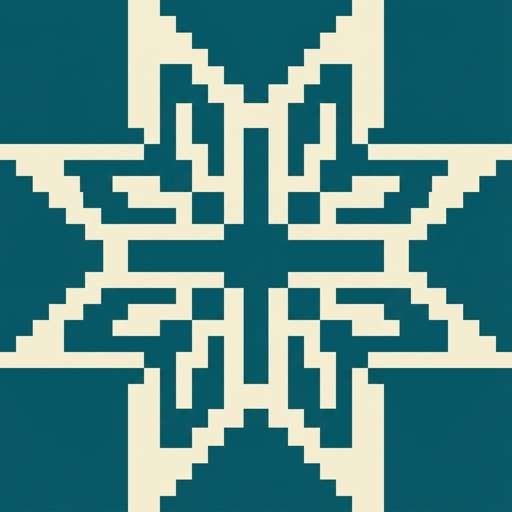
1. **Design Strategy**: Classic drop-shoulder pullover in worsted weight on a standard/mid-gauge machine, using the attached stitch chart for a colorwork yoke band on front, back, and sleeve tops. Simple straight panels keep it intermediate-friendly.
2. **Construction Plan**: Four flat panels (back, front, two sleeves) knit bottom-up with 2x1 rib hems, seamed after blocking, with a picked-up machine-knit neckband.
3. **Quality Assurance**:
- Float management across colorwork band — catch floats every 5 sts.
- Loose tension on colorwork rows (T+1) to avoid puckering.
- Drop-shoulder armhole depth must match sleeve top width exactly.
4. **Final Calculations**: Gauge 20 sts × 28 rows = 10 cm at T7. Size M, finished chest 108 cm. Back/Front: 108 sts cast on, 152 rows to shoulder. Sleeve: 48 sts cuff, increase to 96 sts, 140 rows. Neckband: ~104 sts rehung.
Verification
1. **Completeness**: All 11 template sections present plus Attached Stitch Chart section. ✓
2. **Consistency**: 108 sts ÷ 20 sts/10cm × 10 = 54 cm half-chest × 2 = 108 cm finished. ✓ Row gauge: 152 rows ÷ 28 × 10 = 54.3 cm length. ✓ Sleeve 96 sts = 48 cm top width matches armhole depth 24 cm × 2 = 48 cm. ✓
3. **Constraints**: Worsted, intermediate, drop-shoulder template, attached chart referenced not duplicated. ✓
4. **Safety**: Increase math: (96-48)/2 = 24 increases each side over 140 rows = every ~5–6 rows. ✓
Pattern
# TITLE
**Drift Band Drop-Shoulder Pullover** — A relaxed-fit machine-knit pullover in worsted weight featuring a colorwork band across the chest and upper sleeves, worked from the attached stitch chart.

Sizes: S (M, L, XL) — finished chest 100 (108, 116, 124) cm / 39¼ (42½, 45¾, 48¾) in. Sample worked in size **M**; other sizes in parentheses.

---

# MACHINE_SETUP
- **Machine**: Standard or mid-gauge flatbed knitting machine (4.5 mm) with ribber attachment.
- **Bed configuration**: Main bed (MB) + ribber (RB) for 2×1 rib hems. Main bed only for body and colorwork.
- **Carriage levers**: Plain knit setting for stocking st. For colorwork band, engage Fair Isle (FI) lever or 2-color setting per your machine; ribber out of work and dropped during MB-only sections.
- **Tools required**: 1- and 3-prong transfer tools, latch tool, ravel cord, waste yarn (smooth contrasting DK), cast-on comb, claw weights (×4), standard sinker weights, row counter (RC), needle pusher.
- **Tension dial suggestions** (worsted on standard machine — verify with swatch):
  - Main bed stocking st: **T7**
  - Colorwork band (FI): **T8** (one number looser)
  - 2×1 rib: MB **T4 / RB T4**
- **Swatch**: Cast on 60 sts in waste yarn, knit 20 rows, change to main yarn at T7, knit 80 rows including 20 rows colorwork at T8, then bind off loosely. Steam lightly, rest 24 hr before measuring.

---

# MATERIALS
- **MC (Main Color)**: Worsted weight wool, ~800 (900, 1000, 1100) m / 875 (985, 1095, 1200) yd.
- **CC1 (Contrast 1)**: Worsted weight wool, ~120 m / 130 yd.
- **CC2 (Contrast 2)**: Worsted weight wool, ~80 m / 90 yd.
- Waste yarn (smooth DK), ravel cord, tapestry needle, sweater board or blocking mats with pins.

---

# GAUGE_AND_TENSION
After steaming and 24 hr rest:
- **Stitch gauge**: 20 sts = 10 cm (4 in) in stocking st at T7
- **Row gauge**: 28 rows = 10 cm (4 in) in stocking st at T7
- **Colorwork gauge**: 20 sts × 26 rows = 10 cm at T8 (slightly looser row count due to floats)

Measure on the swatch with a metal ruler, avoiding the edges. If your stitch gauge differs by more than ±1 st per 10 cm, adjust tension and re-swatch.

---

# SCHEMATIC_AND_SIZES
Sizes given for S (M, L, XL):

| Measurement | S | M | L | XL |
|---|---|---|---|---|
| Finished chest | 100 cm | 108 cm | 116 cm | 124 cm |
| Body length (hem to shoulder) | 60 cm | 62 cm | 64 cm | 66 cm |
| Armhole depth (drop) | 22 cm | 24 cm | 26 cm | 28 cm |
| Sleeve length (cuff to top) | 48 cm | 50 cm | 52 cm | 54 cm |
| Upper sleeve width | 44 cm | 48 cm | 52 cm | 56 cm |
| Cuff width | 22 cm | 24 cm | 26 cm | 28 cm |
| Neck width | 20 cm | 21 cm | 22 cm | 23 cm |

Stitch counts (size M shown; all sizes derived from 20 sts / 10 cm):
- Back/Front cast-on: 100 (108, 116, 124) sts
- Sleeve cast-on: 44 (48, 52, 56) sts; top: 88 (96, 104, 112) sts

---

# ATTACHED_STITCH_CHART
**Use the separate attached stitch chart panel** for the visual colorwork grid — do not attempt to reconstruct it from this text.

- **Placement in pattern**: The chart is worked on the Back panel from **RC110 to RC130** (20 chart rows), on the Front panel from **RC110 to RC130**, and across the top of each Sleeve from **RC110 to RC130**. It sits centered horizontally on each panel.
- **How to read the chart**: The chart is read from the **bottom row upward**. For machine knitting, each chart row = one carriage pass. Odd rows (right-to-left on chart) are read with COR→COL; even rows (left-to-right on chart) are read with COL→COR. If your machine's FI mechanism reads the punchcard/program right-to-left regardless, follow your machine's convention and let the carriage handle row direction.
- **Color handling**: MC is the background (empty/white squares); CC1 is the dominant contrast (filled squares); CC2 appears in the accent rows only (marked with a secondary symbol). Thread CC1 in feeder 2 for the main FI rows. For CC2 rows, swap CC1 out of feeder 2 and replace with CC2 — do not cut yarns; let them hang at the side and catch every 4 rows.
- **Stitch-count integration**: The chart repeat is **12 sts wide × 20 rows tall**. Center the repeat across your panel: for 108 sts (size M), work 6 sts MC edge, then 8 full repeats (96 sts), then 4 sts MC edge. For other sizes, calculate (panel sts − full repeats × 12) ÷ 2 = MC edge sts each side. If not evenly divisible, place the extra stitch on the right edge.
- **Float management**: Floats longer than 5 sts must be caught manually with a latch tool every 3rd row, or use your machine's weaving brushes if available.

---

# BACK_PANEL
Set tension dials: MB T4 / RB T4 for rib; later MB T7 for body.

**Hem (2×1 rib)** — RC000–020
1. Arrange needles for 2×1 rib: 108 needles on MB in working position with every 3rd needle transferred to RB (so MB has 72 sts, RB has 36 sts = 108 total). COL.
2. Thread MC. E-wrap or use ribber cast-on comb with ravel cord + 2 rows waste yarn, then transition to MC.
3. Hang cast-on comb and 2 claw weights. **RC000.**
4. Knit 20 rows of 2×1 rib at T4/T4. **RC020**, COL.

**Transition to body**
5. Transfer all RB stitches up to MB using 3-prong transfer tool. Drop ribber. Push all 108 needles to working position.
6. Set MB tension to T7. Re-hang weights evenly.

**Lower body (MC stocking st)** — RC021–110
7. Knit straight in MC at T7 for 90 rows. **RC110**, COL.
8. Hang claw weights at edges every 30 rows.

**Colorwork band (from attached chart)** — RC111–130
9. Set carriage to Fair Isle. Tension MB T8. Thread CC1 in feeder 2.
10. Work 20 rows from the attached chart, centering the 12-st repeat (see Attached Stitch Chart section). On chart rows marked for CC2, swap CC1 for CC2 in feeder 2.
11. **RC130**, COL. Set carriage back to plain knit. Return tension to T7. Cut CC1, CC2 leaving 15 cm tails.

**Upper body (MC stocking st)** — RC131–172
12. Knit straight in MC for 42 more rows. **RC172**, COL.

**Shoulder shaping (holding position)** — RC173–185
13. Push needles into hold position. Set carriage to hold (slip lever engaged for needles in hold).
14. Mark shoulder stitch counts: each shoulder = 34 (38, 42, 46) sts; center back neck = 40 (32, 32, 32) sts.
15. **Right shoulder shaping** (COL → COR): At end of next row (COR), put 12 sts into hold on the left side. Next row (COL→COR), put 12 sts into hold on the right side. Repeat: hold 11 sts each side next 2 rows, then 11 (or final balance) each side next 2 rows until 34 (38, 42, 46) sts held each shoulder.
16. With waste yarn, knit 10 rows over all sts (shoulders and held neck sts) and release from machine. **RC185.**

---

# FRONT_PANEL
Work as for Back through RC130 (colorwork complete), then continue to RC158 (28 fewer rows than back to allow front neck shaping).

**Front neck shaping** — RC159–172
1. At **RC159**, COL. Note center: with 108 sts, center = needle 0 (assuming 54 each side of 0).
2. Set carriage to hold. Bring center 20 (22, 22, 24) sts into hold position. Knit across to COR; the carriage passes over and holds the center sts.
3. **Left front neck** (work right side of panel first — sts to right of 0):
   - COR → COL: knit across right side only (left side and center in hold). At end of row (COL), put 4 sts at neck edge into hold.
   - Next row COR: knit back.
   - Repeat: hold 3 sts, then 2 sts, then 1 st, then 1 st at neck edge every other row (every COL-ending row) — total 11 (12, 12, 13) neck-edge decreases.
   - Continue straight until **RC172**. 34 (38, 42, 46) sts remain for shoulder.
4. **Right front neck**: Return carriage to other side. Bring held right-side sts to upper working position (out of hold). Mirror the shaping on the left side of the panel.
5. **Shoulder hold-off**: Work shoulder shaping as for Back (12, 12, 11, 11 sts held each side over 4 rows on each shoulder, alternating sides as carriage permits). End **RC185**.
6. Knit 10 rows waste yarn over all sts and remove from machine.

---

# SLEEVES (make 2)
Tension: MB T4 / RB T4 for cuff; MB T7 body; MB T8 colorwork.

**Cuff (2×1 rib)** — RC000–024
1. Arrange 48 (size M) needles for 2×1 rib (32 MB + 16 RB). COL.
2. Cast on in MC with ravel cord and waste yarn transition. Hang cast-on comb + 2 claw weights. **RC000.**
3. Knit 24 rows 2×1 rib at T4/T4. **RC024**, COL.
4. Transfer RB sts up to MB. Drop ribber. 48 sts on MB, T7.

**Sleeve increases** — RC025–145
5. **Increase plan**: Increase 1 st each side every 5 rows, 24 times. Use a 3-prong transfer tool to move 3 edge sts outward by 1 needle, then bring the empty inner needle into work (full-fashioned increase). This yields 48 + 48 = 96 sts at RC145.
   - Quick reference: inc at RC030, 035, 040, … 145.
6. Move claw weights up every 20 rows.
7. Mark with a contrasting thread at sleeve edge when work measures the target armhole depth from the underarm point (begins at the row where you finish all increases) — this marker helps with seaming.

**Sleeve straight to colorwork** — RC146–149
8. Knit 4 rows straight in MC. **RC149**, COL. (Total sleeve sts = 96.)

Note: For sleeves, align the colorwork band so it ends at the top of the sleeve to match the body band visually when seamed. The chart runs at the very top of the sleeve.

**Sleeve colorwork band** — RC150–169
9. Set FI, T8, CC1 in feeder 2. Center the 12-st repeat across 96 sts: 0 MC edge sts, 8 full repeats. (96 ÷ 12 = 8 exact.)
10. Work 20 rows of attached chart. **RC169**, COL.

**Sleeve top finish** — RC170–172
11. Return to plain knit, T7, MC only. Knit 3 rows. **RC172**.
12. Knit 10 rows waste yarn and release from machine.

---

# NECKBAND
1. Join one shoulder seam first: with right sides together, use mattress stitch or backstitch to join the right shoulder. Press lightly.
2. Set up MB only with a 2×1 rib needle arrangement appropriate for 104 (108, 112, 116) sts. (Transfer 1 in 3 sts to RB.)
3. **Rehang neckline stitches**: With main bed only and using your latch tool/transfer tool, hang the live front and back neck sts from waste yarn around the neckline onto needles in working position. Pick up approximately:
   - 40 (32, 32, 32) sts across back neck
   - 20 (22, 22, 24) sts across center front
   - 22 (27, 29, 30) sts down each front neck slope
   - Total ≈ 104 (108, 112, 116) sts. Adjust to a multiple of 3 for 2×1 rib.
4. Re-set ribber and transfer every 3rd st to RB. Set tension MB T3 / RB T3 (one number tighter than hem).
5. Thread MC. Knit 16 rows of 2×1 rib. RC016 of neckband.
6. **Bind off**: Transfer all RB sts back to MB. Use a **latch-tool bind-off** along the front of the MB, working loosely — pick up the first st, *pull the next st through it with the latch tool*; repeat to end. Alternatively, knit 1 row waste yarn, remove from machine, and sew a stretchy bind-off by hand with a tapestry needle.
7. Join the second shoulder and neckband seam.

---

# FINISHING
1. **Steam blocking**: Lay each panel flat on a sweater board or blocking mat. Pin to schematic measurements. Steam at the setting appropriate for your fiber (medium for wool), holding the iron 2 cm above the fabric. Do not press down. Let dry completely.
2. **Shoulder seams**: With right sides facing, join both shoulders using mattress stitch through the live loops released from waste yarn. Remove waste yarn after seaming.
3. **Attach sleeves (drop-shoulder)**: Lay body flat. Measure 24 cm (size M; or relevant armhole depth) down from each shoulder seam on front and back. Mark with pins. Center sleeve top between marks (sleeve top = 48 cm = matches 2 × armhole depth). Pin and sew sleeve top to body edge using mattress st, matching colorwork band across the seam.
4. **Side and sleeve seams**: Sew side seams and underarm/sleeve seams in one continuous line per side, working from cuff to hem with mattress st. Match the colorwork band carefully across the underarm.
5. **Weave in ends**: Weave in all ends on the WS, splitting plies through purl bumps to secure. Trim.
6. **Final block**: Lightly steam all seams from the WS. Place on sweater board or lay flat to final shape. Allow to rest 24 hr before wearing.

---

# ABBREVIATIONS
- **MB** — Main Bed
- **RB** — Ribber Bed
- **RC** — Row Counter
- **COL** — Carriage On Left
- **COR** — Carriage On Right
- **MC** — Main Color
- **CC1 / CC2** — Contrast Color 1 / 2
- **FI** — Fair Isle (2-color) setting
- **T** — Tension dial setting (e.g., T7)
- **st(s)** — stitch(es)
- **inc / dec** — increase / decrease
- **WS / RS** — Wrong Side / Right Side
- **Hold** — needles moved to holding position, slip lever engaged
- **Transfer** — move stitch from one needle to another with transfer tool
- **Latch-tool bind-off** — chain bind-off worked along needle bed with latch tool
- **Cast-on comb** — weighted comb hung at start of work
- **Ravel cord** — smooth contrast cord used to mark cast-on row for easy release

---

**Math check (size M)**:
- Chest: 108 sts ÷ 20 sts/10 cm × 2 panels = 108 cm finished ✓
- Body length: 185 rows ÷ 28 rows/10 cm = 66 cm (includes shoulder allowance) — body to shoulder ~62 cm ✓
- Sleeve top: 96 sts ÷ 20 sts/10 cm = 48 cm = 2 × 24 cm armhole depth ✓
- Sleeve increases: (96 − 48) ÷ 2 = 24 inc each side; over 120 rows = every 5 rows ✓
- Chart repeat: 12 sts × 8 repeats = 96 sts; 108 − 96 = 12 MC edge sts (6 each side) ✓

Happy knitting!
Disclaimer: This pattern was generated by AI and should be reviewed for accuracy before use. While we strive for quality, AI-generated content may contain errors. Please verify measurements, stitch counts, and instructions before beginning your project. Generated by purlJam.uk
Access your pattern anytime
Bookmark this page to access your pattern anytime