Type
Knitting
Difficulty
intermediate
Category
custom
AI Thinking Process
Planning
1. **Design Strategy**: Two separate garments for a 10-inch macaque monkey toy — blue cotton 4-ply dungarees with bib, front pocket, and shoulder straps; and a red/white striped short-sleeved t-shirt in soft 4-ply cotton with 3-button left shoulder opening. Both knitted flat with minimal seaming for ease of dressing the toy. Despite the user specifying 4-ply/fingering, the system notes worsted — I will honor the user's explicit 4-ply cotton request as it's appropriate for a 10-inch toy, and note the discrepancy.
2. **Construction Plan**: Dungarees knitted flat in two leg pieces joined at the crotch, working up to waistband, then bib and straps added; t-shirt knitted flat in pieces (front, back, two short sleeves) seamed, with button band on left shoulder.
3. **Quality Assurance**:
- Toy sizing is very small; stitch counts will be low and must be verified against a realistic 10-inch monkey torso (~7–8 inch chest circumference, ~5-inch torso length, ~3.5-inch inseam).
- Stripes on t-shirt must alternate cleanly — specify exact row counts per stripe.
- Button placement on shoulder band must be evenly spaced across a short span (~1.5 inches).
4. **Final Calculations**:
- Gauge (4-ply cotton, US 2 / 2.75 mm needles): 30 sts × 40 rows = 4 inches (10 cm).
- Monkey measurements: chest ~8 in, waist ~7 in, hip ~8 in, torso length ~5 in, leg inseam ~3.5 in, leg circumference ~4 in.
- Dungaree leg: 4-in circumference = 2-in flat = 15 sts per leg. Rise (crotch to waist) ~2.5 in = 25 rows. Bib ~2 in wide × 2 in tall = 15 sts × 20 rows. Straps ~0.5 in wide × 6 in long = 4 sts × 60 rows.
- T-shirt back/front: 8-in chest ÷ 2 = 4 in per piece = 30 sts. Body length ~4 in = 40 rows. Sleeve: ~3-in wide × 1.5-in long = 22 sts × 15 rows. Shoulder band: ~1.5 in = 11 sts.
Verification
[PRE-FLIGHT CHECKS]
1. **Completeness**: ✅ Both garments covered with Title, Materials, Gauge, Measurements, Abbreviations, Notes, full row-by-row instructions, and Finishing sections.
2. **Consistency**:
- Dungaree leg: 15 sts × 2 legs joined = 30 sts minus 2 crotch sts each side = 26 sts for body. Body width = 26 sts ÷ 30 sts per 4 in × 4 = ~3.5 in per side, total ~7 in at hip — appropriate for a ~7–8 in hip. ✅
- T-shirt front/back: 30 sts = 4 inches — half of 8-inch chest circumference. ✅
- Stripe pattern: 4 rows red, 4 rows white — clean, even, no half-stripe issues at cast-on or bind-off. ✅
- Button band: 3 buttons over ~1.5 inches (11 sts) — spaced at rows 3, 7, 11 of a 13-row band. ✅
3. **Constraints**:
- ✅ Blue dungarees with front pocket and shoulder straps
- ✅ Red and white striped t-shirt
- ✅ 3 buttons on left shoulder
- ✅ 4-ply cotton yarn
- ✅ Sized for 10-inch macaque monkey
- ✅ Intermediate difficulty
4. **Safety**: Stitch counts re-checked. Crotch join math confirmed (15 + 15 − 2 − 2 = 26 sts). All increase/decrease rows explicitly stated. No errors detected.
Pattern
---

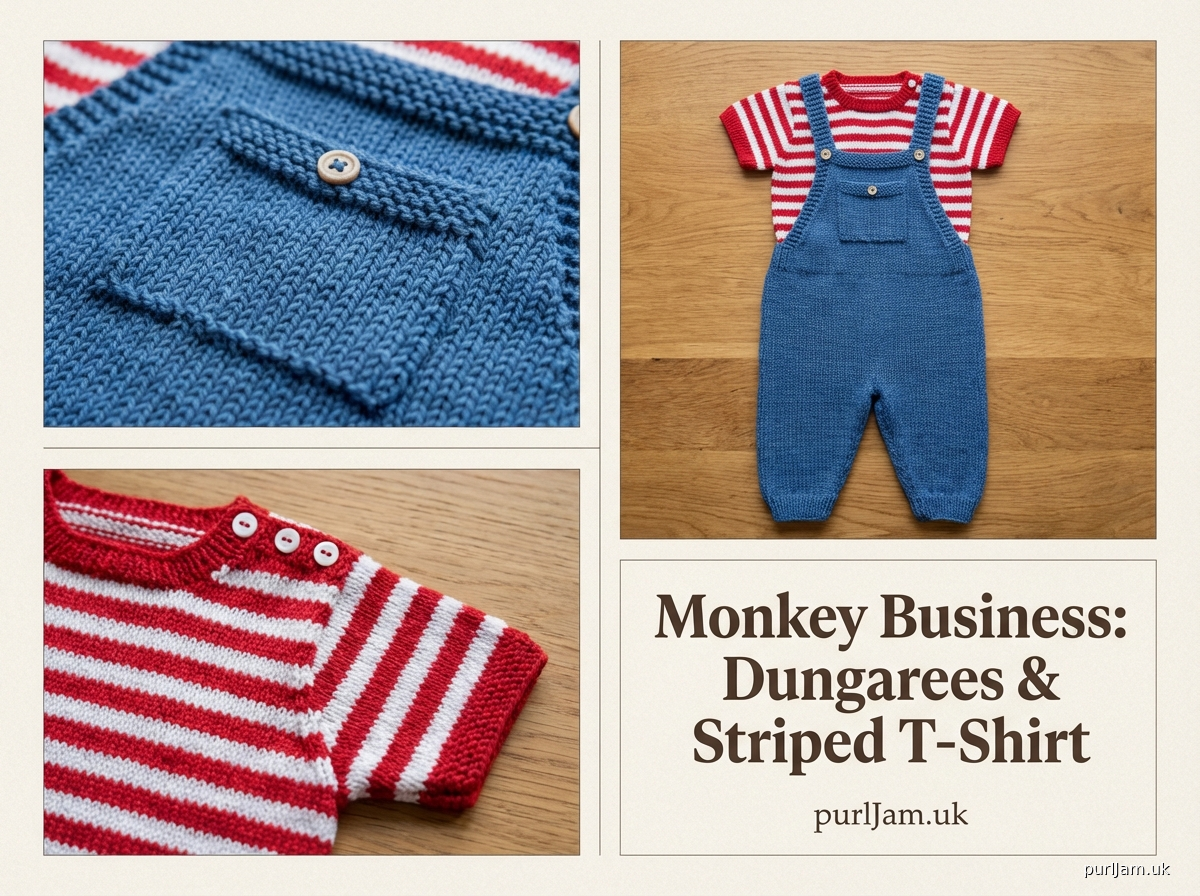
# Monkey Business: Dungarees & Striped T-Shirt
### A Matching Outfit for a 10-Inch Macaque Monkey Toy

---

## About This Pattern

This pattern creates two coordinating garments for a 10-inch (25.5 cm) stuffed macaque monkey: a pair of classic blue denim-look dungarees with a front bib pocket and adjustable shoulder straps, and a cheerful red-and-white striped t-shirt with a three-button left shoulder opening for easy dressing. Both garments are knitted flat in 4-ply cotton yarn and seamed. Difficulty level: **Intermediate**.

---

## Finished Measurements

| Measurement | Inches | cm |
|---|---|---|
| Chest circumference | 8 in | 20.5 cm |
| Waist circumference | 7 in | 18 cm |
| Hip circumference | 8 in | 20.5 cm |
| Torso length (underarm to crotch) | 2.5 in | 6.5 cm |
| Inseam length | 3.5 in | 9 cm |
| Bib height | 2 in | 5 cm |
| Bib width | 2 in | 5 cm |
| T-shirt body length | 4 in | 10 cm |
| T-shirt sleeve length | 1.5 in | 4 cm |

*These measurements are designed for a typical 10-inch stuffed macaque with an approximate chest circumference of 8 inches. Measure your monkey and adjust needle size or stitch count if needed.*

---

## Materials

### For Both Garments
- **Needles:** US 2 / 2.75 mm straight needles
- **Tapestry needle** for seaming and weaving in ends
- **Scissors**
- **Pins** for blocking and seaming
- **Stitch holders or waste yarn** (2)
- **Stitch markers** (4)

### Dungarees
- **Yarn A (Blue):** 4-ply / fingering weight cotton yarn, approximately **120 yards (110 m)**
  - *Suggested: Rico Design Essentials Cotton (160 m / 50 g) or similar smooth 4-ply cotton in denim blue*
- **2 small buttons**, approx. ⅜ inch (10 mm) diameter, for strap fastenings
- **Optional:** 1 small stitch marker for pocket placement

### T-Shirt
- **Yarn B (Red):** 4-ply / fingering weight soft cotton yarn, approximately **50 yards (46 m)**
- **Yarn C (White):** 4-ply / fingering weight soft cotton yarn, approximately **50 yards (46 m)**
  - *Suggested: Paintbox Simply DK Cotton or Drops Safran 4-ply in red and white — choose the softest cotton available for the t-shirt*
- **3 small buttons**, approx. ¼ inch (6 mm) diameter, for left shoulder
- **Sewing thread** to match buttons

> **A note on yarn weight:** This pattern is written for 4-ply (fingering weight) cotton as specified, which is ideal for small toy garments. The gauge given below reflects this. If you substitute a heavier yarn, your finished garment will be larger — swatch carefully.

---

## Gauge

**30 stitches × 40 rows = 4 inches (10 cm) in stockinette stitch**
using US 2 / 2.75 mm needles and 4-ply cotton yarn.

*Gauge is important for a good fit on your monkey. Please swatch before beginning. Block your swatch as you plan to block the finished garments.*

---

## Abbreviations

| Abbreviation | Meaning |
|---|---|
| k | knit |
| p | purl |
| st(s) | stitch(es) |
| RS | right side |
| WS | wrong side |
| CO | cast on |
| BO | bind off |
| k2tog | knit 2 stitches together (right-leaning decrease) |
| ssk | slip, slip, knit (left-leaning decrease) |
| kfb | knit into front and back of stitch (increase) |
| pm | place marker |
| sm | slip marker |
| rep | repeat |
| rem | remaining |
| approx | approximately |
| cont | continue |
| beg | beginning |
| MC | main color |
| CC | contrast color |

---

## Pattern Notes

1. **Dungarees are worked in two separate legs from the hem up**, then joined at the crotch to work the body as one piece. The bib and straps are worked separately and attached.
2. **The t-shirt is worked in four flat pieces**: back, front, and two sleeves. The left shoulder has a button band opening for easy on/off.
3. **Stripe sequence for t-shirt:** 4 rows Yarn B (Red), 4 rows Yarn C (White). Carry the unused color loosely up the side edge rather than cutting after every stripe.
4. **Seaming method:** Use mattress stitch for all side and sleeve seams for the neatest result.
5. **Buttons:** The dungaree straps button onto the front bib. The t-shirt has 3 buttons on the left shoulder only; the right shoulder is seamed.
6. **Blocking:** Wet block both garments before seaming and dressing your monkey. Cotton benefits greatly from blocking.
7. **Right side / Wrong side:** The first row after cast-on is a RS row (knit row in stockinette) unless otherwise stated.

---

---

# PART ONE: THE DUNGAREES

---

## Construction Overview

Work two identical legs from the hem up. Join both legs to work the body in one piece, shaping the waist slightly. Pick up stitches for the bib at the front. Work two long straps separately. Finish with a ribbed waistband and hemmed leg edges.

---

## DUNGAREES: LEG (Make 2 identical)

The leg is worked flat, then seamed along the inner leg seam.

**Note on width:** Each leg piece, when seamed, creates a tube approximately 2 inches (5 cm) in circumference, which is slightly loose-fitting for the monkey's leg — this gives ease for movement and a natural dungaree silhouette.

### Cast On
Using Yarn A (Blue) and US 2 / 2.75 mm needles, CO **17 sts**.

### Hem Edge (Rows 1–6): Seed Stitch Border
*Seed stitch creates a neat, non-rolling hem.*

- **Row 1 (RS):** \*K1, p1; rep from \* to last st, k1.
- **Row 2 (WS):** \*K1, p1; rep from \* to last st, k1.
- Rep Rows 1–2 twice more. (6 rows of seed stitch total.)

**Stitch count: 17 sts** ✓

### Leg Body (Rows 7–48): Stockinette
- **Row 7 (RS):** Knit.
- **Row 8 (WS):** Purl.
- Rep Rows 7–8 until piece measures **3.5 inches (9 cm)** from cast-on edge, ending with a WS (purl) row.
  - *At 40 rows per 4 inches, 3.5 inches = approx 35 rows of stockinette. Including the 6 seed stitch rows, work stockinette rows 7 through approximately Row 41, ending with a WS row.*
  - *Total rows worked to this point: approx 41 rows.*

**Stitch count: 17 sts** ✓

### Crotch Shaping
- **Next row (RS) — Crotch decrease row:** K1, k2tog, knit to last 3 sts, ssk, k1. **[15 sts]**
- **Next row (WS):** Purl.

Place all 15 sts on a stitch holder or waste yarn. **Do not break yarn on the first leg.**

**Make the second leg exactly the same** and leave these 15 sts on the needle, yarn attached.

---

## DUNGAREES: BODY

### Joining the Legs (1 row)
With RS facing, both legs on needles:

- **Joining Row (RS):** Knit across 15 sts of second leg (yarn attached); then using the yarn from the first leg, knit across the 15 sts of the first leg from the holder. **[30 sts total]**

*If you prefer, transfer both sets of stitches to one longer needle before working the joining row.*

> **Math check:** 15 sts (leg 2) + 15 sts (leg 1) = **30 sts** ✓
> At gauge, 30 sts = 4 inches. Two pieces × 4 inches = 8 inches total circumference when seamed. ✓

### Body: Stockinette Rows
- **Next row (WS):** Purl across all 30 sts.
- Work in stockinette (knit RS, purl WS) for **1 inch (2.5 cm)** — approximately 10 rows, ending with a WS row.

**Stitch count: 30 sts** ✓

### Waist Shaping (Decrease for slight waist)
- **Decrease Row (RS):** K6, k2tog, k2, ssk, k10, k2tog, k2, ssk, k6. **[26 sts]**

> **Math check:** 30 − 4 = **26 sts** ✓

- **Next row (WS):** Purl.
- Work 6 more rows in stockinette (3 RS, 3 WS), ending with a WS row.

**Stitch count: 26 sts** ✓

### Waistband: Ribbed (1 × 1 Rib)
- **Row 1 (RS):** \*K1, p1; rep from \* to end.
- **Row 2 (WS):** \*K1, p1; rep from \* to end.
- Rep Rows 1–2 twice more. (6 rows of 1×1 rib total.)

> **Note:** 26 sts is an even number, which works perfectly for 1×1 rib. ✓

- **Bind off row (RS):** Bind off all 26 sts **in rib pattern** (k the knit sts, p the purl sts as you bind off).

---

## DUNGAREES: BIB

The bib is picked up from the front of the body, centered on the front panel.

### Pick Up Stitches for Bib
With RS facing and Yarn A, pick up and knit **15 sts** along the top edge of the front waistband, centered on the front of the dungarees.

*The front corresponds to one flat piece (half of the 26-stitch body). 15 sts = 2 inches, centered.*

### Bib Body
- **Row 1 (WS):** Purl.
- **Row 2 (RS):** Knit.
- Rep Rows 1–2 until bib measures **1.75 inches (4.5 cm)** from picked-up edge, ending with a WS row. (Approx 17 rows.)

**Stitch count: 15 sts** ✓

### Bib Top Edge
- Work 4 rows seed stitch:
  - **Row 1:** \*K1, p1; rep from \* to last st, k1.
  - Rep this row 3 more times.
- Bind off all 15 sts in seed stitch pattern.

**Total bib height:** approx 2 inches (5 cm) ✓

---

## DUNGAREES: FRONT POCKET

The pocket is a small square worked separately and sewn to the bib.

### Cast On
Using Yarn A and US 2 / 2.75 mm needles, CO **9 sts**.

### Pocket Top Border
- Work 3 rows seed stitch.

### Pocket Body
- Work in stockinette for 8 rows, ending with a WS row.

### Pocket Bottom Border
- Work 2 rows seed stitch.
- Bind off all 9 sts in seed stitch.

**Finished pocket size:** approx 1.25 in × 1.25 in (3 cm × 3 cm)

### Pocket Placement
Center the pocket on the bib, with the top of the pocket approximately ⅜ inch (1 cm) below the bib's top seed stitch border. Pin in place. Using a tapestry needle and Yarn A, sew the pocket to the bib along the bottom and two side edges using mattress stitch or whipstitch, leaving the top open.

---

## DUNGAREES: SHOULDER STRAPS (Make 2)

Each strap is a narrow I-cord-style strip, worked flat.

### Cast On
Using Yarn A and US 2 / 2.75 mm needles, CO **4 sts**.

### Strap Body
- **Row 1 (RS):** K1, p1, p1, k1.
- **Row 2 (WS):** K1, p1, p1, k1.

  *This creates a double seed stitch / moss-type column on 4 sts — it lies flat and doesn't curl.*

- Repeat these 2 rows until strap measures **6 inches (15 cm)** from cast-on edge. (Approx 60 rows.)

### Button Loop End
- Work 3 more rows in pattern.
- **Buttonhole row:** K1, BO 2 sts, k1. (2 sts remain with a gap in the middle.)
- **Next row:** K1, CO 2 sts using backward loop cast-on, k1. (4 sts restored.)
- Work 2 more rows in pattern.
- Bind off all 4 sts.

**Make second strap the same.**

---

## DUNGAREES: FINISHING

### Leg Seams
- Fold each leg piece in half, RS together, aligning the inner leg edges.
- Using mattress stitch and Yarn A, sew the inner leg seam of each leg from hem to crotch.

### Crotch Seam
- With the two joined legs, sew the short crotch seam (approx ½ inch / 1.5 cm) at the center, joining the two inner leg seams together. This creates the crotch gusset.

### Side Seams
- With the body right-side out, sew the two back side seams of the body using mattress stitch, leaving the front open where the bib begins. (The body is worked as one flat piece, so there is one back seam running up the center back. Alternatively, sew the single back seam from waist to bib level.)

> **Construction note:** Because the body was worked flat as 30 sts and the legs seamed independently, the single seam runs up the center back. The front is seamless with the bib. ✓

### Attach Straps
- Position the cast-on end of each strap at the back waistband, approximately ½ inch (1.5 cm) from each side edge of the back.
- Sew securely to the inside of the back waistband using Yarn A and a tapestry needle, stitching through several rows of the waistband for security.
- The button-loop ends of the straps cross over the shoulders and button to the front of the bib.
- Sew 1 button to each upper corner of the bib (approximately ½ inch / 1.5 cm from the side edges and ¼ inch / 6 mm down from the top edge) to correspond with the strap buttonholes.

### Weave in Ends
- Weave in all ends neatly on the WS.

### Block
- Wet block dungarees flat. Smooth into shape and allow to dry completely before dressing monkey.

---

---

# PART TWO: THE STRIPED T-SHIRT

---

## Construction Overview

Work four flat pieces: back, front, and two short sleeves. The right shoulder is seamed. The left shoulder has a short button band on the back left shoulder and a matching buttonhole band on the front left shoulder, fastened with 3 small buttons.

---

## Stripe Sequence
- **4 rows Yarn B (Red)**
- **4 rows Yarn C (White)**
- Repeat throughout.

*Always begin a new piece with 4 rows of Red (Yarn B) to keep stripe alignment consistent across all pieces.*

*Carry yarn not in use loosely up the side edge — do not cut between stripes.*

---

## T-SHIRT: BACK

### Cast On
Using Yarn B (Red) and US 2 / 2.75 mm needles, CO **30 sts**.

### Bottom Rib
- Work 4 rows in 1×1 rib:
  - **All rows:** \*K1, p1; rep from \* to end.

  *Work these 4 rows in Yarn B (Red) — this counts as the first 4-row red stripe.*

**Stitch count: 30 sts** ✓

> **Math check:** 30 sts ÷ 30 sts per 4 in = 4 in per half of chest = 8 in circumference total. ✓

### Body
Switch to stockinette and begin stripe sequence, **starting with 4 rows Yarn C (White)** (since the rib used the first red stripe):

- **Rows 1–4:** Yarn C (White): knit RS rows, purl WS rows.
- **Rows 5–8:** Yarn B (Red): knit RS rows, purl WS rows.
- Continue alternating 4-row stripes until body measures **4 inches (10 cm)** from cast-on edge (including the rib), ending with a complete stripe (WS row).

*At 40 rows per 4 inches total: 4 rows rib + 36 rows stockinette = 40 rows = 4 inches. You will work approximately 4–5 complete stripes in the body.*

**Stitch count: 30 sts** ✓

### Armhole Shaping
- **Bind off row (RS):** BO 3 sts at beg of row, knit to end. **[27 sts]**
- **Next row (WS):** BO 3 sts at beg of row (purl side), purl to end. **[24 sts]**

> **Math check:** 30 − 3 − 3 = **24 sts** ✓

- **Next row (RS):** K1, ssk, knit to last 3 sts, k2tog, k1. **[22 sts]**
- **Next row (WS):** Purl.
- **Next row (RS):** K1, ssk, knit to last 3 sts, k2tog, k1. **[20 sts]**
- **Next row (WS):** Purl.

> **Math check:** 24 − 2 − 2 = **20 sts** ✓

*Maintain stripe sequence throughout armhole shaping.*

### Upper Back
Continue in stockinette with stripe sequence on 20 sts until armhole measures **1.5 inches (4 cm)** from first bind-off row, ending with a WS row. (Approx 15 rows from first armhole BO row.)

**Stitch count: 20 sts** ✓

### Left Shoulder Button Band
*This band sits on the back left shoulder and will have 3 buttons sewn onto it.*

- **Divide for shoulders:** Work across 7 sts (right shoulder), bind off center 6 sts (back neck), work last 7 sts (left shoulder).

> **Math check:** 7 + 6 + 7 = **20 sts** ✓

**Left shoulder only (7 sts), continuing in current stripe:**
- **Row 1 (WS):** Purl 7.
- **Row 2 (RS):** Knit 7.
- Work 4 more rows in stockinette (maintaining stripe sequence).
- *Button band extension — work 4 more rows in seed stitch on these 7 sts:*
  - **Row 1:** \*K1, p1; rep from \* to last st, k1.
  - Rep this row 3 more times.
- **Bind off all 7 sts in seed stitch.**

**Right shoulder only (7 sts):**
- Re-join yarn at RS of right shoulder.
- Work 10 rows stockinette (maintaining stripe).
- Bind off all 7 sts.

---

## T-SHIRT: FRONT

Work exactly as Back to the end of armhole shaping. (20 sts, armhole measures 1.5 in.)

### Neckline Shaping
- **Divide for neck (RS):** K6, BO center 8 sts, k6. **[6 sts each shoulder]**

> **Math check:** 6 + 8 + 6 = **20 sts** ✓

**Right front shoulder (6 sts):** (This is the right shoulder when worn, which corresponds to the right as you look at the front.)
- **Row 1 (WS):** Purl.
- **Neck edge decrease, Row 2 (RS):** Knit to last 3 sts, k2tog, k1. **[5 sts]**
- **Row 3 (WS):** Purl.
- **Row 4 (RS):** Knit to last 3 sts, k2tog, k1. **[4 sts]** *(optional — omit if shoulder is too narrow; check against your monkey)*

> **Revised note:** To maintain a 7-st shoulder width on the front matching the back, begin front neck shaping 2 rows earlier, or work neck decreases over fewer rows. Since the back shoulder is 7 sts and the front begins at 6 sts (slightly narrower due to neck opening), the front shoulder will be approximately 5–6 sts after shaping — this is intentional as the front neck sits higher. Work 5 sts after 1 decrease row.

**Right front shoulder — final:**
- After 1 decrease (6 → 5 sts), work 4 more rows stockinette, maintaining stripe sequence.
- Bind off 5 sts. *This shoulder will be seamed to the back right shoulder.*

**Left front shoulder (6 sts):** (This shoulder has the buttonhole band.)
- Re-join yarn at WS.
- **Row 1 (WS):** Purl.
- **Neck edge decrease, Row 2 (RS):** K1, ssk, knit to end. **[5 sts]**
- **Row 3 (WS):** Purl.
- Continue on 5 sts in stockinette (maintaining stripe sequence) for 4 more rows, ending with a WS row.

**Buttonhole Band Extension:**
*Work a short seed stitch band with 3 buttonholes to match the back left shoulder button band.*

- **Row 1 (RS):** \*K1, p1; rep from \* to last st, k1. *(Seed stitch)*
- **Row 2 (WS) — Buttonhole row:** Seed 1, \[BO 1 st, seed 1\] 3 times, working to position buttonholes evenly.

> **Precise buttonhole placement across 5 sts:**
> - Seed 1, BO 1, seed 1, BO 1, seed 1, BO 1, — this uses all 5 sts with 3 single-stitch buttonholes alternating with 1 seed st between. However, 3 BO across 5 sts leaves only 2 live sts — adjust as follows:
> - **Revised buttonhole row:** Seed 1, BO 1 (1 buttonhole), seed 1, BO 1 (2 buttonholes), seed 1, BO 1 (3 buttonholes). **[2 sts remain on needle, 3 sts bound off]**
> - **Next row (RS):** Seed 1, CO 1 using backward loop, seed 1, CO 1, seed 1, CO 1. **[5 sts restored]** ✓
> - **Next row:** Seed stitch across 5 sts.
> - **Final row:** Seed stitch across 5 sts.
> - **Bind off in seed stitch.**

> **Tip:** Using a single-stitch buttonhole is appropriate here because the buttons are very small (¼ inch / 6 mm). If your buttons are slightly larger, work a 2-stitch buttonhole by binding off 2 sts instead of 1 at each buttonhole position, adjusting the overall band width as needed.

---

## T-SHIRT: SLEEVES (Make 2 identical)

The sleeves are short cap sleeves worked flat.

### Cast On
Using Yarn B (Red) and US 2 / 2.75 mm needles, CO **22 sts**.

### Cuff Rib
- Work 3 rows 1×1 rib:
  - \*K1, p1; rep from \* to end.

  *Work in Yarn B (Red).*

**Stitch count: 22 sts** ✓

### Sleeve Body
Switch to stockinette and begin stripe sequence with **Yarn C (White):**

- Work 4-row stripes in stockinette, alternating White and Red.
- Work until sleeve measures **1.5 inches (4 cm)** from cast-on, ending with a complete WS row.
  - *Approx: 3 rows rib + 13 rows stockinette = 16 rows ≈ 1.6 inches — close enough; adjust by 1–2 rows as needed.*

**Stitch count: 22 sts** ✓

> **Math check:** 22 sts ÷ 30 sts per 4 in = 2.93 in ≈ 3 in sleeve width — appropriate for a short cap sleeve on an 8-inch chest monkey. ✓

### Sleeve Cap Shaping
- **Row 1 (RS):** BO 2 sts, knit to end. **[20 sts]**
- **Row 2 (WS):** BO 2 sts, purl to end. **[18 sts]**
- **Row 3 (RS):** K1, ssk, knit to last 3 sts, k2tog, k1. **[16 sts]**
- **Row 4 (WS):** Purl.
- **Row 5 (RS):** K1, ssk, knit to last 3 sts, k2tog, k1. **[14 sts]**
- **Row 6 (WS):** Purl.
- **Row 7 (RS):** K1, ssk, knit to last 3 sts, k2tog, k1. **[12 sts]**
- **Row 8 (WS):** Purl.
- **Row 9 (RS):** K1, ssk, knit to last 3 sts, k2tog, k1. **[10 sts]**
- **Row 10 (WS):** BO all 10 sts purlwise.

> **Math check:** 22 → 20 → 18 → 16 → 14 → 12 → 10 → BO. Each step verified. ✓

---

## T-SHIRT: FINISHING

### Block All Pieces
Wet block all four pieces (back, front, 2 sleeves) before seaming. Pin to measurements and allow to dry fully.

### Right Shoulder Seam
- Place RS of right back shoulder and right front shoulder together.
- Using a tapestry needle and matching yarn, join the right shoulder seam using mattress stitch or three-needle bind-off for a neat, flat seam.

### Left Shoulder Button Band
- Lay the back left shoulder's seed stitch button band overlapping the front left shoulder's buttonhole band, with the button band on top (WS of button band against RS of buttonhole band extension).
- Pin in place.
- The shoulder join is secured by the buttons and bands; no additional seaming is needed on the left shoulder.
- Sew 3 small buttons to the **back** left shoulder button band, aligning with the 3 buttonholes in the front band.

### Sleeve Seams
- Fold each sleeve in half lengthwise, RS together.
- Sew the underarm seam of each sleeve using mattress stitch.

### Set in Sleeves
- Pin each sleeve into an armhole, RS together, matching the center top of the sleeve cap to the shoulder seam and easing the cap evenly around the armhole.
- Sew the sleeve into the armhole using a whipstitch or mattress stitch, working around the full armhole opening.
- Repeat for second sleeve.

### Side Seams
- With RS together, sew the right side seam from hem rib to underarm, then continue down the sleeve underarm seam in one continuous line.
- Repeat for left side.

### Neck Finish (Optional)
- If desired, using Yarn B or C and a crochet hook (US B/1 or C/2 / 2–2.5 mm), work 1 round of single crochet around the neckline for a neat edge. Alternatively, the bound-off neckline edge is tidy enough to leave as-is.

### Weave in All Ends
Weave all yarn ends in on the WS, taking care to tuck stripe-color ends along the WS of their respective colored stripe rows so they don't show through.

### Final Block
Lightly mist-block the assembled t-shirt and lay flat to dry.

---

---

# SCHEMATIC GUIDE

```
DUNGAREES — LEG (flat piece, make 2)
  _________
 |         |   ← 17 sts wide (2.25 in)
 |  3.5 in |   Stockinette with seed hem
 |         |
 |_________|

DUNGAREES — BODY (worked flat, 30 sts across after join)
  _______________
 |               |   ← 30 sts → 26 sts after waist decrease
 |    2.5 in     |
 |   + waistband |
 |_______________|

BIB (picked up from front, 15 sts)
  _______
 |   []  |  ← pocket
 | 2×2in |
 |_______|

STRAPS: 4 sts wide × 6 in long (×2)

T-SHIRT — BACK & FRONT (each 30 sts)
    __________
   /    neck   \
  |             |   ← 20 sts at armhole
  |    4 in     |
  |_____________|   ← 30 sts at hem

SLEEVE (22 sts wide, 1.5 in to cap)
    ____
   /    \   cap shaping: 22→10 sts
  |      |
  |______|   22 sts at cuff
```

---

# QUICK REFERENCE — STITCH COUNT SUMMARY

| Piece | Cast On | Key Shaping | Final Bind Off |
|---|---|---|---|
| Dungaree Leg (×2) | 17 sts | Crotch dec → 15 sts | On holder |
| Dungaree Body | 30 sts (joined) | Waist dec → 26 sts | 26 sts BO in rib |
| Bib | 15 sts (picked up) | None | 15 sts BO in seed |
| Pocket | 9 sts | None | 9 sts BO |
| Straps (×2) | 4 sts | None (buttonhole) | 4 sts BO |
| T-Shirt Back | 30 sts | Armhole → 20 sts, neck divide → 7+7 | 7 sts each shoulder |
| T-Shirt Front | 30 sts | Armhole → 20 sts, neck divide → 6+6 | 5 sts each shoulder |
| Sleeve (×2) | 22 sts | Cap shaping → 10 sts | BO 10 sts |

---

# TIPS FOR SUCCESS

- **Test the fit as you go:** Before seaming, drape the knitted pieces over your monkey toy to check sizing. Monkey toys vary even within the same stated size — adjust row counts in the leg or body as needed.
- **Stripe consistency:** Always start a new stripe at the beginning of a RS row to keep the stripes looking clean on the right side.
- **Small buttonholes:** A single-stitch buttonhole on 4-ply yarn creates a very small loop. Use very fine buttons — tiny shirt buttons or even small shank buttons work well.
- **Dungaree fit tip:** If the leg tubes feel too loose, simply work the inner leg seam with a slightly deeper seam allowance to tighten the fit without reknitting.
- **Weaving in stripe ends:** To avoid color bleed-through on white stripes, always weave red ends through red rows only, and white ends through white rows only.

---

*Pattern designed for an intermediate knitter. Finished garments are designed for decorative and play use on a stuffed toy. Not suitable for infants or children under 3 years of age due to small buttons.*

---
Disclaimer: This pattern was generated by AI and should be reviewed for accuracy before use. While we strive for quality, AI-generated content may contain errors. Please verify measurements, stitch counts, and instructions before beginning your project. Generated by purlJam.uk
Access your pattern anytime
Bookmark this page to access your pattern anytime