Type
Knitting
Difficulty
intermediate
Category
custom
AI Thinking Process
Planning
Verification
Pattern
Nordic Squirrel Cushion Cover
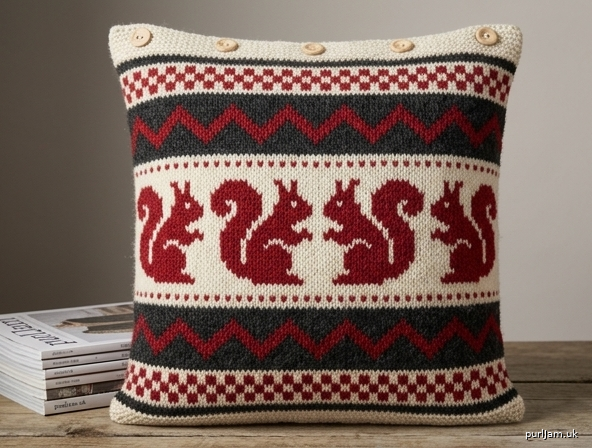
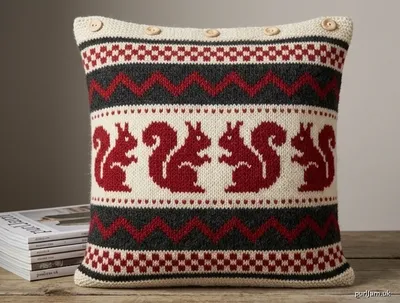
A square, two-colour stranded cushion cover in bulky Icelandic wool, in the Scandinavian folk tradition. Four squirrels sit across the middle of the Front, framed by diagonal zigzags and small checks. The Back is geometric throughout. The cover is worked as two flat panels and buttoned along the top edge.
Skill level: Intermediate (stranded colourwork worked flat, even tension, seaming, buttonholes).
Size
One size.
Finished measurements (after blocking): 50 × 50 cm (19¾ × 19¾ in), to fit a 50 × 50 cm square cushion pad.
For a tailored look use a 50 cm pad; for a plump look use a 55 cm pad.
Materials
Yarn: Álafosslopi (100% Icelandic wool; bulky; 100 m / 109 yd per 100 g ball), or equivalent bulky wool that meets tension.
- MC (main colour): 300 g / 300 m (3 balls) — 0051 White, or 0054 Light Ash Heather, or 9972 Ecru.
- CC (contrast colour): 200 g / 200 m (2 balls) — 0047 Happy Red for a classic folk look, or 0059 Black / 0005 Black Heather for a quieter modern Scandi look.
If your tension is loose, or the squirrels are densely filled, a third ball of CC is wise. Icelandic wool blooms after washing; leftover yarn is useful for mittens.
Needles: 6 mm (UK 4, US 10) straight needles, or a circular needle at least 60 cm long used flat. Use 5.5 mm if you knit loosely, 6.5 mm if you knit tightly — match tension, not the needle number.
Notions:
- Tapestry needle
- 4 stitch markers (optional, to mark the four squirrel quarters)
- 5 buttons, 20–25 mm diameter, in a colour that sits quietly on MC
- 50 × 50 cm cushion pad
- Blocking mats and pins
Tension (gauge)
13 stitches and 17 rows = 10 × 10 cm over stranded colourwork in stocking stitch on 6 mm needles, after wet blocking.
Work a colourwork swatch at least 18 sts × 24 rows. Wash, dry flat, then measure.
Checks:
- 66 sts ÷ 13 sts × 10 cm = 50.8 cm, blocked to 50 cm ✓
- 85 rows ÷ 17 rows × 10 cm = 50 cm ✓
Change needle size if needed. In this yarn, fabric that is too loose will sag; fabric that is too tight will feel board-like and starve the floats.
Abbreviations
| Abbr. | Meaning |
|---|---|
| CC | contrast colour |
| k | knit |
| MC | main colour |
| p | purl |
| rep | repeat |
| RS | right side |
| st(s) | stitch(es) |
| st st | stocking stitch (RS knit, WS purl) |
| WS | wrong side |
| yo | yarn over |
Cast off is used throughout (UK). Garter stitch = knit every row.
Pattern notes
- The cover is two rectangles, each 66 sts × 85 rows. There is no shaping; the count stays at 66 sts on every row (1 MC selvedge, 64 pattern sts, 1 MC selvedge) ✓
- Colourwork is stranded (Fair Isle method), not intarsia. Carry the unused yarn across the WS. Catch floats at least every 3 sts so they cannot snag on the cushion pad. Do not pull the carried yarn tight — the fabric should lie flat and the stitches should remain the same size as the swatch.
- Selvedges: on every row, work the first and last stitch in MC (k on RS, p on WS). These two stitches are never part of a colourwork repeat. Twist MC and CC around each other at the selvedge every few rows to lock the second yarn.
- WS colourwork rows: p1 MC (selvedge), purl each stitch in the same colour it was knitted on the RS, p1 MC. Read the colour sequence from left to right on WS rows (the reverse of the RS sequence).
- If purling colourwork is unwelcome, see In-the-round option at the end of the instructions.
- Do not cut CC between consecutive colourwork bands; carry it up the selvedge. Cut CC only before a garter section, leaving a 15 cm tail.
- Icelandic wool is sticky and blooms. Ends weave in securely; a wet block is essential.
- Four squirrels sit in the centre panel of the Front only, evenly spaced across the 64 pattern stitches. Traditional Nordic folk squirrels: profile, sitting upright, large curled bushy tail, small ear. Work them in CC on an MC ground. Face the two left-hand squirrels to the right and the two right-hand squirrels to the left, so all four look towards the centre. If a colourwork chart is used later, centre one motif in each quarter of the 64 pattern stitches, adding extra MC rows or a light CC dotted ground above, below, or between the motifs so the centre panel still measures exactly 36 rows.
- Keep the squirrels bold and graphic — two colours only. Eyes can be a single CC stitch; do not introduce a third yarn.
Stitch patterns
Work all repeats over the 64 pattern stitches between selvedges. Each RS row is given; WS rows are purled in the colours as set (see notes).
Lower Zigzag (12 rows; 8-st repeat)
CC block travels towards the start of the RS row.
- Row 1 (RS): *K4 MC, k4 CC; rep from * to end of pattern sts. (8 × 8 = 64 ✓)
- Row 3: *K3 MC, k4 CC, k1 MC; rep from * (3 + 4 + 1 = 8 ✓)
- Row 5: *K2 MC, k4 CC, k2 MC; rep from * (64 ✓)
- Row 7: *K1 MC, k4 CC, k3 MC; rep from * (64 ✓)
- Row 9: *K4 CC, k4 MC; rep from * (64 ✓)
- Row 11: *K3 CC, k4 MC, k1 CC; rep from * (3 + 4 + 1 = 8 ✓)
- Rows 2, 4, 6, 8, 10, 12 (WS): purl in the colours as set.
Upper Zigzag (12 rows; 8-st repeat)
The reverse sequence, so the diagonals lean the other way and the two bands frame the centre.
- Row 1 (RS): *K3 CC, k4 MC, k1 CC; rep from * (64 ✓)
- Row 3: *K4 CC, k4 MC; rep from * (64 ✓)
- Row 5: *K1 MC, k4 CC, k3 MC; rep from * (64 ✓)
- Row 7: *K2 MC, k4 CC, k2 MC; rep from * (64 ✓)
- Row 9: *K3 MC, k4 CC, k1 MC; rep from * (64 ✓)
- Row 11: *K4 MC, k4 CC; rep from * (64 ✓)
- WS rows: purl in the colours as set.
Check Band (6 rows; 4-st repeat)
- Row 1 (RS): *K2 MC, k2 CC; rep from * (16 × 4 = 64 ✓)
- Row 3: *K2 CC, k2 MC; rep from * (64 ✓)
- Row 5: *K2 MC, k2 CC; rep from * (64 ✓)
- WS rows: purl in the colours as set.
Dotted Line (2 rows; 4-st repeat)
- Row 1 (RS): *K3 MC, k1 CC; rep from * (16 × 4 = 64 ✓)
- Row 2 (WS): purl in the colours as set.
Front
With MC and 6 mm needles, cast on 66 sts.
Rows 1–4 (garter hem): Knit 4 rows in MC. (Row 1 is RS.)
Lower geometric band (Rows 5–24; 20 rows):
- Rows 5–6: St st in MC (k Row 5, p Row 6), keeping selvedges as set.
- Rows 7–18: Lower Zigzag (12 rows).
- Rows 19–24: Check Band (6 rows).
(2 + 12 + 6 = 20 ✓)
Centre squirrel panel (Rows 25–60; 36 rows):
- Rows 25–26: Dotted Line.
- Rows 27–58 (32 rows): MC ground. Place four squirrel motifs evenly across the 64 pattern stitches (one in each quarter). Work the squirrels in CC, stranded, catching floats every 3 sts. Alternate facing as described in the notes. If the motifs are shorter than 32 rows, add MC rows (with or without a light CC peerie of scattered single stitches) above and below until 32 rows are complete. If they are slightly taller, scale the surrounding MC ground — the panel must still end after Row 58.
- Rows 59–60: Dotted Line.
(2 + 32 + 2 = 36 ✓)
Upper geometric band (Rows 61–80; 20 rows):
- Rows 61–66: Check Band (6 rows).
- Rows 67–78: Upper Zigzag (12 rows).
- Rows 79–80: St st in MC.
(6 + 12 + 2 = 20 ✓)
Rows 81–85 (garter button facing): Knit 5 rows in MC.
(4 + 20 + 36 + 20 + 5 = 85 ✓)
Cast off knitwise in MC. Fasten off, leaving a 20 cm tail for seaming.
Back
With MC, cast on 66 sts.
Rows 1–24: Work exactly as Front (garter hem + lower geometric band). The side borders will then match at the seams.
Centre geometric panel (Rows 25–60; 36 rows):
- Rows 25–36: Lower Zigzag (12 rows).
- Rows 37–48: Upper Zigzag (12 rows).
- Rows 49–60: Lower Zigzag (12 rows).
(12 + 12 + 12 = 36 ✓)
This three-part wave (out, back, out) reads as a large chevron/diamond field — the quiet reverse of the squirrels.
Rows 61–80: Work exactly as Front upper geometric band.
Rows 81–85 (garter button band):
- Row 81 (RS): Knit in MC.
- Row 82 (WS): Knit in MC.
- Row 83 (RS, buttonholes): K6, [yo, k2tog, k11] 4 times, yo, k2tog, k6.
- Count: 6 + 4 × (2 + 11) + 2 + 6 = 6 + 52 + 2 + 6 = 66 ✓
- Five holes sit at even intervals with a 6-st margin at each end.
- Row 84 (WS): Knit in MC, working each yo as 1 knit st.
- Row 85 (RS): Knit in MC.
Cast off knitwise in MC.
Finishing
- Weave in ends on the WS, following the same colour as the surrounding stitches so they do not show through. Icelandic wool grips; a short split-yarn weave is enough.
- Wet block. Soak both pieces in lukewarm water (no agitating, a drop of wool wash if you like) for 20 minutes. Roll in a towel. Pin each piece to 50 × 50 cm, keeping edges straight and the squirrels upright. Dry fully before unpinning. Do not use heat.
- Assemble. Place Front and Back together, WS facing, cast-on edges at the bottom, buttonholes on the Back at the top. With MC, mattress-stitch the two side edges and the cast-on (bottom) edge, taking one selvedge stitch from each side. The top (cast-off) edges stay open.
- Buttons. On the Front garter facing, sew five buttons to match the buttonholes. Sit them on the inner half of the facing so the top edges meet cleanly when closed.
- Insert the cushion pad, button closed.
The cover can be opened for washing. Hand-wash cool, squeeze (do not wring), and dry flat.
In-the-round option (avoids purling colourwork)
Cast on 132 sts with MC. Join to work in the round, taking care not to twist. Place a marker at the join (right side of cushion) and a second marker after 66 sts (left side).
Work 80 rounds, knitting every round, with Front instructions over the first 66 sts and Back instructions over the second 66 sts of every round. Treat the stitch next to each marker as the MC “selvedge”. After 80 rounds, divide at the markers. Work Front Rows 81–85 in garter (knit RS, purl WS) on the first 66 sts; work Back Rows 81–85 with buttonholes on the remaining 66 sts. Cast off each half separately. Mattress-stitch the cast-on edge closed for the bottom, then attach buttons as above.
(66 + 66 = 132 ✓; 80 rounds + 5 split rows = 85 ✓)
Designer’s notes
- The lower diagonals and upper diagonals lean in opposite directions so the geometric bands point towards the squirrels, which is a classic Scandinavian framing device.
- Two colours keep the drawing bold at this scale. Cream and red is folk; cream and charcoal is modern Scandi interiors.
- Álafosslopi’s long staple and slight stickiness are ideal for stranded work — the floats stay put after blocking and the fabric has the right rustic hand for a cushion.
Disclaimer: This pattern was generated by AI and should be reviewed for accuracy before use. While we strive for quality, AI-generated content may contain errors. Please verify measurements, stitch counts, charts, and instructions before beginning your project. Generated by purlJam.uk
Love this pattern?
Save this pattern to your free PurlJam libraryAccess your pattern anytime
Bookmark this page to access your pattern anytime