Type
Knitting
Difficulty
beginner
Category
socks
AI Thinking Process
Planning
Verification
Pattern
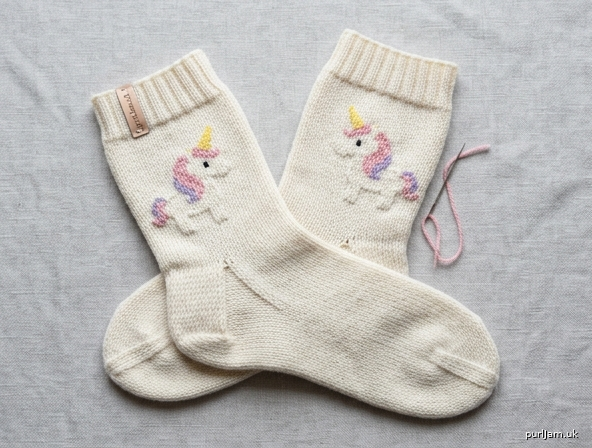
Pastel Unicorn Cuff-Down Socks
Easy Beginner Pattern – Makes a Pair
Skill Level: Beginner
Construction: Cuff-down, traditional heel flap & gusset, wedge toe
Yarn Weight: Worsted
These cozy worsted-weight socks feature a simple unicorn motif worked in pastel colors on the outer leg. The rest is plain stockinette so you can focus on learning sock construction. You can try them on as you go!
Sizes
- S (Child/Small Adult): 7–7.5" (18–19 cm) foot circumference
- M (Women’s Medium): 8–8.5" (20.5–21.5 cm) foot circumference
- L (Men’s/Large): 9–9.5" (23–24 cm) foot circumference
Foot length is customizable — instructions tell you when to start the toe.
Shown in size M. Instructions are written S (M, L).
Yarn
Worsted weight yarn (approx. 180–220 yd / 165–200 m total per pair)
Main Color (MC): 150–180 yd (137–165 m) – soft white, pale gray, or light mint
Contrast Colors (CC) for unicorn – small amounts (10–20 yd / 9–18 m each):
- CC1: pastel pink (mane/tail)
- CC2: pastel purple or lavender (mane accents)
- CC3: soft yellow or gold (horn)
- CC4: light blue or mint (eyes/details)
- Black or dark gray scrap (eye outline – optional embroidery)
Any soft superwash worsted wool or wool-blend sock/worsted yarn works. Pastels look magical!
Needles
- US 6 (4 mm) double-pointed needles (DPNs), or size needed to obtain gauge
OR 32–40" circular for magic loop - Spare needle or tapestry needle for Kitchener stitch
Notions
- Stitch markers
- Tapestry needle
- Scissors
- Optional: small amount of waste yarn for afterthought details
Gauge
22 stitches & 30 rounds = 4" (10 cm) in stockinette stitch in the round
(5.5 sts per inch)
Check your gauge! Too loose = floppy socks that wear out fast. Too tight = hard to get on. Adjust needle size if needed.
Abbreviations (US)
- CO: cast on
- k: knit
- p: purl
- st(s): stitch(es)
- rnd(s): round(s)
- DPN: double-pointed needle
- sl: slip stitch purlwise
- wyib: with yarn in back
- wyif: with yarn in front
- k2tog: knit 2 together (right-leaning decrease)
- ssk: slip, slip, knit (left-leaning decrease)
- p2tog: purl 2 together
- RS: right side
- WS: wrong side
- MC: main color
- CC: contrast color
- rep: repeat
- pm: place marker
- sm: slip marker
Pattern Notes for Beginners
- These socks are worked cuff down. You can try them on after the heel and during the foot.
- DPN method: Distribute stitches over 3 or 4 needles; use a 4th/5th to knit.
- Magic loop: Divide stitches in half on a long circular.
- The unicorn is a small chart (12 sts wide × 16 rnds tall). Work it with intarsia (separate lengths of yarn) or simply knit the leg in MC and add the unicorn later with duplicate stitch (easiest for true beginners!). Both methods are described.
- Make two identical socks for a pair (or reverse motif side if you want mirrored unicorns).
- Slip the first stitch of every heel-flap row for a neat chain edge that is easy to pick up.
Instructions
1. Cuff
With MC, CO 40 (44, 48) sts using a stretchy cast-on (long-tail or alternate cable).
Join to work in the round being careful not to twist. Place marker for beginning of round (BOR).
Distribute stitches:
- DPNs (4 needles): 10/10/10/10 (S), 11/11/11/11 (M), 12/12/12/12 (L)
- Magic loop: 20/20 (S), 22/22 (M), 24/24 (L)
Work k2, p2 ribbing for 2" (5 cm), about 14–16 rnds.
2. Leg
Switch to stockinette (knit every round).
Work even in MC until leg measures 3.5" (9 cm) from cast-on edge (including cuff).
Unicorn Motif Placement (outer leg):
The motif is 12 sts wide. Center it on the stitches that will sit on the outside of the leg (usually the second half of the round or Needle 2 & part of Needle 3 if using 4 DPNs).
Option A – Easy Duplicate Stitch (recommended for beginners)
Continue knitting the entire leg in MC stockinette until total leg measures 6" (15 cm). Then use the chart and duplicate stitch (Swiss darning) to embroider the unicorn with CC yarns after the sock is finished or before starting the heel.
Option B – Simple Intarsia in the Round (still beginner-friendly)
When you reach motif height, work the 16-round chart over the center 12 sts of the outer leg, using separate 18–24" lengths of each CC. Twist yarns at color changes to avoid holes. Keep all other sts in MC. After chart, break CCs and continue with MC only.
Unicorn Chart (12 sts wide × 16 rnds high)
Read chart from right to left on every round (in the round).
Rnd 16: . . . . H . . . . . . .
Rnd 15: . . . H H H . . . . . .
Rnd 14: . . H P P P H . . . . .
Rnd 13: . H P P Y P P H . . . .
Rnd 12: H P P Y Y Y P P H . . .
Rnd 11: . H P P P P P H . . . .
Rnd 10: . . H M M M H . B . . .
Rnd  9: . . . M M M . B B B . .
Rnd  8: . . M M M M M B . B . .
Rnd  7: . M M M M M M . . . . .
Rnd  6: M M M . M M M . . . . .
Rnd  5: . M . . . M . . . . . .
Rnd  4: . . . . . . . . . . . .
Rnd  3: . . . E . . . . . . . .
Rnd  2: . . . . . . . . . . . .
Rnd  1: . . . . . . . . . . . .
Key
. = MC (body/background)
H = CC3 yellow (horn)
P = CC1 pink (mane)
Y = CC2 purple (mane highlight)
M = CC1 pink or CC2 (mane/tail flow – use pink)
B = CC1 or CC4 (body accent optional)
E = CC4 or black (eye – or embroider later)
After motif (or plain leg), continue in MC stockinette until total leg measures 6" (15 cm) from cast-on (or desired length to ankle). End at BOR.
3. Heel Flap
Heel is worked back and forth over half the stitches: 20 (22, 24) sts.
Move the heel sts onto one needle. The remaining 20 (22, 24) sts are held for the instep (you can leave them on spare needles or a holder).
Row 1 (RS): *Sl 1 wyib, k1; rep from * to end. Turn.
Row 2 (WS): Sl 1 wyif, purl to end. Turn.
Repeat Rows 1–2 until heel flap measures approximately 2–2.25" (5–5.5 cm), ending after a WS row.
(About 20–24 rows total — you will have a chain of slipped sts along each edge.)
4. Heel Turn
Continue on the 20 (22, 24) heel sts only.
Row 1 (RS): Sl 1, k11 (12, 13), ssk, k1, turn.
Row 2 (WS): Sl 1, p5, p2tog, p1, turn.
Row 3: Sl 1, knit to 1 st before gap, ssk (1 st from each side of gap), k1, turn.
Row 4: Sl 1, purl to 1 st before gap, p2tog, p1, turn.
Rep Rows 3–4 until all heel sts have been worked, ending with a WS row.
You now have 12 (14, 14) heel sts remaining.
(S: 12 sts; M: 14 sts; L: 14 sts)
5. Gusset
Pick-up round:
Knit across the 12 (14, 14) heel sts.
Pick up and knit 10 (11, 12) sts along the slipped edge of the heel flap (one st in each chain).
Place marker (optional).
Knit across the 20 (22, 24) held instep sts.
Pick up and knit 10 (11, 12) sts along the other heel-flap edge.
Place BOR marker at center of heel (or continue from current position and mark new BOR at center bottom).
Total sts now: 52 (58, 62) sts.
Gusset decrease rnds:
Rnd 1: Knit.
Rnd 2 (dec): Knit to 3 sts before instep, k2tog, k1; knit across instep; k1, ssk, knit to end. (2 sts decreased)
Repeat Rnds 1–2 until you return to original stitch count: 40 (44, 48) sts.
6. Foot
Work even in stockinette (knit every rnd) on 40 (44, 48) sts until foot measures approximately 1.75–2" (4.5–5 cm) less than desired total finished foot length.
Try on the sock!
Common finished lengths (heel to toe):
- S: 8–9" (20.5–23 cm)
- M: 9–10" (23–25.5 cm)
- L: 10–11" (25.5–28 cm)
Stop 2" short of your measurement so the toe shaping fits.
7. Toe
Redistribute sts if needed so front (instep) and back (sole) have 20 (22, 24) sts each.
Decrease rnd:
*K1, ssk, knit to 3 sts before side marker/midpoint, k2tog, k1; rep from * once more. (4 sts decreased)
Next rnd: Knit.
Repeat these 2 rnds until 20 (22, 24) sts remain total (10/11/12 per side).
Then work decrease rnd every round until 16 (18, 20) sts remain (8/9/10 per side).
8. Finishing
Cut yarn leaving a 12–18" (30–45 cm) tail.
Graft the remaining sts together with Kitchener stitch for a seamless toe:
- Hold needles parallel, wrong sides together, equal sts on each.
- Setup: Front needle – go through first st as if to purl, leave on. Back needle – go through first st as if to knit, leave on.
- Repeat: Front – knit off, purl on; Back – purl off, knit on.
- Pull yarn gently to match gauge. Weave in end.
Weave in all ends securely on WS.
If you used duplicate stitch for the unicorn, add it now (or any embroidered eye/smile).
Block lightly if desired (soak, roll in towel, lay flat or put on sock blockers).
Make a second sock the same way for a pair!
Tips for Success
- Count stitches after every section.
- Use stitch markers at sides for gusset and toe.
- Pastel yarns show best against a light MC.
- If the unicorn chart feels scary, skip colorwork entirely and embroider a simple unicorn face or use a store-bought unicorn patch after finishing.
- Socks stretch — slightly snug is better than loose.
Enjoy your magical pastel unicorn socks!
Disclaimer: This pattern was generated by AI and should be reviewed for accuracy before use. While we strive for quality, AI-generated content may contain errors. Please verify measurements, stitch counts, charts, and instructions before beginning your project. Generated by purlJam.uk
Love this pattern?
Save this pattern to your free PurlJam libraryAccess your pattern anytime
Bookmark this page to access your pattern anytime