Type
Knitting
Difficulty
intermediate
Category
pullover
AI Thinking Process
Planning
Verification
Pattern
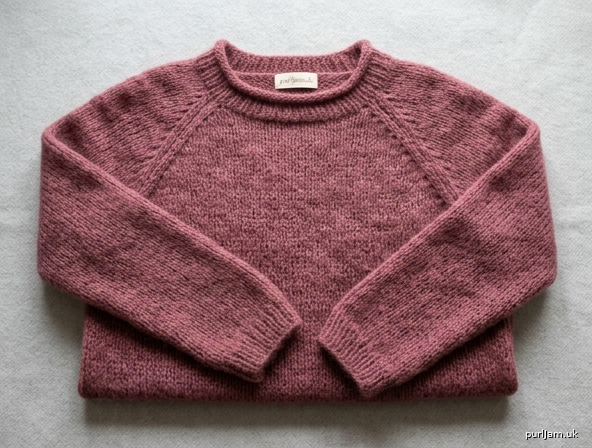
Peony Jumper — Crew Neck Modification
BM 03-37A, Size L only Difficulty: Easy Neckline method: Full-circumference crew neck with German short rows to raise the back (bottom-up raglan continuation)
This is a surgical modification of the sweater already on your needles. Body and sleeves are complete. The work is still joined in the round. You have not started V-neck shaping — leave it that way.
Do not work the original center-front split. Do not complete all 14 original raglan decrease rounds.
Modification Snapshot
| Question | Decision |
|---|---|
| 1. Continue in the round? | Yes, until the short rows. Short rows are worked flat. Resume in the round for the neckband. |
| 2. How many of the remaining 6 raglan decrease rounds? | 3 only (decrease rounds 9, 10, and 11). |
| 3. Complete all 14 decreases? | No. 14 rounds leave 60 sts — too small for a pull-over crew with a rolled edge. |
| 4. Stop raglan decreases at | 84 stitches. |
| 5. Extra front-neck shaping? | No V and no center-front bind-off. Short rows leave the center front unworked so it sits lower than the back. |
| 6. Short rows? | Yes. Four pairs of German short rows to raise the back about 2" (5 cm). |
| 7. Change to US 10 / 6 mm when | After short rows are resolved, at the start of the neckband. |
| 8. Finished neckline stitch count | 84 stitches. |
| 9. Neckband | 5 rounds stockinette on US 10 / 6 mm, bind off loosely with US 11 / 8 mm for a rolled edge. |
Size
Women’s Large (42–44" / 106.5–112 cm bust), as already underway.
Yarn
Påfugl (the yarn already in the work), worsted/aran weight, at the loose gauge established on US 11 / 8 mm.
Needles
- US 11 / 8 mm circular — already in use for the yoke
- US 10 / 6 mm circular, 16" (40 cm) long, or the 8 mm needle used with magic loop — for the neckband
- Bind off the neck with US 11 / 8 mm so the edge stays stretchy
Notions
- 4 raglan markers (already in place)
- 1 locking marker for center front
- Tapestry needle
Gauge
As established in your fabric on US 11 / 8 mm. Typical for this needle and yarn: about 12 sts = 4" (10 cm) in stockinette, unstretched. Neckband gauge on US 10 / 6 mm is denser; that denser fabric is what draws the opening in to a crew.
Abbreviations (US)
BOR — beginning of round CF — center front DS — double stitch (German short row) k — knit k2tog — knit 2 together (right-leaning decrease) m — marker p — purl rep — repeat rnd(s) — round(s) RS — right side SKP — slip 1 knitwise, k1, pass slipped stitch over (left-leaning decrease; same lean as ssk — keep SKP to match the raglan lines already worked) sl — slip st(s) — stitch(es) WS — wrong side wyif — with yarn in front
Pattern Notes
Why not 60 stitches. The original 14 decrease rounds leave 172 − (14 × 8) = 60 sts. That count is sized for a V-neck that opens at the chest, then is picked up at 60–70 sts on US 10 / 6 mm. A closed crew must pass over the head. Sixty stitches on US 10 / 6 mm measure about 15–16" (38–41 cm) unstretched — too tight for a rolled stockinette edge, which has less recovery than ribbing.
Why 84 stitches. Three more decrease rounds: 108 − (3 × 8) = 84 sts. On US 10 / 6 mm that is about 21" (53 cm) unstretched and stretches comfortably over an adult head. Completing 4 more decrease rounds (76 sts) makes a closer classic crew; use that only if 84 feels wide at the try-on checkpoint.
Why work even after the decreases. The original remaining 6 decrease rounds also supply about 2" (5 cm) of yoke length. If you stop knitting when you stop decreasing, the armhole will be shallow. After 84 sts are reached, knit even so the front neck sits near 20.5" (52 cm) from the hem.
Why short rows. A raglan worked even all the way around puts front and back necks at the same height. That feels high and tight at the throat. German short rows add about 2" (5 cm) at the back only, so the front drops toward the collarbone.
Raglan decrease (unchanged from your work). On every decrease round: *knit to 2 sts before marker, k2tog, sl m, SKP; rep from * at all 4 markers. 8 sts decreased.
German short row — make a DS. After you turn: sl 1 purlwise wyif. Pull the working yarn up and over the right needle to the back until both legs of that slipped stitch show on the needle. If the next stitch is a knit, leave the yarn in back; if it is a purl, bring the yarn to the front under the needle.
German short row — resolve a DS. Knit (on RS) or purl (on WS) both legs of the DS together as one stitch.
Current Position (do not rewind)
- 108 sts on US 11 / 8 mm
- 8 of 14 original raglan decrease rounds completed: 172 − (8 × 8) = 108 ✓
- 4 raglan markers in place
- About 18½" (47 cm) from hem
- Still joined in the round; no V-split
If your last round was a decrease round, start at Modification Round 1 below. If you have already worked the even round after decrease round 8, skip Modification Round 1 and begin at Modification Round 2.
Place a locking marker at center front now: count the stitches in the Front section (the body section that lies on your chest) and mark the midpoint. Leave the 4 raglan markers where they are.
Yoke Continuation — Size L Crew
Work with US 11 / 8 mm.
Modification Round 1 (even): Knit. 108 sts.
Modification Round 2 (decrease round 9): *Knit to 2 sts before marker, k2tog, sl m, SKP; rep from * 3 more times, knit to end of round. 108 − 8 = 100 sts ✓
Modification Round 3 (even): Knit. 100 sts.
Modification Round 4 (decrease round 10): *Knit to 2 sts before marker, k2tog, sl m, SKP; rep from * 3 more times, knit to end of round. 100 − 8 = 92 sts ✓
Modification Round 5 (even): Knit. 92 sts.
Modification Round 6 (decrease round 11): *Knit to 2 sts before marker, k2tog, sl m, SKP; rep from * 3 more times, knit to end of round. 92 − 8 = 84 sts ✓
Stop raglan decreases. You should have 84 sts. Do not work original decrease rounds 12–14.
Sleeve check (optional, one extra decrease only if needed): Count stitches between markers. The two smaller sections are the sleeves. If each sleeve still has 18 sts or more, work one more even round, then one more raglan decrease round (76 sts) and proceed. If each sleeve has 17 sts or fewer — the expected case — do not decrease again.
Modification Rounds 7 and 8 (even): Knit 2 rounds even on 84 sts.
Length check: Front should measure about 20½" (52 cm) from the hem, or about 2" (5 cm) longer than your current 18½" (47 cm). If you are short of that measurement, knit additional even rounds (no decreases) until you reach it. If you are already there after Round 8, go on.
You now have 84 sts. Remaining original decrease rounds (12, 13, 14) are permanently omitted.
German Short Rows — Raise the Back Neck
Still on US 11 / 8 mm. Work back and forth. The 12 center-front stitches stay unworked on the first pair so the front neck sits lower than the back. Each later pair is 6 sts shorter on each side, so extra height stacks at the back.
Knit to 6 sts before the CF marker. Turn. (Ignore BOR; CF is the reference from here.)
Short Row 1 (WS): Make DS, purl to 6 sts before CF marker on the other side. Turn.
Short Row 2 (RS): Make DS, knit to 6 sts before the previous DS. Turn.
Short Row 3 (WS): Make DS, purl to 6 sts before the previous DS. Turn.
Short Row 4 (RS): Make DS, knit to 6 sts before the previous DS. Turn.
Short Row 5 (WS): Make DS, purl to 6 sts before the previous DS. Turn.
Short Row 6 (RS): Make DS, knit to 6 sts before the previous DS. Turn.
Short Row 7 (WS): Make DS, purl to 6 sts before the previous DS. Turn.
Short Row 8 (RS): Make DS. Knit all the way around, resolving every DS as you meet it by knitting both legs together, past CF, and continue until you have resolved every remaining DS and returned to CF.
You have worked 4 short-row pairs (8 extra rows at center back ≈ 2" / 5 cm). Stitch count is still 84 sts.
Back neck now sits about 22½" (57 cm) from the hem; front neck remains about 20½" (52 cm).
Try-on checkpoint: Slide the 84 sts onto a spare cable or waste yarn and try the sweater on. The raw opening will look wide — the US 10 / 6 mm neckband will draw it in. Confirm:
- it passes over your head without a struggle
- the front is not sitting on your throat
- the back feels like the base of the neck, not the middle of the head
If it will not pass over your head, you decreased too far — this should not happen at 84 sts. If it feels like a boatneck even allowing for the smaller-needle band, return the sts to US 11 / 8 mm and work one additional raglan decrease round to 76 sts, then one even round, then go to the neckband.
Neckband — Rolled Crew
Change to US 10 / 6 mm. 84 sts.
Neckband Rounds 1–5: Knit 5 rounds even in stockinette.
Bind off: Bind off loosely knitwise using US 11 / 8 mm. The larger needle is required; a tight bind-off on 6 mm will not pass over the head. If you tend to bind off firmly, bind off over two needles held together, or use a sewn/Jeny’s surprisingly stretchy bind-off.
The stockinette band will roll to the right side on its own. Do not block the roll out.
Optional classic crew (instead of the roll)
If you prefer a closer, more traditional neck: on US 10 / 6 mm, work k1, p1 rib for 1" (2.5 cm) — 84 is even, so 1×1 rib is even around — then bind off loosely in rib with US 11 / 8 mm. Rib pulls in more than the rolled edge and has more stretch.
Finishing
- Remove the CF locking marker and the 4 raglan markers.
- Weave in ends, including the neckband join.
- Block the body and sleeves as you prefer. Do not stretch the neck opening on the blocker; let the roll form naturally.
- Finished neckline: 84 sts, about 21" (53 cm) unstretched, comfortable to pull over the head, front lower than the back.
What you are deliberately not doing
- Not splitting at center front at 18" (46 cm)
- Not working original raglan decrease rounds 12–14
- Not ending at 60 sts
- Not casting on extra front-neck stitches after the short rows
- Not switching to 6 mm until the neckband
Disclaimer: This pattern was generated by AI and should be reviewed for accuracy before use. While we strive for quality, AI-generated content may contain errors. Please verify measurements, stitch counts, charts, and instructions before beginning your project. Generated by purlJam.uk
Love this pattern?
Save this pattern to your free PurlJam libraryAccess your pattern anytime
Bookmark this page to access your pattern anytime