Type
Crochet
Difficulty
intermediate
Category
shawl
AI Thinking Process
Planning
Verification
Pattern
Petite Filet Mesh Shawl
A small, narrow isosceles triangle in simple filet mesh — an open grid of double crochet and chain-2 spaces. Worked from the bottom tip up, it stays beginner-friendly: after two setup rows you repeat one increase row to the end. The fabric is airy enough for summer air-conditioning and cozy enough to wrap around the neck in cooler weather. A single round of single crochet gives a clean, stable edge with no fringe and no heavy border.
Skill Level: Easy / Beginner
Finished Size
Measured after blocking.
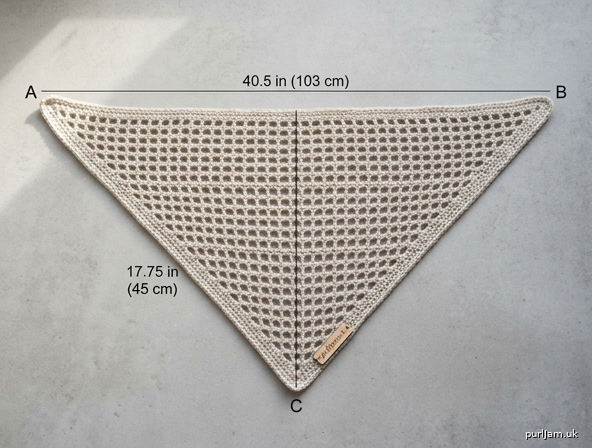
- Wingspan (longest edge): 40½ in (103 cm)
- Depth (tip to center of longest edge): 17¾ in (45 cm)
The shawl is a compact neck-wrap / shoulder drape, not a full-sized shawl.
   A •————————————————• B     wingspan 40½ in (103 cm)
      \              /
       \            /
        \          /
         \        /         depth 17¾ in (45 cm)
          \      /
           \    /
            \  /
             \/
             C  starting tip
Materials
- Yarn: 300 yd (275 m) sport-weight yarn (Category 2). A softly plied wool, wool blend, or cotton blend gives a slightly loose, relaxed fabric. Solid or tonal colors show the mesh grid clearly.
- Hook: US G-6 / 4.0 mm, or size needed to obtain gauge. For a more open, drapey fabric, try US 7 / 4.5 mm and follow the measurement (not the row count) in the pattern.
- Notions: Tapestry needle; 1 stitch marker; blocking mats and rustproof pins; measuring tape.
Gauge
6 filet meshes and 7 rows = 4 in (10 cm) in filet mesh, blocked.
One mesh = 1 dc + 1 ch-2 space. To swatch: work Rows 1–12 of the pattern, block, and measure the center 4 in (10 cm).
Gauge is important for the 40 in (100 cm) wingspan. If your blocked swatch has fewer than 6 meshes in 4 in (10 cm), go down a hook size; if more, go up a hook size. You may also simply work until the long edge measures 40 in (100 cm).
Abbreviations (US terms)
- ch — chain
- dc — double crochet
- sc — single crochet
- sp(s) — space(s)
- st(s) — stitch(es)
- rep — repeat
- sl st — slip stitch
Notes
- The shawl is worked flat, turning at the end of every row, starting at the tip and increasing at both edges on every row.
- Turning chain: Ch 5 at the start of every row counts as 1 dc + 1 ch-2 sp.
- End-of-row stitch: The last stitch of each row is the 3rd ch of the turning ch-5 (the chain that sits at the top of the dc). Mark it every row so you do not miss the increase.
- Filet mesh is reversible; there is no right or wrong side.
- Stitch counts are given as dc / meshes. Meshes always increase by 2 and are always an odd number.
- Do not skip the blocking step. Filet mesh opens and evens out only after a full wet block.
Marker habit (do this every row): After you make the turning ch-5, count from the base of that chain (the first ch you made) and clip a marker in the 3rd ch. That marked ch is the last stitch of the next row.
Shawl
Foundation / Row 1: Ch 6, dc in 6th ch from hook. Place a marker in the 3rd ch of the beginning ch-6 (the top of the ch-3 that counts as dc).
(2 dc, 1 ch-2 sp / 1 mesh)
Row 2: Ch 5, turn, dc in first dc, ch 2, (dc, ch 2, dc) in marked st. Move marker to the 3rd ch of the ch-5 just made.
(4 dc, 3 ch-2 sps / 3 meshes; 2 + 2 = 4 dc ✓)
Row 3: Ch 5, turn, dc in first dc, ch 2, dc in next dc, ch 2, (dc, ch 2, dc) in marked st. Move marker up.
(6 dc, 5 ch-2 sps / 5 meshes; 4 + 2 = 6 dc ✓)
Row 4: Ch 5, turn, dc in first dc, *ch 2, dc in next dc; rep from * until the marked st remains, ch 2, (dc, ch 2, dc) in marked st. Move marker up.
(8 dc, 7 ch-2 sps / 7 meshes; 6 + 2 = 8 dc ✓)
Rows 5–31: Repeat Row 4. Each row adds 1 mesh at each edge (+2 dc and +2 ch-2 sps).
Use the checkpoints below. If your gauge differs, stop when the longest edge measures 40 in (100 cm) after a gentle stretch, even if you have not reached Row 31.
| Row | dc | Meshes (ch-2 sps) | Check |
|---|---|---|---|
| 5 | 10 | 9 | 8 + 2 = 10 dc ✓ |
| 10 | 20 | 19 | 2 × 10 = 20 dc ✓ |
| 15 | 30 | 29 | 2 × 15 = 30 dc ✓ |
| 20 | 40 | 39 | 2 × 20 = 40 dc ✓ |
| 25 | 50 | 49 | 2 × 25 = 50 dc ✓ |
| 31 | 62 | 61 | 2 × 31 = 62 dc ✓ |
Row 31 long-edge check: 61 meshes × (4 in / 6 meshes) = 40⅔ in ≈ 40½ in (103 cm) ✓ Depth check: 31 rows × (4 in / 7 rows) = 17¾ in (45 cm) ✓
Do not fasten off.
Edging
A single round of single crochet firms the edges without adding weight or fringe.
Round 1: Ch 1, do not turn. Work around all three sides as follows:
- First short side (tip-ward): Work 3 sc around the post of each dc / turning ch down to the tip. (About 3 sc per row.)
- Tip (point C): 3 sc in the tip.
- Second short side: Work 3 sc around the post of each dc / turning ch up to the next corner.
- Corner B: 3 sc in the corner.
- Long edge (A–B, last filet row): *1 sc in next dc, 2 sc in next ch-2 sp; rep from * across, ending with 1 sc in the last dc.
- Corner A: 3 sc in the corner.
Join with sl st to the first sc. Fasten off.
Finishing
Weave in all ends on the wrong side, leaving them until after blocking so they can be re-woven if they peek through the mesh.
Blocking (required for drape and an even grid):
- Soak the shawl in lukewarm water with a drop of wool wash for 15–20 minutes. Do not agitate.
- Lift it out, support the fabric, and press out water between towels. Do not wring.
- Pin to a blocking surface in an isosceles triangle:
- Longest edge (A–B) = 40½ in (103 cm)
- Depth from the midpoint of A–B down to tip C = 17¾ in (45 cm)
- Keep sides A–C and B–C equal.
- Pin out each mesh so the holes form even rectangles/squares. Place pins along all three edges, with extra pins at the three corners.
- Let dry completely before removing pins.
After blocking, the mesh opens, the drape softens, and the edges lie flat. Wear wrapped at the neck or draped over the shoulders.
Disclaimer: This pattern was generated by AI and should be reviewed for accuracy before use. While we strive for quality, AI-generated content may contain errors. Please verify measurements, stitch counts, charts, and instructions before beginning your project. Generated by purlJam.uk
Love this pattern?
Save this pattern to your free PurlJam libraryAccess your pattern anytime
Bookmark this page to access your pattern anytime