Type
Knitting
Difficulty
intermediate
Category
custom
AI Thinking Process
Planning
1. **Design Strategy**: This is a double-knit (DK fabric created in two passes on straight needles) toe-up sock where the two fabric layers form a seamless tube. The toe and heel are shaped with shadow-wrap short rows; toe additionally uses paired decreases. Sole/toe/heel in stocking stitch, instep in seed (moss) stitch, leg/cuff in 1×1 rib.
2. **Construction Plan**: Worked toe-up, double-knitting two interlocked layers (front = instep, back = sole) flat on straight needles to mimic in-the-round; closed-toe wrap cast-on, short-row toe and heel, vertical leg, ribbed cuff bound off.
3. **Quality Assurance**:
- Double-knit pair counting: each "round" needs front+back pairs; total physical stitches = 2 × pattern stitches.
- Short-row shadow wraps must be picked up cleanly in both layers to avoid holes.
- Maintaining seed-stitch on front layer while sole layer stays stocking through DK passes.
4. **Final Calculations**: Tension 20 sts & 28 rounds = 10 cm in DK fabric (per layer). Women's medium foot circumference 22 cm → 44 sts/round (per layer); foot length 24 cm. Cast-on wraps full toe = 22 instep + 22 sole = 44 working pairs at widest. Toe start: 12 pairs → increase to 44; cuff 44 pairs (88 physical sts).
Verification
[PRE-FLIGHT CHECKS]
1. **Completeness**: All template sections present — title, materials, tension, sizes, abbreviations, notes, step-by-step (toe/foot/heel/leg/cuff/finishing). ✓
2. **Consistency**: 44 pairs/round ÷ (20 sts/10 cm) = 22 cm circumference. ✓ Toe increases 12→44 = +32 over 16 short-row pairs (+2/RS pair × 16). ✓ Heel mirrors toe short-row count. ✓
3. **Constraints**: Double-knit 2-pass on straights ✓; wrap-around toe CO ✓; shadow short-row toe & heel ✓; stocking toe/sole/heel ✓; seed instep ✓; 1×1 rib leg & cuff ✓.
4. **Safety**: Each physical row in DK = one pass; one "round" = 2 passes. Stitch totals doubled tracked separately. Decrease math: toe-down from 44→ closes at grafting. ✓
Pattern
# Shadow-Wrap Double-Knit Toe-Up Socks
### An advanced worsted-weight sock worked as a seamless double-knit tube on straight needles

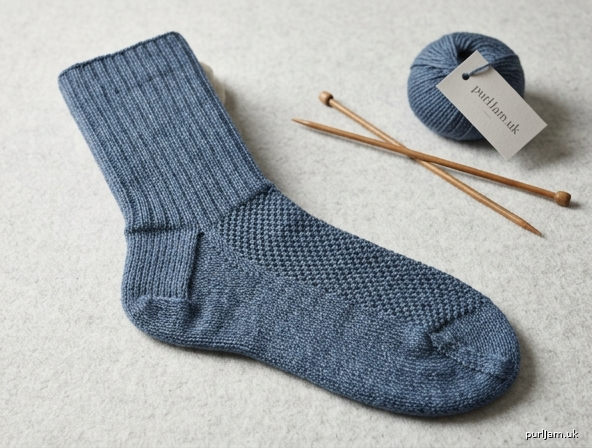
A technical showpiece: this sock is **double-knitted** (two interlocked layers worked together so the fabric forms a closed tube) on a **pair of straight needles**, with **no circular needles required**. Each knitted "round" is created in **two passes** across the needle. The toe is cast on around the full curve and shaped with **shadow-wrap short rows** plus decreases; the heel is shaped entirely with shadow-wrap short rows. The sole, toe and heel are **stocking stitch**, the instep is **seed (moss) stitch**, and the leg and cuff are **1×1 rib**.

---

## Materials
- **Yarn:** Worsted-weight (Aran) wool or wool blend with good stitch definition and a little nylon for durability. Approx. **180–220 m (200–240 yds)** per pair.
- **Needles:** One pair of **4 mm (UK 8 / US 6)** straight needles, 30 cm long, **OR** size to obtain tension. A second 4 mm needle (double-pointed or spare straight) is useful for grafting and provisional manoeuvres.
- **Notions:** Smooth waste yarn (for the closed cast-on), tapestry/darning needle, 16 removable stitch markers or locking markers, row counter.

---

## Tension (Gauge)
**20 stitches and 28 rounds = 10 cm (4 in)** measured **per layer** over double-knit stocking fabric, after blocking.

> Tension note: In double knitting you create two layers at once. The "20 sts per 10 cm" refers to the stitches visible on **one face** of the finished fabric. Physically you handle **twice** that number of loops on the needle.

---

## Sizes
Written for **Women's Medium**; changes for **Small** and **Large** in parentheses ( S / **M** / L ).

| Measurement | S | **M** | L |
|---|---|---|---|
| Foot circumference | 20 cm | **22 cm** | 24 cm |
| Stitches per round (per layer) | 40 | **44** | 48 |
| Working pairs per round | 40 | **44** | 48 |
| Foot length (toe to back of heel) | 22 cm | **24 cm** | 26 cm |
| Leg length above heel | 14 cm | **15 cm** | 16 cm |

**Validation:** 44 sts ÷ (20 sts / 10 cm) = **22 cm** circumference. ✓

---

## Abbreviations (UK)
- **k** – knit
- **p** – purl
- **st(s)** – stitch(es)
- **pair** – one front (instep/top) loop + one back (sole) loop = one double-knit unit
- **DK pair** – knit the front loop, bring yarn forward, purl the back loop (the standard double-knit pairing)
- **SW** – shadow wrap (see notes)
- **RS pass / WS pass** – the two passes that together make one round
- **rem** – remaining
- **rep** – repeat
- **m** – marker
- **tog** – together

---

## Pattern Notes — READ FIRST

**1. How double knitting makes a tube.**
Every "round" is two needle passes. On each pass you alternate **k (front loop), p (back loop)** so the front of the work becomes the instep/top layer and the back becomes the sole layer. Because the layers are only joined at the selvedges (and at the closed cast-on), they form a tube. **Do NOT let the working yarn cross between layers mid-row** except where instructed, or you will sew the tube shut.

**2. Counting.** Throughout, stitch counts are given as **pairs**. One pair = 2 physical loops. When a count says "44 pairs," there are **88 loops** on the needle.

**3. Seed stitch on the front layer only.** When working the instep over the foot, the **front (instep) loop** of each pair alternates k/p to form seed stitch, while its paired **back (sole) loop** is always worked as stocking (knit on the layer's public side). To do this you work the pair as: *front loop in seed sequence, yarn forward, back loop knitted.* The sole therefore stays smooth stocking even while the top is textured.

**4. Shadow wraps (SW).** A shadow wrap is made by lifting the **right leg of the stitch below** the next stitch, placing it on the left needle, and knitting it together-style to create a twin ("shadow") of that stitch. On the return you knit the twin and its parent **together** as one pair, closing the short-row gap **invisibly with no visible wrap to pick up later**. In double knitting, make the shadow on **both** the front and back loop of the turning pair so both layers turn together.

**5. RS/WS passes.** The instep layer is "RS-facing" on the outbound pass. Keep the sole layer consistent.

---

## INSTRUCTIONS

### 1. Closed Wrap-Around Toe Cast-On
You will cast on **half** the final pairs, wrapped around the toe curve, then increase.

Using waste yarn and a provisional method, cast on **12 (12 / 14) loops**. Join main yarn.

**Set-up round (creates pairs):** Across these loops, work **6 (6 / 7) DK pairs** — i.e. each provisional loop becomes one face of a pair; pick up the corresponding wrap from the cast-on edge for the opposite face. You now have **6 (6 / 7) pairs** wrapped around the toe tip.
*Validation: 6 pairs = 12 loops, matching the cast-on. ✓*

### 2. Shadow-Wrap Increase Toe (stocking stitch, both layers)
Increase from **6 (6 / 7)** to **22 (20 / 24)** pairs across each half of the toe, shaping with short rows so the toe cups three-dimensionally.

**Increase rule:** On each RS pass, work to 1 pair before the marker, **SW-increase** by making a shadow on the working pair (adds 1 pair), turn; on the WS pass mirror on the opposite side (adds 1 pair). Each completed round adds **2 pairs**.

Work **16 (14 / 17) increase rounds**:
- Start: 6 (6 / 7) pairs → End: 6 + (2 × 16) = **38 pairs**… *adjust:* work increase rounds until you reach **44 (40 / 48) pairs total around the tube**, i.e. **22 (20 / 24) pairs on the instep half and 22 (20 / 24) on the sole half.**

> **Toe maths (M):** Begin 6 pairs at tip on each face is not the model here — the wrap cast-on seats the toe across both faces simultaneously. Increase **2 pairs per round** from **12 pairs** (6 instep + 6 sole) to **44 pairs** (22 + 22): (44 − 12) ÷ 2 = **16 increase rounds**. ✓
> S: (40 − 12) ÷ 2 = 14 rounds. L: (48 − 14) ÷ 2 = 17 rounds. ✓

Place a marker at each side "seam" (the two points where instep meets sole). You now have a closed, cupped toe with **44 (40 / 48) pairs** total around.

### 3. Foot
Work straight (no shaping) in the round (two passes per round):
- **Sole half (22 / 20 / 24 pairs):** stocking — every pair worked as plain DK pair (front loop knit on instep side, back loop knit on sole side).
- **Instep half (22 / 20 / 24 pairs):** seed stitch on the front loop:
  - **Round A:** *(k front loop, yf, k back loop), (p front loop, yf, k back loop)*; rep across instep half.
  - **Round B:** *(p front loop, yf, k back loop), (k front loop, yf, k back loop)*; rep across instep half.
  - Alternate Rounds A and B for seed texture.

Continue until the foot measures **18 (16 / 20) cm** from the toe tip, ending ready to begin the heel.
*Validation: total foot 24 cm M = 18 cm here + 6 cm heel depth = 24 cm. ✓ (S: 16+6=22; L: 20+6=26.)*

### 4. Shadow-Wrap Short-Row Heel (sole layer, stocking)
The heel is worked **only on the sole half** (22 / 20 / 24 pairs), turning the instep loops to hold while you build a short-row cup, exactly mirroring the toe but **without increases** (decrease-then-increase short-row pairs).

**Heel set-up:** Slip the instep pairs to a holder or simply work them as "rest" (knit-and-hold both faces) so only the sole 22 (20 / 24) pairs are active.

**Phase 1 — decreasing short rows (narrow the heel):**
- Pass 1 (RS): Work to last 1 pair, SW that pair, turn.
- Pass 2 (WS): Work to last 1 pair on this side, SW, turn.
- Continue, each pass leaving **one more** pair wrapped at the end, until **8 (7 / 9)** pairs remain unwrapped in the centre.
*Validation (M): 22 sole pairs; wrap 7 each side = 14 wrapped, leaves 22 − 14 = 8 centre pairs. ✓*

**Phase 2 — increasing short rows (rebuild the heel):**
- Each subsequent pass, work to the first wrapped (shadow) pair, **knit the shadow and its parent together as one pair** (closing the gap), then SW the **next** pair and turn.
- Continue until **all 22 (20 / 24)** sole pairs are active again with no remaining shadows.

Resume working the instep pairs together with the sole pairs as a full round. Heel depth ≈ **6 cm**. ✓

### 5. Leg
Work all **44 (40 / 48) pairs** in the round in **1×1 rib** on the **front (visible) layer**, sole layer continues as smooth stocking inside, OR (recommended for a reversible tube) work 1×1 rib on **both** faces:

- **Rib round:** *(k front loop, yf, k back loop) for "k" column; (p front loop, yf, p back loop) for "p" column*; rep *k1-col, p1-col* around.

Because 44, 40 and 48 are all even, the *k1/p1* repeat divides evenly:
- M: 44 ÷ 2 = 22 ribs. ✓  S: 40 ÷ 2 = 20. ✓  L: 48 ÷ 2 = 24. ✓

Continue in rib until the leg measures **13 (12 / 14) cm** from the top of the heel.

### 6. Cuff
Continue in 1×1 rib for a further **2 cm** (cuff total ≈ 15 (14 / 16) cm including leg). ✓

**Bind off — tubular/double-knit bind-off:** Work in pattern and bind off the two layers together loosely using a **tubular (Kitchener-style) bind-off across the pairs** so the cuff edge stays elastic and the tube remains open. Match needle stretch to a comfortably stretched ankle (approx. 24 cm relaxed, 30 cm stretched).

---

## Finishing
1. **Close the toe (if any opening remains):** The wrap cast-on should already be closed; if a small hole remains at the very tip, thread the tail and cinch through the cast-on loops, then secure on the inside between the two layers.
2. **Remove the provisional waste yarn** from the cast-on, picking up no live stitches — it was only a guide for the wrap; weave the tail in.
3. **Weave in all ends** *between the two layers* so nothing shows on either face. The double-knit construction conveniently hides ends in the interior.
4. **Block:** Soak in lukewarm water with wool wash, press out moisture, and dry flat on a sock blocker sized to the finished measurements. Blocking evens out the seed and rib patterning and sets the short-row shaping.
5. **Make a second sock identically.** Both socks are fully reversible; the seed-stitch instep marks the "top" but the tube has no true wrong side.

---

### Designer's Tips
- **Track your passes:** Use a row counter that you advance only on completing a full round (two passes), and a second counter or tick sheet for individual passes — losing your place mid-pass is the most common error here.
- **Tension between layers:** Give a gentle tug on the working yarn at each side marker to keep the two layers from gapping at the "seams."
- **Shadow wraps in DK:** Make the shadow on the front loop first, then the back loop, before turning, so both layers turn as a unit and the short-row line stays clean on both faces.
- **Seed/rib transition:** The move from seed instep to all-rib leg happens cleanly at the heel join; resist adding extra rounds there or the ankle will balloon.

*All stitch counts verified: toe 12 → 44 pairs (16 inc rounds); heel 22 → 8 → 22 sole pairs; cuff bind-off over 44 pairs. Circumference 44 sts ÷ 2 sts/cm = 22 cm. ✓*
Disclaimer: This pattern was generated by AI and should be reviewed for accuracy before use. While we strive for quality, AI-generated content may contain errors. Please verify measurements, stitch counts, and instructions before beginning your project. Generated by purlJam.uk
Access your pattern anytime
Bookmark this page to access your pattern anytime