Type
Crochet
Difficulty
intermediate
Category
bag
Pattern
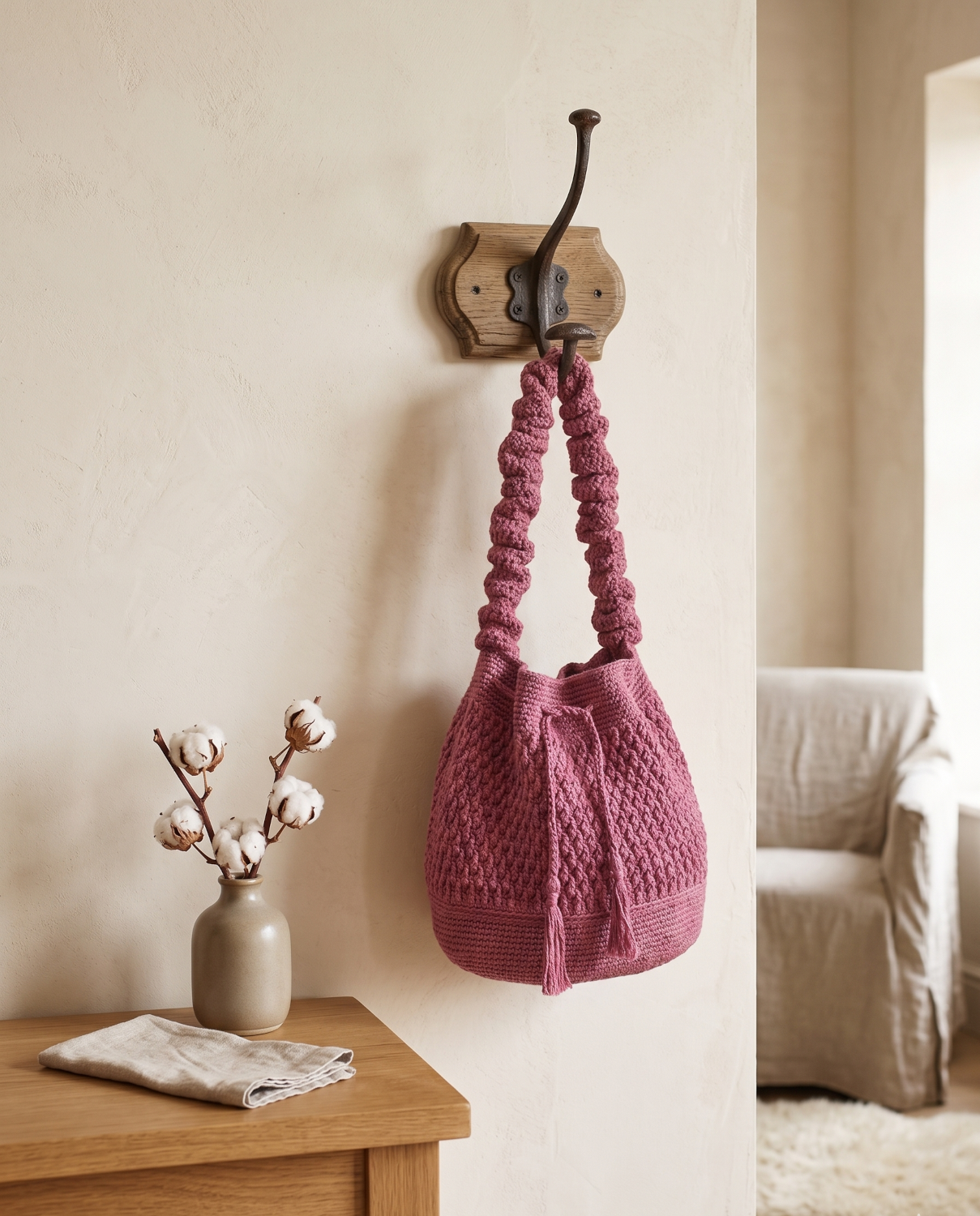
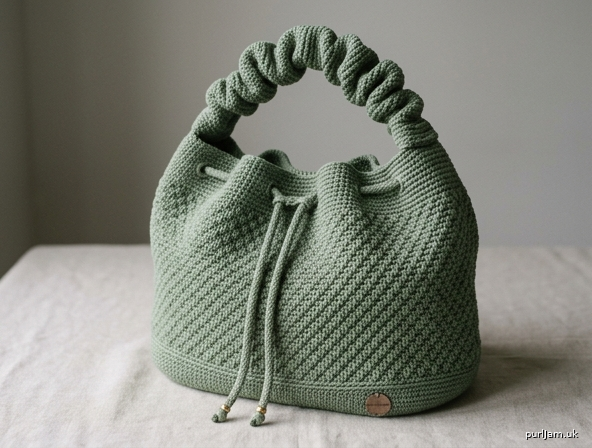
1. **Design Strategy**: A slouchy textured hobo bag worked in the round from the base up, using a bobble/alternating puff-style texture for visual interest. A ruched scrunchie-style top-edge handle creates the signature gathered look, with an i-cord drawstring threaded through eyelets for closure.

2. **Construction Plan**: Worked seamlessly in continuous rounds from an oval base upward in textured body, finishing with an eyelet round, scrunchie tube handle, and separate i-cord drawstring.

3. **Quality Assurance**:

- Oval base must lie flat — increases spaced evenly.

- Scrunchie handle tube must be wide enough to gather smoothly over stuffing/cord.

- Eyelet spacing must be even for neat i-cord closure.

4. **Final Calculations**:

- Tension: 18 sts × 22 rows = 10 cm in dc (DK, 3.5 mm hook).

- Base: oval, 20 ch foundation, worked to 72 sts round 1.

- Body: increased to 120 sts; worked straight ~22 cm.

- Finished size: approx 30 cm wide × 28 cm tall (excluding handle).

- Handle tube: 100 cm long × 8 cm wide, gathered to ~45 cm.

- I-cord: 75 cm long.

1. **Completeness**: Materials, tension, abbreviations, base, body, eyelet round, handle, i-cord, finishing — all included.

2. **Consistency**: 72 base sts → increased to 120 body sts checks out (8-st increases across 6 rounds). Eyelet round uses 96 sts ÷ 8 = 12 eyelets ✓.

3. **Constraints**: UK terminology (dc, htr, tr), metric first, DK yarn, textured stitch, scrunchie handle, i-cord fastening — all addressed.

4. **Safety**: Stitch counts verified at each transition; oval base math (2 sides + 2 ends) balances.

# Textured Scrunchie Bag

A slouchy, softly textured hobo bag worked seamlessly in the round from the base up. The body features a subtle alternating texture stitch for depth, finished with an eyelet round, a generous **scrunchie-style gathered handle**, and a coordinating **i-cord drawstring** fastening that cinches the top closed.

**Difficulty:** Intermediate

---
## Finished Measurements

- Width (at widest point): approx. **30 cm**

- Height (excluding handle): approx. **28 cm (11 in)**

- Handle drop (gathered): approx. **22 cm (8¾ in)**

---
## Materials

- **Yarn:** DK weight cotton or cotton blend, approx. **300 g / 600 m** in your chosen colour (main colour, MC). A firm, non-splitty cotton is recommended for structure.

- Suggested: Drops Paris, Scheepjes Cahlista, or similar.

- **Hook:** **3.5 mm (UK 9 / US E)** crochet hook

- **Notions:**

- Stitch marker (for marking round beginnings)

- Tapestry needle

- Scissors

- Optional: 45 cm length of 1 cm cord for the scrunchie handle

- Optional: two small beads or tassels for i-cord ends

---
## Tension (Gauge)

**18 sts × 22 rows = 10 cm (4 in)** in dc, worked in the round, after light blocking.

Take time to check your tension. A firm fabric is essential for the bag to hold its shape.

---
## Abbreviations (UK Terminology)

- **ch** – chain

- **sl st** – slip stitch

- **dc** – double crochet (US sc)

- **htr** – half treble (US hdc)

- **tr** – treble (US dc)

- **st(s)** – stitch(es)

- **sp** – space

- **BLO** – back loop only

- **FPtr** – front post treble

- **htr2tog** – work 2 htr together (decrease)

- **PM** – place marker

- **rep** – repeat

- **rnd** – round

---
## Construction Notes

- The bag is worked **in continuous spiral rounds** from an oval base. Do **not** join unless instructed. Move your stitch marker up as you go.

- The **texture stitch** uses front post trebles worked into the round below to create a gentle pebbled fabric.

- The **handle** is a long tube, seamed into a loop, gathered over the top edge of the bag to create the scrunchie effect.

- The **i-cord drawstring** is worked with the easy-i-cord method and threaded through eyelets at the top.

---
## Pattern

### Part 1 – Oval Base

**Foundation:** Ch 21.

**Rnd 1:** 2 dc in 2nd ch from hook, 1 dc in each of next 18 ch, 3 dc in last ch; working along the opposite side of the foundation chain, 1 dc in each of next 18 ch, 1 dc in the same ch as the starting 2 dc. PM in this last st. **(42 sts)**

*Math check: 2 + 18 + 3 + 18 + 1 = 42 ✓*

**Rnd 2:** 2 dc in next st, 2 dc in next st, 1 dc in next 18 sts, (2 dc in next st) 3 times, 1 dc in next 18 sts, 2 dc in last st. **(48 sts)**

**Rnd 3:** (1 dc, 2 dc in next st) twice, 1 dc in next 18 sts, (1 dc, 2 dc in next st) 3 times, 1 dc in next 18 sts, (1 dc, 2 dc in next st) once. **(54 sts)**

**Rnd 4:** (2 dc, 2 dc in next st) twice, 1 dc in next 18 sts, (2 dc , 2 dc in next st) 3 times, 1 dc in next 18 sts, (2 dc, 2 dc in next st) once. **(60 sts)**

**Rnd 5:** (3 dc, 2 dc in next st) twice, 1 dc in next 18 sts, (3 dc, 2 dc in next st) 3 times, 1 dc in next 18 sts, (3 dc , 2 dc in next st) once. **(66 sts)**

**Rnd 6:** (4 dc, 2 dc in next st) twice, 1 dc in next 18 sts, (4 dc, 2 dc in next st) 3 times, 1 dc in next 18 sts, (4 dc, 2 dc in next st) once. **(72 sts)**

**Rnd 7:** (5 dc, 2 dc in next st) twice, 1 dc in next 18 sts, (5 dc, 2 dc in next st) 3 times, 1 dc in next 18 sts, (5 dc, 2 dc in next st) once. **(78 sts)**

**Rnd 8:** (6 dc, 2 dc in next st) twice, 1 dc in next 18 sts, (6 dc, 2 dc in next st) 3 times, 1 dc in next 18 sts, (6 dc, 2 dc in next st) once. **(84 sts)**

**Rnd 9:** (7 dc, 2 dc in next st) twice, 1 dc in next 18 sts, (7 dc, 2 dc in next st) 3 times, 1 dc in next 18 sts, (7 dc, 2 dc in next st) once. **(90 sts)**

**Rnd 10:** (8 dc, 2 dc in next st) twice, 1 dc in next 18 sts, (8 dc, 2 dc in next st) 3 times, 1 dc in next 18 sts, (8 dc, 2 dc in next st) once. **(96 sts)**

**Rnd 11:** (9 dc, 2 dc in next st) twice, 1 dc in next 18 sts, (9 dc, 2 dc in next st) 3 times, 1 dc in next 18 sts, (9 dc, 2 dc in next st) once. **(102 sts)**

*Math check: 6 increases per end × 2 ends = 12 increases per rnd; 42 + 6×10 = 102 ✓. Base measures approx. 22 × 10 cm.*

---
### Part 2 – Sides (Transition)

**Rnd 12:** 1 dc in each st around. **(102 sts)**

**Shape the hobo curve** – increase gradually to 120 sts over the next 6 rounds:

**Rnd 13:** *1 dc in each of next 16 sts, 2 dc in next st; rep from *around. **(108 sts)**

**Rnd 14:** 1 dc in each st around. **(108 sts)**

**Rnd 15:** *1 dc in each of next 17 sts, 2 dc in next st; rep from *around. **(114 sts)**

**Rnd 16:** 1 dc in each st around. **(114 sts)**

**Rnd 17:** *1 dc in each of next 18 sts, 2 dc in next st; rep from *around. **(120 sts)**

*Math check: 102 + 6 + 6 + 6 = 120 ✓*

**Rnds 18–22:** 1 dc in each st around. **(120 sts)**

**Rnd 23:** Working in **BLO**, 1 dc in each st around. **(120 sts)**

---
### Part 3 – Textured Body

**Alpine Texture Pattern (worked over 4 rows):**

**Setup Rnd 1:** Working in **BLO, **1 tr in each st around.** (120 sts)**

**Setup Rnd 2:** 1 dc in each st around. **(120 sts)**

**Texture Rnd A:** *1 FPtr around the st 2 rounds below, 1 tr in next st; rep from *around. **(120 sts)**

**Texture Rnd B:** 1 dc in each st around. **(120 sts)**

**Texture Rnd C:** *1 tr, 1 FPtr around the st 2 rounds below in next st; rep from *around. **(120 sts)**

**Texture Rnd D:** 1 dc in each st around. **(120 sts)**

This 4-round sequence (A, B, C, D) creates an alternating raised texture.

**Work the 4-round texture repeat a total of 6 times** (24 rounds total, Rnds 24–49).

*The body now measures approx. 18 cm from the base fold.*

---
### Part 4 – Shaping the Hobo Curve (Decreases)

**Rnd 41:** *1 dc in next 13 sts, dc2tog; rep from *around. **(112 sts)**

**Rnd 42:** *1 dc in next 12 sts, dc2tog; rep from *around. **(104 sts)**

**Rnd 43:** *1 dc in next 11 sts, dc2tog; rep from *around. **(96 sts)**

*Math check: 120 → 96 over 3 decrease rnds (8 dec each) ✓. Top opening circumference ≈ 54 cm.*

---
### Part 5 – Eyelet Round (for I-Cord)

**Rnd 44:** *1 dc in next 7 sts, ch2, skip 1 st; rep from *around. **(84 dc + 12 ch-1 sps)**

**Rnd 45:** 1 dc in each st around, including 1 dc in each ch2 sp. **(96 sts)**

**Rnd 46:** *1 dc in next 3 sts, dc2tog, 1 dc in next 11 sts; rep from *around. **(90 sts)**

**Rnds 47:** 1 dc in each st around. **(90 sts)**

**Rnd 48:** *1 dc in next 10 sts, dc2tog, 1 dc in next 3 sts; rep from *around. **(84 sts)**

**Rnds 49:** 1 dc in each st around. **(84 sts)**

Fasten off (use a an invisible join) and weave in ends. This completes the bag body.

---
### Part 6 – Scrunchie-Style Handle

Either worked flat as a long rectangle and then seamed, or continuously as a tube. This is then gathered.

**WORKED FLAT**

**Foundation:** Ch 17.

**Row 1 (RS):** 1 htr in 3rd ch from hook (skipped ch count as first htr), 1 htr in each ch to end, turn. **(16 htr)**

**Rows 2–120:** Ch 2 (counts as first htr), 1 htr in each st across, turn. **(16 htr)**

*Handle strip measures approx. 92 cm long × 8 cm wide.*

Fasten off, leaving a long tail for seaming. Fold the strip lengthways, right sides together, and seam the long edge using mattress stitch or whip stitch to form a tube. Turn right side out.

**IN THE ROUND**

**Foundation:** Ch 16, do not turn.

**Rnd 1 (RS):** Bring the chain together to make a ring (ensure this isn't twisted), 1 htr in each ch to end. **(16 htr)**

**Rnds 2–120:** 1 htr in each st around. **(16 htr)**

*Handle tube measures approx. 92 cm long × 4 cm wide.*

Fasten off, leaving a long tail for seaming.

**INNER HANDLE:**

**Foundation:** Leave a long tail (approx. 80cm) for seaming before making a slip knot. Ch 76.

**Row 1 (RS):** 1 dc in 2nd ch from hook, 1 dc in each ch to end, turn. **(75 dc)**

**Rows 2–6:** Ch 1, 1 dc in each st across, turn. **(75 dc)**

Fasten off, leaving a long tail (approx. 80 cm) for seaming. Handle measures approx 40cm x 3cm.

**Attach and assemble the handle:**

1. Lay the bag flat. The eyelets should match up. Mark the side folds.

2. Position one end of the inner handle on the inside edge matching the centre of the handle with the side fold, pin in place. This should sit approx 4cm down from the rim and between the eyelets.

3. Using the yarn tail and a tapestry needle, stitch around the edge of the handle to attach firmly inside the bag.

4. Thread the other end of the inner handle through the handle tube. Ensure this isn't twisted and sew the other end of the inner handle to the opposite edge.

5. Gather/ruche the tube evenly along the handle. Add a couple of stitches to secure the ends to the top of the bag.

*Tip: The handle should look like a gathered ruffle.*

---
### Part 7 – Cord Drawstring

**Step 1:** With a tail approx 200cm long, create a slip knot and place on the hook with the tail to the front.

**Step 2:** Wrap the tail over the hook from front to back and hold in place at the same height as the stitch. This creates 2 loops on the hook as though making a dc. Take the working yarn and wrap over as normal and pull through both loops, completing the stitch.

Continue to work step 2 until the cord is approx 75 cm in length.

Fasten off, weaving tail back through the cord end.

**Finish the i-cord:**

- Attach a tassel or bead for decoration to the end of the cord.

**Thread the i-cord:**

- Starting at the centre front, weave the i-cord in and out through the 12 eyelets around the top of the bag.

- Bring both ends out at the centre front. Pulling the ends draws the top closed.

---
## Finishing

1. Weave in all remaining ends on the wrong side.

2. **Block** the bag: dampen with a spray bottle or use a steamer, shape over a towel-stuffed form (or a cushion) and allow to dry fully. This evens out the texture stitch and sets the hobo curve.

---
## Care Instructions

Hand wash in cool water with gentle detergent. Reshape while damp and dry flat. Do not tumble dry. Remove i-cord before washing if desired.

---
**Congratulations — your Gabbi-style textured hobo bag is ready to wear!** The scrunchie handle will soften with use, and the i-cord keeps your essentials secure.

*Design © purljam. For personal use. Please credit the designer if sharing finished items on social media.*
Disclaimer: This pattern was generated by AI and should be reviewed for accuracy before use. While we strive for quality, AI-generated content may contain errors. Please verify measurements, stitch counts, and instructions before beginning your project. Generated by purlJam.uk
Access your pattern anytime
Bookmark this page to access your pattern anytime