Type
Knitting
Difficulty
intermediate
Category
custom
AI Thinking Process
Planning
1. **Design Strategy**: A beginner-friendly knitted rose worked flat as a long garter/stocking strip, then coiled and stitched into a layered bloom. Uses only knit, purl, and basic increases — ideal for confidence-building.
2. **Construction Plan**: Knit a single shaped rectangular strip flat (petal band), gather along the straight edge, then spiral-coil and seam to form the rose; add an optional leaf and stem-wrapped wire.
3. **Quality Assurance**:
- Keep the gather even so the coil sits flat, not cone-shaped.
- Secure each coil round as you wind to avoid the bloom unravelling.
- Don't pull the seaming yarn too tight or the rose stiffens.
4. **Final Calculations**: Tension 20 sts × 28 rows = 10 cm in st st (worsted, 4.5 mm). Petal strip cast on 80 sts; finished strip ≈ 40 cm long × tapering height. Coiled rose ≈ 7–8 cm diameter. Leaf cast on 7 sts, max 11 sts.
Verification
[PRE-FLIGHT CHECKS]
1. **Completeness**: Title, description, materials, tension, abbreviations, notes, instructions (rose + leaf + assembly), finishing — all present.
2. **Consistency**: 80 sts ÷ 20 sts/10 cm = 40 cm strip length ✓. Petal height 2 cm = ~6 rows at 28 rows/10 cm ✓. Increases for scalloped edge verified below.
3. **Constraints**: Worsted yarn, UK terminology, metric-first, beginner techniques only — all met.
4. **Safety**: Stitch counts re-checked at each step; floral wire is optional and noted with a safety tip.
Pattern
# The Garden Rose — A Beginner's Knitted Bloom

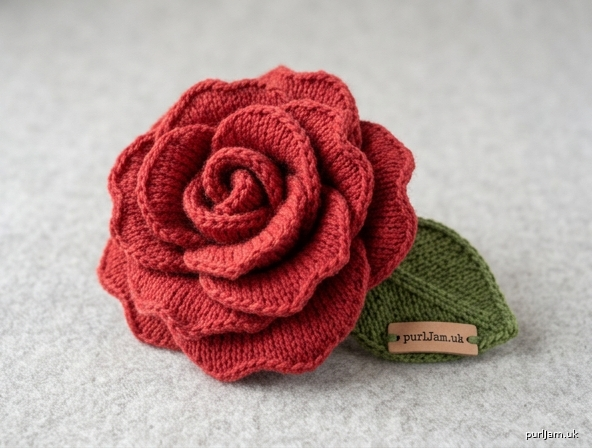
A charming single rose worked entirely flat in worsted yarn, then coiled into a full, romantic blossom. Perfect as a brooch, a gift topper, or a posy filler. No shaping cleverness required — if you can knit, purl, and cast off, you can make this rose. Make one, or make a dozen in different colours for a whole bouquet.

**Finished size:** Approximately 7–8 cm (2¾–3¼ in) across the bloom; leaf approximately 5 cm (2 in) long.

---

## Materials

- **Yarn:** Worsted weight (Aran/medium, #4) yarn.
  - Main Colour (MC – petals): approx. **20 m (22 yd)** — a small amount, ideal for scraps. Red, pink, peach, or cream.
  - Contrast Colour (CC – leaf): approx. **8 m (9 yd)** in green.
- **Needles:** 4.5 mm (UK 7 / US 7) straight or circular needles.
- **Notions:**
  - Tapestry/darning needle.
  - Scissors.
  - Optional: a brooch pin back, or 15 cm of green floral wire for a stem.
  - Optional: a small amount of green yarn to wrap the stem.

---

## Tension (Gauge)

20 sts × 28 rows = 10 cm (4 in) square in stocking stitch on 4.5 mm needles.

**Tension is not critical for this rose** — a slightly different tension simply gives a slightly larger or smaller bloom. Knit at a tension you find comfortable.

---

## Sizes

One size as written. To make a **larger rose**, cast on in multiples of 8 (e.g. 88 or 96 sts). To make a **smaller rosebud**, cast on 56 or 64 sts.

---

## Abbreviations (UK)

- **k** – knit
- **p** – purl
- **st(s)** – stitch(es)
- **kfb** – knit into front and back of stitch (1 st increased)
- **k2tog** – knit two stitches together (1 st decreased)
- **st st** – stocking stitch (knit RS rows, purl WS rows)
- **RS** – right side
- **WS** – wrong side
- **rep** – repeat
- **cast off** – bind off

---

## Pattern Notes

- The rose is made from **one long strip**. One long edge is shaped into scallops (the petal tops); the opposite straight edge is gathered and then spiralled into the bloom.
- Work the strip, then **gather** the straight edge with a running stitch before coiling — this is what gives the rose its full, ruffled look.
- Leave a **long tail (about 50 cm)** when casting on the petal strip; you will use it for gathering and seaming.
- Keep the gathered edge loose enough to lie flat as you coil.

---

## Instructions

### Part 1 — The Petal Strip (MC)

Leaving a 50 cm tail, cast on **80 sts** in MC.

**Row 1 (WS):** Purl across. (80 sts)

**Row 2 (RS):** Knit across. (80 sts)

**Row 3 (WS):** Purl across. (80 sts)

Now shape the scalloped petal edge:

**Row 4 (RS – scallop increase):** \*k1, kfb; rep from \* to end.
*Check: 80 sts ÷ 2 = 40 reps, each adding 1 st → 80 + 40 = **120 sts**.*

**Row 5 (WS):** Purl across. (120 sts)

**Row 6 (RS):** \*k2, kfb; rep from \* to end.
*Check: 120 sts ÷ 3 = 40 reps, each adding 1 st → 120 + 40 = **160 sts**.*

**Row 7 (WS):** Purl across. (160 sts)

**Cast off** all 160 sts loosely knitwise. Cut yarn leaving a 20 cm tail.

You now have a strip with a flared, ruffled top edge (160 sts cast off) and a straight bottom edge (the 80-st cast-on row).

---

### Part 2 — The Leaf (CC) — Optional

With CC, cast on **3 sts**.

**Row 1 (WS):** Purl. (3 sts)
**Row 2 (RS):** kfb, k1, kfb. *Check: 3 + 2 = **5 sts**.*
**Row 3:** Purl. (5 sts)
**Row 4 (RS):** kfb, k3, kfb. *Check: 5 + 2 = **7 sts**.*
**Row 5:** Purl. (7 sts)
**Row 6:** Knit. (7 sts)
**Row 7:** Purl. (7 sts)
**Row 8 (RS):** k2tog, k3, k2tog. *Check: 7 − 2 = **5 sts**.*
**Row 9:** Purl. (5 sts)
**Row 10 (RS):** k2tog, k1, k2tog. *Check: 5 − 2 = **3 sts**.*
**Row 11:** p3tog (purl 3 together). *Check: 3 − 2 = **1 st**.*

Cut yarn, draw through the remaining st, and pull tight. Leave a tail for sewing.

---

## Finishing & Assembly

### 1. Gather the strip
Thread the 50 cm cast-on tail onto your tapestry needle. Working along the **straight (cast-on) edge**, sew a loose running stitch from one end to the other. Gently pull the tail to gather the strip into a tight, ruffled rope. Do not cut the tail.

### 2. Coil the rose
- Hold one gathered end and begin **winding the strip into a spiral**, keeping the gathered edge at the bottom (this becomes the base) and the scalloped edge at the top (the open petals).
- The first 2–3 winds form a tight centre bud; let later winds spiral more loosely and openly to suggest opening petals.
- As you wind, **stitch through the gathered base** with the same tail every half-turn to lock each round in place. Take your time — a few extra stitches here keep the rose secure.

### 3. Secure the base
Once the whole strip is coiled, sew firmly back and forth across the gathered base to create a flat, solid foundation. Fasten off and weave in the tail.

### 4. Attach the leaf
Position the leaf behind or beside the base of the bloom and stitch in place with the CC tail. Weave in ends.

### 5. Optional stem / brooch
- **Brooch:** Sew a pin back securely to the flat base.
- **Stem:** Fold 15 cm of floral wire in half, push the folded end up into the base, and stitch to anchor. Wrap the wire neatly with green yarn, securing the ends with a dab of glue or a few stitches.
  - *Safety tip: floral wire has sharp ends — fold and tape or bead them, and keep wired roses away from small children.*

### 6. Block lightly (optional)
Gently steam or mist the open petals and arrange them with your fingers to shape the bloom. Leave to dry.

---

## Tips for a Beautiful Bloom
- **Fuller rose:** gather the strip more tightly before coiling.
- **More open rose:** gather more loosely and spiral the outer winds with gaps.
- **Variegated effect:** work the first half of the strip in one colour and the second half in a paler shade for a natural ombré centre.

Enjoy your everlasting rose! 🌹
Disclaimer: This pattern was generated by AI and should be reviewed for accuracy before use. While we strive for quality, AI-generated content may contain errors. Please verify measurements, stitch counts, and instructions before beginning your project. Generated by purlJam.uk
Access your pattern anytime
Bookmark this page to access your pattern anytime