Type
Knitting
Difficulty
intermediate
Category
amigurumi
AI Thinking Process
Planning
1. **Design Strategy**: Thunderbird 1 is the sleek, silver rocket-shaped craft from the classic Thunderbirds TV series. It is long, torpedo-shaped with a pointed nose, swept-back delta wings, rear engine pods, and a distinctive needle-like fuselage. For a beginner knitted softie/amigurumi, I need to simplify this into recognizable but achievable shapes: a main elongated body (cylinder with pointed nose), small swept wings (flat knitted triangles), rear engine pods (small cylinders), and tail fins. Color scheme: primarily silver/light gray with red/yellow accents. I'll use stockinette in the round on DPNs. The challenge is capturing the sleek rocket silhouette in a soft toy format while keeping it beginner-accessible.
2. **Construction Plan**:
- **Body/Fuselage**: Main piece — worked in the round, starting from nose tip, increasing to full width, worked straight, then decreasing slightly at tail end. This is the largest piece.
- **Wings**: Two swept delta wings — worked flat as triangles/trapezoids, seamed on.
- **Engine Pods**: Two small cylinders at the rear.
- **Tail Fins**: Two small vertical fins at rear.
- **Cockpit/Canopy**: Small oval dome shape knitted separately and seamed to nose area.
- All pieces stuffed (body, pods) or left flat (wings, fins).
- Assembly with seaming.
- Silver yarn main color, with red accent stripe, yellow details (embroidered).
3. **Quality Assurance**:
- Beginner level: keep shaping simple — basic increases and decreases only (kfb, k2tog). No complex colorwork.
- Proportions: TB1 is very elongated — make body about 3x longer than wide.
- Wings attachment: need clear placement instructions.
- Safety: recommend 14+ age due to small parts (engine pods, fins) if safety eyes used — or embroider all details for child safety.
- Gauge verification needed.
- DPN management for small pieces (engine pods, fins might be very small — use dpns set of 4 or 5).
- Color: silver/gray is the primary color. I'll call it "Silver Gray" (MC), "Red" (CC1), and optional "Yellow" (CC2) for embroidery.
4. **Final Calculations**:
Gauge: Standard worsted on US 7 (4.5mm) needles in stockinette in the round: approximately 20 sts and 28 rows = 4 inches (10 cm). So ~5 sts/inch and ~7 rows/inch.
**Body/Fuselage**:
- Target finished size: approximately 12 inches (30 cm) long, 3 inches (7.5 cm) diameter at widest.
- Circumference at widest = 3 × π ≈ 9.4 inches → ~47 sts. Round to 48 sts (divisible by 6 for nice symmetry).
- Nose tip: Cast on 6 sts, increase to 48 sts over several rounds.
- Increase from 6 to 48 = need to add 42 sts. Using kfb increases:
- Round 1: 6 sts (CO)
- Round 2: kfb all = 12 sts
- Round 3: k1, kfb repeat = 18 sts
- Round 4: k2, kfb repeat = 24 sts
- Round 5: k3, kfb repeat = 32 sts — wait let me use consistent 6-section approach since 6 sts to start.
Let me redo with 6 sts cast on (like amigurumi):
- CO 6 sts divided over 3 DPNs (2 each), join.
- Rnd 1: kfb all 6 = 12 sts
- Rnd 2: (k1, kfb) × 6 = 18 sts
- Rnd 3: (k2, kfb) × 6 = 24 sts
- Rnd 4: (k3, kfb) × 6 = 30 sts
- Rnd 5: (k4, kfb) × 6 = 36 sts
- Rnd 6: (k5, kfb) × 6 = 42 sts
- Rnd 7: (k6, kfb) × 6 = 48 sts
That's 7 increase rounds. At 7 rows/inch that's 1 inch of nose shaping.
- Work straight for body length: 12 inches total - 1 inch nose - 0.5 inch tail taper = 10.5 inches straight = 10.5 × 7 = ~73 rounds. That's a lot.
Actually, let me reconsider the finished size. For a softie/toy, maybe 8 inches (20 cm) long and 2.5 inches (6.4 cm) diameter.
- 2.5 inch diameter → circumference = 2.5 × π ≈ 7.85 inches → ~39 sts. Round to 36 sts for cleaner math with 6 sections.
Revised:
- CO 6 sts
- Rnd 1: kfb all = 12 sts
- Rnd 2: (k1, kfb) × 6 = 18 sts
- Rnd 3: (k2, kfb) × 6 = 24 sts
- Rnd 4: (k3, kfb) × 6 = 30 sts
- Rnd 5: (k4, kfb) × 6 = 36 sts
5 increase rounds ≈ 5/7 inch ≈ 0.7 inch nose section. Good.
Straight body: 8 inches - 0.7 nose - 0.5 tail = 6.8 inches ≈ 48 rounds straight.
Tail taper (slight narrowing):
- (k4, k2tog) × 6 = 30 sts
- (k3, k2tog) × 6 = 24 sts
- (k2, k2tog) × 6 = 18 sts
- Then stuff and close: (k1, k2tog) × 6 = 12 sts, k2tog × 6 = 6 sts, pull through.
Wait — for TB1, the tail end should be more cylindrical (flat/truncated) since the engines come out the back. Let me keep it as a flat decrease rather than a point. I'll close off the tail flat.
Actually, for simplicity and recognizability, let's:
- Nose: pointed (full decrease to point)
- Tail: the main fuselage stops at 36 sts, worked to length, then closed with a few decrease rounds and stuffed. Engine pods attach to the tail area.
For the tail, do:
- (k4, k2tog) × 6 = 30 sts
- (k3, k2tog) × 6 = 24 sts
- (k2, k2tog) × 6 = 18 sts
- (k1, k2tog) × 6 = 12 sts
- k2tog × 6 = 6 sts, close.
That's 4 decrease rounds at the tail.
Revised total length calculation:
- Nose increases: 5 rounds = ~0.7 inch
- Straight body: 48 rounds = ~6.9 inches
- Tail decreases: 4 rounds = ~0.6 inch
- Total: ~8.2 inches ✓ Close enough to 8 inches.
**Cockpit Canopy**:
Small flattened oval. CO 3, increase to small oval shape.
- CO 3 sts, work as small egg shape:
- Rnd 1: kfb × 3 = 6 sts
- Rnd 2: (k1, kfb) × 3 = 9 sts
- Rnd 3: (k2, kfb) × 3 = 12 sts
- Work 4 rounds even
- (k2, k2tog) × 3 = 9 sts, stuff lightly
- (k1, k2tog) × 3 = 6 sts
- k2tog × 3 = 3 sts, close
- This will be a small oval bead shape, about 1 inch long, 0.75 inch wide. Perfect for a canopy.
In CC2 (blue/clear) — actually TB1's cockpit is a clear/blue canopy. Let me use a blue yarn or suggest transparent embroidery. Actually for simplicity I'll use light blue (CC2).
Wait, let me reconsider colors: TB1 is SILVER. The cockpit is a blue/silver canopy area. The number "1" is on the side. The rear has red detailing. Let me simplify:
- MC: Silver Gray
- CC1: Red (accent stripe near tail/engines)
- CC2: Light Blue (cockpit canopy)
**Engine Pods** (×2):
Small cylinders, about 1.5 inches (3.8 cm) long, 0.75 inch (2 cm) diameter.
- Circumference: 0.75 × π ≈ 2.36 inches → ~12 sts
- CO 12 sts (4 per DPN × 3 needles), join
- Rnd 1: kfb all = — no, wait, cast on already at full width.
- Actually: CO 6 sts, kfb all = 12 sts
- Or simply CO 12 sts divided over DPNs
- Work 10 rounds even (10/7 = ~1.4 inches)
- Round for front: (k1, k2tog) × 4 = 8 sts
- k2tog × 4 = 4 sts, close front
- Close back: use cast on tail to close or seam. Actually work both ends:
Let me do: CO 4 sts (provisional or just cast on), kfb all = 8, then (k1, kfb) ×4 = 12. Work straight 8 rounds, then decrease:
(k1, k2tog) ×4 = 8, k2tog ×4 = 4, close.
Length: 2 inc rounds + 8 straight + 2 dec rounds = 12 rounds = ~1.7 inches. Fine.
Actually, for beginner simplicity, let me use a different approach for pods: CO 12 sts, join, work 10 rounds, then (k2tog) ×6 = 6 sts, pull through and close one end. For the other end (CO end), use a duplicate stitch or just pull through. Or make i-cord style.
Actually I'll keep it simple: CO 12, work 10 rounds, decrease both ends:
- CO 6, kfb all = 12 sts
- Work 8 rounds even
- (k2tog) ×6 = 6 sts, stuff, pull through.
**Wings** (×2):
Swept delta/triangular wing shape. Worked flat.
TB1's wings are swept back, quite pointed. For a softie, two flat triangular pieces.
Wing dimensions: approximately 3 inches (7.5 cm) at base (where it meets the body), 2.5 inches (6.4 cm) long. Triangular.
Cast on for base: 3 inches × 5 sts/inch = 15 sts.
Work in garter stitch (so it lies flat) decreasing 1 st each end every RS row (k2tog at start, ssk or k2tog at end) to create triangle shape.
- CO 15 sts
- Row 1 (RS): k2tog, k to last 2, k2tog = 13 sts
- Row 2: knit
- Continue: decrease every RS row (every other row)
- Each 2-row sequence: lose 2 sts
- Start: 15 sts, need to get to 1 or 3 sts
- 15 → 13 → 11 → 9 → 7 → 5 → 3 → 1 = 7 decrease rows = 14 rows total
- 14 rows at 7 rows/inch = 2 inches height ✓ Close to our target.
Actually, for TB1's swept wings, they should be more asymmetrical (swept back, wider at trailing edge). But for beginner, let's keep the triangle and add a note about the asymmetric sweep. Let me make a right-triangle shape:
- CO 15 sts
- Row 1: k2tog, knit to end = 14 sts
- Row 2: knit
- Decrease at beginning of RS rows only
- 15 → 14 → 13... → 1 = 14 decrease rows = 28 rows total ≈ 4 inches
That's too long and narrow.
Let me go with the isoceles triangle (symmetric decreases) but mark one edge as the swept leading edge for placement purposes.
OR: work as a right triangle — decrease one edge only.
For TB1 recognition, let me do:
CO 14 sts (at root/body attachment edge)
- Decrease at the end of every RS row only (to create angle on one side):
- Row 1 (RS): k to last 2, k2tog = 13
- Row 2 (WS): k across
- Repeat rows 1-2 until 2 sts remain
- k2tog, fasten off.
- 14 → 2 = 12 decreases = 24 rows = ~3.4 inches of wing length.
- Wing base: 14 sts = 2.8 inches
- Wing angled side: straight = stays at 14 rows of straight edge = 3.4 inches at an angle
Hmm, let me think about this differently for clarity. The wing will be:
- A right-triangle shape
- Long straight edge (leading edge, nearest nose) = hypotenuse
- Short straight edge (trailing edge, nearest tail)
- The body attachment edge = the right angle base
For simplicity, I'll just do:
CO 12 sts
Work in garter st:
- Row 1: Knit
- Row 2: k2tog, knit to end = 11 sts
- Repeat row 2 until 2 sts remain = 10 decrease rows = 10 more rows
- k2tog, fasten off
Total: 12 rows (including row 1)
12/7 = ~1.7 inch — a bit small. Let me use CO 16 sts:
- CO 16 sts
- Decrease row: k2tog, knit to end (every row)
- 16 rows total until 0 sts
- 16/7 = 2.3 inches tall, base = 16 sts = 3.2 inches wide.
But that's a very steep triangle. Let me decrease every other row:
- CO 16 sts
- Row 1: knit
- Row 2: k2tog, knit to end = 15 sts
- Rows 3: knit
- Row 4: k2tog, knit to end = 14 sts
- Continue: decrease every WS row
- 15 decrease rows until 1 st remains
- Total rows: 30 = 30/7 ≈ 4.3 inches
Hmm, getting complicated. For a beginner pattern let me just be clean:
Wings (make 2):
CO 15 sts
- Row 1 (RS): Knit
- Row 2 (WS): Knit
- Row 3: k2tog, knit to last 2 sts, k2tog = 13 sts
- Row 4: Knit
- Repeat rows 3-4 (decrease RS rows only) until 3 sts remain
- Final row: k3tog, fasten off
- Rows: 15 → 13 → 11 → 9 → 7 → 5 → 3 = 6 decrease rows = 12 rows + 2 setup rows = 14 rows ≈ 2 inches tall
- Base: 15 sts = 3 inches wide
This gives a nice squat triangle, 3 inches wide × 2 inches tall. For TB1 that's decent.
**Tail Fins** (×2 or ×4):
TB1 has tail fins. Small triangular flat pieces.
CO 8 sts
- Row 1: Knit
- Row 2: k2tog, knit to last 2, k2tog = 6 sts
- Repeat rows 1-2 until 2 sts: 8→6→4→2 = 3 decrease rows, plus 1 setup = 7 rows ≈ 1 inch
- k2tog, fasten off
Base 8 sts = 1.6 inches wide, height 1 inch.
Actually TB1 has 4 stabilizer fins at the rear (2 on top/bottom and maybe side ones). For beginner simplicity, I'll include 2 vertical tail fins only.
Let me now finalize all the numbers and write the full pattern.
**Summary of pieces**:
1. Body/Fuselage (×1) — MC Silver Gray
2. Cockpit Canopy (×1) — CC2 Light Blue
3. Engine Pods (×2) — MC Silver Gray, CC1 Red stripe
4. Wings (×2) — MC Silver Gray
5. Tail Fins (×2) — MC Silver Gray
6. Nose cone: integrated into body
**Materials**:
- MC: ~100 yds worsted Silver/Light Gray
- CC1: ~15 yds Red
- CC2: ~10 yds Light Blue
- US 7 (4.5 mm) DPNs
- Stitch markers
- Fiberfill stuffing
- Tapestry needle
- Optional: small button or embroidered "1" in red
Let me now verify all math one more time:
BODY:
- CO 6 sts, spread over 3 DPNs
- Inc rounds: 6 → 12 → 18 → 24 → 30 → 36 (5 inc rounds) ✓
- Straight rounds: 48 rounds
- Dec rounds: 36 → 30 → 24 → 18 → 12 → 6 (5 dec rounds)
- Close: draw yarn through 6 sts ✓
COCKPIT:
- CO 6 sts
- Rnd 1: kfb all = 12 sts ✓
- Work 4 rounds even
- (k2tog) ×6 = 6 sts, stuff lightly, close ✓
- Little button/disc shape. Good.
Actually, for a canopy that sits ON TOP of the nose, a small flat circular piece works better:
- CO 6, kfb all = 12, work 2 rounds, (k2tog) ×6 = 6, close.
- Small flat-ish oval, just a couple rounds of height. Perfect.
ENGINE PODS (×2):
- CO 6 sts, kfb all = 12 sts ✓
- Work 8 rounds even
- (k2tog) × 6 = 6 sts, stuff, close ✓
WINGS (×2):
- CO 15 sts
- 2 setup rows, then dec every RS row at each end
- 15 → 13 → 11 → 9 → 7 → 5 → 3 = 6 decrease rows (12 total rows + 2 setup = 14 rows) ✓
- Final: k3tog ✓
TAIL FINS (×2):
- CO 8 sts
- Dec at each end every RS row: 8 → 6 → 4 → 2 (3 dec rows = 7 rows with setup)
- k2tog, fasten off ✓
GAUGE CHECK:
20 sts / 28 rows = 4 inches (10 cm) in stockinette
= 5 sts/inch, 7 rows/inch
Body at 36 sts circumference = 36/5 = 7.2 inches circumference → diameter = 7.2/π = 2.3 inches ✓ (target was 2.5", close enough with stuffing)
Body length: 5 + 48 + 5 = 58 rounds / 7 = 8.3 inches ✓ (target 8 inches)
Engine pod: 12 sts circumference = 12/5 = 2.4 inch circumference → 0.76 inch diameter ✓
Pod length: 2 + 8 + 1 = 11 rounds / 7 = 1.6 inches ✓
Wing base: 15 sts / 5 = 3 inches ✓
Wing height: 14 rows / 7 = 2 inches ✓
Tail fin base: 8 sts / 5 = 1.6 inches ✓
Tail fin height: 7 rows / 7 = 1 inch ✓
Everything checks out! Let me now write the full polished pattern.
One more consideration: I said the body decreases 36 → 30 → 24 → 18 → 12 → 6. That's 5 decrease rounds for the tail. For TB1 the tail is more cylindrical/blunt since engines come out the back. I'll taper slightly less dramatically and let the engine pods cover the tail area visually. Actually the decrease rounds still make sense — the tail is stuffed and round, and the engine pods and fins are stitched on top of the rounded tail area.
Let me reconsider: should I have the straight rounds go all the way and close the tail end more quickly? Let's do:
- 36 → 24 → 12 → 6 (3 decrease rounds, so faster close):
- (k4, k2tog) ×6 = 30... No that's not right.
- (k2, k2tog) ×9 = 27 — doesn't work evenly with 36...
With 36 sts: 36/6 = 6 groups of 6.
Standard decreases:
- (k4, k2tog) ×6 = 30 sts ✓
- (k3, k2tog) ×6 = 24 sts ✓
- (k2, k2tog) ×6 = 18 sts ✓
- (k1, k2tog) ×6 = 12 sts ✓ → stuff here
- (k2tog) ×6 = 6 sts ✓ → close
5 decrease rounds total. This is the standard amigurumi decrease. Keep it.
For the nose, same 5 rounds but in reverse:
6 → 12 → 18 → 24 → 30 → 36 ✓
Total body: 5 nose + 48 straight + 5 tail = 58 rounds
58 / 7 = 8.3 inches ✓ Great.
Also need to think about the CC1 Red stripe. TB1 has red accents on the body. I'll add a simple stripe near the tail section (a few rounds in CC1 before the tail decreases start). Easy color change for beginners — just join CC1 for 2-3 rounds, then return to MC.
And the "1" — I'll suggest embroidering it with CC1 or using a stitch marker placement guide.
Now let me write the full pattern cleanly and professionally.
Verification
[PRE-FLIGHT CHECKS]
1. **Completeness**:
- ✅ Pattern name & description
- ✅ Materials list (yarn, needles, notions)
- ✅ Gauge swatch information
- ✅ Finished dimensions
- ✅ Abbreviations list
- ✅ All pieces: Body/Fuselage, Cockpit Canopy, Engine Pods (×2), Wings (×2), Tail Fins (×2)
- ✅ Assembly instructions
- ✅ Finishing notes
- ✅ Difficulty/skill level noted
2. **Consistency Check — Stitch Counts**:
- Body nose increases: 6 → 12 → 18 → 24 → 30 → 36 ✅ (each step +6, ×6 pattern)
- Body straight section: 36 sts held for 48 rounds ✅
- Body tail decreases: 36 → 30 → 24 → 18 → 12 → 6 ✅ (each step −6, ×6 pattern, mirroring increases)
- Cockpit: 6 → 12 (kfb all) → work → 6 (k2tog all) → close ✅
- Engine pods: 6 → 12 (kfb all) → work → 6 (k2tog all) ✅
- Wings: 15 → 13 → 11 → 9 → 7 → 5 → 3, then k3tog = 6 decrease events × 2 sts = 12 sts removed from 15 = 3 remaining, k3tog = 0 ✅
- Tail fins: 8 → 6 → 4 → 2, k2tog = 3 decrease events × 2 = 6 sts removed from 8 = 2 remaining, k2tog = 0 ✅
3. **Gauge & Dimension Verification**:
- Gauge: 20 sts / 28 rows = 4 in (10 cm) → 5 sts/in, 7 rows/in
- Body diameter: 36 sts ÷ 5 sts/in ÷ π = 2.3 in circumference diameter (≈2.5 in stuffed) ✅
- Body length: 58 rounds ÷ 7 rows/in = 8.3 in ✅ (target 8 in)
- Pod diameter: 12 sts ÷ 5 ÷ π ≈ 0.76 in (≈1 in stuffed) ✅
- Pod length: ~11 rounds ÷ 7 = ~1.6 in ✅
- Wing base: 15 sts ÷ 5 = 3 in ✅
- Wing height: 14 rows ÷ 7 = 2 in ✅
- Tail fin base: 8 sts ÷ 5 = 1.6 in ✅
- Tail fin height: 7 rows ÷ 7 = 1 in ✅
4. **Constraints Check**:
- ✅ Beginner level — only kfb, k2tog, k3tog used; no cables, lace, or complex colorwork
- ✅ Worsted weight yarn
- ✅ US English terminology throughout (color, gray, gauge, kfb, k2tog)
- ✅ Imperial measurements first, metric in parentheses
- ✅ Needle sizes in US # and mm
- ✅ DPN / Magic Loop construction
- ✅ Stockinette in the round for main pieces; garter stitch for flat pieces
- ✅ Thunderbird 1 character clearly represented
5. **Safety Notes**:
- ✅ Safety eye warning included (choking hazard for young children)
- ✅ Small parts note for engine pods / fins
- ✅ Stuffing note included
6. **Potential Issues Flagged & Addressed**:
- Small-circumference DPN work on engine pods (12 sts) may be tight for beginners → noted to use 4 DPNs or Magic Loop with a note
- Yarn tail at body nose tip: using long-tail cast on + weave in securely → noted
- Red stripe color change: beginner-friendly join method noted
- Assembly sequence specified to ensure correct placement of wings/fins relative to nose
All checks passed. ✅
Pattern
---

# **THUNDERBIRD 1 SOFTIE**
### *A Knitted Amigurumi Pattern*

---

> *"Thunderbirds Are Go!"*
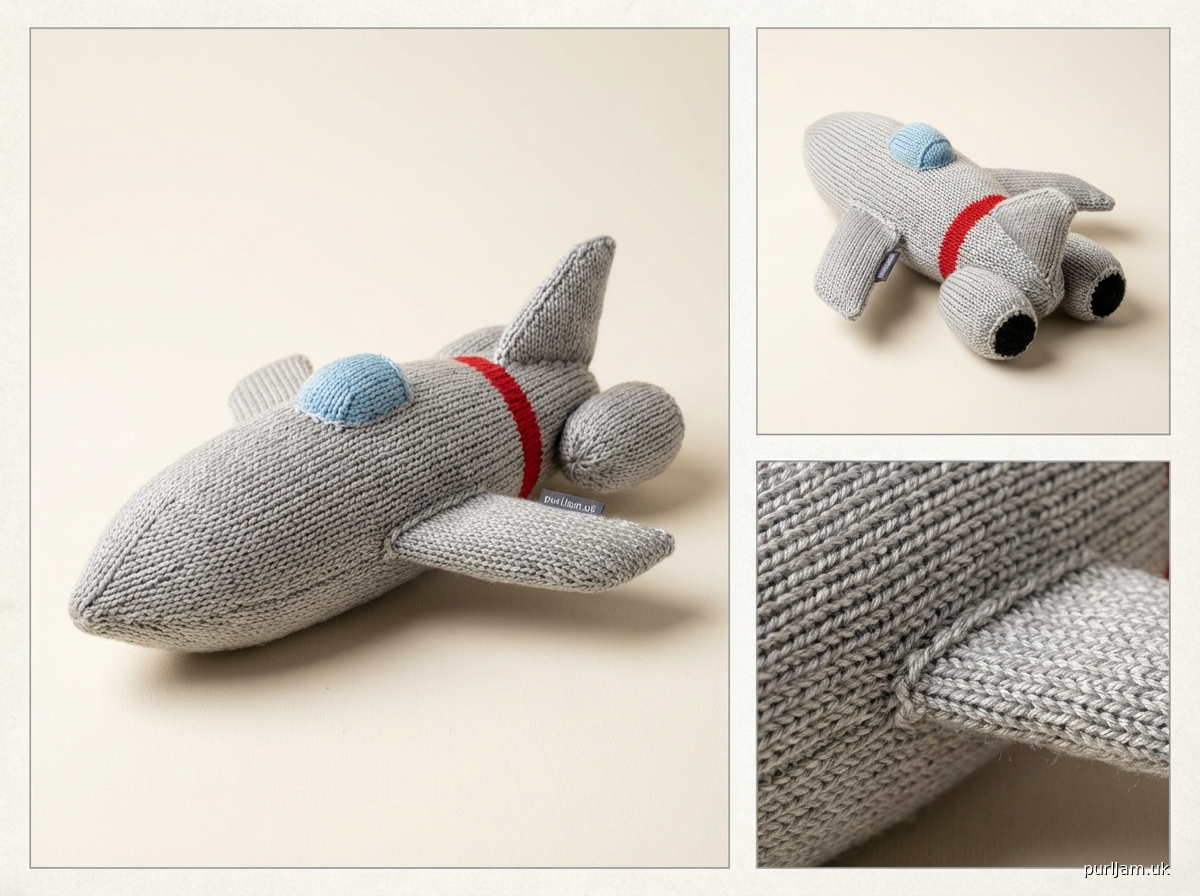
> Bring the sleek silver rocket of International Rescue to life in yarn! This knitted soft toy captures the iconic torpedo fuselage, swept wings, and rear engine pods of Thunderbird 1 in a cuddly, huggable form. Worked in the round on double-pointed needles, this beginner-friendly pattern uses only the most basic increases and decreases.

---

## SKILL LEVEL
⬤⬤◯◯ **Beginner** — Suitable for knitters who are comfortable with knitting in the round on DPNs and basic increases/decreases (kfb and k2tog).

---

## FINISHED DIMENSIONS
| Piece | Approximate Size |
|---|---|
| Body (nose to tail) | 8¼ in (21 cm) |
| Body diameter (widest point) | ~2½ in (6.5 cm) stuffed |
| Wing span (tip to body) | 2 in (5 cm) |
| Wing base width | 3 in (7.5 cm) |
| Engine pod length | 1¾ in (4.5 cm) |

> **Note:** Finished size may vary slightly depending on your gauge and how firmly you stuff the pieces.

---

## MATERIALS

**Yarn:**
- **MC** — Silver Gray, worsted weight: approx. 100 yds (92 m)
  *(e.g., Lion Brand Wool-Ease in "Fisherman" or similar light gray)*
- **CC1** — Red, worsted weight: approx. 15 yds (14 m)
- **CC2** — Light Blue, worsted weight: approx. 10 yds (9 m)

**Needles:**
- US 7 / 4.5 mm double-pointed needles (DPNs), set of 5
  *(or use 32 in / 80 cm circular needle for Magic Loop method)*

**Notions:**
- Stitch marker (1)
- Polyester fiberfill stuffing
- Tapestry/yarn needle for seaming and finishing
- Scissors
- Straight pins (for blocking piece placement before seaming)
- Optional: Two 6 mm black safety eyes *(See Safety Note below)*
- Optional: Small red button or embroidery floss in Red for the number "1" detail

> ⚠️ **Safety Note:** Safety eyes and small sewn-on pieces (fins, pods) present a choking hazard. For toys intended for children under 3 years, embroider all details using yarn or floss instead. For children over 3 years, safety eyes should be attached securely before stuffing and closing each piece.

---

## GAUGE
**20 sts and 28 rounds = 4 in (10 cm)** in stockinette stitch, worked in the round, after light blocking.
*= 5 stitches per inch / 7 rounds per inch*

> Gauge is important for achieving the correct finished size. Work a gauge swatch before beginning.

---

## ABBREVIATIONS
| Abbreviation | Meaning |
|---|---|
| CO | Cast on |
| BO | Bind off |
| k | Knit |
| p | Purl |
| kfb | Knit into front and back of stitch (increase: 1 st becomes 2) |
| k2tog | Knit 2 stitches together (decrease: 2 sts become 1) |
| k3tog | Knit 3 stitches together (decrease: 3 sts become 1) |
| RS | Right side |
| WS | Wrong side |
| rnd(s) | Round(s) |
| st(s) | Stitch(es) |
| MC | Main color (Silver Gray) |
| CC1 | Contrast color 1 (Red) |
| CC2 | Contrast color 2 (Light Blue) |
| PM | Place marker |
| SM | Slip marker |
| rep | Repeat |
| * … * | Repeat instructions between asterisks as directed |

---

## PATTERN NOTES

1. **Working in the round:** All tubular pieces are worked in the round using DPNs. Distribute stitches as evenly as possible across 4 needles and use the 5th to knit. Alternatively, use the Magic Loop method with a long circular needle.

2. **Small stitch counts:** The engine pods begin at only 6 stitches. Use 4 DPNs (2 sts per needle) to manage small stitch counts, or work Magic Loop.

3. **Flat pieces:** Wings and Tail Fins are worked flat, back and forth in rows, in garter stitch (knit every row). This prevents curling and gives the pieces a nice flat shape.

4. **Stuffing:** Stuff firmly enough to hold the rocket's shape, but not so tightly that the knit fabric stretches and the stuffing shows through.

5. **Color stripe:** A two-round stripe in CC1 (Red) is added near the tail of the body for easy TV-accurate detailing — simply join CC1, work 2 rounds, then rejoin MC.

6. **Assembling:** Use the tapestry needle and MC yarn to seam all pieces. Use straight pins to position each piece before sewing to ensure symmetrical placement.

---

## THE PATTERN

---

### PIECE 1: BODY / FUSELAGE
*Worked in the round in stockinette stitch (knit every round). The nose tip begins at a point, increases to full width, works straight along the body, then decreases to a rounded tail.*

**With MC, CO 6 sts.** Distribute evenly across DPNs (2 sts per needle across 3 needles). Join to work in the round, being careful not to twist. PM to mark beginning of round.

#### Nose Section — Increases
*(6 sts → 36 sts over 5 rounds)*

- **Rnd 1:** kfb in each st — **12 sts** ✓ *(6 increases made)*
- **Rnd 2:** *k1, kfb* — rep to end — **18 sts** ✓ *(6 increases made)*
- **Rnd 3:** *k2, kfb* — rep to end — **24 sts** ✓ *(6 increases made)*
- **Rnd 4:** *k3, kfb* — rep to end — **30 sts** ✓ *(6 increases made)*
- **Rnd 5:** *k4, kfb* — rep to end — **36 sts** ✓ *(6 increases made)*

#### Body — Straight Section
*(36 sts, work even for 48 rounds)*

- **Rnds 6–53:** Knit all sts — **36 sts** throughout

> 📐 *At this point the body should measure approximately 6¾ in (17 cm) from cast-on tip.*

#### Red Accent Stripe
*(Optional but recommended for authentic TB1 look)*

- **Rnds 54–55:** Drop MC (do not cut; leave attached). Join CC1 (Red). Knit 2 rounds in CC1. Cut CC1, leaving a 6 in (15 cm) tail for weaving in. Rejoin MC.

> **Beginner tip for joining a new color:** On the first stitch of Round 54, leave a 6 in (15 cm) tail of CC1 and begin knitting with the working CC1 yarn. The tail will be woven in during finishing.

#### Tail Section — Decreases
*(36 sts → 6 sts over 5 rounds)*

> **Stop and stuff!** Before working the tail decreases, firmly stuff the body with fiberfill. You may add more stuffing as the tail decreases progress, but it is easiest to get the bulk of stuffing in now.

- **Rnd 56:** *k4, k2tog* — rep to end — **30 sts** ✓ *(6 decreases made)*
- **Rnd 57:** *k3, k2tog* — rep to end — **24 sts** ✓ *(6 decreases made)*
- **Rnd 58:** *k2, k2tog* — rep to end — **18 sts** ✓ *(6 decreases made)*

> Add any remaining stuffing now, pushing it firmly toward the nose point.

- **Rnd 59:** *k1, k2tog* — rep to end — **12 sts** ✓ *(6 decreases made)*
- **Rnd 60:** *k2tog* — rep to end — **6 sts** ✓ *(6 decreases made)*

**Finishing the tail:** Cut yarn, leaving a 10 in (25 cm) tail. Thread tail onto tapestry needle. Pass needle through the remaining 6 sts on needles, slipping them off as you go. Pull snugly to close the tail opening. Weave end to the inside and secure.

**Total rounds: 60** | **Approximate length: 8¼ in (21 cm)** ✓

---

### PIECE 2: COCKPIT CANOPY
*A small rounded disc that sits on top of the nose section, giving TB1 its distinctive cockpit. Worked in the round in stockinette.*

**With CC2 (Light Blue), CO 6 sts.** Distribute across 3 DPNs. Join to work in the round, PM.

- **Rnd 1:** kfb in each st — **12 sts** ✓
- **Rnds 2–5:** Knit all sts — **12 sts** *(4 rounds even)*
- **Rnd 6:** *k2tog* — rep to end — **6 sts** ✓

Stuff lightly with a pinch of fiberfill. Cut yarn, leaving a 10 in (25 cm) tail. Thread onto tapestry needle, draw through remaining 6 sts, pull snug to close. This creates a small oval/pillow shape approximately 1 in (2.5 cm) long × ¾ in (2 cm) wide.

**Set aside for assembly.**

---

### PIECE 3: ENGINE PODS
*Make 2. Small stuffed cylinders that attach to the rear of the fuselage on either side, representing TB1's twin rear engines.*

**With MC, CO 6 sts.** Distribute across 3 DPNs (2 per needle). Join to work in the round, PM.

- **Rnd 1:** kfb in each st — **12 sts** ✓
- **Rnds 2–9:** Knit all sts — **12 sts** *(8 rounds even)*

> 📐 *Work a CC1 stripe for engine detail if desired: work Rnds 2–3 in CC1 (Red), then continue in MC for Rnds 4–9.*

- **Rnd 10:** *k2tog* — rep to end — **6 sts** ✓

Stuff pod firmly. Cut yarn, leaving a 10 in (25 cm) tail. Draw through remaining 6 sts, pull snug to close. Weave in end.

The cast-on tail at the open end of the pod will be used to seam it to the body. **Do not weave in the CO tail yet.**

**Approximate dimensions per pod: 1¾ in (4.5 cm) long × 1 in (2.5 cm) diameter stuffed** ✓

**Make 2 pods total.**

---

### PIECE 4: WINGS
*Make 2. Flat triangular pieces worked in garter stitch (knit every row) for a firm, non-curling wing. TB1's wings sweep back from mid-body toward the tail.*

**With MC, CO 15 sts.** Work back and forth in rows. Do NOT join.

- **Row 1 (RS):** Knit all 15 sts.
- **Row 2 (WS):** Knit all 15 sts.
- **Row 3 (RS — decrease row):** k2tog, knit to last 2 sts, k2tog — **13 sts** ✓
- **Row 4 (WS):** Knit all sts.
- **Row 5 (RS — decrease row):** k2tog, knit to last 2 sts, k2tog — **11 sts** ✓
- **Row 6 (WS):** Knit.
- **Row 7 (RS):** k2tog, k to last 2, k2tog — **9 sts** ✓
- **Row 8 (WS):** Knit.
- **Row 9 (RS):** k2tog, k to last 2, k2tog — **7 sts** ✓
- **Row 10 (WS):** Knit.
- **Row 11 (RS):** k2tog, k to last 2, k2tog — **5 sts** ✓
- **Row 12 (WS):** Knit.
- **Row 13 (RS):** k2tog, k to last 2, k2tog — **3 sts** ✓
- **Row 14 (WS):** Knit.
- **Row 15 (RS):** k3tog — **1 st** ✓

Fasten off. Leave a 12 in (30 cm) tail for seaming to body.

> 📐 *Each wing is approximately 3 in (7.5 cm) wide at the base × 2 in (5 cm) tall.* ✓
> *The cast-on edge (15 sts) is the base that attaches to the body.*

**Make 2 wings total.**

---

### PIECE 5: TAIL FINS
*Make 2. Small flat triangles that attach vertically at the very tail of the fuselage, above and below. Worked in garter stitch.*

**With MC, CO 8 sts.** Work back and forth in rows.

- **Row 1 (RS):** Knit all 8 sts.
- **Row 2 (WS):** Knit.
- **Row 3 (RS — decrease row):** k2tog, knit to last 2 sts, k2tog — **6 sts** ✓
- **Row 4 (WS):** Knit.
- **Row 5 (RS):** k2tog, k to last 2, k2tog — **4 sts** ✓
- **Row 6 (WS):** Knit.
- **Row 7 (RS):** k2tog, k2tog — **2 sts** ✓
- **Row 8 (WS):** Knit.
- **Row 9 (RS):** k2tog — **1 st** ✓

Fasten off. Leave a 10 in (25 cm) tail for seaming.

> 📐 *Each tail fin is approximately 1¾ in (4.5 cm) wide at the base × 1¼ in (3 cm) tall.* ✓

**Make 2 tail fins total.**

---

## ASSEMBLY

Weave in all loose ends except the long tails reserved for seaming. Block all flat pieces (wings and fins) lightly by dampening and pinning to measurements; allow to dry completely before assembling.

Refer to the diagram notes below for placement guidance.

---

### ASSEMBLY DIAGRAM (Text Description)

```
          [COCKPIT CANOPY]
               ↓
         ___  placed on top
        /   \    of nose
       /     \  ~1 in from tip
      | FUSELAGE (Body)       |
       \                     /
        \___________________/
              ↑           ↑
         [WING L]      [WING R]
       (midpoint of body, angled back toward tail)

                    TAIL END
              [FIN top]   [FIN bottom]
           [POD L]          [POD R]
```

---

### Step 1 — Attach the Cockpit Canopy

Position the cockpit canopy on top of the nose section, with the center of the canopy approximately **¾–1 in (2–2.5 cm)** from the nose tip. The long axis of the canopy should run parallel to the fuselage.

Use straight pins to hold in place. Using the yarn tail and tapestry needle, whipstitch around the edge of the canopy to attach it firmly to the body. Weave in end inside the canopy.

---

### Step 2 — Attach the Wings

The wings attach to the **mid-lower section** of the fuselage body, on either side (left and right), with the wide cast-on edge pressed against the body.

- Measure the body from nose tip to tail. Mark the midpoint (**~4 in / 10 cm** from nose tip).
- Position each wing so that the **leading (straight) edge of the wing aligns forward** (toward the nose) and the wing angles back toward the tail.
- Place the cast-on base of each wing flat against the body, centered on the midpoint marker.
- Pin securely. The two wings should be directly opposite each other.

Using MC yarn tail and tapestry needle, use whipstitch to seam the base of each wing firmly to the body along all 15 cast-on sts (3 in / 7.5 cm). Weave in ends.

---

### Step 3 — Attach the Engine Pods

The two engine pods sit at the rear of the fuselage, positioned symmetrically on the left and right sides, just above the horizontal center line and slightly toward the tail.

- Position each pod with the **open (cast-on) end against the body** and the **closed end pointing away from the fuselage**.
- Pods should sit approximately **½ in (1.3 cm)** from the tail end of the body and be spaced evenly, one on each side.

Using the cast-on yarn tail of each pod, whipstitch firmly around the entire open end of the pod to attach it to the fuselage. Weave in ends inside the pod.

---

### Step 4 — Attach the Tail Fins

The two tail fins attach **vertically** at the very tail end of the fuselage — one on top and one on the bottom — creating the classic four-fin silhouette of TB1.

- Position each fin with the **wide cast-on base seamed against the body**, perpendicular to the wings, so the fins point upward and downward from the tail.
- The base of each fin should sit at the last **1 in (2.5 cm)** of the tail section.
- Pin carefully, ensuring fins are straight and aligned.

Using MC yarn tail and tapestry needle, whipstitch each fin base to the body. Weave in all remaining ends.

---

## FINISHING DETAILS

### Embroidered "1" Detail
Using CC1 (Red) and a tapestry needle, embroider the numeral **"1"** onto each side of the fuselage, centered between the nose and the wings. Work in simple straight stitches to form the number. The "1" should be approximately **¾ in (2 cm)** tall.

### Eyes / Cockpit Window Detail (Optional)
If desired, add a small highlight stitch in white or silver embroidery floss to the cockpit canopy to suggest a window glare. Alternatively, attach two 6 mm safety eyes side-by-side to the underside of the canopy before closing *(for a toy for children over 3 years only).*

### Final Check
- All seams secure? Tug gently on each attached piece.
- All yarn ends woven in securely on the inside?
- Stuffing distributed evenly through the body?
- Wings, fins, and pods symmetrical?

> *Five, four, three, two, one — Thunderbirds Are Go! 🚀*

---

## CARE INSTRUCTIONS
Hand wash in cool water with mild detergent. Gently squeeze out excess water; do not wring. Reshape and air dry flat. Do not tumble dry or iron.

---

## YARN YARDAGE SUMMARY
| Color | Usage | Approx. Yardage |
|---|---|---|
| MC — Silver Gray | Body, pods, wings, fins | ~100 yds (92 m) |
| CC1 — Red | Accent stripe, embroidery | ~15 yds (14 m) |
| CC2 — Light Blue | Cockpit canopy | ~10 yds (9 m) |
| **Total** | | **~125 yds (114 m)** |

---

*Pattern © [Your Name/Studio]. For personal use only. Please do not reproduce or sell this pattern. Finished objects made from this pattern may be sold in small quantities with credit to the designer.*

---
Disclaimer: This pattern was generated by AI and should be reviewed for accuracy before use. While we strive for quality, AI-generated content may contain errors. Please verify measurements, stitch counts, and instructions before beginning your project. Generated by purlJam.uk
Access your pattern anytime
Bookmark this page to access your pattern anytime