Type
Knitting
Difficulty
intermediate
Category
custom
AI Thinking Process
Planning
Verification
Pattern
Top-Down Flared Ribbed Hem
with German Short-Row Center Shaping
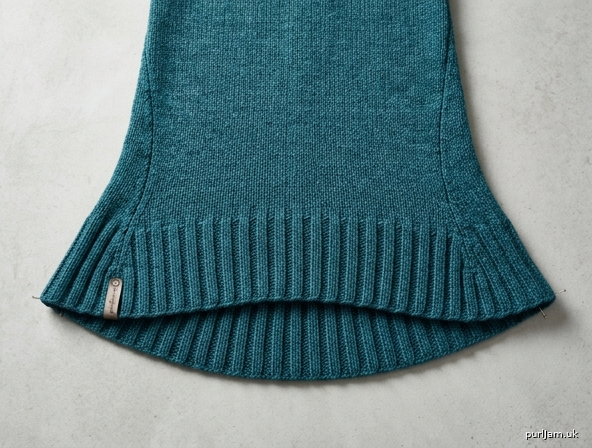
A drop-in hem module that converts the supplied bottom-up hem into top-down knitting. You arrive with the body stitch count, add a center-long short-row curve, flare the fabric with two increase rows, then work 2¾" (7 cm) of k3/p2 rib and bind off. The finished edge matches the original: a fuller ribbed hem, longer at the center than at the sides.
Use the size whose body stitch count matches the piece already on your needles.
Materials
Yarn: Worsted weight (CYC 4), wool or wool-blend recommended for rib recovery.
Yardage for this hem only: 90 (95, 110, 115, 120, 135, 140, 155, 170) yd / 80 (85, 100, 105, 110, 125, 130, 140, 155) m.
Needles
- US 7 / 4.5 mm circular, 24" (60 cm) or longer (body / short rows) — already in use
- US 6 / 4 mm circular, 24" (60 cm) or longer (ribbing; one size smaller than body)
Notions: 4 stitch markers (optional), tapestry needle, scissors, blocking supplies.
Gauge
20 sts and 28 rows = 4" (10 cm) in stockinette stitch on US 7 / 4.5 mm, blocked.
Ribbing on US 6 / 4 mm is denser; the extra stitches in the hem are what create the flare. Always match the gauge you used for the body.
Sizes
9 sizes, given as Size 1 (2, 3, 4, 5, 6, 7, 8, 9). Choose the size that matches your current body stitch count.
Body width at start of hem (St st):
16½ (17¼, 18¾, 19½, 20½, 22, 22¾, 24½, 26)" / 41.5 (44, 47.5, 49.5, 52, 56, 58, 62, 66) cm
Body stitch count (start here):
82 (86, 94, 98, 102, 110, 114, 122, 130) sts
Stitch count after Inc Row 1:
96 (100, 108, 112, 116, 124, 128, 136, 144) sts
Stitch count after Inc Row 2 / for ribbing:
134 (139, 149, 154, 159, 169, 174, 184, 194) sts
Ribbing depth: 2¾" (7 cm)
Extra length at center vs side edges: about 1¾" (4.5 cm) from 6 short-row pairs (12 extra rows)
Abbreviations (US)
| Abbrev | Meaning |
|---|---|
| BO | bind off |
| CO | cast on |
| ds | double stitch (German short row; see Special Techniques) |
| k | knit |
| kfb | knit into front and back of the same stitch (1 st increased) |
| p | purl |
| pfb | purl into front and back of the same stitch (1 st increased) |
| pm | place marker |
| rem | remain(ing) |
| rep | repeat |
| RS | right side |
| sl1p | slip 1 stitch purlwise |
| st(s) | stitch(es) |
| St st | stockinette stitch (knit RS, purl WS) |
| tw | turn work |
| WS | wrong side |
| wyif | with yarn in front |
| yo | yarn over |
Pattern Notes
- Worked flat, back and forth on circular needles, as in the original.
- This module begins when the piece measures the desired length to the start of hem shaping, with a RS row just completed and 82 (86, 94, 98, 102, 110, 114, 122, 130) sts on US 7 / 4.5 mm needles.
- Discontinue slipped-stitch selvedges when you begin Inc Row 1. The ribbing uses a 3-st / 2-st edge instead.
- Double stitches are always worked as 1 stitch.
- Short rows are worked in reverse order from the original so the extra length still sits just above the rib (center longer, sides shorter).
- Inc Row 2 both adds stitches and opens the purl columns of the rib; you will purl selected stitches that were previously knit.
- When only one number is given, it applies to all sizes.
What was reversed
| Bottom-up original | Top-down here |
|---|---|
| Cast on for rib | Bind off in rib |
| 2¾" (7 cm) rib | 2¾" (7 cm) rib |
| RS decrease (38–50 sts) | Inc Row 2 (38–50 sts) |
| Change to US 7 | Change to US 6 |
| WS decrease + 2 edge bind-offs (14 sts) | Inc Row 1 + 2 edge cast-ons (14 sts) |
| Expanding GSR (leave 12, then 10…2) | Contracting GSR (leave 2, then 4…12) |
Special Techniques
German short rows (double stitch)
After you turn: with yarn in front, slip the first stitch purlwise. Pull the working yarn up and over the right needle to the back until both legs of that stitch sit on the needle. That is 1 ds.
On later rows, work both legs together as 1 stitch (knit both legs on RS, purl both legs on WS). Do not work them as 2 stitches.
Backward-loop cast-on (for the 1-st edge increases)
Loop the working yarn over your thumb and place the loop on the right needle. Tighten gently. Used to reverse the original 1-st bind-offs.
Stretchy bind-off in pattern
Work each stitch as it appears (k the knits, p the purls) as you bind off. Keep the edge elastic — a ribbed hem must stretch. If your usual bind-off is tight, go up one needle size for the bind-off row only, or use Jeny’s Surprisingly Stretchy Bind-Off.
Instructions
Setup
You should have:
82 (86, 94, 98, 102, 110, 114, 122, 130) sts on US 7 / 4.5 mm needles, RS just completed.
If your body uses slipped selvedges, the next row matches the original closing row:
Selvedge row (WS): Sl1p wyif, purl to last st, sl1p wyif.
German Short-Row Shaping
Work ds as 1 stitch throughout. No stitch-count change in this section.
These turns sit 2, 4, 6, 8, 10, then 12 sts from each edge — the reverse of the original 12-to-2 sequence — so the wedge still points at the hem.
Short Row 1 (RS): Knit to last 2 sts, tw.
Short Row 2 (WS): Ds, purl to last 2 sts, tw.
Short Row 3 (RS): Ds, knit to 2 sts before the previous ds, tw.
Short Row 4 (WS): Ds, purl to 2 sts before the previous ds, tw.
Rep Short Rows 3–4 four times more.
(Short Rows 3–4 are worked 5 times total. You now have 6 double stitches each side, with 12 sts unworked at each edge.)
Next row (RS): Knit to end of row, working each ds as 1 stitch.
82 (86, 94, 98, 102, 110, 114, 122, 130) sts.
Increase to Ribbing
Inc Row 1 (WS): Using backward-loop method, CO 1 st, (p1, pfb) 6 times, purl to last 12 sts (working any rem ds as 1 stitch), (pfb, p1) 6 times, CO 1 st.
Count check, Size 1 (all sizes add the same 14 sts):
CO 1 + 6 pfb + 6 pfb + CO 1 = 14 sts increased.
12 sts used at each edge for the (p1, pfb) / (pfb, p1) pairs; remaining 82 − 24 = 58 (62, 70, 74, 78, 86, 90, 98, 106) sts purled plain.
82 + 14 = 96 ✓; 86 + 14 = 100 ✓; 94 + 14 = 108 ✓; 98 + 14 = 112 ✓; 102 + 14 = 116 ✓; 110 + 14 = 124 ✓; 114 + 14 = 128 ✓; 122 + 14 = 136 ✓; 130 + 14 = 144 ✓.
96 (100, 108, 112, 116, 124, 128, 136, 144) sts.
Change to US 6 / 4 mm needles.
Inc Row 2 (RS):
K2,
*(k1, yo, p1, yo, k1); rep from * 5 times more (6 groups),
*k1, p1, yo, p1, k1; rep from * 13 (14, 16, 17, 18, 20, 21, 23, 25) times more
[14 (15, 17, 18, 19, 21, 22, 24, 26) groups],
*(k1, yo, p1, yo, k1); rep from * 5 times more (6 groups),
k2.
Each (k1, yo, p1, yo, k1) uses 3 sts and makes 5 (2 sts increased).
Each (k1, p1, yo, p1, k1) uses 4 sts and makes 5 (1 st increased).
Count check, sts used:
2 + (6 × 3) + [14 (15, 17, 18, 19, 21, 22, 24, 26) × 4] + (6 × 3) + 2
= 40 + 56 (60, 68, 72, 76, 84, 88, 96, 104)
= 96 (100, 108, 112, 116, 124, 128, 136, 144) ✓
Count check, sts produced:
2 + (6 × 5) + [14 (15, 17, 18, 19, 21, 22, 24, 26) × 5] + (6 × 5) + 2
= 64 + 70 (75, 85, 90, 95, 105, 110, 120, 130)
= 134 (139, 149, 154, 159, 169, 174, 184, 194) ✓
Increases: 12 + 14 (15, 17, 18, 19, 21, 22, 24, 26) + 12
= 38 (39, 41, 42, 43, 45, 46, 48, 50) sts increased ✓
134 (139, 149, 154, 159, 169, 174, 184, 194) sts.
Set-up Row (WS): P3, (k3, p2) to last st, p1, knitting each yo (the yos sit in the k3 columns on this side and become purl columns on the RS).
Rib repeat check: 4 edge sts (P3 + last p1) leave
130 (135, 145, 150, 155, 165, 170, 180, 190) sts;
÷ 5 = 26 (27, 29, 30, 31, 33, 34, 36, 38) repeats of (k3, p2) ✓
Ribbing
Work stitches as they appear:
- RS: K3, (p3, k2) to last st, k1.
- WS: P3, (k3, p2) to last st, p1.
Continue until ribbing measures 2¾" (7 cm) from Inc Row 2, ending with a WS row.
Stitch count remains 134 (139, 149, 154, 159, 169, 174, 184, 194) sts.
Bind off (RS): Bind off in pattern (knit the knits, purl the purls). Keep it stretchy.
Finishing
Weave in ends, working them along the same rib column so they disappear.
Block the piece with the center of the hem 1¾" (4.5 cm) lower than the two side edges, matching the short-row wedge. Pin the rib to the flare you want; do not drag it out so far that the rib goes limp unless a very wide hem is the goal.
If this panel is seamed (back, front, or cardigan piece), join side seams after blocking, matching rib row-for-row. The short-row curve is at the hem, so the side edges are the shorter ones — ease the longer center around if you are joining to a shaped side seam.
Steam the bind-off lightly if it wants to flare more than the rib.
Quick-Reference Stitch Map
| Stage | Size 1 | 2 | 3 | 4 | 5 | 6 | 7 | 8 | 9 |
|---|---|---|---|---|---|---|---|---|---|
| Start (body) | 82 | 86 | 94 | 98 | 102 | 110 | 114 | 122 | 130 |
| Inc Row 1 (+14) | 96 | 100 | 108 | 112 | 116 | 124 | 128 | 136 | 144 |
| Inc Row 2 | +38 | +39 | +41 | +42 | +43 | +45 | +46 | +48 | +50 |
| Rib / bind-off | 134 | 139 | 149 | 154 | 159 | 169 | 174 | 184 | 194 |
Disclaimer: This pattern was generated by AI and should be reviewed for accuracy before use. While we strive for quality, AI-generated content may contain errors. Please verify measurements, stitch counts, charts, and instructions before beginning your project. Generated by purlJam.uk
Love this pattern?
Save this pattern to your free PurlJam libraryAccess your pattern anytime
Bookmark this page to access your pattern anytime