Type
Knitting
Difficulty
intermediate
Category
pullover
AI Thinking Process
Planning
Verification
Pattern
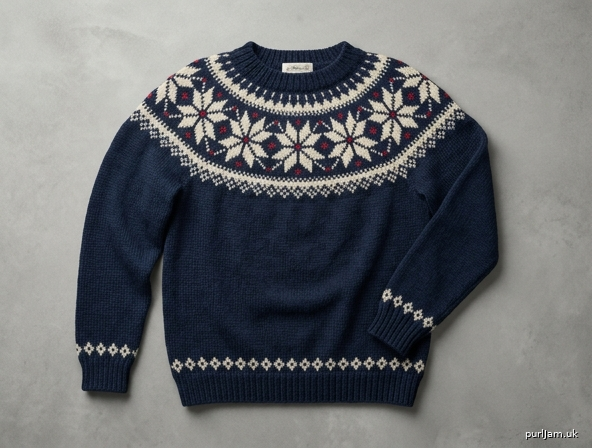
Vinterstjerne Pullover
A traditional Nordic pullover with a circular yoke. The body and sleeves are worked in the round from the hem up in main colour, joined at the underarm, and shaped with six evenly spaced decrease rounds. A cream-and-navy star band, accented with red, sits on the widest part of the yoke — there are no raglan lines. The fabric is a pullover, not a cardigan; a cut steek is not used.
Figures are given for sizes S (M, L, XL, 2XL). Where only one figure appears, it applies to all sizes.
Sizes
| S | M | L | XL | 2XL | |
|---|---|---|---|---|---|
| To fit bust | 86–91 cm (34–36") | 97–102 cm (38–40") | 107–112 cm (42–44") | 117–122 cm (46–48") | 127–132 cm (50–52") |
| Finished bust | 100 cm (39½") | 110 cm (43¼") | 120 cm (47¼") | 132 cm (52") | 144 cm (56¾") |
| Ease at bust | 9–14 cm (3½–5½") | 8–13 cm (3–5") | 8–13 cm (3–5") | 10–15 cm (4–6") | 12–17 cm (4¾–6¾") |
Choose a size with about 8–15 cm (3–6") of positive ease. Colourwork does not stretch like plain stocking stitch, so do not size down to a zero-ease or negative-ease finished bust. If you are between sizes, or at the top of a size range and prefer a looser traditional fit, choose the larger size.
This is a straight silhouette with no waist shaping. The finished hip matches the finished bust.
Finished measurements
| S | M | L | XL | 2XL | |
|---|---|---|---|---|---|
| Bust / hip | 100 cm (39½") | 110 cm (43¼") | 120 cm (47¼") | 132 cm (52") | 144 cm (56¾") |
| Length to underarm | 40 cm (15¾") | 41 cm (16¼") | 42 cm (16½") | 43 cm (17") | 44 cm (17¼") |
| Yoke depth | 24 cm (9½") | 25 cm (9¾") | 26.5 cm (10½") | 27.5 cm (10¾") | 28.5 cm (11¼") |
| Neckband depth | 3.5 cm (1½") | 3.5 cm (1½") | 3.5 cm (1½") | 3.5 cm (1½") | 3.5 cm (1½") |
| Total length | 67.5 cm (26½") | 69.5 cm (27¼") | 72 cm (28¼") | 74 cm (29¼") | 76 cm (30") |
| Sleeve to underarm | 46 cm (18") | 47 cm (18½") | 48 cm (19") | 49 cm (19¼") | 49 cm (19¼") |
| Upper arm | 34 cm (13½") | 37 cm (14½") | 40 cm (15¾") | 46 cm (18") | 48 cm (19") |
| Cuff (unstretched, main tension) | 20 cm (7¾") | 22 cm (8¾") | 24 cm (9½") | 24 cm (9½") | 26 cm (10¼") |
| Neck circumference | 52 cm (20½") | 54 cm (21¼") | 56 cm (22") | 58 cm (22¾") | 60 cm (23½") |
| Underarm hold | 9 cm (3½") | 10 cm (4") | 11 cm (4¼") | 11 cm (4¼") | 12 cm (4¾") |
The cuff is worked on a smaller needle and draws in further; it stretches to fit the wrist. The neckband is rib and, cast off loosely, stretches over the head.
Yarn
Worsted-weight wool or wool blend, about 180–200 m per 100 g. A woollen-spun, non-superwash wool is traditional: it grips, blocks beautifully, and makes stranded floats easier to manage. Superwash, cotton and slippery yarns are not recommended.
Shown in
- MC — deep navy
- CC1 — cream
- CC2 — red (accent only)
Quantities (includes colourwork floats; buy an extra ball of MC if you lengthen the body or sleeves)
| S | M | L | XL | 2XL | |
|---|---|---|---|---|---|
| MC | 850 m | 950 m | 1050 m | 1200 m | 1350 m |
| CC1 | 200 m | 220 m | 250 m | 280 m | 320 m |
| CC2 | 60 m | 70 m | 80 m | 90 m | 100 m |
Approximate 100 g balls at 180 m: MC 5 (6, 6, 7, 8); CC1 2 (2, 2, 2, 2); CC2 1 (1, 1, 1, 1).
Needles and notions
Metric sizes are the reference. US equivalents are in parentheses.
- 4.5 mm (US 7) circular needle, 80 cm (32"), for the body rib; a 40 cm (16") circular, or double-pointed needles, for cuff and neck ribs
- 5.0 mm (US 8) circular needle, 80 cm (32"), for the body and the start of the yoke
- 5.0 mm (US 8) circular needle, 40 cm (16"), or a long circular for magic loop, for the upper yoke and sleeves
- 5.0 mm (US 8) double-pointed needles, if not using magic loop for the sleeves
- Stitch markers, including one distinct beginning-of-round marker
- 4 stitch holders or lengths of waste yarn
- Tapestry needle
Change to a shorter circular needle whenever the stitches are strained on the current needle.
Tension
20 stitches and 26 rounds = 10 cm (4") over stranded colourwork stocking stitch, after washing and blocking. A plain stocking-stitch swatch is not a substitute: colourwork is usually 1–2 stitches per 5 cm firmer, and this pattern is calculated on the colourwork tension.
Work a swatch of at least 36 stitches and 24 rounds, including Chart B. Wash and block it before measuring. If you have more than 20 stitches to 10 cm, go up a needle size; if you have fewer, go down. Rib is worked on 4.5 mm and is not used to check tension.
Pattern notes
Construction. The body and sleeves are separate tubes. At the underarm, a short run of stitches from each piece is set aside, and the remaining stitches are placed on one needle. The yoke is then one large round. Decreases are scattered evenly around the round — not stacked on raglan “seams” — so the yoke narrows in a smooth curve. There is no sewn-in sleeve cap; the yoke decreases form the shoulder.
Stranded colourwork. Knit every stitch. Carry the unused colour loosely across the wrong side. In these charts no float is longer than 5 stitches. The fabric must still stretch to the width of the round above it: if the yoke puckers, the floats are too tight. Spread each float behind the stitches it crosses rather than pulling it taut.
On Chart B rounds 8–10, CC2 appears twice in each 12-stitch repeat (a 5-stitch float). Keep that float as relaxed as the cream floats on the same rounds.
Dominant colour. Carry the contrast colour below the main colour so the pattern stitches sit slightly forward. Keep the same hand (or the same finger) for each colour throughout, or the motif will look uneven.
Two-handed knitting (one colour in each hand) is the easiest way to keep an even tension. A single-hand method is fine if your floats stay loose.
Reading the charts. Every chart round is written in knitting order: knit the first symbol first, then the next, and repeat that sequence to the end of the round. All rounds are right-side rounds. Do not read them back and forth.
- A = MC (navy), knit
- B = CC1 (cream), knit
- C = CC2 (red), knit
Cast-on. A long-tail cast-on is assumed. A tubular cast-on is a neat upgrade if you already use one; it does not change the stitch count.
Lengths. Body and sleeve lengths may be changed. Work even in MC to the length you want, ending at the start of the round, and buy extra MC if you add more than a few centimetres. Do not add rounds inside a chart.
Abbreviations
| Abbreviation | Meaning |
|---|---|
| CC1, CC2 | contrast colours 1 and 2 |
| cm | centimetre(s) |
| dec | decrease |
| k | knit |
| k2tog | knit 2 stitches together (1 stitch decreased) |
| m1L | make 1 left: lift the strand between the needles from front to back and knit it through the back loop |
| m1R | make 1 right: lift the strand between the needles from back to front and knit it through the front loop |
| MC | main colour |
| p | purl |
| pm | place marker |
| rnd(s) | round(s) |
| st(s) | stitch(es) |
| sm | slip marker |
Stitch reference (for checking your place)
| S | M | L | XL | 2XL | |
|---|---|---|---|---|---|
| Body cast-on | 200 | 220 | 240 | 264 | 288 |
| Cuff cast-on | 40 | 44 | 48 | 48 | 52 |
| Sleeve at underarm | 68 | 74 | 80 | 92 | 96 |
| Underarm stitches set aside (each of 4 places) | 18 | 20 | 22 | 22 | 24 |
| Yoke after joining | 264 | 288 | 312 | 360 | 384 |
| After Decrease 1 | 228 | 252 | 272 | 312 | 336 |
| After Decrease 2 | 196 | 216 | 236 | 268 | 288 |
| After Decrease 3 | 168 | 184 | 200 | 228 | 244 |
| After Decrease 4 | 144 | 156 | 168 | 188 | 200 |
| After Decrease 5 | 120 | 132 | 140 | 152 | 160 |
| Neck, after Decrease 6 | 104 | 108 | 112 | 116 | 120 |
Charts
Chart A — yoke opening border
8-stitch repeat. 5 rounds. Worked once, on the full yoke stitch count only.
Rnd 1: B A B A B A B A
Rnd 2: A B A A A B A A
Rnd 3: A A B A A A B A
Rnd 4: A B A A A B A A
Rnd 5: B A B A B A B A
Chart B — Fjord star
12-stitch repeat. 18 rounds. Worked once, on the full yoke stitch count only. Rounds 8–10 use all three colours; every other round uses MC and CC1 only.
Rnd  1: A B B A B B A B B A B B
Rnd  2: A A B A A B A A B A A B
Rnd  3: A B A B A B A B A B A B
Rnd  4: B A A A B A A A B A A A
Rnd  5: A B A B A A A A B A B A
Rnd  6: A A B A B B A B A B A A
Rnd  7: A B A A A B A A A A B A
Rnd  8: B A A C A A B A A C A A
Rnd  9: A B C A B A A B C A B A
Rnd 10: B A A C A A B A A C A A
Rnd 11: A B A A A B A A A A B A
Rnd 12: A A B A B B A B A B A A
Rnd 13: A B A B A A A A B A B A
Rnd 14: B A A A B A A A B A A A
Rnd 15: A B A B A B A B A B A B
Rnd 16: A A B A A B A A B A A B
Rnd 17: A B B A B B A B B A B B
Rnd 18: B A A B A A B A A B A A
Each of these lines is exactly one 12-stitch repeat. At the yoke join that is 22 (24, 26, 30, 32) repeats.
Chart C — small diamond
4-stitch repeat. 6 rounds. Used above the hem, above each cuff, and once on the middle yoke.
Rnd 1: A B A B
Rnd 2: B A A A
Rnd 3: A B B A
Rnd 4: B A A A
Rnd 5: A B A B
Rnd 6: B A B A
Chart D — upper cross
4-stitch repeat. 4 rounds. Upper yoke.
Rnd 1: B B A A
Rnd 2: A B A A
Rnd 3: B A B A
Rnd 4: A B A A
Chart E — neck peerie
4-stitch repeat. 3 rounds. Worked just above the shoulders.
Rnd 1: A A B A
Rnd 2: A B A B
Rnd 3: A A B A
Body
With MC and the 4.5 mm circular needle, 80 cm, cast on 200 (220, 240, 264, 288) sts. Join to work in the round, being careful not to twist. Place a marker for the beginning of the round. This marker sits at the left side, at the start of the underarm stitches.
Rib rnd: *K2, p2; rep from * to end.
Work in rib until the piece measures 6 cm (2¼").
Change to the 5.0 mm needle, 80 cm.
Work Chart C once (6 rnds). Break CC1.
Continue in MC and stocking stitch (knit every round) until the body measures 40 (41, 42, 43, 44) cm / 15¾ (16¼, 16½, 17, 17¼)" from the cast-on edge.
Do not cast off. Leave the stitches on the needle or on a holder, and do not break MC. Set the body aside.
Sleeves (make 2)
With MC and 4.5 mm double-pointed needles or a short circular, cast on 40 (44, 48, 48, 52) sts. Join to work in the round, being careful not to twist. Pm for the beginning of the round (this is the underarm).
Rib rnd: *K2, p2; rep from * to end.
Work in rib until the cuff measures 6 cm (2¼").
Change to 5.0 mm needles.
Work Chart C once (6 rnds). Break CC1.
Shape the sleeve
Increases are worked 1 stitch in from the marker so a soft false seam runs up the inside of the arm. The increase schedule below is written for the stated tension. After the last increase, work even until the sleeve reaches the length given, even if that means a few rounds more or fewer than you expect.
Size S — 40 sts. Knit 6 rnds. Inc rnd: K1, m1L, knit to the last st, m1R, k1. 2 sts increased. Rep the last 7 rnds a further 13 times. 14 increase rounds in total; 68 sts (40 + 28 = 68 ✓). Knit 6 rnds, or until the sleeve measures 46 cm (18") from the cast-on edge.
Size M — 44 sts. Knit 6 rnds. Inc rnd: K1, m1L, knit to the last st, m1R, k1. Rep the last 7 rnds a further 14 times. 15 increase rounds; 74 sts (44 + 30 = 74 ✓). Work even until the sleeve measures 47 cm (18½") from the cast-on edge.
Size L — 48 sts. Knit 5 rnds. Inc rnd: K1, m1L, knit to the last st, m1R, k1. Rep the last 6 rnds a further 15 times. 16 increase rounds; 80 sts (48 + 32 = 80 ✓). Work even until the sleeve measures 48 cm (19") from the cast-on edge.
Size XL — 48 sts. Knit 4 rnds. Inc rnd: K1, m1L, knit to the last st, m1R, k1. Rep the last 5 rnds a further 21 times. 22 increase rounds; 92 sts (48 + 44 = 92 ✓). Work even until the sleeve measures 49 cm (19¼") from the cast-on edge.
Size 2XL — 52 sts. Knit 4 rnds. Inc rnd: K1, m1L, knit to the last st, m1R, k1. Rep the last 5 rnds a further 21 times. 22 increase rounds; 96 sts (52 + 44 = 96 ✓). Work even until the sleeve measures 49 cm (19¼") from the cast-on edge.
Leave each sleeve on waste yarn. Do not break the yarn of the second sleeve if you prefer to use it for the joining round; otherwise break both yarns and use the body yarn to join.
Yoke
Slip the sleeves onto spare needles if they are on waste yarn, with the beginning of the round (the underarm) at the tip, ready to slip the first stitches off.
With MC, the 5.0 mm circular needle, 80 cm, and the right side facing, join as follows. The gaps left at the underarms are closed in finishing.
- Slip the first 18 (20, 22, 22, 24) body stitches onto a holder (first underarm).
- Slip the first 18 (20, 22, 22, 24) stitches of one sleeve onto a holder. Knit the remaining 50 (54, 58, 70, 72) sleeve stitches. Pm.
- Knit the next 82 (90, 98, 110, 120) body stitches. Pm.
- Slip the next 18 (20, 22, 22, 24) body stitches onto a holder (second underarm).
- Slip the first 18 (20, 22, 22, 24) stitches of the second sleeve onto a holder. Knit the remaining 50 (54, 58, 70, 72) sleeve stitches. Pm.
- Knit the remaining 82 (90, 98, 110, 120) body stitches. Place the distinct marker for the new beginning of the round.
264 (288, 312, 360, 384) stitches.
Check: 50+82+50+82 = 264; 54+90+54+90 = 288; 58+98+58+98 = 312; 70+110+70+110 = 360; 72+120+72+120 = 384 ✓. Also: body + both sleeves − four underarm holds = 200+136−72 = 264; 220+148−80 = 288; 240+160−88 = 312; 264+184−88 = 360; 288+192−96 = 384 ✓.
The four markers divide sleeve stitches from body stitches. They are only landmarks. Decreases are not worked at the markers; they are worked evenly around the whole round, as written. If a marker lands in the middle of a decrease repeat, slip it and continue the repeat.
Knit 1 round in MC.
Work Chart A once (5 rnds). 33 (36, 39, 45, 48) repeats of the 8-stitch chart (264÷8 = 33, 288÷8 = 36, 312÷8 = 39, 360÷8 = 45, 384÷8 = 48 ✓).
Knit 1 round in MC. Break CC1 if you wish to tidy ends now; you will need it again for Chart B. It is fine to carry it up the wrong side instead.
Work Chart B once (18 rnds). 22 (24, 26, 30, 32) repeats (264÷12 = 22, 288÷12 = 24, 312÷12 = 26, 360÷12 = 30, 384÷12 = 32 ✓). Break CC2 after round 10, and break CC1 after round 18.
Knit 1 round in MC.
Decrease Round 1
Removes 36 (36, 40, 48, 48) stitches.
- S: [(K5, k2tog) twice, k6, k2tog] 12 times. 228 sts (264 − 36 = 228 ✓).
- M: (K6, k2tog) 36 times. 252 sts (288 − 36 = 252 ✓).
- L: [K5, k2tog, (k6, k2tog) 4 times] 8 times. 272 sts (312 − 40 = 272 ✓).
- XL: [(K5, k2tog), k6, k2tog] 24 times. 312 sts (360 − 48 = 312 ✓).
- 2XL: (K6, k2tog) 48 times. 336 sts (384 − 48 = 336 ✓).
Knit 2 rounds in MC.
Work Chart C once (6 rnds). All of these counts divide by 4 (228÷4 = 57, 252÷4 = 63, 272÷4 = 68, 312÷4 = 78, 336÷4 = 84 ✓). Break CC1.
Decrease Round 2
Removes 32 (36, 36, 44, 48) stitches.
- S: [(K5, k2tog) 7 times, k6, k2tog] 4 times. 196 sts (228 − 32 = 196 ✓).
- M: (K5, k2tog) 36 times. 216 sts (252 − 36 = 216 ✓).
- L: [(K5, k2tog) 4 times, (k6, k2tog) 5 times] 4 times. 236 sts (272 − 36 = 236 ✓).
- XL: [(K5, k2tog) 10 times, k6, k2tog] 4 times. 268 sts (312 − 44 = 268 ✓).
- 2XL: (K5, k2tog) 48 times. 288 sts (336 − 48 = 288 ✓).
Knit 2 rounds in MC.
Work Chart D once (4 rnds). Counts still divide by 4 (196÷4 = 49, 216÷4 = 54, 236÷4 = 59, 268÷4 = 67, 288÷4 = 72 ✓). Break CC1.
Decrease Round 3
Removes 28 (32, 36, 40, 44) stitches.
- S: (K5, k2tog) 28 times. 168 sts (196 − 28 = 168 ✓).
- M: [(K4, k2tog), (k5, k2tog) 3 times] 8 times. 184 sts (216 − 32 = 184 ✓).
- L: [(K4, k2tog) 4 times, (k5, k2tog) 5 times] 4 times. 200 sts (236 − 36 = 200 ✓).
- XL: [(K4, k2tog) 3 times, (k5, k2tog) 7 times] 4 times. 228 sts (268 − 40 = 228 ✓).
- 2XL: [(K4, k2tog) 5 times, (k5, k2tog) 6 times] 4 times. 244 sts (288 − 44 = 244 ✓).
Knit 4 (5, 6, 7, 7) rounds in MC. Change to a shorter needle when the stitches no longer reach comfortably around the 80 cm needle.
Decrease Round 4
Removes 24 (28, 32, 40, 44) stitches.
- S: (K5, k2tog) 24 times. 144 sts (168 − 24 = 144 ✓).
- M: [(K4, k2tog) 3 times, (k5, k2tog) 4 times] 4 times. 156 sts (184 − 28 = 156 ✓).
- L: [(K4, k2tog) 3 times, k5, k2tog] 8 times. 168 sts (200 − 32 = 168 ✓).
- XL: [(K3, k2tog) 3 times, (k4, k2tog) 7 times] 4 times. 188 sts (228 − 40 = 188 ✓).
- 2XL: [(K3, k2tog) 5 times, (k4, k2tog) 6 times] 4 times. 200 sts (244 − 44 = 200 ✓).
Knit 4 (4, 5, 6, 7) rounds in MC.
Work Chart E once (3 rnds). Counts divide by 4 (144÷4 = 36, 156÷4 = 39, 168÷4 = 42, 188÷4 = 47, 200÷4 = 50 ✓). Break CC1 for the last time.
Decrease Round 5
Removes 24 (24, 28, 36, 40) stitches.
- S: (K4, k2tog) 24 times. 120 sts (144 − 24 = 120 ✓).
- M: [(K4, k2tog), (k5, k2tog)] 12 times. 132 sts (156 − 24 = 132 ✓).
- L: (K4, k2tog) 28 times. 140 sts (168 − 28 = 140 ✓).
- XL: [(K3, k2tog) 7 times, (k4, k2tog) twice] 4 times. 152 sts (188 − 36 = 152 ✓).
- 2XL: (K3, k2tog) 40 times. 160 sts (200 − 40 = 160 ✓).
Knit 2 (4, 5, 6, 6) rounds in MC.
Decrease Round 6
Removes 16 (24, 28, 36, 40) stitches.
- S: [(K5, k2tog), (k6, k2tog)] 8 times. 104 sts (120 − 16 = 104 ✓).
- M: [(K3, k2tog), (k4, k2tog)] 12 times. 108 sts (132 − 24 = 108 ✓).
- L: (K3, k2tog) 28 times. 112 sts (140 − 28 = 112 ✓).
- XL: [(K2, k2tog) 7 times, (k3, k2tog) twice] 4 times. 116 sts (152 − 36 = 116 ✓).
- 2XL: (K2, k2tog) 40 times. 120 sts (160 − 40 = 120 ✓).
Knit 2 (2, 3, 3, 4) rounds in MC.
The yoke should now measure about 24 (25, 26.5, 27.5, 28.5) cm / 9½ (9¾, 10½, 10¾, 11¼)" from the underarm join. A round or two either way is acceptable. Do not add extra decrease rounds; the neck stitch count is the one required for the rib.
Neckband
Change to the 4.5 mm needle, 40 cm (or magic loop / double-pointed needles).
Rib rnd: *K2, p2; rep from * to end.
104÷4 = 26, 108÷4 = 27, 112÷4 = 28, 116÷4 = 29, 120÷4 = 30, so the rib repeats evenly on every size ✓.
Work in rib for 3.5 cm (1½").
Cast off loosely in rib, using a 5.0 mm needle or larger so the edge will stretch over the head. A tight cast-off will make the sweater impossible to put on, even though the stitch count is sufficient.
Finishing
Underarms. At each underarm, return the 18 (20, 22, 22, 24) held body stitches to one needle and the matching 18 (20, 22, 22, 24) held sleeve stitches to another. Hold the two needles parallel with wrong sides together (the ridge will sit on the inside).
With MC, work a three-needle cast-off: insert the needle into the first stitch of each needle and knit them together, *knit the next stitch of each needle together, then pass the first stitch on the right needle over the second; rep from * until one stitch remains. Fasten off.
Repeat for the second underarm.
A Kitchener graft (wrong sides out, so the graft mimics a knitted round) may be used instead if you prefer an invisible join. The three-needle cast-off is sturdier under the arm and is the recommended finish.
Ends. Weave colourwork ends in along a colour boundary for a few centimetres, then change direction briefly so they cannot work out. Trim after blocking, not before.
Blocking. Wash according to the ball band. Squeeze out water; do not wring. Pin to the measurements in the table: bust 100 (110, 120, 132, 144) cm, length 67.5 (69.5, 72, 74, 76) cm, sleeve 46 (47, 48, 49, 49) cm, and a neck that lies at 52 (54, 56, 58, 60) cm without being forced open. Ease the colourwork flat so the stars are round rather than pulled up. Dry fully before removing the pins.
Fit notes
The lower 11 cm or so of the yoke is worked without decreases so the star band sits on the chest and the top of the sleeve, where it can be seen. The six decrease rounds then curve the yoke over the shoulder. This is not a raglan: do not move the decreases to the four junction markers, or the colourwork repeats will no longer meet and the shoulder line will be wrong.
If the finished neck feels close, the cause is almost always a tight cast-off, not the stitch count. Unpick the cast-off and work it again on a larger needle before considering any other change.
Variation not included
A cardigan version of this yoke would be worked as a tube with a steek (extra plain stitches) up the centre front, then cut and banded. That is a separate technique and is not written here. Do not cut this pullover.
Disclaimer: This pattern was generated by AI and should be reviewed for accuracy before use. While we strive for quality, AI-generated content may contain errors. Please verify measurements, stitch counts, charts, and instructions before beginning your project. Generated by purlJam.uk
Love this pattern?
Save this pattern to your free PurlJam libraryAccess your pattern anytime
Bookmark this page to access your pattern anytime