Type
Crochet
Difficulty
beginner
Category
amigurumi
AI Thinking Process
Planning
Verification
Pattern
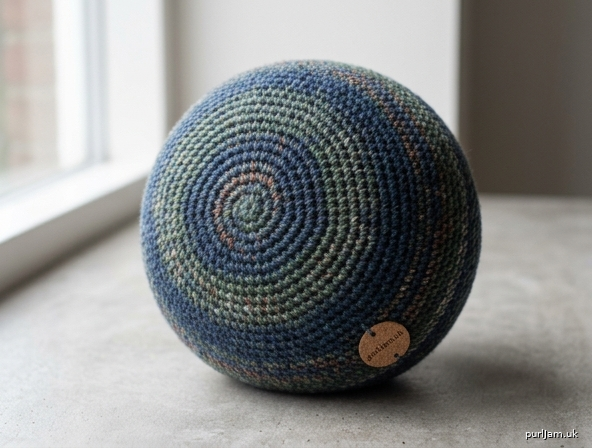
10-Inch Crochet Ball
A smooth, firmly stuffed amigurumi sphere. The stitches are beginner-level (single crochet, increase, and decrease only); the project is large, so plan several sittings.
Skill level: Beginner
Construction: One piece, worked in a continuous spiral from the top down (crown to opposite crown)
Finished Size
10 inches (25 cm) in diameter, measured through the center of the stuffed ball.
Size depends on matching gauge and stuffing firmly. Checkpoints are given in the pattern so you can adjust before you close the ball.
Materials
- Yarn: Worsted weight (category 4), 380 yards (347 m) — 2 standard 200-yard skeins is a safe amount. Any fiber is fine; a smooth acrylic or wool-blend shows stitch definition and washes well for a play ball.
- Hook: US F-5 (3.75 mm), or the hook size needed to obtain gauge. Fabric must be dense; stuffing should not show through.
- Polyester fiberfill: About 12 ounces (340 g). Have extra on hand; a 10-inch ball takes more stuffing than you expect.
- Yarn needle
- Stitch marker
- Scissors
- Optional: kitchen scale or ruler for stuffing and size checks
Gauge
5 sc = 1 inch (2.5 cm)
11 rounds = 2 inches (5 cm)
Worked tightly in single crochet in the round.
To check gauge without a separate swatch, work Rnds 1–8. The circle should measure 3 inches (7.5 cm) across when laid flat (48 sts).
- Too big / floppy fabric: go down a hook size.
- Too small: go up a hook size.
Do not work loosely. Gaps will show stuffing on a ball this size.
Abbreviations (US terms)
| Abbreviation | Meaning |
|---|---|
| MR | magic ring |
| ch | chain |
| sc | single crochet |
| inc | increase — 2 sc in the same stitch |
| dec | decrease — invisible decrease (see Special Stitches) or sc2tog |
| st(s) | stitch(es) |
| rnd(s) | round(s) |
| [...] | stitch count at the end of the round |
Special Stitches
Invisible decrease (recommended): Insert hook under the front loop only of the next st, then under the front loop only of the following st (2 loops on hook plus the original loop = 3 loops). Yarn over, pull through 2 loops, yarn over, pull through remaining 2 loops. This sits flatter than sc2tog and keeps the ball smooth.
sc2tog (easier alternative): Insert hook in next st, yarn over, pull up a loop; insert hook in following st, yarn over, pull up a loop; yarn over, pull through all 3 loops.
Pattern Notes
- US crochet terms throughout.
- Work in a continuous spiral. Do not join at the end of a round and do not turn.
- Place a stitch marker in the first stitch of every round and move it up as you go.
- Counts in brackets are the stitches you should have when the round is finished. Count every few rounds — a missed increase on a 10-inch ball will throw the shape off.
- “Around” means repeat the stitches in parentheses until the round is complete. Every increase or decrease round has exactly 6 inc or dec.
- Faint ridges at the six increase/decrease lines are normal. Firm stuffing rounds them out.
- Stuff as instructed. You cannot add enough stuffing at the very end.
Ball
Make 1.
Leave a 6-inch (15 cm) starting tail. Work tightly.
Rnd 1: 6 sc in MR. [6]
(Alternative start: ch 2, 6 sc in 2nd ch from hook. [6])
Rnd 2: Inc in each st around. [12] (6 inc → 6 + 6 = 12 ✓)
Rnd 3: (Sc, inc) around. [18] (6 inc → 12 + 6 = 18 ✓)
Rnd 4: (2 sc, inc) around. [24] (6 inc → 18 + 6 = 24 ✓)
Rnd 5: (3 sc, inc) around. [30] (6 inc → 24 + 6 = 30 ✓)
Rnd 6: (4 sc, inc) around. [36] (6 inc → 30 + 6 = 36 ✓)
Rnd 7: (5 sc, inc) around. [42] (6 inc → 36 + 6 = 42 ✓)
Rnd 8: (6 sc, inc) around. [48] (6 inc → 42 + 6 = 48 ✓)
— Checkpoint: piece measures about 3 inches (7.5 cm) across.
Rnd 9: (7 sc, inc) around. [54] (6 inc → 48 + 6 = 54 ✓)
Rnd 10: (8 sc, inc) around. [60] (6 inc → 54 + 6 = 60 ✓)
Rnd 11: (9 sc, inc) around. [66] (6 inc → 60 + 6 = 66 ✓)
Rnd 12: (10 sc, inc) around. [72] (6 inc → 66 + 6 = 72 ✓)
Rnd 13: (11 sc, inc) around. [78] (6 inc → 72 + 6 = 78 ✓)
Rnd 14: (12 sc, inc) around. [84] (6 inc → 78 + 6 = 84 ✓)
Rnd 15: (13 sc, inc) around. [90] (6 inc → 84 + 6 = 90 ✓)
Rnd 16: (14 sc, inc) around. [96] (6 inc → 90 + 6 = 96 ✓)
— Checkpoint: piece measures about 6 inches (15 cm) across and is beginning to cup.
The next 12 rounds add width more slowly so the ball rounds instead of lying flat.
Rnd 17: Sc around. [96]
Rnd 18: (15 sc, inc) around. [102] (6 inc → 96 + 6 = 102 ✓)
Rnd 19: Sc around. [102]
Rnd 20: (16 sc, inc) around. [108] (6 inc → 102 + 6 = 108 ✓)
Rnd 21: Sc around. [108]
Rnd 22: (17 sc, inc) around. [114] (6 inc → 108 + 6 = 114 ✓)
Rnd 23: Sc around. [114]
Rnd 24: (18 sc, inc) around. [120] (6 inc → 114 + 6 = 120 ✓)
Rnd 25: Sc around. [120]
Rnd 26: (19 sc, inc) around. [126] (6 inc → 120 + 6 = 126 ✓)
Rnd 27: Sc around. [126]
Rnd 28: (20 sc, inc) around. [132] (6 inc → 126 + 6 = 132 ✓)
The next 12 rounds slow the increases again.
Rnd 29: Sc around. [132]
Rnd 30: Sc around. [132]
Rnd 31: (21 sc, inc) around. [138] (6 inc → 132 + 6 = 138 ✓)
Rnd 32: Sc around. [138]
Rnd 33: Sc around. [138]
Rnd 34: (22 sc, inc) around. [144] (6 inc → 138 + 6 = 144 ✓)
Rnd 35: Sc around. [144]
Rnd 36: Sc around. [144]
Rnd 37: (23 sc, inc) around. [150] (6 inc → 144 + 6 = 150 ✓)
Rnd 38: Sc around. [150]
Rnd 39: Sc around. [150]
Rnd 40: (24 sc, inc) around. [156] (6 inc → 150 + 6 = 156 ✓)
— Width checkpoint: the opening should measure 10 inches (25 cm) across. This is the equator of the ball. If it is smaller than 9½ inches, add another (25 sc, inc) round [162] and treat 162 as your new even-round count. If it is larger than 10½ inches, you can begin the even rounds now and skip Rnd 40’s extra stitches by working even on 150 instead — the ball will be slightly smaller.
Rnds 41–45: Sc around. [156]
— Height checkpoint: the bowl should be about 5 inches (12.5 cm) deep from crown to opening. If it is short of 5 inches, work extra even rounds at 156 sts until it is. If it is already taller than 5½ inches, go ahead to Rnd 46.
You now have a hemisphere. Begin filling it with stuffing, packing small handfuls and pushing them out to the sides so the crown is round, not pointed. Keep the stuffing even.
Decrease in mirror of the increases.
Rnd 46: (24 sc, dec) around. [150] (6 dec → 156 − 6 = 150 ✓)
Rnds 47–48: Sc around. [150]
Rnd 49: (23 sc, dec) around. [144] (6 dec → 150 − 6 = 144 ✓)
Rnds 50–51: Sc around. [144]
Rnd 52: (22 sc, dec) around. [138] (6 dec → 144 − 6 = 138 ✓)
Rnds 53–54: Sc around. [138]
Rnd 55: (21 sc, dec) around. [132] (6 dec → 138 − 6 = 132 ✓)
Rnds 56–57: Sc around. [132]
Rnd 58: (20 sc, dec) around. [126] (6 dec → 132 − 6 = 126 ✓)
Rnd 59: Sc around. [126]
Rnd 60: (19 sc, dec) around. [120] (6 dec → 126 − 6 = 120 ✓)
Rnd 61: Sc around. [120]
Rnd 62: (18 sc, dec) around. [114] (6 dec → 120 − 6 = 114 ✓)
Rnd 63: Sc around. [114]
Rnd 64: (17 sc, dec) around. [108] (6 dec → 114 − 6 = 108 ✓)
Rnd 65: Sc around. [108]
Rnd 66: (16 sc, dec) around. [102] (6 dec → 108 − 6 = 102 ✓)
Rnd 67: Sc around. [102]
Rnd 68: (15 sc, dec) around. [96] (6 dec → 102 − 6 = 96 ✓)
Rnd 69: Sc around. [96]
Keep stuffing as you go. Add extra fill before the opening gets small — this is your last easy chance to pack the center.
Rnd 70: (14 sc, dec) around. [90] (6 dec → 96 − 6 = 90 ✓)
Rnd 71: (13 sc, dec) around. [84] (6 dec → 90 − 6 = 84 ✓)
Rnd 72: (12 sc, dec) around. [78] (6 dec → 84 − 6 = 78 ✓)
Rnd 73: (11 sc, dec) around. [72] (6 dec → 78 − 6 = 72 ✓)
Rnd 74: (10 sc, dec) around. [66] (6 dec → 72 − 6 = 66 ✓)
Rnd 75: (9 sc, dec) around. [60] (6 dec → 66 − 6 = 60 ✓)
Rnd 76: (8 sc, dec) around. [54] (6 dec → 60 − 6 = 54 ✓)
Rnd 77: (7 sc, dec) around. [48] (6 dec → 54 − 6 = 48 ✓)
Stuff firmly one last time. Push fill into any soft spots so the ball feels equally firm all over and measures close to 10 inches through the middle.
Rnd 78: (6 sc, dec) around. [42] (6 dec → 48 − 6 = 42 ✓)
Rnd 79: (5 sc, dec) around. [36] (6 dec → 42 − 6 = 36 ✓)
Rnd 80: (4 sc, dec) around. [30] (6 dec → 36 − 6 = 30 ✓)
Rnd 81: (3 sc, dec) around. [24] (6 dec → 30 − 6 = 24 ✓)
Rnd 82: (2 sc, dec) around. [18] (6 dec → 24 − 6 = 18 ✓)
Rnd 83: (Sc, dec) around. [12] (6 dec → 18 − 6 = 12 ✓)
Rnd 84: Dec around. [6] (6 dec → 12 − 6 = 6 ✓)
Finishing
Fasten off, leaving a 12-inch (30 cm) tail.
Thread the tail onto a yarn needle. Run the needle through the front loop of each of the remaining 6 stitches. Pull tight to close the hole. Take the needle through the closing point and out the side of the ball, tug gently so the end buries itself in the stuffing, then snip the yarn close to the fabric. Weave in the starting tail the same way.
Roll the ball between your hands to even out the stuffing. If you find a dent, you can snip a tiny stitch, poke in a bit more fill with the yarn needle, and close the stitch again — but a fully packed ball should not need this.
Finished measurement: 10 inches (25 cm) through the center.
Tips for a Round, Even Ball
- Tension: If your fabric loosens as the rounds get long, drop down a hook size for the equator section (Rnds 29–57).
- Counting: On increase rounds you should have exactly 6 extra stitches; on decrease rounds, exactly 6 fewer. If your count is off by 1 or 2, fix it on the next even round rather than ripping a 150-stitch round unless the gap is obvious.
- Stuffing: Many small handfuls beat one big clump. Overstuff slightly — the fabric should be taut, with no wrinkles.
- Play ball / washable toy: Use acrylic yarn and stuff firmly. If the ball is for a child under 3, keep stitches tight, bury ends deep, and do not add buttons, eyes, or other detachable parts.
- Size tweak after Rnd 40: Extra even rounds at 156 sts make a slightly taller ball; fewer even rounds make it a little flatter. Width is set by the 156-st equator and your gauge.
Round Planner (quick reference)
| Rounds | What happens | Stitch count |
|---|---|---|
| 1–16 | Increase every round | 6 → 96 |
| 17–28 | 1 even rnd, 1 inc rnd (6 times) | 96 → 132 |
| 29–40 | 2 even rnds, 1 inc rnd (4 times) | 132 → 156 |
| 41–45 | Even (equator) | 156 |
| 46–57 | 1 dec rnd, 2 even rnds (4 times) | 156 → 132 |
| 58–69 | 1 dec rnd, 1 even rnd (6 times) | 132 → 96 |
| 70–84 | Decrease every round | 96 → 6 |
| Close | Weave through last 6 sts | — |
Disclaimer: This pattern was generated by AI and should be reviewed for accuracy before use. While we strive for quality, AI-generated content may contain errors. Please verify measurements, stitch counts, charts, and instructions before beginning your project. Generated by purlJam.uk
Love this pattern?
Save this pattern to your free PurlJam libraryAccess your pattern anytime
Bookmark this page to access your pattern anytime