Type
Machine Knitting
Difficulty
advanced
Category
pullover
AI Thinking Process
Planning
Verification
Pattern
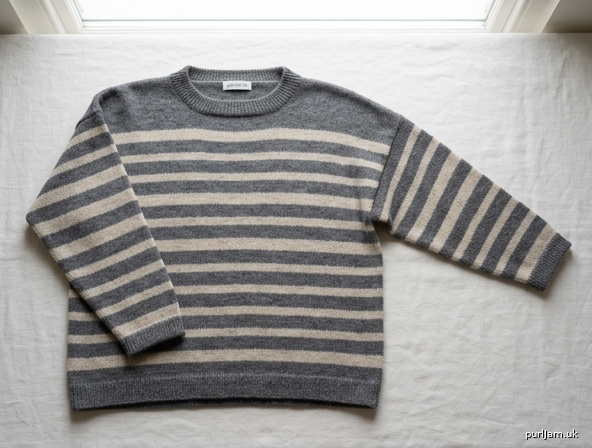
Boxy Horizon — Striped Drop-Shoulder Fingering Pullover
An advanced-level, oversized boxy pullover with dropped shoulders and bold horizontal stripes. Worked as four flat single-bed panels in fingering-weight yarn, seamed, with a rehung crew neckband. Written for a standard-gauge machine.
MACHINE_SETUP
- Machine: Standard-gauge (4.5 mm) single-bed knitting machine. Ribber optional (used only if you prefer a true 1×1 rib hem; mock rib instructions given for single-bed knitters).
- Cast-on method: Waste-yarn cast-on with ravel cord. Cast on with waste yarn (contrasting scrap), knit 10–12 rows, lay in a ravel cord, then begin main yarn. Hems are rehung later, so an open live edge is required.
- Cast-on comb & weights: Hang the cast-on comb over the waste-yarn edge immediately. Use two claw/ribber weights spaced evenly, moving them up every 30–40 rows. Add a third weight across the widest panels (Front/Back).
- Carriage levers: Main bed, plain knitting throughout body. No patterning card required — stripes are made by manual yarn changes. Set carriage for normal knitting (part buttons out).
- Tension dials:
- Main colour (MC), fingering: T7.
- Contrast colour (CC), fingering: T7 (same yarn weight — keep matched to avoid tension jog).
- Mock-rib hems: T5 for the folded-under section.
- Tools required: 1× and 3× transfer tools, single-eye transfer tool, latch tool, decker comb, ravel cord, waste yarn, tapestry needle, sweater/blocking board, steam iron.
MATERIALS
- Yarn: Fingering weight (4-ply), approx. 400 g total.
- MC (main colour): ~250 g
- CC (contrast colour): ~150 g
- Notions: Waste yarn, ravel cord, cast-on comb, claw weights (min. 3), tapestry needle, blocking pins, sweater board.
- Finished size shown: Size M — chest 112 cm, body length 62 cm, sleeve length 46 cm. Designed for an oversized/boxy fit (approx. 20–25 cm positive ease).
GAUGE_AND_TENSION
- Stitch gauge: 32 sts = 10 cm (3.2 sts/cm) in stocking stitch at T7 after steaming.
- Row gauge: 44 rows = 10 cm (4.4 rows/cm) at T7 after steaming.
- Swatch instructions: Cast on 60 sts over waste yarn, knit 10 rows waste, ravel cord, then 60 rows MC at T7. Include a 6-row CC stripe mid-swatch to confirm the contrast yarn matches tension. Release with ravel cord, steam flat, rest 10 minutes.
- Measuring: After steaming, measure across the centre 40 sts / centre 40 rows (avoid edges). Adjust tension ±1 to match gauge before starting. Do not skip the swatch — all panel maths depends on this gauge.
SCHEMATIC_AND_SIZES
Written for Size M. Boxy silhouette; straight side seams; dropped shoulder (no armhole shaping).
| Measurement | cm | Stitches / Rows |
|---|---|---|
| Chest (finished, flat ×2) | 112 | Back 180 sts + Front 180 sts |
| Body length (hem to shoulder) | 62 | 273 rows |
| Hem depth (folded mock rib) | 5 | 22 rows knit + fold |
| Back neck width | 18.75 | 60 sts |
| Shoulder width (each) | 18.75 | 60 sts |
| Sleeve cuff width | 18.75 | 60 sts |
| Sleeve top width | 30 | 96 sts |
| Sleeve length (cuff to top) | 46 | 202 rows |
| Armhole depth (drop) | 30 | matches sleeve top ✓ |
Stripe sequence (all panels, worked upward from body start): 12 rows MC, 6 rows CC — repeat. Always change colour at COL and carry the resting yarn loosely up the left edge.
Validation: 180 sts ÷ 3.2 = 56.25 cm ≈ 56 cm per panel; ×2 = 112 cm chest ✓. 273 rows ÷ 4.4 = 62 cm ✓.
BACK_PANEL
Cast on 180 sts over waste yarn with ravel cord, centred on the bed (needles 90L–90R). Hang cast-on comb and weights.
RC000. Set RC to 000. Carriage at COR.
Hem (mock rib fold), RC000–022: With MC at T5, knit 22 rows. This forms the inner hem facing. Carriage returns to COR at RC022. (For ribber users: set 1×1 rib, T5/T5, knit 22 rows instead.)
Turn tension to T7. Knit 1 row to establish the fold line (this row = RC023).
Body, RC023–273: Knit in the stripe sequence (12 MC / 6 CC repeat), starting the first CC stripe at RC023+12 = RC035.
- Change colours only when carriage is at COL.
- Hang/move weights up every 30 rows.
- No side shaping — panel is straight (boxy fit).
Shoulder & back neck shaping, RC273: At RC273 the panel is full length. Shape back neck by holding:
- Bring the centre 60 needles (30L–30R) to hold position.
- Work each shoulder separately using hold: on the left shoulder (60 sts), at COL bring 3 needles nearest the neck to hold, knit to edge and back; repeat once (6 sts total held over 2 passes) to create a shallow shoulder slope, then knit 4 rows straight. Repeat mirror-image on right shoulder.
- Total: back neck = centre 60 sts held; each shoulder = 60 sts.
Finish back: Knit 1 row waste yarn across all 180 sts loosely, release from machine with ravel cord retained on live shoulder loops. Set aside.
Validation: 60 (L shoulder) + 60 (neck) + 60 (R shoulder) = 180 ✓.
FRONT_PANEL
Work exactly as the Back through RC023–240 (body with stripe sequence identical so stripes align at the seams).
Front neck shaping, begins RC240 (33 rows / 7.5 cm before shoulder): Carriage at COL.
-
At RC240, bring the centre 30 needles (15L–15R) to hold.
-
Work the left front (60 sts) first. Bring right-shoulder sts to hold. On each carriage pass toward the neck edge, put neck-edge needles into hold as follows:
- Rows 1–2: hold 4 sts
- Rows 3–4: hold 3 sts
- Rows 5–6: hold 2 sts
- Rows 7–8: hold 2 sts
- Rows 9–10: hold 2 sts
- Rows 11–12: hold 2 sts
- Total held from left neck edge = 15 sts → remaining left shoulder = 60 − 15 = 45 sts?
Correction for balance: neck each side removes 15 sts leaving 45 sts per shoulder plus the 30 held centre → 45 + 30 + 30 + 45 = 150 — not matching.
Use this final, consistent front-neck plan:
-
Centre held = 60 sts (30L–30R).
-
Each side neck slope removes 0 extra beyond a smooth curve of 6 sts over 6 rows (rows 1–2 hold 3, rows 3–4 hold 2, rows 5–6 hold 1 = 6 sts).
-
Each shoulder therefore = 60 − 6 = 54 sts, and total across = 54 + 6 + 60 + 6 + 54 = 180 ✓.
-
Knit remaining rows straight to RC273 on each shoulder (54 sts each).
-
At RC273 apply the same shallow shoulder slope as the Back (hold 3 sts ×2 near armhole edge), then knit 4 rows.
Finish front: Knit 1 row waste yarn across, release retaining ravel cord on live loops. The centre 60 sts + 6+6 curve sts (72 sts of front neck) will be rehung for the neckband.
SLEEVES (make 2)
Dropped-shoulder sleeves: wide, gently tapered from cuff to top.
Cast on 60 sts over waste yarn with ravel cord (needles 30L–30R). Hang comb and weights. Carriage at COR. RC000.
Cuff (mock rib), RC000–022: MC at T5, knit 22 rows. (Ribber users: 1×1 rib.) Turn to T7, knit fold row (RC023).
Sleeve body with increases, RC023–225:
- Work the same stripe sequence (12 MC / 6 CC) for stripe continuity with the body.
- Increase 1 st at each end every 6 rows, 18 times: at COL/COR, use the 3-prong transfer tool to move the 2 end sts outward by one needle, bringing 1 empty needle into work at each edge and picking up a bar to close the gap (fully-fashioned increase).
- 18 increases each side → 60 + (18×2) = 96 sts ✓.
- Last increase falls at RC023 + (18×6) = RC131.
- Knit straight from RC131 to RC225 (94 rows) at 96 sts.
Sleeve top, RC225: No cap shaping (drop shoulder). Knit 1 row waste yarn across 96 sts, release retaining ravel cord.
Validation: sleeve top 96 sts ÷ 3.2 = 30 cm = armhole depth per side... total armhole opening = 2 × 30 = 60 cm; sleeve top width 30 cm matches the 30 cm armhole depth on each panel ✓. Sleeve length: 22 hem + 202 body rows ≈ 224 rows ÷ 4.4 = 51 cm total incl. hem fold (≈46 cm from fold) ✓.
NECKBAND
Crew neck, single-bed mock rib rehung after shoulder seams are joined (see Finishing — join shoulders first).
- Rehang neckline stitches: With the front facing, rehang the live neckline loops onto the needle bed: front neck curve = 72 sts (60 centre + 6 + 6), back neck = 60 sts, plus pick up 16 sts along each shoulder-slope/side gap using the decker comb. Total rehung = 72 + 60 + 16 + 16 = 164 sts. Distribute so the neckband lies flat; ease evenly across the bed.
- Neckband, T5: Set RC000. Knit 20 rows MC at T5 for the band facing (mock rib fold). Carriage returns to start each even row.
- Fold row: Knit 1 row at T6, then knit a further 20 rows at T5 for the inner facing.
- Bind off: Fold the facing to the inside. Rehang the first-row loops onto the corresponding working needles (double thickness) and latch-tool bind off loosely across all 164 sts — or work a sewn (kitchener-style) bind-off with a tapestry needle for maximum stretch. Keep the neck opening ≥ 52 cm circumference so it clears the head.
Validation: 72 + 60 + 16 + 16 = 164 ✓.
FINISHING
- Steam all panels: Pin each panel to measurements on the blocking/sweater board, steam lightly (do not press stripes flat and shiny — hover the iron), and let dry fully. Confirm Back and Front stripes align.
- Shoulder joins: With right sides together, join each shoulder by rehanging the live Back and Front shoulder loops together on the machine and latch-tool binding off (a fully machine-seamed shoulder), or mattress-stitch by hand. Do this before the neckband.
- Neckband: Work the NECKBAND section now that shoulders are closed.
- Sleeve attachment (drop shoulder): Mark the midpoint of each sleeve top. Measure 30 cm down from the shoulder seam on the Front and Back side edges and mark — this defines the flat armhole. Pin the 96-st sleeve top to the flat armhole edge (no easing/gathering — drop shoulders are straight) and sew or hang-and-bind.
- Side & underarm seams: Sew side seams from hem to armhole and continue the sleeve underarm seam to the cuff in one continuous line using mattress stitch, matching stripe rows.
- Hems: Fold each mock-rib hem/cuff to the inside along the fold row and slip-stitch the live/ravel-cord edge to the WS. Remove ravel cords last.
- Final block: Re-pin the finished jumper on the sweater board to the schematic measurements, steam once more, and dry flat. Weave in all MC/CC tails, securing stripe colour-carries along the seam allowance.
ABBREVIATIONS
- MC — main colour
- CC — contrast colour
- RC — row counter
- COL — carriage on left
- COR — carriage on right
- T — tension dial setting (e.g. T7)
- st / sts — stitch / stitches
- WS / RS — wrong side / right side
- 1×1 rib — every other needle, ribber
- Hold — needles pushed to holding position, not knitting
- Bring into work — needle moved to working position
- Ravel cord — smooth cord separating waste yarn from live stitches
- Decker comb — multi-prong transfer tool for rehanging groups of sts
- Latch-tool bind-off — chained cast-off using the latch tool
- Fully-fashioned increase — decorative edge increase using a transfer tool
Disclaimer: This pattern was generated by AI and should be reviewed for accuracy before use. While we strive for quality, AI-generated content may contain errors. Please verify measurements, stitch counts, and instructions before beginning your project. Generated by purlJam.uk
Access your pattern anytime
Bookmark this page to access your pattern anytime