Type
Knitting
Difficulty
intermediate
Category
hat
AI Thinking Process
Planning
Verification
Pattern
Cabled Hat with Pompom
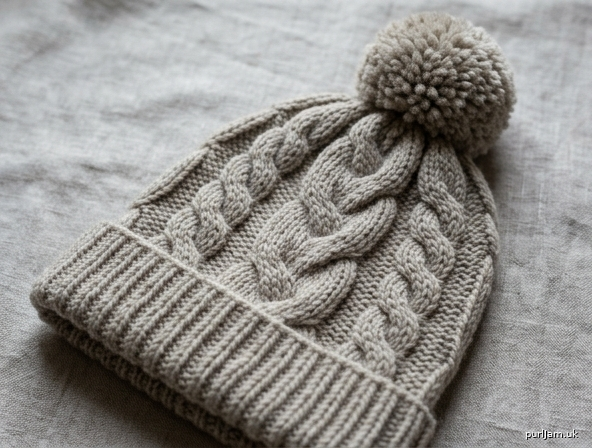
A seamed adult beanie in bulky wool, with six cable panels set against reverse stocking stitch, a folded rib brim, and a plump pompom. The hat is worked flat on straight needles from the brim up. The centre-back seam sits in the middle of a reverse stocking stitch panel, so it disappears into the fabric. Crown decreases follow the cables: the panels are crossed as they narrow, then decreased inside the cable stitches themselves.
Difficulty: Intermediate
Skills used: long-tail cast-on, 1×1 rib, cables, paired decreases, mattress stitch, pompom.
Sizes
To fit head circumference: 52–54 (56–58, 60–62) cm
[20½–21¼ (22–22¾, 23½–24½) in]
Instructions are given for size S, with M and L in parentheses. Where only one figure is given, it applies to all sizes. The crown is written out separately for each size — work only your own size.
Cable fabric has little stretch. Choose the size that gives about 4–6 cm (1½–2¼ in) of negative ease. If you are between sizes, choose the larger one.
Finished measurements
| S | M | L | |
|---|---|---|---|
| Circumference, above brim, unstretched | 48 cm (19 in) | 52 cm (20½ in) | 56 cm (22 in) |
| Length, brim unfolded | 30 cm (11¾ in) | 30 cm (11¾ in) | 30 cm (11¾ in) |
| Length worn, brim folded | 25 cm (9¾ in) | 25 cm (9¾ in) | 25 cm (9¾ in) |
| Folded brim depth | 5 cm (2 in) | 5 cm (2 in) | 5 cm (2 in) |
| Pompom diameter | 8 cm (3¼ in) | 8 cm (3¼ in) | 8 cm (3¼ in) |
Circumference check: 72 (78, 84) pattern sts ÷ 15 sts × 10 cm = 48 (52, 56) cm ✓. The two selvedge stitches are taken into the seam and are not included in the circumference.
Yarn
Chunky-weight wool (bulky, CYC 5), with good stitch definition.
Amount, including pompom: 160 (180, 200) m / 175 (197, 219) yds
Approximately 115 (130, 145) g if the ball is 140 m per 100 g.
Two 100 g balls of a typical 140 m chunky wool will cover every size, the seam, and the pompom. A wool or wool-rich fibre is recommended so the hat can be blocked and the cables relax. One colour is used throughout; a contrast pompom is optional and needs only a small extra amount.
Match the tension below. A yarn labelled bulky that knits to fewer than 15 stitches to 10 cm will make this stitch count too large — change needle size until the tension is correct, rather than following the ball-band needle alone.
Needles and notions
- Pair of 5.5 mm (UK 5) straight needles, for the brim
- Pair of 6.5 mm (UK 3) straight needles, for the body and crown
- Cable needle
- Tapestry needle
- Pompom maker, 8 cm (3¼ in), or two cardboard circles
- Optional: a locking marker to mark the right side
- Optional: six stitch markers to sit at the start of each cable
This hat is worked entirely on straight needles. Circular needles and double-pointed needles are not used.
Tension (gauge)
15 stitches and 20 rows to 10 cm (4 in) over Cable Pattern, using 6.5 mm needles, after blocking.
Cast on 32 stitches and work the Size S cable layout (edge stitches, two cables, and the reverse stocking stitch between them) for 24 rows. Block the swatch before measuring. If you have too many stitches to 10 cm, use a larger needle; if too few, use a smaller needle. The hat will not match the measurements unless this tension is achieved.
Row-length check used in this pattern: 24 rows = 12 cm ✓; 16 rows = 8 cm ✓; 8 rows = 4 cm ✓.
Abbreviations
- k — knit
- p — purl
- RS / WS — right side / wrong side
- st(s) — stitch(es)
- k2tog — knit 2 stitches together (1 stitch decreased)
- p2tog — purl 2 stitches together (1 stitch decreased)
- ssk — slip 2 stitches knitwise one at a time, insert the left needle into the fronts of both, and knit them together (1 stitch decreased)
- C6B — cable 6 back (see Special stitches)
- C4B — cable 4 back (see Special stitches)
- CN — cable needle
- rep — repeat
- rev st st — reverse stocking stitch (purl on RS, knit on WS)
- cm — centimetres
- mm — millimetres
Special stitches
C6B (cable 6 back): Slip the next 3 stitches onto the cable needle and hold at the back of the work, k3 from the left needle, then k3 from the cable needle.
C4B (cable 4 back): Slip the next 2 stitches onto the cable needle and hold at the back of the work, k2 from the left needle, then k2 from the cable needle.
Garter selvedge: Knit the first and last stitch of every row. These two stitches are the seam allowance. Take them fully into the mattress stitch so they sit on the inside of the hat.
Pattern notes
- The piece is a flat rectangle. Do not join it in the round.
- There are six cable panels of 6 stitches, alternating with six reverse stocking stitch panels. The back panel is split: half of it is at the start of the RS row and half at the end. After seaming, those halves become one panel the same width as the others.
- Panel widths (purl stitches on RS rows):
| S | M | L | |
|---|---|---|---|
| Left half-panel (worked first on RS) | 3 sts | 3 sts | 4 sts |
| Each full panel | 6 sts | 7 sts | 8 sts |
| Right half-panel (worked last on RS) | 3 sts | 4 sts | 4 sts |
| Joined back panel | 6 sts | 7 sts | 8 sts |
- On Size M the two halves are not equal (3 and 4). The seam falls half a stitch off the mathematical centre of a 7-stitch panel, which is invisible in reverse stocking stitch. Do not “correct” them to matching numbers.
- Mark the right side on the first rib row. Cable crosses are always worked on RS rows.
- The brim is designed to be folded in half when worn.
- Closer fit: work 16 rows of Cable Pattern (2 repeats) instead of 24. Unfolded length becomes 26 cm (10¼ in); worn length with the brim folded becomes 21 cm (8¼ in). The crown instructions do not change. (10 + 8 + 8 = 26 ✓; 26 − 5 = 21 ✓)
- Deeper hat or more slouch: work 32 rows of Cable Pattern (4 repeats) instead of 24. This adds 4 cm (1½ in). Any whole number of 8-row repeats will still start the crown on a cable-cross row.
Cable pattern (written)
Panel layout, RS rows:
K1 (selvedge), p3 (3, 4) [left half-panel], [6 cable sts, p6 (7, 8)] 5 times, 6 cable sts, p3 (4, 4) [right half-panel], k1 (selvedge).
Stitch check: 1 + 3 (3, 4) + 5 × [6 + 6 (7, 8)] + 6 + 3 (4, 4) + 1 = 74 (80, 86) ✓.
Row 1 (RS, cable cross): K1, p3 (3, 4), [C6B, p6 (7, 8)] 5 times, C6B, p3 (4, 4), k1.
Row 2 (WS): K1, k3 (4, 4) [this is the right half-panel], [p6, k6 (7, 8)] 5 times, p6, k3 (3, 4) [this is the left half-panel], k1.
Row 3 (RS): K1, p3 (3, 4), [k6, p6 (7, 8)] 5 times, k6, p3 (4, 4), k1.
Row 4 (WS): As Row 2.
Row 5 (RS): As Row 3.
Row 6 (WS): As Row 2.
Row 7 (RS): As Row 3.
Row 8 (WS): As Row 2.
These 8 rows form the Cable Pattern. The stitch count does not change: 74 (80, 86) sts.
On WS rows, Size M begins with k4 (right half) and ends with k3 (left half). Those two numbers are meant to differ.
Cable chart
The chart shows one 6-stitch cable. Reverse stocking stitch panels are not drawn on the chart; work them from the written rows, in the width for your size. Written instructions are the authority for edge panels and for the crown.
Read odd (RS) rows from right to left. Read even (WS) rows from left to right. On WS rows, work the opposite of the RS meaning of each symbol.
Cable panel (6 sts)

Row 8 (WS)   │ │ │ │ │ │
Row 7 (RS)   │ │ │ │ │ │
Row 6 (WS)   │ │ │ │ │ │
Row 5 (RS)   │ │ │ │ │ │
Row 4 (WS)   │ │ │ │ │ │
Row 3 (RS)   │ │ │ │ │ │
Row 2 (WS)   │ │ │ │ │ │
Row 1 (RS)   └── C6B ──┘
Key
- │ Knit on RS rows; purl on WS rows.
- C6B Slip 3 to CN and hold at back, k3, k3 from CN.
- Between cables, purl 6 (7, 8) on RS rows and knit those same stitches on WS rows.
- Keep the garter selvedge (k1 at each end of every row) outside the chart.
A second cross, C4B, is used only in the crown, once each cable has been reduced to 4 stitches: slip 2 to CN and hold at back, k2, k2 from CN.
Instructions
Brim
With 5.5 mm straight needles and the long-tail method, cast on 74 (80, 86) stitches.
Cast-on check: 6 cables × 6 sts = 36; 6 reverse panels × 6 (7, 8) sts = 36 (42, 48); 36 + 36 (42, 48) = 72 (78, 84) pattern sts; + 2 selvedge sts = 74 (80, 86) ✓.
Rib row: *K1, p1; repeat from * to end.
This row is both the RS and the WS rib row, because the cast-on is an even number. Mark the first row as the right side.
Repeat the rib row until the brim measures 10 cm (4 in), and you have just finished a WS row. If the piece reaches 10 cm at the end of a RS row, work one more rib row so the next row is a RS row.
Do not cast off.
Body
Change to 6.5 mm straight needles.
Work Rows 1–8 of the Cable Pattern 3 times (24 rows). The last row worked is Row 8 (WS).
The piece measures approximately 22 cm (8¾ in) from the cast-on edge, and 12 cm (4¾ in) from the top of the rib (24 rows ÷ 20 rows × 10 cm = 12 cm ✓).
You still have 74 (80, 86) stitches. Six cable crosses have been set (Rows 1, 9 and 17 of the body). The next RS row continues the sequence and is another cable-cross row.
For the closer fit, stop after 2 repeats (16 rows) instead. Do not change the crown.
Crown shaping
Decreases are worked inside the reverse stocking stitch panels first, so the cables draw together, and then inside the cable stitches. Cables are crossed on the first crown row (C6B) and again as 4-stitch cables (C4B). Work the 16 rows for your size only. A stitch count is given at the end of every row; stop and recount if you do not have that number.
The first and last stitches remain a garter selvedge until they are decreased near the top.
Size S only (74 sts)
Row 1 (RS): K1, p1, p2tog, [C6B, p2tog, p2, p2tog] 5 times, C6B, p2tog, p1, k1.
74 − 12 = 62 sts ✓. (Each of 5 full panels decreases by 2; each half-panel decreases by 1.)
Row 2 (WS): K1, k2, [p6, k4] 5 times, p6, k2, k1. 62 sts.
Row 3 (RS): K1, p2, [k6, p4] 5 times, k6, p2, k1. 62 sts.
Row 4 (WS): As Row 2. 62 sts.
Row 5 (RS): K1, p2tog, [k6, p2tog, p2tog] 5 times, k6, p2tog, k1.
62 − 12 = 50 sts ✓.
Row 6 (WS): K1, k1, [p6, k2] 5 times, p6, k1, k1. 50 sts.
Row 7 (RS): K1, p1, [k6, p2] 5 times, k6, p1, k1. 50 sts.
Row 8 (WS): As Row 6. 50 sts.
Row 9 (RS): K1, p1, [ssk, k2, k2tog, p2tog] 5 times, ssk, k2, k2tog, p1, k1.
Each cable goes from 6 sts to 4, and each full reverse panel from 2 sts to 1. 50 − 17 = 33 sts ✓.
Row 10 (WS): K1, k1, [p4, k1] 5 times, p4, k1, k1. 33 sts.
Row 11 (RS, cable cross): K1, p1, [C4B, p1] 5 times, C4B, p1, k1. 33 sts.
Row 12 (WS): As Row 10. 33 sts.
Row 13 (RS): K1, p1, [ssk, k2tog, p1] 5 times, ssk, k2tog, p1, k1.
Each cable goes from 4 sts to 2. 33 − 12 = 21 sts ✓.
Row 14 (WS): K1, k1, [p2, k1] 5 times, p2, k1, k1. 21 sts.
Row 15 (RS): *K2tog; repeat from * to the last st, k1.
10 decreases: 21 − 10 = 11 sts ✓.
Row 16 (WS): *P2tog; repeat from * to the last st, p1.
5 decreases: 11 − 5 = 6 sts ✓.
Size M only (80 sts)
Row 1 (RS): K1, p1, p2tog, [C6B, p2tog, p3, p2tog] 5 times, C6B, p2tog, p2, k1.
80 − 12 = 68 sts ✓.
Row 2 (WS): K1, k3, [p6, k5] 5 times, p6, k2, k1. 68 sts.
Row 3 (RS): K1, p2, [k6, p5] 5 times, k6, p3, k1. 68 sts.
Row 4 (WS): As Row 2. 68 sts.
Row 5 (RS): K1, p2tog, [k6, p2tog, p1, p2tog] 5 times, k6, p2tog, p1, k1.
68 − 12 = 56 sts ✓.
Row 6 (WS): K1, k2, [p6, k3] 5 times, p6, k1, k1. 56 sts.
Row 7 (RS): K1, p1, [k6, p3] 5 times, k6, p2, k1. 56 sts.
Row 8 (WS): As Row 6. 56 sts.
Row 9 (RS): K1, p1, [ssk, k2, k2tog, p2tog, p1] 5 times, ssk, k2, k2tog, p2tog, k1.
Cables go from 6 sts to 4; reverse panels narrow with them. 56 − 18 = 38 sts ✓.
Row 10 (WS): K1, k1, [p4, k2] 5 times, p4, k1, k1. 38 sts.
Row 11 (RS, cable cross): K1, p1, [C4B, p2tog] 5 times, C4B, p1, k1.
38 − 5 = 33 sts ✓.
Row 12 (WS): K1, k1, [p4, k1] 5 times, p4, k1, k1. 33 sts.
Row 13 (RS): K1, p1, [ssk, k2tog, p1] 5 times, ssk, k2tog, p1, k1.
33 − 12 = 21 sts ✓.
Row 14 (WS): K1, k1, [p2, k1] 5 times, p2, k1, k1. 21 sts.
Row 15 (RS): *K2tog; repeat from * to the last st, k1.
10 decreases: 21 − 10 = 11 sts ✓.
Row 16 (WS): *P2tog; repeat from * to the last st, p1.
5 decreases: 11 − 5 = 6 sts ✓.
Size L only (86 sts)
Row 1 (RS): K1, p2, p2tog, [C6B, p2tog, p4, p2tog] 5 times, C6B, p2tog, p2, k1.
86 − 12 = 74 sts ✓.
Row 2 (WS): K1, k3, [p6, k6] 5 times, p6, k3, k1. 74 sts.
Row 3 (RS): K1, p1, p2tog, [k6, p2tog, p2, p2tog] 5 times, k6, p2tog, p1, k1.
74 − 12 = 62 sts ✓.
Row 4 (WS): K1, k2, [p6, k4] 5 times, p6, k2, k1. 62 sts.
Row 5 (RS): K1, p2tog, [k6, p2tog, p2tog] 5 times, k6, p2tog, k1.
62 − 12 = 50 sts ✓.
Row 6 (WS): K1, k1, [p6, k2] 5 times, p6, k1, k1. 50 sts.
Row 7 (RS): K1, p1, [k6, p2] 5 times, k6, p1, k1. 50 sts.
Row 8 (WS): As Row 6. 50 sts.
Row 9 (RS): K1, p1, [ssk, k2, k2tog, p2tog] 5 times, ssk, k2, k2tog, p1, k1.
50 − 17 = 33 sts ✓.
Row 10 (WS): K1, k1, [p4, k1] 5 times, p4, k1, k1. 33 sts.
Row 11 (RS, cable cross): K1, p1, [C4B, p1] 5 times, C4B, p1, k1. 33 sts.
Row 12 (WS): As Row 10. 33 sts.
Row 13 (RS): K1, p1, [ssk, k2tog, p1] 5 times, ssk, k2tog, p1, k1.
33 − 12 = 21 sts ✓.
Row 14 (WS): K1, k1, [p2, k1] 5 times, p2, k1, k1. 21 sts.
Row 15 (RS): *K2tog; repeat from * to the last st, k1.
10 decreases: 21 − 10 = 11 sts ✓.
Row 16 (WS): *P2tog; repeat from * to the last st, p1.
5 decreases: 11 − 5 = 6 sts ✓.
Close the crown
All sizes now have 6 stitches.
Cut the yarn, leaving a 25 cm tail. Thread the tail through the remaining 6 stitches, pull firmly to close the hole, and take the yarn to the wrong side. Secure with a small stitch through the gathered stitches. Do not cut the tail yet if you would like to use it to start the side seam; otherwise weave it in later and use a fresh length for the seam.
Crown depth is 16 rows: 16 ÷ 20 × 10 cm = 8 cm (3¼ in) ✓.
Making up
Sew the side seam with mattress stitch, right sides facing you, using a tapestry needle and a length of about 90 cm.
- Take the whole garter selvedge stitch into the seam on each edge, so both selvedges turn to the inside.
- Match the rib rows, then match each cable cross.
- The 3 (3, 4) purl stitches at one edge and the 3 (4, 4) purl stitches at the other edge form one reverse stocking stitch panel of 6 (7, 8) stitches, the same width as the other five panels (3 + 3 = 6; 3 + 4 = 7; 4 + 4 = 8 ✓).
Weave in the rib and seam ends on the wrong side.
Blocking: Wet-block or steam the wool gently. Ease the cable section to 48 (52, 56) cm around and the unfolded length to 30 cm (or to 26 cm if you worked the closer fit). Do not stretch the cables flat. A bowl, balloon, or hat blocker helps the crown stay round. Dry completely.
Fold the brim in half to the outside. The folded brim is 5 cm deep, and the worn length is 25 cm (30 − 5 = 25 ✓).
Pompom
Make a dense pompom 8 cm (3¼ in) in diameter.
With a pompom maker, follow the tool instructions and wind until the arms are full. Or cut two cardboard circles 8 cm across with a 3 cm hole in the centre, wind yarn evenly through the hole until it is firmly packed, then slide a 40 cm tie between the circles, knot it tightly, and cut the loops around the outer edge.
Trim to a neat sphere. Use the tie ends to sew the pompom to the gathered crown, passing through the gather at least twice and finishing with a secure knot on the inside. The pompom should sit straight on the centre of the crown and not droop over the cables.
Schematic
                 pompom 8 cm
                     ●
                     |
              _______|_______
            /    crown 8 cm   \
           |                   |
           |   6 cable panels  |   circumference
           |   + rev st st     |   48 (52, 56) cm
           |                   |
           |____ rib 10 cm ____|   folds to 5 cm
                 seam at
               centre back

Unfolded length (cast-on to crown): 30 cm
Worn length (brim folded):          25 cm
Before seaming, the flat piece is 48 (52, 56) cm wide across the cable section (selvedges excluded) and 30 cm long.
Care
Hand-wash in cool water with a wool wash. Squeeze — do not wring — and dry flat, reshaping the brim fold and the crown. Keep the pompom free so it dries evenly. Store folded, not crushed, so the cables keep their roundness.
Disclaimer: This pattern was generated by AI and should be reviewed for accuracy before use. While we strive for quality, AI-generated content may contain errors. Please verify measurements, stitch counts, charts, and instructions before beginning your project. Generated by purlJam.uk
Love this pattern?
Save this pattern to your free PurlJam libraryAccess your pattern anytime
Bookmark this page to access your pattern anytime