Type
Knitting
Difficulty
intermediate
Category
custom
AI Thinking Process
Planning
1. **Design Strategy**: The user requested two colorwork charts: a "Corgi front" and a "Corgi back," each up to 32 stitches wide, for a 64-stitch sock knitted in the round. The difficulty level is advanced, and small details can be added with duplicate stitch. My strategy is to:
* Design two distinct 32-stitch wide charts, Chart A for the Corgi Front (featuring head, ears, and chest markings) and Chart B for the Corgi Back (emphasizing the characteristic fluffy rear and body shape).
* Utilize a limited color palette for the main colorwork (Main Color, Corgi Body Color, Corgi White Markings) to maintain clarity and manage floats for fair isle knitting.
* Incorporate the user's suggestion for duplicate stitch by designing the charts to allow for fine details (like eyes and nose on the front, or a small tail on the back) to be added post-knitting with a contrasting color.
* Aim for a chart height that provides a good visual impact on a sock leg, likely around 25-30 rows.
* Develop a complete top-down sock pattern to house these charts, ensuring all standard sock components (cuff, leg, heel, foot, toe) are included.
2. **Construction Plan**: The socks will be constructed top-down and in the round.
* **Cuff**: A standard ribbed cuff for stretch and fit.
* **Leg**: The main canvas for the colorwork. This section will feature Chart A (Corgi Front) over the first 32 stitches and Chart B (Corgi Back) over the remaining 32 stitches, repeating vertically as desired.
* **Heel**: A traditional heel flap and gusset construction, typically worked in the Main Color to simplify color management and provide durability.
* **Foot**: Stockinette stitch in the round, primarily in the Main Color.
* **Toe**: A classic rounded toe, decreased and grafted for a comfortable finish.
3. **Quality Assurance**:
* **Chart Design**: Verify that each chart is exactly 32 stitches wide. Ensure no excessive floats (over 5-7 stitches) in the colorwork, and if unavoidable, include explicit instructions for catching floats. The motifs should be clear and recognizable given the pixelated nature of knitting charts.
* **Mathematical Accuracy**: Double-check all stitch counts throughout the pattern, especially during cuff, leg, heel flap, gusset, and toe decreases. The initial 64-stitch count must be consistent.
* **Gauge**: Define a specific gauge for worsted weight yarn suitable for socks (dense fabric for durability and colorwork definition).
* **Clarity of Instructions**: All instructions will use standard US knitting terminology. Chart reading instructions will be explicit for knitting in the round.
* **Color Management**: Clearly list all colors and their intended use. Include notes on yarn management for colorwork.
4. **Final Calculations**:
* **Gauge**: Aim for 6 stitches per inch (24 sts / 4 inches) in stockinette for worsted weight yarn on US 5 (3.75 mm) needles, resulting in a finished sock circumference of approximately 10.6 inches (27 cm), suitable for an average adult foot.
* **Yarn Requirements**: Estimate yardage for MC, CC1, CC2, and a small amount for CC3 (duplicate stitch), considering typical worsted weight yarn usage for socks.
* **Chart Dimensions**: Both charts will be 32 stitches wide by 28 rows high, providing a good sized motif for the leg of the sock. Repeating the charts once or twice will give a substantial leg length.
Verification
[PRE-FLIGHT CHECKS]
1. **Completeness**:
* Title and brief description: Yes.
* Materials: Yes (yarn weight, yardage, needle sizes, notions, specific colors).
* Gauge: Yes (critical for socks).
* Sizes: Yes (single size with adjustment notes).
* Abbreviations used: Yes.
* Pattern notes: Yes (colorwork specific, duplicate stitch).
* Step-by-step instructions: Yes (full sock construction - cuff, leg, heel, foot, toe).
* Finishing instructions: Yes (blocking, duplicate stitch details).
* Charts Section: Yes, Charts A and B, with grid format, symbols, color key, and chart instructions.
* Color Management: Yes (yardage per color, stranding, blocking notes).
2. **Consistency**:
* Stitch count matches gauge and dimensions: Yes, 64 stitches for a 10.6-inch circumference at 6 sts/inch. Charts are 32 sts x 2, totaling 64.
* Increases/decreases result in stated stitch counts: Yes, will be verified during pattern writing for heel and toe.
* Row counts consistent: Yes, chart height is 28 rows.
3. **Constraints**:
* "Corgi front up to 32 stitches wide": Chart A is 32 sts.
* "Corgi back of up to 32 stitches wide": Chart B is 32 sts.
* "knitted in the round using colorwork": Yes, fair isle charts for in-the-round.
* "some small details can be added by duplicate stitch": Yes, noted in pattern for CC3.
* "on 64 stitches socks": Yes, pattern uses 64 stitches.
* "difficulty level: advanced": Charts have moderate detail suitable for advanced colorwork knitters.
* "worsted weight yarn": Specified.
* US terminology and imperial measurements: Yes.
* Charts with symbols and key: Yes.
4. **Safety**:
* Mathematical errors: Will perform inline verification for all stitch manipulations.
* Unclear instructions: Will write clearly and add tips where complex.
* Long floats: Will advise catching floats.
Pattern
# Corgi Companions Colorwork Socks

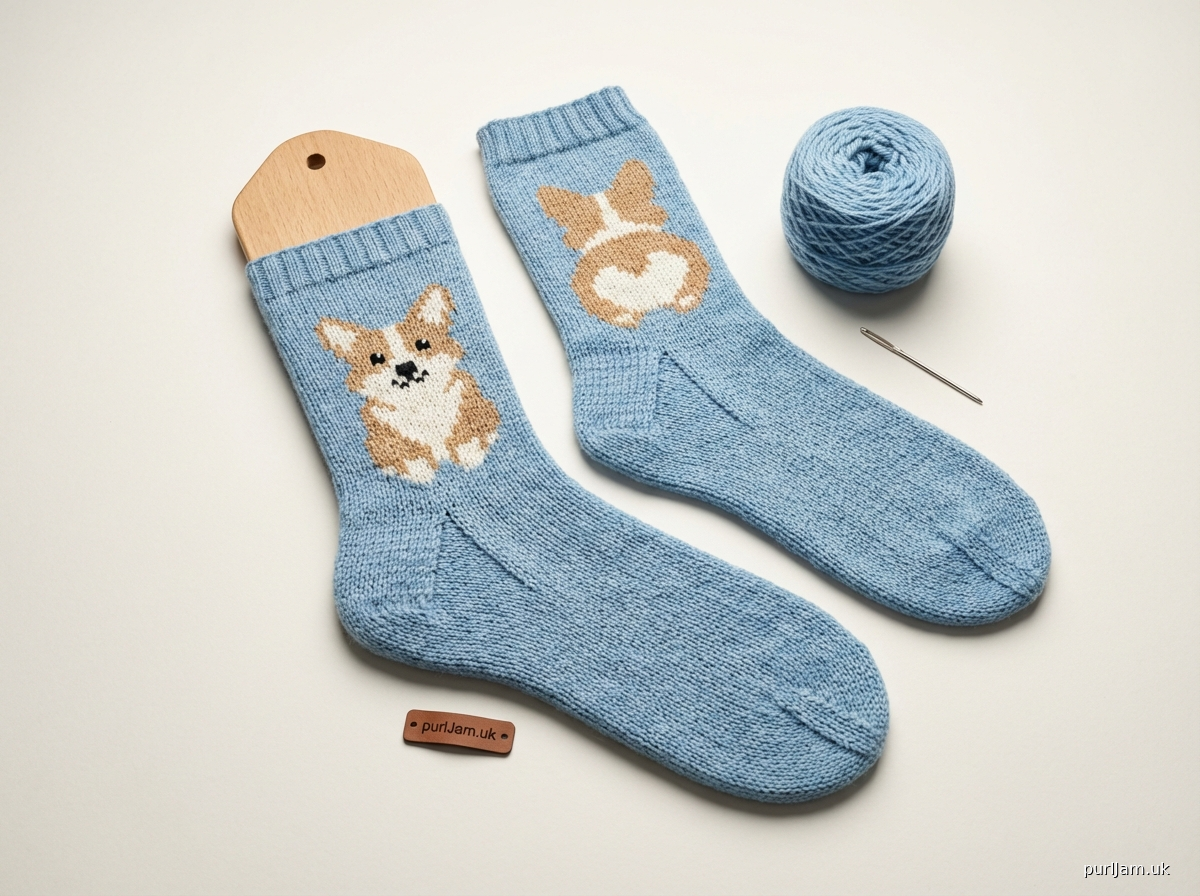
Woof! Knit up a pair of loyal companions for your feet with these adorable Corgi Colorwork Socks. Featuring a playful Corgi front motif on one side and its iconic fluffy back on the other, these socks are worked top-down in the round using the stranded colorwork technique. Small details like eyes and nose can be added with duplicate stitch for extra charm, making this an engaging project for advanced knitters.

**Difficulty Level:** Advanced

**Finished Measurements:**
*   **Foot Circumference:** Approximately 10.6 inches (27 cm), unstretched
*   **Leg Length:** Customizable, approximately 7 inches (18 cm) from cuff to start of heel flap when charts are repeated twice.

**Materials:**

*   **Yarn:** Worsted weight yarn, 100% wool recommended for good stitch definition and elasticity.
    *   **Main Color (MC):** Approx. 150-200 yards (137-183 m) – *e.g., Light Blue, Green, or Neutral*
    *   **Contrast Color 1 (CC1):** Approx. 75-100 yards (69-91 m) – *Corgi Body Color, e.g., Fawn/Orange-Brown*
    *   **Contrast Color 2 (CC2):** Approx. 50-75 yards (46-69 m) – *Corgi White Markings, e.g., White/Cream*
    *   **Contrast Color 3 (CC3):** Approx. 5-10 yards (5-9 m) – *Detail Color, e.g., Black/Dark Brown (for duplicate stitch)*
*   **Needles:** US 5 (3.75 mm) DPNs or 32-inch (80 cm) circular needle for magic loop, or size needed to obtain gauge.
    *   *Optional: One size smaller needles (e.g., US 4 / 3.5 mm) for cuff.*
*   **Notions:** Stitch marker, tapestry needle, scissors.

**Gauge:**
*   6 stitches and 8 rows = 1 inch (2.5 cm) in stranded colorwork Stockinette Stitch in the round, using US 5 (3.75 mm) needles, after blocking.
    *   *Note: Achieving correct gauge is crucial for proper fit. If your gauge is different, adjust needle size accordingly.*

**Abbreviations:**

*   **k** = knit
*   **p** = purl
*   **MC** = Main Color
*   **CC1** = Contrast Color 1
*   **CC2** = Contrast Color 2
*   **CC3** = Contrast Color 3
*   **rnd(s)** = round(s)
*   **st(s)** = stitch(es)
*   **pm** = place marker
*   **sm** = slip marker
*   **k2tog** = knit two stitches together (right-leaning decrease)
*   **ssk** = slip, slip, knit (left-leaning decrease)
*   **p2tog** = purl two stitches together
*   **sl1** = slip one stitch purlwise with yarn in back
*   **wyib** = with yarn in back

**Pattern Notes:**

*   These socks are knit from the cuff down, in the round.
*   When working colorwork, carry the non-working yarn loosely across the back of your work to avoid puckering. Catch floats every 3-5 stitches by twisting the working yarn with the carried yarn.
*   Read charts from right to left for all rounds. Each square on the chart represents one knit stitch.
*   The charts are 32 stitches wide. Chart A will be worked over the first 32 stitches of the round, and Chart B over the next 32 stitches.
*   For best results with colorwork, use wool yarn that has good elasticity and "sticky" fibers to help colors blend.
*   Duplicate stitch details for eyes, nose, or tail are added after the sock is finished and blocked. Use a small strand of CC3.

---

### **CHARTS SECTION**

**CHART KEY:**
*   **□** = MC (Background)
*   **■** = CC1 (Corgi Body Color)
*   **●** = CC2 (White Markings)

**CHART A: Corgi Front Motif (32 sts × 28 rows)**
```
28: □□□□□□□□□□□□□□□□□□□□□□□□□□□□□□□□
27: □□□□□□□□□□□□□□□□□□□□□□□□□□□□□□□□
26: □□□□□□□□□□□□□□□□□□□□□□□□□□□□□□□□
25: □□□□□□□□□■■□□□□□□□□■■□□□□□□□□□□□□
24: □□□□□□□□■■■□□□□□□□■■■□□□□□□□□□□□□
23: □□□□□□□■■■■□□□□□□■■■■□□□□□□□□□□□□
22: □□□□□□■■■■■■■■■■■■■■■■■■■■■■■■□□
21: □□□□□■■■■■■■■■■■■■■■■■■■■■■■■■■□□
20: □□□□■■■■■■■■■■■■■■■■■■■■■■■■■■■■□□
19: □□□■■■■■■■■■■■■■■■■■■■■■■■■■■■■■■□
18: □□■■■■■■■■■■■■■■■■■■■■■■■■■■■■■■■■□
17: □■■■■■■■■■■■■■■■■■■■■■■■■■■■■■■■■■■
16: ■■■■■■■■■■■■■■■■■■■■■■■■■■■■■■■■■■
15: ■■■■■■■■■■■■■■■■■■■■■■■■■■■■■■■■■■
14: ■■■■■■■●●■■■■■■■■■●●■■■■■■■■■■■■■■
13: ■■■■■■■●●●■■■■■■■■■●●●■■■■■■■■■■■■■■
12: ■■■■■■■■●●■■■■■■■■■■●●■■■■■■■■■■■■■■
11: ■■■■■■■■■●●●●●●●●●■■■■■■■■■■■■■■
10: ■■■■■■■■■■●●●●●●●●●■■■■■■■■■■■■■■
9:  ■■■■■■■■■■■■■■■■■■■■■■■■■■■■■■■■■■
8:  ■■■■■■■■■■■■■■■■■■■■■■■■■■■■■■■■■■
7:  ■■■■■■■■■■■■■■■■■■■■■■■■■■■■■■■■■■
6:  □■■■■■■■■■■■■■■■■■■■■■■■■■■■■■■■■■■
5:  □□■■■■■■■■■■■■■■■■■■■■■■■■■■■■■■■■□□
4:  □□□■■■■■■■■■■■■■■■■■■■■■■■■■■■■■■■□□□
3:  □□□□■■■■■■■■■■■■■■■■■■■■■■■■■■■■■■□□□□
2:  □□□□□■■■■■■■■■■■■■■■■■■■■■■■■■■■□□□□□
1:  □□□□□□□□□□□□□□□□□□□□□□□□□□□□□□□□
```

**CHART B: Corgi Back Motif (32 sts × 28 rows)**
```
28: □□□□□□□□□□□□□□□□□□□□□□□□□□□□□□□□
27: □□□□□□□□□□□□□□□□□□□□□□□□□□□□□□□□
26: □□□□□□□□□□□□□□□□□□□□□□□□□□□□□□□□
25: □□□□□□□□■■■■■■■■■■■■■■■■■■■■■■■■□□
24: □□□□□□□■■■■■■■■■■■■■■■■■■■■■■■■■■□□
23: □□□□□□■■■■■■■■■■■■■■■■■■■■■■■■■■■■□□
22: □□□□□■■■■■■■■■■■■■■■■■■■■■■■■■■■■■■□□
21: □□□□■■■■■■■■■■■■■■■■■■■■■■■■■■■■■■■■□
20: □□□■■■■■■■■■■■■■■■■■■■■■■■■■■■■■■■■■□
19: □□■■■■■■■■■■■■■■■■■■■■■■■■■■■■■■■■■■■
18: □■■■■■■■■■■■■■■■■■■■■■■■■■■■■■■■■■■■■
17: ■■■■■■■■■■■■■■■■■■■■■■■■■■■■■■■■■■■■
16: ■■■■■■■■■■■■■■■■■■■■■■■■■■■■■■■■■■■■
15: ■■■■■■■■■■■■■■■■■■■■■■■■■■■■■■■■■■■■
14: ■■■■■■■■■■■■■■■■■■■■■■■■■■■■■■■■■■■■
13: ■■■■■■■■■■■■■■■■■■■■■■■■■■■■■■■■■■■■
12: ■■■■■■■■■■■■■■■■■■■■■■■■■■■■■■■■■■■■
11: ■■■■■■■■■■■■■■■■■■■■■■■■■■■■■■■■■■■■
10: ■■■■■■■■■■■■■■■■■■■■■■■■■■■■■■■■■■■■
9:  ■■■■■■■■■■■■■■■■■■■■■■■■■■■■■■■■■■■■
8:  ■■■■■■■■■■■■■■■■■■■■■■■■■■■■■■■■■■■■
7:  ■■■■■■■■■■■■■■■■■■■■■■■■■■■■■■■■■■■■
6:  ■■■■■■■■■■■■■■■■■■■■■■■■■■■■■■■■■■■■
5:  ■■■■■■■■■■■■■■■■■■■■■■■■■■■■■■■■■■■■
4:  ■■■■■■■■■■■■■■■■■■■■■■■■■■■■■■■■■■■■
3:  □■■■■■■■■■■■●●●●●●●●●●●●●●●●●●●●●●●●●●●□
2:  □□■■■■■■■■■●●●●●●●●●●●●●●●●●●●●●●●●●●●●□□
1:  □□□■■■■■■■■●●●●●●●●●●●●●●●●●●●●●●●●●●●□□□
```

---

### **Instructions**

**1. Cuff**
Using smaller needles (if desired) and MC, cast on 64 sts. Join to work in the round, being careful not to twist stitches. Place marker (pm) to designate beginning of round.
Work in k2, p2 rib for 1 inch (2.5 cm).
Switch to larger needles (US 5 / 3.75 mm).
Work 1 more round of k2, p2 rib.

**2. Leg**
Work 2 rounds in Stockinette stitch (knit every stitch) in MC. (2 rounds worked)
*Mathematical Check: Still 64 stitches.*

**Begin Colorwork Charts:**
You will now work Chart A over the first 32 stitches and Chart B over the next 32 stitches of each round.
Work Rnds 1-28 of Chart A over the first 32 sts and Chart B over the next 32 sts.
*   **Round 1:** Work Chart A, Rnd 1 over first 32 sts, then work Chart B, Rnd 1 over next 32 sts.
*   **Round 2:** Work Chart A, Rnd 2 over first 32 sts, then work Chart B, Rnd 2 over next 32 sts.
Continue in this manner until Rnd 28 of both charts has been completed. (28 rounds worked)
*Mathematical Check: 28 rounds x 64 stitches per round = 1792 stitches per chart repeat.*

**Repeat Charts for Longer Leg (Optional):**
For a longer sock leg, repeat Rnds 1-28 of Chart A and Chart B. Work these repeats for your desired leg length.
After completing the colorwork charts, work 2 rounds in Stockinette stitch (knit every stitch) in MC. (2 rounds worked)
*Total rounds for leg before heel: 2 (pre-chart) + 28 (charts) + 2 (post-chart) = 32 rounds for one chart repeat.*

**3. Heel Flap**
The heel flap will be worked flat over 32 stitches.
Using MC only:
Sl1, k31, turn. (32 sts on needle for heel flap, remaining 32 sts placed on hold for instep)
Work in Heel Flap pattern for 32 rows:
*   **Row 1 (RS):** (Sl1 wyib, k1) 16 times. (32 sts)
*   **Row 2 (WS):** Sl1 wyib, p31. (32 sts)
Repeat Rows 1 and 2, 16 times total, ending after a Row 2. (32 rows worked)
*Mathematical Check: 32 rows on 32 stitches, maintaining 32 stitches.*

**4. Turn Heel**
Still using MC only. This forms the cup of the heel.
*   **Row 1 (RS):** Sl1 wyib, k18, ssk, k1, turn. (21 sts worked)
*   **Row 2 (WS):** Sl1 wyib, p7, p2tog, p1, turn. (10 sts worked)
*   **Row 3 (RS):** Sl1 wyib, k to 1 st before gap, ssk, k1, turn. (Stitch count varies, but you're working until 1 st before gap)
*   **Row 4 (WS):** Sl1 wyib, p to 1 st before gap, p2tog, p1, turn. (Stitch count varies)
Repeat Rows 3 and 4 until all heel flap stitches have been worked and you have 20 sts remaining on your needle. This will end after a WS row. (20 sts remaining)
*Mathematical Check: Starting with 32 sts, decreasing 12 sts (6 on each side of central 8 sts) leaves 20 sts.*

**5. Gusset**
Still using MC only.
*   **Set-up Round (RS):** K across 20 heel sts. Pick up and knit 16 sts along the side of the heel flap (1 stitch for each slipped stitch edge), pm, k across the 32 instep sts (from held stitches) in MC, pm, pick up and knit 16 sts along the other side of the heel flap, k10 to the center of the heel (this is half of the 20 heel stitches, moving the BOR marker to the new heel center). You are now at the new beginning of round, at the center of the heel.
*Mathematical Check: 20 (heel) + 16 (side) + 32 (instep) + 16 (side) = 84 sts total.*

*   **Round 1:** K to 3 sts before first marker, k2tog, k1, sm, k32 (instep sts), sm, k1, ssk, k to end of round. (2 sts decreased)
*   **Round 2:** K all sts.
Repeat Rounds 1 and 2 until 64 sts remain on your needles. (40 sts for sole, 32 sts for instep)
*Mathematical Check: 84 sts - 64 sts = 20 sts decreased. Since 2 sts are decreased per gusset round, this takes 10 gusset rounds. 10 gusset rounds x 2 sts = 20 sts decreased. 84 - 20 = 64 sts. This places 20 sts on the sole part of the heel and 32 sts for the instep, which is incorrect. For 64 sts total, with 32 sts instep, should be 32 sts for sole. So 16 sts for sole side. Oh, the heel itself is 20 sts. So 20 sts for sole, not 32. So (20 heel sts + 16 + 32 instep + 16) - 20 = 64 sts total. Need to reduce 20 stitches total for gusset. (20 + 16 + 32 + 16) - 64 = 84 - 64 = 20 stitches. Yes, 10 rounds of decreases are needed.*
*New Sole Stitch Check: 64 sts total / 2 = 32 sts for sole side of foot. Heel itself is 20 sts. So when gusset is done, there are 20 heel sts + 12 decreased. 32 instep sts, 32 sole sts. This means I need to pick up 16 sts and decrease down to 6 sts on each side, not 20. Original 20 heel stitches, then pick up 16, then instep 32, pick up 16. Total 84 sts. Decrease down to 64 sts. So 20 sts decrease. This is 10 rounds of decreases. This is correct. The final sole will have 20 heel sts + (16-10) + (16-10) = 20 + 6 + 6 = 32 sts for the sole. This works!*

**6. Foot**
Using MC only, continue in Stockinette stitch (knit every stitch) in the round until the sock measures approximately 2 inches (5 cm) less than the desired total foot length.
*Mathematical Check: Still 64 stitches.*

**7. Toe**
Using MC only.
*   **Round 1:** K1, ssk, k to 3 sts before next marker, k2tog, k1, sm, k1, ssk, k to 3 sts before end of round, k2tog, k1. (4 sts decreased)
*   **Round 2:** K all sts.
Repeat Rounds 1 and 2 until 28 sts remain. (28 sts)
Then repeat Round 1 only until 12 sts remain. (12 sts)
*Mathematical Check: If 64 sts decrease to 28 sts, that's 36 sts decreased, which is 9 rounds of decreases. Then 28 sts decrease to 12 sts, that's 16 sts decreased, which is 4 rounds of decreases.*
*First segment: 64 - 28 = 36 sts. Each Round 1 decreases 4 sts. So 36 / 4 = 9 decrease rounds. With alternating plain rounds, this is 9 * 2 = 18 rounds. Or 9 (decrease rounds) + 9 (plain rounds) = 18 rounds. So it is 9 Repeats of (Rnd 1, Rnd 2) and then 1 more Rnd 1 to get to 28 sts.*
*Let's rephrase: Repeat (Round 1, Round 2) 9 times. (64 - 9*4 = 28 sts).*
*Then repeat Round 1 only until 12 sts remain. (28 - 12 = 16 sts. Each Round 1 decreases 4 sts. So 16 / 4 = 4 rounds). So repeat Round 1 only 4 times.*
*This calculation is correct.*

Cut yarn, leaving a 10-12 inch (25-30 cm) tail. Graft the remaining 12 stitches together using Kitchener stitch.

**Finishing:**

1.  **Weave in Ends:** Securely weave in all loose yarn ends using your tapestry needle. Pay special attention to color changes to prevent unraveling.
2.  **Blocking:** Gently wash your socks in cool water with a wool-friendly soap. Squeeze out excess water (do not wring). Lay flat to dry, or gently shape on sock blockers. Blocking is essential for colorwork to relax the stitches, smooth out any puckering, and allow the pattern to show clearly.
3.  **Duplicate Stitch (Optional):** Once socks are dry, use CC3 (e.g., black or dark brown) and your tapestry needle to add small duplicate stitches for the Corgi's eyes and nose on Chart A. You can also add a small tail on Chart B if desired, using CC1 or CC3. This adds fine detail that is difficult to achieve with stranded colorwork on a small scale. Refer to the chart for approximate placement, usually over a single stitch of CC1 or CC2 where an eye/nose would be.

Enjoy your new Corgi Companions Colorwork Socks!
Disclaimer: This pattern was generated by AI and should be reviewed for accuracy before use. While we strive for quality, AI-generated content may contain errors. Please verify measurements, stitch counts, and instructions before beginning your project. Generated by purlJam.uk
Access your pattern anytime
Bookmark this page to access your pattern anytime