Type
Crochet
Difficulty
intermediate
Category
pullover
AI Thinking Process
Planning
Verification
Pattern
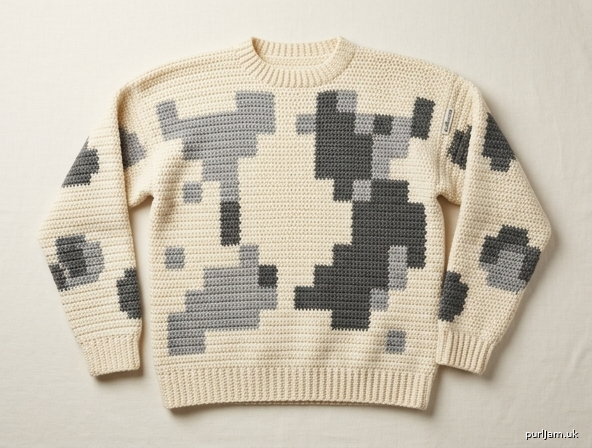
Cow Hide Pullover
Classic Crochet Crewneck with Cow-Print Colorwork
A hip-length pullover worked in double crochet with stretchy single-crochet ribbing. Irregular black spots are scattered over a cream field to mimic cow hide. Pieces are worked flat from the bottom up and seamed. Colorwork uses simple bobbin intarsia (no floats), so the only extra skill is changing color in the last yarn-over of a stitch.
Skill level: Beginner (color changing)
Sizes
Small (Medium, Large, XL, 2XL)
To fit bust: 34–36 (38–40, 42–44, 46–48, 50–52)" / 86.5–91.5 (96.5–101.5, 106.5–112, 117–122, 127–132) cm
Instructions are written for Small with changes for larger sizes in parentheses. When only one number is given, it applies to all sizes. Circle your size throughout before you begin.
Finished measurements
Bust (seamed): 38 (42, 46, 50, 54)" / 96.5 (106.5, 117, 127, 137) cm
Back width: 19 (21, 23, 25, 27)" / 48.5 (53.5, 58.5, 63.5, 68.5) cm
Length (shoulder to hem): 23 (24, 25, 26, 27)" / 58.5 (61, 63.5, 66, 68.5) cm
Armhole depth: 8 (8.5, 9, 9.5, 10)" / 20.5 (21.5, 23, 24, 25.5) cm
Cross-back after armhole indent: 17.25 (18.75, 20, 21.75, 22.75)" / 44 (47.5, 51, 55, 58) cm
Upper arm: 13.25 (14.25, 16, 17.75, 18.75)" / 33.5 (36, 40.5, 45, 47.5) cm
Sleeve length to underarm (including cuff): 17.5 (18, 18, 18.5, 18.5)" / 44.5 (45.5, 45.5, 47, 47) cm
Cuff circumference: 8 (8.5, 9, 9.5, 10)" / 20.5 (21.5, 23, 24, 25.5) cm
Shoulder seam: 4.75 (5.5, 5.75, 6.25, 6.5)" / 12 (14, 14.5, 16, 16.5) cm
Back neck width: 7.5 (8, 8.5, 9.25, 9.75)" / 19 (20.5, 21.5, 23.5, 25) cm
Ease is about 2–4" (5–10 cm) over the body measurement. Choose the size whose to-fit range matches your bust.
Materials
Yarn: Worsted weight (#4 Medium), smooth, high-contrast, not heavily heathered.
- MC (cream, ivory, or off-white): 800 (900, 1050, 1200, 1350) yd / 730 (825, 960, 1100, 1235) m
- CC (black): 400 (450, 500, 600, 700) yd / 365 (410, 460, 550, 640) m
Exact amounts vary with how densely you place spots. Buy an extra skein of each color if your spots are large or frequent.
Hooks:
- US I-9 (5.5 mm), or size needed to obtain gauge — body and sleeves
- US H-8 (5 mm), or one size smaller than body hook — ribbing and neckband
Notions: Yarn needle; 4 stitch markers; scissors; 8–12 yarn bobbins or butterfly windings for CC spots; 2 extra MC balls or both ends of the MC skein for working on either side of a large spot.
Gauge
14 dc and 8 rows = 4" (10 cm) over double crochet with US I-9 (5.5 mm), blocked.
Ribbing (optional check): 16 sc BLO and 16 rows = 4" (10 cm) with US H-8 (5 mm).
Make two swatches:
- Solid MC double crochet, at least 6" (15 cm) square. Wash and block. Count the center 4" (10 cm).
- A small cow-print swatch (one or two spots) in intarsia. Your colorwork gauge must match the solid gauge. If spots pull in, go up a hook size for the body.
Change hook size until you match 14 dc = 4" (10 cm). A ½" (1.3 cm) miss over 4" becomes about 2" (5 cm) off at bust. Do not skip this step.
Abbreviations (US)
BLO — back loop only
CC — contrast color (black)
ch — chain
dc — double crochet
dc2tog — double crochet 2 together (decrease 1)
MC — main color (cream)
rep — repeat
RS — right side
sc — single crochet
sl st — slip stitch
st(s) — stitch(es)
WS — wrong side
dc2tog: Yarn over, insert hook in next st, yarn over, pull up a loop, yarn over, pull through 2 loops (2 loops on hook); yarn over, insert hook in following st, yarn over, pull up a loop, yarn over, pull through 2 loops (3 loops on hook); yarn over, pull through all 3 loops.
Notes
- US crochet terms throughout. Turning ch-3 counts as the first dc of the row. Work the last dc of each row into the top of the turning ch-3 unless told otherwise.
- Pieces are worked flat, bottom up: hem ribbing is made sideways, then the body is worked across the long edge in dc.
- Join new yarn and fasten off at the start of a row when possible. Weave ends as you go — cow print creates many of them.
- Keep the first and last stitch of every body/sleeve row in MC so side and sleeve seams stay one color.
- Stitch counts appear in bold at the end of a row or section. Counts include the turning ch-3 as 1 dc.
Cow-hide colorwork
The fabric is a cream field with scattered, irregular black spots — large ovals, kidney shapes, and uneven blobs, not polka dots and not a repeating stripe. Spots vary in size; some may run off the edge of a piece. Leave more cream than black (about two-thirds MC).
If you have a cow-print chart, center it on the Front, Back, and each Sleeve and work the charted colors in intarsia, reading RS rows from right to left and WS rows from left to right. Skip ribbing and neckband (those stay solid MC).
If you are working without a chart, use the freeform method below. Do not try to copy a hide stitch-for-stitch; aim for the same overall look on Front and Back so the seamed sweater feels balanced.
Intarsia (bobbin) method — use this, do not carry CC across MC:
- Wind 8–12 small CC bobbins (about 8–20 yd / 7–18 m each). Use a separate bobbin for every spot that is “live” on the row. Use a second MC source when a large spot splits the cream field.
- Change color in the last yarn-over of the last stitch of the old color: yarn over with the new color and complete the stitch. The new color sits on top, ready for the next stitch.
- At every color change, twist the two yarns once (bring the old color over the new) so a hole does not form.
- Drop the idle yarn to the WS and pick it up again on the next row when that spot continues.
- When a spot is finished, cut CC, leaving a 6" (15 cm) tail, and weave it in on the WS.
Freeform spot recipe (no chart):
- Small spot: CC over 3–5 sts for 2–3 rows, narrowing by 1 st each side on the last row.
- Medium spot: CC over 6–10 sts for 3–5 rows; grow or shrink 1 st from the previous CC block so the outline is uneven.
- Large spot: CC over 10–16 sts for 5–8 rows; offset the start by 1–2 sts each row so the shape is lopsided, not a circle.
- Start spots on different rows and at different distances from the edges. A good beginner layout: 5–8 spots on Back, 5–8 on Front, 3–5 on each Sleeve.
- Space spots so cream shows between them — typically a few inches of MC, sometimes less where two spots almost touch.
- Do not stack identical spots in a column; cow hide is random.
- Pause colorwork 2 rows before the shoulder and 1 st from each side edge if it keeps seaming easier.
Practice two or three spots on your colorwork swatch before you start the Back.
Pattern
Back
Hem ribbing (MC, smaller hook)
With US H-8 (5 mm) and MC, ch 11.
Row 1: Sc in 2nd ch from hook and in each ch across, turn. 10 sc.
Row 2: Ch 1, sc BLO in each st across, turn. 10 sc.
Rep Row 2 until the strip measures 19 (21, 23, 25, 27)" / 48.5 (53.5, 58.5, 63.5, 68.5) cm, slightly stretched along the long edge, ending after a WS row. Do not fasten off.
The 10 sc stand 2½" (6.5 cm) tall and become the hem. The number of ribbing rows does not need to match the dc count; you will space the first dc row evenly.
Body (larger hook, begin colorwork)
Change to US I-9 (5.5 mm). Turn the ribbing so the long edge is on top (ribbing ridges run vertically).
Row 1 (RS): Ch 3 (counts as dc here and throughout), work 65 (73, 79, 87, 93) more dc evenly across the long edge of the ribbing, changing to CC for any spot that begins on this row, turn. 66 (74, 80, 88, 94) dc.
(Spacing check: you need 66 (74, 80, 88, 94) dc over 19 (21, 23, 25, 27)"; skip or double-up in a ribbing row-end now and then so the edge does not ruffle or pull.)
Rows 2–25 (26, 27, 28, 29): Ch 3, dc in each dc across, following your cow-print placement, turn. 66 (74, 80, 88, 94) dc.
Piece measures about 12.5 (13, 13.5, 14, 14.5)" / 32 (33, 34.5, 35.5, 37) cm from the top of the ribbing, and 15 (15.5, 16, 16.5, 17)" / 38 (39.5, 40.5, 42, 43) cm from the cast-on edge of the hem. (25 (26, 27, 28, 29) rows × ½" = 12.5 (13, 13.5, 14, 14.5)" ✓)
Shape armholes
Next row (RS): Sl st loosely in first 3 (4, 5, 6, 7) sts, ch 3 (counts as dc), dc in each st across until 3 (4, 5, 6, 7) sts remain, leave remaining sts unworked, turn. 60 (66, 70, 76, 80) dc.
(66 − 3 − 3 = 60; 74 − 4 − 4 = 66; 80 − 5 − 5 = 70; 88 − 6 − 6 = 76; 94 − 7 − 7 = 80 ✓)
Next 15 (16, 17, 18, 19) rows: Ch 3, dc in each dc across, turn. 60 (66, 70, 76, 80) dc.
Armhole measures 8 (8.5, 9, 9.5, 10)" / 20.5 (21.5, 23, 24, 25.5) cm — 16 (17, 18, 19, 20) rows including the indent row. (16 × ½" = 8"; 17 × ½" = 8.5"; 18 × ½" = 9"; 19 × ½" = 9.5"; 20 × ½" = 10" ✓)
Total length from hem: 23 (24, 25, 26, 27)" / 58.5 (61, 63.5, 66, 68.5) cm.
Shape back neck
Last row: Ch 3, dc in next 16 (18, 19, 21, 22) sts (shoulder = 17 (19, 20, 22, 23) dc including turning ch). Fasten off.
Skip center 26 (28, 30, 32, 34) sts for back neck. Join MC (or working color) in the next st, ch 3, dc in each remaining st across. 17 (19, 20, 22, 23) dc. Fasten off.
(17 + 26 + 17 = 60; 19 + 28 + 19 = 66; 20 + 30 + 20 = 70; 22 + 32 + 22 = 76; 23 + 34 + 23 = 80 ✓)
Front
Work Hem ribbing and Body exactly as for Back through the end of Rows 2–25 (26, 27, 28, 29). 66 (74, 80, 88, 94) dc.
Shape armholes
Work the armhole indent row as for Back. 60 (66, 70, 76, 80) dc.
Next 9 (10, 11, 12, 13) rows: Ch 3, dc in each dc across, turn. 60 (66, 70, 76, 80) dc.
Front matches Back to 3" (7.5 cm) before the shoulder. (1 indent row + 9 (10, 11, 12, 13) even + 6 neck rows = 16 (17, 18, 19, 20) armhole rows ✓)
Shape left neck (as worn; this is the first shoulder you work, beginning at the armhole edge)
Divide row (RS): Ch 3, dc in next 18 (20, 21, 23, 24) sts, turn, leaving remaining sts unworked. 19 (21, 22, 24, 25) dc.
Neck dec row (WS): Ch 3, dc2tog (neck edge), dc in each st to end, turn. 18 (20, 21, 23, 24) dc.
Neck dec row (RS): Ch 3, dc in each st to last 2 sts, dc2tog, turn. 17 (19, 20, 22, 23) dc.
Next 3 rows: Ch 3, dc in each dc across, turn. 17 (19, 20, 22, 23) dc.
Fasten off. Left shoulder matches Back shoulder count. (19 − 1 − 1 = 17; 21 − 1 − 1 = 19; 22 − 1 − 1 = 20; 24 − 1 − 1 = 22; 25 − 1 − 1 = 23 ✓)
Shape right neck
With RS facing, skip center 22 (24, 26, 28, 30) sts, join yarn in the next st.
Divide row (RS): Ch 3, dc in each st to end, turn. 19 (21, 22, 24, 25) dc.
(19 + 22 + 19 = 60; 21 + 24 + 21 = 66; 22 + 26 + 22 = 70; 24 + 28 + 24 = 76; 25 + 30 + 25 = 80 ✓)
Neck dec row (WS): Ch 3, dc in each st to last 2 sts, dc2tog (neck edge), turn. 18 (20, 21, 23, 24) dc.
Neck dec row (RS): Ch 3, dc2tog, dc in each st to end, turn. 17 (19, 20, 22, 23) dc.
Next 3 rows: Ch 3, dc in each dc across, turn. 17 (19, 20, 22, 23) dc.
Fasten off. Front and Back shoulders are the same height. Front neck opening at the base plus the 2 decreases each side equals the back neck: 22 + 2 + 2 = 26; 24 + 2 + 2 = 28; 26 + 2 + 2 = 30; 28 + 2 + 2 = 32; 30 + 2 + 2 = 34 ✓
Sleeves (make 2)
Cuff ribbing (MC, smaller hook)
With US H-8 (5 mm) and MC, ch 11.
Row 1: Sc in 2nd ch from hook and in each ch across, turn. 10 sc.
Row 2: Ch 1, sc BLO in each st across, turn. 10 sc.
Rep Row 2 until the strip measures 8 (8.5, 9, 9.5, 10)" / 20.5 (21.5, 23, 24, 25.5) cm, slightly stretched, ending after a WS row. Do not fasten off.
Sleeve body (larger hook, begin colorwork)
Change to US I-9 (5.5 mm). Turn ribbing so the long edge is on top.
Row 1 (RS): Ch 3, work 27 (29, 31, 33, 35) more dc evenly across the long edge, turn. 28 (30, 32, 34, 36) dc.
Work in dc, placing cow-print spots as on the body. Increase as follows.
Increase row: Ch 3, dc in first st (inc made at the start; turning ch + extra dc into the same st), dc in each st to last st, 2 dc in last st, turn. +2 sts.
Small only: Work Increase row every 3rd row 9 times (increase on Rows 3, 6, 9, 12, 15, 18, 21, 24, and 27), then work 3 rows even (Rows 28–30).
(9 × 2 = 18 sts increased; 28 + 18 = 46 dc ✓. 30 rows × ½" = 15" / 38 cm above cuff ✓)
Medium only: Work Increase row every 3rd row 10 times (increase on Rows 3, 6, 9, 12, 15, 18, 21, 24, 27, and 30).
(10 × 2 = 20; 30 + 20 = 50 dc ✓. 30 rows = 15" / 38 cm ✓)
Large only: Work Increase row every other row 12 times (increase on Rows 2, 4, 6, 8, 10, 12, 14, 16, 18, 20, 22, and 24), then work 7 rows even (Rows 25–31).
(12 × 2 = 24; 32 + 24 = 56 dc ✓. 31 rows = 15.5" / 39.5 cm ✓)
XL only: Work Increase row every other row 14 times (increase on Rows 2, 4, 6, 8, 10, 12, 14, 16, 18, 20, 22, 24, 26, and 28), then work 4 rows even (Rows 29–32).
(14 × 2 = 28; 34 + 28 = 62 dc ✓. 32 rows = 16" / 40.5 cm ✓)
2XL only: Work Increase row every other row 15 times (increase on Rows 2, 4, 6, 8, 10, 12, 14, 16, 18, 20, 22, 24, 26, 28, and 30), then work 2 rows even (Rows 31–32).
(15 × 2 = 30; 36 + 30 = 66 dc ✓. 32 rows = 16" / 40.5 cm ✓)
All sizes, after increases: 46 (50, 56, 62, 66) dc.
Sleeve measures 17.5 (18, 18, 18.5, 18.5)" / 44.5 (45.5, 45.5, 47, 47) cm from the cuff edge including 2½" (6.5 cm) ribbing.
Shape sleeve cap
Cap row 1: Sl st loosely in first 3 (4, 5, 6, 7) sts, ch 3, dc in each st until 3 (4, 5, 6, 7) sts remain, leave remaining sts unworked, turn. 40 (42, 46, 50, 52) dc.
(46 − 3 − 3 = 40; 50 − 4 − 4 = 42; 56 − 5 − 5 = 46; 62 − 6 − 6 = 50; 66 − 7 − 7 = 52 ✓. Indent matches body armhole.)
Cap rows 2–3 (2–4, 2–3, 2–3, 2–3): Ch 3, dc in each dc across, turn. 40 (42, 46, 50, 52) dc.
(2 (3, 2, 2, 2) even rows.)
Decrease row: Ch 3, dc2tog, dc in each st to last 2 sts, dc2tog, turn. −2 sts.
Rep Decrease row 13 (13, 15, 16, 17) times. 14 (16, 16, 18, 18) dc.
(40 − 26 = 14; 42 − 26 = 16; 46 − 30 = 16; 50 − 32 = 18; 52 − 34 = 18 ✓)
Fasten off.
Cap is 16 (17, 18, 19, 20) rows = 8 (8.5, 9, 9.5, 10)" / 20.5 (21.5, 23, 24, 25.5) cm, matching armhole depth.
(Small: 1 indent + 2 even + 13 dec = 16 rows ✓; Medium: 1 + 3 + 13 = 17 ✓; Large: 1 + 2 + 15 = 18 ✓; XL: 1 + 2 + 16 = 19 ✓; 2XL: 1 + 2 + 17 = 20 ✓)
Work the second sleeve the same way. Mirror the general spot scale (not a stitch-for-stitch copy) so the sleeves look related.
Finishing
Weave in remaining ends on the WS. Block pieces to the schematic measurements. Pin spots so they stay irregular; do not stretch black areas harder than cream or the hide pattern will warp.
Seams
Use MC and a yarn needle. Mattress stitch (invisible seam) or whip stitch through the back loops of the edge stitches. A sl st crochet seam also works if you prefer to seam with a hook.
- Shoulders: Seam Front to Back at each shoulder, matching the 17 (19, 20, 22, 23) sts. 17 (19, 20, 22, 23) sts each shoulder ✓
- Set in sleeves: Pin the center of the sleeve cap to the shoulder seam. Pin the cap indent corners to the body indent corners. Ease the cap evenly around the armhole and sew.
- Side and underarm: Sew each side seam from hem to underarm, then continue down the sleeve from underarm to cuff, matching ribbing ridges.
Neckband (MC, smaller hook)
With US H-8 (5 mm), RS facing, join MC at a shoulder seam.
Round 1: Ch 1, sc evenly around the neck, working:
- 1 sc in each back-neck dc,
- 2 sc in each dc row-end along the front neck slopes (6 rows × 2 sc = 12 sc per slope),
- 1 sc in each unworked front-neck dc,
- 1 extra sc in any inside corner that looks like a hole.
Join with sl st to first sc. Do not twist. Place a marker at the join.
Count your stitches. The band must be able to stretch over the head (at least 22" / 56 cm stretched). If Round 1 is tight, redo it with more stitches; if it flares, skip 2–4 sts evenly.
Rounds 2–6: Ch 1, sc BLO in each sc around, join with sl st to first sc.
Round 7: Ch 1, sc BLO in each sc around, join. Fasten off.
Six BLO rounds give about 1¼–1½" (3–4 cm) of stretchy rib. For a slightly higher crew, work 8–10 rounds.
Final
Weave in neckband ends. Steam the seams lightly if the yarn allows (do not flatten the ribbing). Let dry fully.
Schematic measurements (blocked)
Back / Front
- Hem width: 19 (21, 23, 25, 27)" / 48.5 (53.5, 58.5, 63.5, 68.5) cm
- Hem ribbing height: 2½" / 6.5 cm
- Underarm length above ribbing: 12.5 (13, 13.5, 14, 14.5)" / 32 (33, 34.5, 35.5, 37) cm
- Armhole indent each side: about ¾ (1, 1½, 1¾, 2)" / 2 (2.5, 4, 4.5, 5) cm
- Armhole depth: 8 (8.5, 9, 9.5, 10)" / 20.5 (21.5, 23, 24, 25.5) cm
- Full length: 23 (24, 25, 26, 27)" / 58.5 (61, 63.5, 66, 68.5) cm
- Each shoulder: 4.75 (5.5, 5.75, 6.25, 6.5)" / 12 (14, 14.5, 16, 16.5) cm
- Back neck: 7.5 (8, 8.5, 9.25, 9.75)" / 19 (20.5, 21.5, 23.5, 25) cm
- Front neck drop: 3" / 7.5 cm
Sleeve
- Cuff: 8 (8.5, 9, 9.5, 10)" / 20.5 (21.5, 23, 24, 25.5) cm
- Cuff ribbing height: 2½" / 6.5 cm
- Length to underarm: 17.5 (18, 18, 18.5, 18.5)" / 44.5 (45.5, 45.5, 47, 47) cm
- Upper arm: 13.25 (14.25, 16, 17.75, 18.75)" / 33.5 (36, 40.5, 45, 47.5) cm
- Cap height: 8 (8.5, 9, 9.5, 10)" / 20.5 (21.5, 23, 24, 25.5) cm
Beginner checkpoints
- After Back ribbing, the strip should reach your size width when slightly stretched.
- After the first dc row you must have 66 (74, 80, 88, 94) sts — recount before you add spots.
- After the armhole indent you must have 60 (66, 70, 76, 80) sts.
- Front shoulders must equal Back shoulders: 17 (19, 20, 22, 23) sts each.
- Sleeve before cap: 46 (50, 56, 62, 66) sts.
- If the sweater is narrow, your gauge is tight (too many sts per 4"). If it is wide, your gauge is loose. Recheck before starting the Front.
Wear with jeans or over a black turtleneck; the cream field and black spots read as cow hide from a distance and as casual colorwork up close.
Disclaimer: This pattern was generated by AI and should be reviewed for accuracy before use. While we strive for quality, AI-generated content may contain errors. Please verify measurements, stitch counts, charts, and instructions before beginning your project. Generated by purlJam.uk
Love this pattern?
Save this pattern to your free PurlJam libraryAccess your pattern anytime
Bookmark this page to access your pattern anytime