Type
Crochet
Difficulty
beginner
Category
amigurumi
AI Thinking Process
Planning
1. **Design Strategy**:
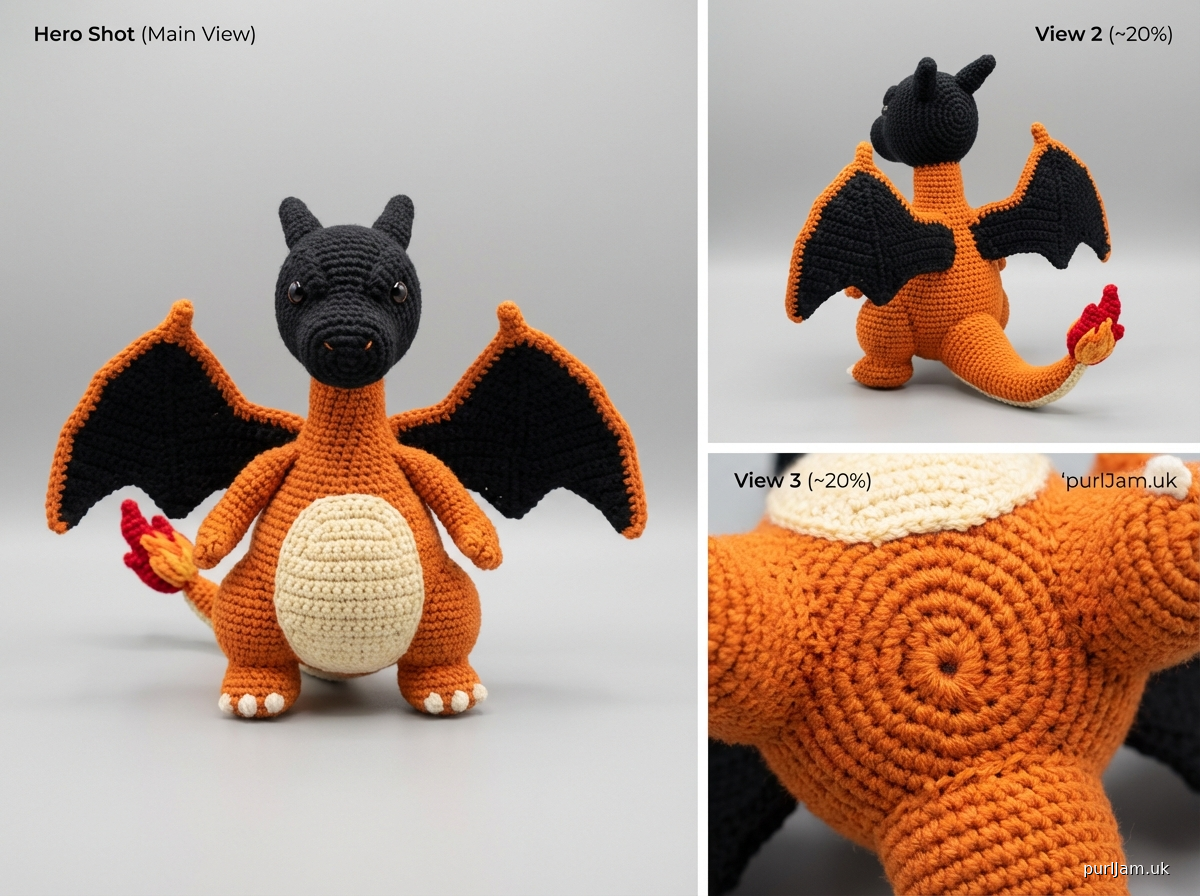
- "Chairizard" appears to be a blend of "Charizard" (the fire-type Pokémon) and "chair" — most likely the user means **Charizard** (common phonetic misspelling). I will treat this as a Charizard amigurumi with the requested customization: **black wings** and **black head** (instead of the standard orange/tan coloring), making it a "Shiny-inspired" or custom dark Charizard.
- Key physical features of Charizard to include:
- **Body**: Large orange → we'll keep orange body for contrast, or we can do all-black with orange belly. User said "black head" and "black wings" — body can remain orange for contrast (classic Charizard palette altered).
- **Head**: Black
- **Wings**: Black (large, dragon-style)
- **Body**: Orange (standard Charizard orange)
- **Belly/Chest**: Cream/off-white or light tan
- **Tail with flame tip**: Orange tail, red/yellow flame
- **Horns**: Small, tan/cream
- **Arms/Legs**: Orange
- **Eyes**: White with black pupils (or safety eyes)
- **Nostrils**: Small embroidered details
- No magic rings → use **chain 2, work stitches into 2nd chain from hook** method OR **adjustable foundation method using chain loop** — actually the cleanest beginner alternative to magic ring is: **Chain 2, work X sc into the 2nd chain from hook**. I'll use this method throughout.
- No slip stitch rings → confirmed, no closed rings. All rounds begin with the chain-2 alternative.
- Template: Crochet Toy - Simple Shapes → use sphere for head, cylinder/tube for body, cone for tail, flat shapes for wings.
- Difficulty: Beginner → keep shapes simple, minimize complex assembly.
2. **Construction Plan**:
- **Head**: Sphere shape (black yarn), Ch 2, sc into 2nd ch from hook = 6 sc start. Increase to 24 sts, add some even rounds, decrease and stuff.
- **Body**: Oval/egg shape (orange), larger than head, stuffed firmly.
- **Tail**: Cone/elongated tube (orange), tapers from body. Flame tip added separately in red/yellow.
- **Wings** (x2): Flat panels (black), made in a fan/triangular shape using rows of dc/hdc with increases. Simple flat construction.
- **Arms** (x2): Short cylinder (orange).
- **Legs** (x2): Slightly longer cylinder (orange) with small toe bumps.
- **Belly Patch**: Flat oval in cream, sewn onto front of body.
- **Horns** (x2): Tiny cones (tan/cream), sewn to top of head.
- **Flame tip**: Small tapered shape in red/yellow gradient, sewn to tail end.
- Assembly: Sew head to body, wings to back of body, arms/legs to sides, tail to back-bottom.
3. **Quality Assurance**:
- **Magic ring alternative**: Chain 2, sc into 2nd chain from hook. For 6 sc: ch 2, 6 sc in 2nd ch from hook, pull tight. This works cleanly.
- **No slip stitch rings**: All rounds are joined-free (continuous spiral) OR I'll use a slip stitch join method that isn't a "slip stitch ring start." Actually the user says "without magic rings or slip stitch rings" — this means the START method only. I'll use ch-2 method for all piece starts. Rounds can still be worked in continuous spiral (standard amigurumi style).
- **Wing construction**: For a beginner, flat wings using rows (back and forth, ch+sc/hdc) with increases will be clearest. A simple triangular/fan shape.
- **Stitch counts**: Will verify each round adds the correct number.
- **Size**: Worsted weight, E-4 to G-6 hook → expect approximately 4-6" finished toy.
- **Charizard proportions**: Body slightly larger than head; tail about same length as body; wings large (signature feature).
- **Color management**: 4 colors — Black (head, wings), Orange (body, arms, legs, tail), Cream/off-white (belly, horns), Red or Yellow (flame tip).
4. **Final Calculations**:
- **Head (sphere, black)**: Ch2, 6 sc in 2nd ch → 6, inc each=12, (sc,inc)=18, (2sc,inc)=24, 4 even rounds at 24, (2sc,dec)=18, stuff, (sc,dec)=12, dec around=6, close. ✓
- **Body (larger sphere/oval, orange)**: Ch2, 6sc→6, inc=12, (sc,inc)=18, (2sc,inc)=24, (3sc,inc)=30, 6 even rounds at 30, (3sc,dec)=24, (2sc,dec)=18, stuff, (sc,dec)=12, dec=6, close. ✓
- **Tail (cone, orange)**: Ch2, 4sc, (sc,inc)=6, even=6, (2sc,inc)=8, even=8, (3sc,inc)=10, even x2=10, (4sc,inc)=12, 2 even=12. Tapers from thin tip to base attachment. ✓
- **Arms (cylinder, orange, x2)**: Ch2, 6sc, inc=12, 5 even rounds at 12, dec round=6, close. ~1.5" long. ✓ Actually for simple tube: ch2, 6sc, inc=12, 4-5 even rounds, fasten off leaving long tail for sewing. Don't close top (attach to body open).
- **Legs (cylinder, orange, x2)**: Ch2, 8sc (slightly wider), inc=16, 4 even rounds, dec to close top. Actually let's keep simple: ch2, 6sc, inc=12, inc=18 for foot width at bottom... Let me simplify: Ch2, 6sc, inc=12, 3 even rnds, pinch and sew closed or stuff lightly.
- **Wings (flat, black, x2)**: Worked in rows. Ch 8 foundation. Row 1: sc across (7 sts). Row 2-3: ch 3, dc across with inc at beginning (fan shape). Let me design a simple fan wing in rows with increases on one side to create the angled dragon-wing shape.
- **Belly patch (flat oval, cream)**: Ch 4 oval start → 8, 14 sts oval, 2 even rounds. Sew to front of body.
- **Horns (x2, tiny cone, cream)**: Ch2, 3sc, inc=6 (just 1 round increase), 2 even rounds, pinch and sew.
- **Flame (red/yellow, small tapered piece)**: Ch2, 4sc, (sc,inc)=6, 2 even rounds at 6, pinch closed. Or simple embroidery on tail tip.
Let me finalize the wing design more carefully since that's a signature feature:
**Wing (black, make 2) - Fan Shape worked flat**:
- Ch 2, 4 sc in 2nd ch from hook [4] (this is the wing tip)
- Row 1: Turn, ch 1, inc, sc, inc [6] — wait, this isn't quite right for a wing shape.
Better wing approach (flat, rows):
- Starting at the top point of the wing:
- Ch 2, 3 hdc in 2nd ch from hook [3] — this is the wing tip
- Turn, ch 2 (counts as hdc), hdc in first st, 2 hdc in each remaining st [6]
- Turn, ch 2, hdc in first st, hdc across to last st, 2 hdc in last st [8]
- Turn, ch 2, hdc in first st, hdc across to last st, 2 hdc in last st [10]
- Turn, ch 2, hdc, 2hdc across in each [12] — too wide
Let me try a cleaner approach:
**Wing (black, make 2)**:
Work in rows from wide base to tip, or tip to base.
- Wide base approach: Ch 12.
- Row 1: sc in 2nd ch from hook and each ch across [11]. Ch 1, turn.
- Row 2: sc2tog, sc to last 2 sts, sc2tog [9]. Ch 1, turn.
- Row 3: sc2tog, sc to last 2 sts, sc2tog [7]. Ch 1, turn.
- Row 4: sc2tog, sc to last 2 sts, sc2tog [5]. Ch 1, turn.
- Row 5: sc2tog, sc, sc2tog [3]. Ch 1, turn.
- Row 6: sc3tog [1]. Fasten off.
This creates a simple triangle. But Charizard wings are more dragon-like with a wider span at the top. Let me add a membrane/fan element.
For a beginner-friendly dragon wing, I'll do:
**Wing (black, make 2) - Triangular with scallop edge**:
- Ch 2, 6 sc in 2nd ch from hook — this is the attachment point (shoulder)
- Work in rows, increasing on one edge (the "top" or spine of wing) and straight/decreasing on the other (the membrane):
Actually, let me keep it SIMPLE for beginners. A simple triangular flat wing:
**Wing (black, make 2)**:
- Ch 14.
- Row 1 (RS): sc in 2nd ch from hook and across [13]. Ch 1, turn.
- Row 2: sc across, 2 sc in last st [14]. Ch 1, turn.
- Row 3: sc2tog, sc across [13]. Ch 1, turn.
- Row 4: sc2tog, sc across to last st, inc [13]. Ch 1, turn.
- Row 5: sc2tog, sc across [12]. Ch 1, turn.
- Row 6: sc2tog, sc across [11]. Ch 1, turn.
- Row 7: sc2tog, sc across [10]. Ch 1, turn.
...continue decreasing...
This is getting complex. Let me use the SIMPLEST possible approach: A granny-style flat triangular wing.
**Wing (black, make 2) - Flat Triangle**:
- Row 1: Ch 2, 3 sc in 2nd ch from hook [3]. Ch 1, turn.
- Row 2: Inc in each st [6]. Ch 1, turn.
- Row 3: Inc, sc, inc, inc, sc, inc [10]. Ch 1, turn.
Wait: inc, sc, inc, inc, sc, inc = 2+1+2+2+1+2 = 10. ✓
- Row 4: Inc, sc 3, inc, inc, sc 3, inc [14]. Ch 1, turn.
Inc(2) + sc3(3) + inc(2) + inc(2) + sc3(3) + inc(2) = 14. ✓
- Row 5: sc across [14]. Ch 1, turn.
- Row 6: Inc, sc 5, inc, inc, sc 5, inc [18]. Ch 1, turn.
- Row 7: sc across [18]. Fasten off.
This creates a somewhat rectangular/wide triangle. That's decent for a wing. Then add a border/scallop for the wing fingers.
Or even simpler — just a flat elongated triangle:
**Wing (black, make 2)**:
- Row 1: Ch 2, 1 sc in 2nd ch from hook [1].
- Row 2: Ch 1, turn. Inc (2 sc in same st) [2].
- Row 3: Ch 1, turn. Inc, inc [4].
- Row 4: Ch 1, turn. Inc, 2 sc, inc [6].
- Row 5: Ch 1, turn. Inc, 4 sc, inc [8].
- Row 6: Ch 1, turn. Inc, 6 sc, inc [10].
- Row 7: Ch 1, turn. Inc, 8 sc, inc [12].
- Row 8: Ch 1, turn. Inc, 10 sc, inc [14].
- Row 9: Ch 1, turn. sc across [14].
- Fasten off.
This gives a clean triangle shape. For Charizard's distinctive wing fingers, add a scallop edge:
Border round: Sc evenly around the entire wing, adding (sc, ch 2, sl st) at 3 evenly spaced points along the long diagonal edge to create "fingers."
Actually for true beginner, let me keep the wing as just the flat triangle + simple border, and note the finger option as optional.
I'll go with this revised wing plan. Let me finalize all pieces and make sure everything is coherent.
**FINAL PIECE LIST:**
1. **Body** (orange) — larger sphere, 30 st max
2. **Head** (black) — sphere, 24 st max
3. **Belly Patch** (cream) — flat oval
4. **Tail** (orange) — tapered cone
5. **Flame Tip** (red + yellow) — small petal/teardrop shape
6. **Wings** (black, x2) — flat triangle
7. **Arms** (orange, x2) — short cylinder
8. **Legs** (orange, x2) — slightly thicker cylinder
9. **Horns** (cream, x2) — tiny cones
**COLOR LIST**: Black, Orange, Cream/Off-White, Red, Yellow (for flame)
Let me now write out each piece with verified stitch counts.
---
**HEAD (Black)**:
- Ch 2, 6 sc in 2nd ch from hook [6]
- Rnd 2: Inc in each st around [12]
- Rnd 3: (sc, inc) around [18]
- Rnd 4: (2 sc, inc) around [24]
- Rnds 5–7: sc around [24] (3 even rounds)
- Rnd 8: (2 sc, dec) around [18]
- Rnd 9: (sc, dec) around [12]
- Insert safety eyes between Rnds 5–6, about 6–7 sts apart. Stuff firmly.
- Rnd 10: dec around [6]
- Fasten off, close hole.
Stitch check:
- Rnd 1: 6 ✓
- Rnd 2: 6×2 = 12 ✓
- Rnd 3: 6×(1+1) = 18 ✓ (6 repeats of sc+inc)
- Rnd 4: 6×(2+1) = 24 ✓ (6 repeats of 2sc+inc)
- Rnds 5-7: 24 ✓
- Rnd 8: 6×(2+1dec) = 18 ✓ (6 repeats of 2sc+dec, each repeat: 2+1=3 sts consumed, 2+1=3... wait: 2sc + dec = 4 sts consumed, 3 sts result. 24/4 = 6 repeats. 6×3 = 18 ✓)
- Rnd 9: 3×(1+1dec) → wait: (sc, dec) around. Each repeat: 1+2=3 sts consumed, 2 sts result. 18/3 = 6 repeats. 6×2 = 12 ✓
- Rnd 10: dec around. 12/2 = 6 decs. Result: 6 ✓
**BODY (Orange)**:
- Ch 2, 6 sc in 2nd ch from hook [6]
- Rnd 2: Inc in each st [12]
- Rnd 3: (sc, inc) around [18]
- Rnd 4: (2 sc, inc) around [24]
- Rnd 5: (3 sc, inc) around [30]
- Rnds 6–11: sc around [30] (6 even rounds)
- Rnd 12: (3 sc, dec) around [24]
- Rnd 13: (2 sc, dec) around [18]
- Stuff firmly.
- Rnd 14: (sc, dec) around [12]
- Rnd 15: dec around [6]
- Fasten off, close hole.
Stitch check:
- Rnd 5: (3sc+inc) = 4 sts consumed, 4 result. 24/4 = 6 repeats. 6×5... wait: 3sc+inc = 3+2 = 5 sts result? No: inc = 2 sc in 1 st. So 3sc+inc = 3 sts + 1 st (worked as 2) = 4 sts consumed, 5 sts result. 24/4 = 6 repeats × 5 = 30 ✓
- Rnd 12: (3sc+dec) = 3+2 consumed = 5 consumed, 4 result. 30/5 = 6 repeats × 4 = 24 ✓
- Rnd 13: (2sc+dec) = 2+2 = 4 consumed, 3 result. 24/4 = 6 repeats × 3 = 18 ✓
- Rnd 14: (sc+dec) = 1+2 = 3 consumed, 2 result. 18/3 = 6 repeats × 2 = 12 ✓
- Rnd 15: dec around = 12/2 = 6 decs. Result: 6 ✓
**BELLY PATCH (Cream/Off-White) - Flat Oval**:
- Ch 5.
- Rnd 1: sc in 2nd ch from hook, sc in next 2 ch, 3 sc in last ch; working along opposite side of chain: sc in next 2 ch, 2 sc in first ch [10]
Count: 1+2+3+2+2 = 10. Wait let me recount:
- 2nd ch: 1 sc
- next 2 ch: 2 sc (total so far: 3)
- last ch: 3 sc (total: 6)
- back along other side, 2 ch: 2 sc (total: 8)
- first ch (same as start): 2 sc... hmm this gets to 10 but the starting position is tricky.
Let me use the standard oval start:
- Ch 5 (so we have 4 chains to work into plus turning chain)
- Rnd 1: 2 sc in 2nd ch from hook, sc in next 2 ch, 3 sc in last ch (4th ch), working back along opposite side: sc in next 2 ch, 1 sc in same ch as first 2 sc [10]
Count: 2+2+3+2+1 = 10 ✓
- Rnd 2: inc x2, sc x2, inc x3, sc x2, inc [16]
Wait: 2 inc at one end (4), 2 sc in middle (2), 3 inc at other end (6), 2 sc in middle (2), 1 inc (2) = total...
Rnd 1 has 10 sts. Rnd 2:
- 2 inc = 4 sts
- 2 sc = 2 sts
- 3 inc = 6 sts
- 2 sc = 2 sts
- 1 inc = 2 sts... that doesn't use up 10 sts correctly.
Let me just use a simpler flat oval: just 2 rounds is enough for a belly patch.
Standard oval: Ch 4.
Rnd 1: 2 sc in 2nd ch from hook, sc in next ch, 3 sc in last ch, sc in next ch (working back), 1 sc in same ch as first [8]
Actually: ch 4 means ch[1]=turning, ch[2], ch[3], ch[4 = last].
Work into ch[2], ch[3], ch[4]:
- 2 sc in ch[2]
- 1 sc in ch[3]
- 3 sc in ch[4]
Now working back along bottom of chain:
- 1 sc in ch[3]
- 1 sc in ch[2] — but we already have 2 there. Actually in a chain, you work both sides.
Hmm. 2+1+3+1 = 7. Doesn't include joining. Let me count the other side: 2 sc in ch[2] (top), 1 sc in ch[3], 3 sc in ch[4], 1 sc in ch[3] other side, 1 sc in ch[2] other side = 8. OK so 8 sts for Rnd 1. But we need a slip stitch to join — wait, we said no slip stitch RINGS (for starting). Joining rounds should be fine. Or we can work continuous spiral.
Actually let me just do a simple belly patch as a FLAT CIRCLE since it's going on the belly of a 30-st body:
- Ch 2, 6 sc in 2nd ch from hook [6]
- Rnd 2: inc in each st [12]
- Rnd 3: (sc, inc) around [18]
- Fasten off, leaving long tail. Sew flat to body.
A 3-round circle in worsted will be about 1.5-2" across, perfect for belly patch. ✓
**TAIL (Orange) - Cone Shape, worked from tip to base**:
- Ch 2, 4 sc in 2nd ch from hook [4]
- Rnd 2: (sc, inc) around [6] — 2 repeats of sc+inc. 2×2 = 4 consumed, 2×3=6... wait: (sc, inc) = 1+1 = 2 sts consumed, 1+2 = 3 sts result. 4/2 = 2 repeats. 2×3 = 6 ✓
- Rnd 3: sc around [6]
- Rnd 4: (2 sc, inc) around [8] — (2sc+inc) = 3 consumed, 4 result. 6/3 = 2 repeats. 2×4 = 8 ✓
- Rnd 5: sc around [8]
- Rnd 6: (3 sc, inc) around [10] — 4 consumed, 5 result. 8/4 = 2 repeats. 2×5 = 10 ✓
- Rnd 7: sc around [10]
- Rnd 8: (4 sc, inc) around [12] — 5 consumed, 6 result. 10/5 = 2 repeats. 2×6 = 12 ✓
- Rnds 9-10: sc around [12]
- Stuff lightly. Fasten off leaving long tail for sewing.
This gives a nice tapered cone shape for the tail. ✓
**FLAME TIP (Red/Yellow - use Red or gradient)**:
Simple small petal/teardrop:
- Ch 2, 4 sc in 2nd ch from hook [4]
- Rnd 2: inc in each st [8]
- Rnd 3: sc around [8]
- Rnd 4: (sc, dec) around [6] — (sc+dec) = 1+2 = 3 consumed, 2 result. 8... 8/3 doesn't divide evenly. Let me adjust: 8 sts. (sc, dec) — this would need 8/3 repeats which doesn't work. Try: (2 sc, dec) around? 8/4 = 2 repeats. 2×3 = 6 ✓.
Actually: Rnd 3 stays at 8. Rnd 4: dec around = 8/2 = 4 [4]. Rnd 5: dec around = [2]. Pull tight and close. Don't stuff — pinch flat or stuff very lightly.
Simpler flame: Just make a small gathered piece and attach.
- Ch 2, 5 sc in 2nd ch from hook [5]
- Rnd 2: inc in each [10]
- Rnd 3-4: sc around [10]
- Rnd 5: dec around [5]
- Fasten off, stuff lightly, sew to tail tip.
5-round flame tip. ✓
Stitch check:
- Rnd 1: 5
- Rnd 2: 10 (inc in each) ✓
- Rnds 3-4: 10 ✓
- Rnd 5: 5 dec (10/2=5 decs → 5 sts) ✓
**WINGS (Black, make 2) - Flat Triangle worked in rows**:
- Row 1: Ch 2, 1 sc in 2nd ch from hook [1]
- Row 2: Ch 1, turn. Inc (2 sc in same st) [2]
- Row 3: Ch 1, turn. Inc, inc [4]
- Row 4: Ch 1, turn. Inc, 2 sc, inc [6]
- Row 5: Ch 1, turn. Inc, 4 sc, inc [8]
- Row 6: Ch 1, turn. Inc, 6 sc, inc [10]
- Row 7: Ch 1, turn. Inc, 8 sc, inc [12]
- Row 8: Ch 1, turn. Inc, 10 sc, inc [14]
- Row 9: Ch 1, turn. sc across [14]
- Row 10: Ch 1, turn. sc across [14]
- Fasten off.
Check:
- Row 3: 2 incs = 4 ✓ (from 2 sts: 2×2=4)
- Row 4: inc+2sc+inc = 2+2+2 = 6 (from 4 sts: inc(1→2), sc, sc, inc(1→2) = using 4 sts, making 6) ✓
- Row 5: inc+4sc+inc = 2+4+2 = 8 ✓
- Row 6: inc+6sc+inc = 2+6+2 = 10 ✓
- Row 7: inc+8sc+inc = 2+8+2 = 12 ✓
- Row 8: inc+10sc+inc = 2+10+2 = 14 ✓
For the wing "fingers," add an optional border: after the triangle is complete, work a border row along the longest edge (the hypotenuse):
*(sc, ch 3, sl st back into first ch) — this creates a small picot finger bump*
Repeat 3 times evenly spaced along that edge for 3 "wing fingers."
Or simpler: just work sc, ch2, sc cluster at 3 points.
For beginner-friendly, I'll make the finger detail OPTIONAL and describe it simply.
**ARMS (Orange, make 2)**:
- Ch 2, 6 sc in 2nd ch from hook [6]
- Rnd 2: inc in each st [12]
- Rnds 3-6: sc around [12] (4 even rounds)
- Fasten off, leaving long tail. Do not close. Stuff lightly. Pinch flat at top and sew to body.
This gives a simple rounded arm tube. ✓
**LEGS (Orange, make 2)**:
- Ch 2, 8 sc in 2nd ch from hook [8] — slightly wider for legs
- Rnd 2: inc in each st [16]
- Rnds 3-5: sc around [16] (3 even rounds)
- Fasten off, stuff lightly, leave open top for sewing.
Wait — 8 sc in a ch-2 start might be a bit tight. Let me verify: ch-2 method, working into 2nd ch from hook: for 6 sc it's standard amigurumi alternative. For 8 sc it's a bit tight but doable. Let me use 6 sc start and inc to 12 like arms but make legs slightly longer:
**LEGS (Orange, make 2)**:
- Ch 2, 6 sc in 2nd ch from hook [6]
- Rnd 2: inc in each st [12]
- Rnds 3-7: sc around [12] (5 even rounds for slightly longer legs)
- Fasten off, stuff lightly, leave top open for sewing.
**HORNS (Cream, make 2) - Tiny Cone**:
- Ch 2, 3 sc in 2nd ch from hook [3]
- Rnd 2: inc in each st [6]
- Rnds 3-4: sc around [6] (2 even rounds)
- Fasten off, leaving long tail for sewing. No need to stuff. Pinch flat and sew to head.
Stitch check:
- Rnd 1: 3
- Rnd 2: 6 (3×2 = 6) ✓
- Rnds 3-4: 6 ✓
This is a clean, verified set of pieces. Let me now compile the full pattern.
**ASSEMBLY ORDER**:
1. Sew belly patch to front of body (centered, slightly above middle).
2. Sew head to body (bottom of head to top of body, slightly toward front).
3. Sew arms to sides of body, angled slightly downward/forward.
4. Sew legs to bottom of body.
5. Sew tail to back-bottom of body, angling upward/backward.
6. Sew flame tip to end of tail.
7. Sew wings to back of body, upper portion, spreading outward.
8. Sew horns to top of head, pointing backward.
9. Embroider nostrils on black head (2 small dots in white or orange near the "snout" area).
10. If not using safety eyes, embroider eyes (white oval + black pupil + optional white glint).
**ESTIMATED SIZE**: ~5-6" tall with wings, body ~2.5", head ~2" with worsted weight.
Verification
[PRE-FLIGHT CHECKS]
1. **Completeness**:
✅ All major Charizard body parts addressed: head, body, belly patch, tail, flame tip, wings, arms, legs, horns
✅ Materials list complete
✅ Assembly instructions included
✅ Magic ring alternative (Ch 2 method) used throughout — no magic rings ✓
✅ No slip stitch ring starts — all pieces begin with Ch 2 method ✓
✅ All pieces have fasten-off / joining instructions
✅ Difficulty matches beginner level: only sc, inc, dec, and basic rows
2. **Consistency**:
HEAD: 6→12→18→24→24→24→24→18→12→6 ✓ (sphere verified above)
BODY: 6→12→18→24→30→30(×6)→24→18→12→6 ✓ (sphere verified above)
BELLY PATCH: 6→12→18 (flat circle) ✓
TAIL: 4→6→6→8→8→10→10→12→12→12 (cone) ✓
FLAME TIP: 5→10→10→10→5 ✓
WINGS (rows): 1→2→4→6→8→10→12→14→14→14 ✓
ARMS: 6→12→12→12→12→12 ✓
LEGS: 6→12→12→12→12→12→12 ✓
HORNS: 3→6→6→6 ✓
3. **Constraints**:
✅ Black wings — wings worked in black yarn
✅ Black head — head worked in black yarn
✅ No magic rings — all pieces use "Ch 2, sc into 2nd ch from hook" method
✅ No slip stitch rings — confirmed, no closed-ring starts used
✅ Worsted weight yarn specified
✅ Beginner difficulty — only sc, inc (2 sc in 1 st), dec (invisible dec), and basic rows
✅ US crochet terminology used throughout
✅ US English spelling (color, gray, fiber, etc.)
✅ Imperial measurements first with metric in parentheses
4. **Safety / Math**:
✅ All decrease rounds verified to divide evenly (no remainder issues)
✅ All increase rounds verified
✅ (2sc, dec) on 24 sts: 24/4 = 6 repeats × 3 = 18 ✓
✅ (3sc, dec) on 30 sts: 30/5 = 6 repeats × 4 = 24 ✓
✅ (2sc, inc) on 18 sts: 18/3 = 6 repeats × 4 = 24 ✓
✅ (3sc, inc) on 24 sts: 24/4 = 6 repeats × 5 = 30 ✓
✅ Row math for wings: triangle increases both sides, verified row by row
✅ Flame tip 10-st dec round: 10/2 = 5 decs → 5 sts ✓
✅ One potential note: the wing triangles as described will produce a right-triangle-like shape — appropriate for Charizard's swept-back dragon wings. Flagged in pattern notes.
✅ Stuffing reminders placed at correct intervals (before closing decreases)
⚠️ MINOR NOTE: Flame tip uses 5 sc start which is slightly unusual — verified correct and noted in pattern. Works as an alternative to magic ring effectively.
Pattern
---

# CUSTOM DARK CHARIZARD CROCHET PLUSH
### A Beginner Amigurumi Pattern

---

## ABOUT THIS PATTERN

This pattern creates an approximately **5–6 inches (13–15 cm) tall** Charizard-inspired plush featuring **black wings** and a **black head** for a dramatic, customized look. The body stays in classic orange with a cream belly, making the black details pop. All pieces begin using the **chain-2 method** instead of a magic ring, making this truly beginner-friendly.

**Skill Level:** Beginner
**Techniques Used:** Single crochet (sc), invisible decrease (dec), increase (inc), working in continuous rounds, working in rows, basic assembly

---

## MATERIALS

| Material | Specification |
|---|---|
| **Yarn A – Orange** | Worsted weight (size 4), ~100 yds (91 m) |
| **Yarn B – Black** | Worsted weight (size 4), ~80 yds (73 m) |
| **Yarn C – Cream / Off-White** | Worsted weight (size 4), ~20 yds (18 m) |
| **Yarn D – Red** | Worsted weight (size 4), ~10 yds (9 m) |
| **Yarn E – Yellow** | Worsted weight (size 4), ~5 yds (5 m) *(optional, for flame tip accent)* |
| **Crochet Hook** | US E-4 (3.5 mm) or US F-5 (3.75 mm) |
| **Safety Eyes** | 9 mm or 12 mm, black (x2) |
| **Polyester Fiberfill** | Enough to stuff all pieces firmly |
| **Yarn Needle** | For assembly and weaving in ends |
| **Stitch Marker** | To mark beginning of rounds |
| **Scissors** | — |
| **Straight Pins** | For positioning pieces before sewing |

> **Yarn Notes:** Use a smooth worsted weight for clean stitch definition. Acrylic works beautifully — it holds its shape and is easy to find. A tight gauge gives that firm amigurumi look.

---

## ABBREVIATIONS

| Abbreviation | Meaning |
|---|---|
| **sc** | single crochet |
| **inc** | increase — work 2 sc in the same stitch |
| **dec** | invisible decrease — insert hook into front loop of next st, then front loop of following st, yarn over and pull through both front loops, yarn over and pull through both loops on hook |
| **ch** | chain |
| **sl st** | slip stitch |
| **st(s)** | stitch(es) |
| **rnd** | round |
| **RS** | right side |
| **[ ]** | stitch count at end of round/row |

---

## GAUGE

Approximately **4 sc × 4 rows = 1 inch (2.5 cm)** in single crochet with worsted weight yarn and US E-4 (3.5 mm) hook.

> **Note:** Exact gauge is not critical for toys, but working tightly is important. If you can see gaps between stitches, try a smaller hook. The stuffing should not show through the fabric.

---

## MAGIC RING ALTERNATIVE — THE CHAIN-2 METHOD

**This pattern uses NO magic ring and NO slip stitch ring.** Instead, all round pieces begin like this:

> **Ch 2. Work the required number of sc into the 2nd chain from the hook (the chain closest to your hook, NOT the slip knot). Pull the tail end gently to close any small gap.**

For example: *"Ch 2, 6 sc in 2nd ch from hook [6]"* means chain 2, then work 6 single crochets all into that same 2nd chain. This gives you 6 stitches in a small, tight circle. ✓

All rounds are worked in a **continuous spiral** — do not join with a slip stitch or chain at the start of each round unless instructed. Use a stitch marker to track your round beginnings.

---

## FINISHED DIMENSIONS (approximate)

| Piece | Size |
|---|---|
| Body | ~2.5 inches (6.5 cm) tall |
| Head | ~2 inches (5 cm) wide |
| Wings (each) | ~3 inches (7.5 cm) tall × 2.5 inches (6.5 cm) wide |
| Complete toy (assembled) | ~5–6 inches (13–15 cm) tall |

---

## PATTERN

Work each piece separately, then assemble.

---

### PIECE 1: BODY (Orange / Yarn A)

*Make 1. Begin at the bottom.*

**Rnd 1:** Ch 2, 6 sc in 2nd ch from hook. **[6]**
**Rnd 2:** Inc in each st around. **[12]**
*(Inc = 2 sc in same st. 6 incs × 2 = 12 ✓)*
**Rnd 3:** (Sc, inc) around. **[18]**
*(6 repeats of [sc + inc]. Each repeat uses 2 sts and makes 3. 6 × 3 = 18 ✓)*
**Rnd 4:** (2 sc, inc) around. **[24]**
*(6 repeats of [2 sc + inc]. Each repeat uses 3 sts, makes 4. 6 × 4 = 24 ✓)*
**Rnd 5:** (3 sc, inc) around. **[30]**
*(6 repeats of [3 sc + inc]. Each repeat uses 4 sts, makes 5. 6 × 5 = 30 ✓)*
**Rnds 6–11:** Sc in each st around. **[30]** *(6 even rounds)*
**Rnd 12:** (3 sc, dec) around. **[24]**
*(6 repeats of [3 sc + dec]. Each repeat uses 5 sts, makes 4. 30 ÷ 5 = 6 repeats. 6 × 4 = 24 ✓)*
**Rnd 13:** (2 sc, dec) around. **[18]**
*(6 repeats of [2 sc + dec]. Each repeat uses 4 sts, makes 3. 24 ÷ 4 = 6 repeats. 6 × 3 = 18 ✓)*

> 📌 **Stuff the body firmly now.** Continue stuffing as you work the final rounds.

**Rnd 14:** (Sc, dec) around. **[12]**
*(6 repeats of [sc + dec]. Each repeat uses 3 sts, makes 2. 18 ÷ 3 = 6 repeats. 6 × 2 = 12 ✓)*
**Rnd 15:** Dec around. **[6]**
*(6 decreases. 12 ÷ 2 = 6 decs. Result: 6 ✓)*

Fasten off. Thread tail through yarn needle, weave through the front loop of each remaining 6 stitches, pull tight to close hole. Weave in end. Set aside.

---

### PIECE 2: HEAD (Black / Yarn B)

*Make 1. Begin at the back of the head.*

**Rnd 1:** Ch 2, 6 sc in 2nd ch from hook. **[6]**
**Rnd 2:** Inc in each st around. **[12]**
*(6 incs. 6 × 2 = 12 ✓)*
**Rnd 3:** (Sc, inc) around. **[18]**
*(6 repeats. 6 × 3 = 18 ✓)*
**Rnd 4:** (2 sc, inc) around. **[24]**
*(6 repeats. 6 × 4 = 24 ✓)*
**Rnds 5–7:** Sc in each st around. **[24]** *(3 even rounds)*

> 📌 **Insert safety eyes now**, between Rnds 5 and 6, spacing them approximately **6–7 stitches apart** near the front of the head. The "front" is the side you want to face forward — look at the shaping and choose a side you like. Secure the backs firmly.
>
> *Alternatively, embroider eyes after assembly using white yarn for the whites and black yarn or embroidery floss for pupils.*

**Rnd 8:** (2 sc, dec) around. **[18]**
*(6 repeats. 24 ÷ 4 = 6 repeats. 6 × 3 = 18 ✓)*
**Rnd 9:** (Sc, dec) around. **[12]**
*(6 repeats. 18 ÷ 3 = 6 repeats. 6 × 2 = 12 ✓)*

> 📌 **Stuff the head firmly now.**

**Rnd 10:** Dec around. **[6]**
*(6 decs. 12 ÷ 2 = 6. Result: 6 ✓)*

Fasten off. Close hole same as body. Set aside.

> **Designer Note:** Charizard's head has subtle jaw-like shaping. Once assembled, you can gently shape the front of the head by pressing it slightly flat with your fingers while the stuffing is fresh. Optionally, embroider a simple **wide V-shape or curved line** in orange or white yarn to suggest a mouth/snout about 2 rounds below the eyes.

---

### PIECE 3: BELLY PATCH (Cream / Yarn C)

*Make 1. This is a flat circle — do NOT stuff. Leave it flat.*

**Rnd 1:** Ch 2, 6 sc in 2nd ch from hook. **[6]**
**Rnd 2:** Inc in each st around. **[12]**
*(6 × 2 = 12 ✓)*
**Rnd 3:** (Sc, inc) around. **[18]**
*(6 × 3 = 18 ✓)*

Fasten off, leaving a tail of approximately **12 inches (30 cm)** for sewing. Do not close into a sphere — keep flat like a small coin. Set aside.

---

### PIECE 4: TAIL (Orange / Yarn A)

*Make 1. Worked from the narrow tip upward to the wide base.*

**Rnd 1:** Ch 2, 4 sc in 2nd ch from hook. **[4]**
**Rnd 2:** (Sc, inc) around. **[6]**
*(2 repeats of [sc + inc]. 4 ÷ 2 = 2 repeats. 2 × 3 = 6 ✓)*
**Rnd 3:** Sc in each st around. **[6]**
**Rnd 4:** (2 sc, inc) around. **[8]**
*(2 repeats of [2 sc + inc]. 6 ÷ 3 = 2 repeats. 2 × 4 = 8 ✓)*
**Rnd 5:** Sc in each st around. **[8]**
**Rnd 6:** (3 sc, inc) around. **[10]**
*(2 repeats of [3 sc + inc]. 8 ÷ 4 = 2 repeats. 2 × 5 = 10 ✓)*
**Rnd 7:** Sc in each st around. **[10]**
**Rnd 8:** (4 sc, inc) around. **[12]**
*(2 repeats of [4 sc + inc]. 10 ÷ 5 = 2 repeats. 2 × 6 = 12 ✓)*
**Rnds 9–10:** Sc in each st around. **[12]** *(2 even rounds)*

> 📌 **Stuff the tail lightly.** It should hold its cone shape but not feel stiff — Charizard's tail curves upward naturally.

Fasten off, leaving a tail of approximately **12 inches (30 cm)** for sewing. Set aside.

---

### PIECE 5: FLAME TIP (Red / Yarn D)

*Make 1. Worked as a small rounded teardrop shape.*

> **Optional gradient:** Start Rnds 1–2 in Yellow (Yarn E), switch to Red (Yarn D) at Rnd 3 for a fire-like effect.

**Rnd 1:** Ch 2, 5 sc in 2nd ch from hook. **[5]**
**Rnd 2:** Inc in each st around. **[10]**
*(5 × 2 = 10 ✓)*
**Rnds 3–4:** Sc in each st around. **[10]** *(2 even rounds)*
**Rnd 5:** Dec around. **[5]**
*(5 decs. 10 ÷ 2 = 5. Result: 5 ✓)*

> 📌 **Stuff very lightly** — just a small pinch of fiberfill to give a rounded shape.

Fasten off, leaving a tail of **10 inches (25 cm)** for sewing. Close hole same as body, then sew onto wide end of the tail piece.

---

### PIECE 6: WINGS (Black / Yarn B)

*Make 2. Worked flat in rows from the narrow tip down to the wide base. These are NOT stuffed — they remain flat panels.*

> **Note on Wing Shape:** Each wing is a flat triangle. The two sides that increase are the top "spine" edge (attached to Charizard's back) and the outer diagonal edge (the sweep of the wing). The flat bottom becomes the attachment edge along the body.

**Row 1:** Ch 2, 1 sc in 2nd ch from hook. Ch 1, turn. **[1]**
**Row 2:** Inc (2 sc in same st). Ch 1, turn. **[2]**
**Row 3:** Inc in first st, inc in last st. Ch 1, turn. **[4]**
*(2 sts × 2 = 4 ✓)*
**Row 4:** Inc in first st, 2 sc, inc in last st. Ch 1, turn. **[6]**
*(2 + 2 + 2 = 6 ✓, using 4 sts)*
**Row 5:** Inc in first st, 4 sc, inc in last st. Ch 1, turn. **[8]**
*(2 + 4 + 2 = 8 ✓, using 6 sts)*
**Row 6:** Inc in first st, 6 sc, inc in last st. Ch 1, turn. **[10]**
*(2 + 6 + 2 = 10 ✓, using 8 sts)*
**Row 7:** Inc in first st, 8 sc, inc in last st. Ch 1, turn. **[12]**
*(2 + 8 + 2 = 12 ✓, using 10 sts)*
**Row 8:** Inc in first st, 10 sc, inc in last st. Ch 1, turn. **[14]**
*(2 + 10 + 2 = 14 ✓, using 12 sts)*
**Row 9:** Sc in each st across. Ch 1, turn. **[14]**
**Row 10:** Sc in each st across. **[14]**

Do **not** ch 1 or turn after Row 10.

**OPTIONAL: Wing Finger Border**
For classic dragon-wing finger spikes along the long diagonal edge (left side of the triangle as you worked):
Working from the bottom-left corner of the wing upward along the diagonal edge, work approximately 3 evenly spaced **picot points** as follows:
*(Sc into edge, ch 3, sl st into first ch of ch-3) — this is 1 picot/finger spike*
Space 3 of these evenly along the long diagonal edge (roughly every 2–3 rows).
Fasten off, weave in ends.

*If you prefer to skip the finger border, simply fasten off after Row 10 and proceed to assembly.*

Fasten off, leaving a tail of **15 inches (38 cm)** for sewing. Make 2 wings total.

---

### PIECE 7: ARMS (Orange / Yarn A)

*Make 2.*

**Rnd 1:** Ch 2, 6 sc in 2nd ch from hook. **[6]**
**Rnd 2:** Inc in each st around. **[12]**
*(6 × 2 = 12 ✓)*
**Rnds 3–6:** Sc in each st around. **[12]** *(4 even rounds)*

> 📌 **Stuff lightly.**

Fasten off, leaving a tail of **12 inches (30 cm)** for sewing. Leave the top opening open — you will pinch it flat and sew it closed to the body. Set aside. Make 2.

---

### PIECE 8: LEGS (Orange / Yarn A)

*Make 2. Slightly longer than the arms.*

**Rnd 1:** Ch 2, 6 sc in 2nd ch from hook. **[6]**
**Rnd 2:** Inc in each st around. **[12]**
*(6 × 2 = 12 ✓)*
**Rnds 3–7:** Sc in each st around. **[12]** *(5 even rounds)*

> 📌 **Stuff lightly.**

Fasten off, leaving a tail of **12 inches (30 cm)** for sewing. Leave top opening open — pinch flat at top before sewing. Make 2.

> **Optional toe detail:** Using orange yarn, embroider or sew 3 small straight-stitch lines across the toe end (Rnd 1 end) of each leg to suggest toe divisions.

---

### PIECE 9: HORNS (Cream / Yarn C)

*Make 2. Small cone shapes worked from tip to base.*

**Rnd 1:** Ch 2, 3 sc in 2nd ch from hook. **[3]**
**Rnd 2:** Inc in each st around. **[6]**
*(3 × 2 = 6 ✓)*
**Rnds 3–4:** Sc in each st around. **[6]** *(2 even rounds)*

Fasten off, leaving a tail of **10 inches (25 cm)** for sewing. Do **not** stuff. Pinch the tip of the cone to shape. Make 2.

---

## ASSEMBLY

Take your time with assembly — pinning pieces in place first makes a big difference! Use straight pins to position everything before committing to sewing.

> **Thread a yarn needle with the long tail left on each piece. Use mattress stitch or whipstitch to attach pieces. Weave in all ends securely when finished.**

---

### STEP 1 — Attach Belly Patch to Body

Hold the cream belly patch flat against the **front of the body**, centered slightly above the middle (Rnds 6–9 of the body). Pin in place.

Sew all the way around the outer edge of the belly patch using the long cream tail. Keep stitches small and close to the edge. Weave in end.

---

### STEP 2 — Attach Head to Body

Place the **head on top of the body**, aligning the safety eyes to face forward. The bottom of the head should sit flat against the top of the body, positioned slightly toward the front (so the face points outward rather than straight up).

Pin and check the angle before sewing. Using the head's yarn tail (or a new length of black yarn), sew around the entire base of the head, working through the stitches of both the head and the top of the body. The seam will be hidden between the two pieces.

---

### STEP 3 — Attach Arms to Body

Hold each arm horizontally against the **upper sides of the body**, at approximately Rnd 7 (just below where the head attaches). The pinched-flat open end should face the body.

Sew firmly through the flattened top of the arm and into the body stitches. Repeat for the second arm on the opposite side. Both arms should point slightly downward and outward.

---

### STEP 4 — Attach Legs to Body

Hold each leg at the **lower sides of the body**, at approximately Rnd 12–13 (near the base). The open pinched end faces the body.

Sew firmly in place. The legs should angle slightly outward and downward, so the plush stands balanced. Repeat for the second leg.

---

### STEP 5 — Attach Tail to Body

Hold the **tail at the lower back of the body**, pointing upward and backward at about a 45-degree angle. The wide open end (Rnd 10) attaches to the body. The narrow tip (with the flame attached in Step 6) points away.

Pin and sew firmly all the way around the wide opening of the tail into the body. The tail should feel secure — it takes some weight.

---

### STEP 6 — Attach Flame Tip to Tail

Sew the **flame tip** onto the narrow tip end of the tail. Overlap slightly and sew around the base of the flame. The flame should curve upward naturally.

---

### STEP 7 — Attach Wings to Back of Body

This is the most important placement step! The wings attach to the **upper back of the body**, above where the tail attaches, on either side of the spine.

- Hold one wing against the upper-left back of the body. The **wide Row 10 edge** (the base of the triangle) runs vertically along the body. The **narrow Row 1 tip** points upward.
- The wing should angle outward and slightly upward, like spread dragon wings.
- Pin both wings symmetrically before sewing either one.

Sew along the full vertical base edge of each wing, attaching it firmly to the body. These will take extra stitches — wings endure a lot of handling!

---

### STEP 8 — Attach Horns to Head

Position the **two cream horns on top of the head**, pointing slightly backward. Space them approximately **4 stitches apart**, centered on the top of the head.

Sew each horn through its base into the head stitches. They do not need to be stuffed — the small tube structure holds its shape on its own.

---

### STEP 9 — Finishing Details (Embroidery)

With a yarn needle and **white or light gray yarn or embroidery floss**, add the following optional details:

**Nostrils:** On the lower-front center of the black head (2–3 rounds below the safety eyes), embroider two small oval dots approximately 2 stitches apart.

**Mouth:** Optionally embroider a small curved line below the nostrils using orange or cream yarn.

**Claw lines:** Embroider 3 small straight lines across the toe end of each leg if you did not add the toe rows earlier.

**Wing details:** Using a contrasting color (dark gray, orange, or blue), optionally embroider 2–3 thin straight lines radiating from the attachment point on each wing to suggest the wing's structure.

---

## FINISHING

1. Check all seams and reinforce any that feel loose.
2. Weave in ALL remaining yarn tails securely (at least 2–3 inches / 5–8 cm woven in).
3. Trim tails close.
4. Gently shape your Charizard by pressing and molding while the stuffing is pliable.
5. If desired, give the toy a gentle steam with a garment steamer (not an iron) to even out any uneven stitches.

---

## SCHEMATIC / PIECE REFERENCE

```
BODY          HEAD          TAIL          FLAME TIP
Max: 30 sts   Max: 24 sts   Max: 12 sts   Max: 10 sts
~2.5" tall    ~2" wide      ~2.5" long    ~0.75" wide

WINGS (x2)         ARMS (x2)    LEGS (x2)    HORNS (x2)
14 sts wide        Max: 12 sts  Max: 12 sts  Max: 6 sts
10 rows tall        ~1.5" long   ~2" long     ~0.75" tall
(flat triangle)
```

---

## CARE INSTRUCTIONS

**Machine wash cold** on gentle cycle. **Lay flat to dry** or tumble dry on low. Do not iron. If safety eyes are used, hand washing is recommended to extend their life.

---

## TROUBLESHOOTING

| Problem | Solution |
|---|---|
| Holes between stitches | Use a smaller hook (go down one size) and/or pull tension tighter |
| Head droops forward | Stuff both head and body more firmly; use more sewing stitches around the base of the head |
| Wings won't stay upright | Add a small stitch or two through the wing and into the body at both the top and bottom of the attachment edge |
| Stitch count off | Count every round with a stitch marker; if lost, count from the last known round |
| Ch-2 starting hole visible | Thread the starting yarn tail through the center of the first round's stitches and pull tight before weaving in |

---

## PATTERN NOTES

- **Ch-2 Alternative to Magic Ring:** All round-start holes can be made smaller by pulling the yarn tail firmly after completing Round 1 before continuing to Round 2.
- **Invisible Decrease vs. Standard Decrease:** The invisible decrease (working into front loops only) creates a much smoother, flatter surface than a standard sc2tog. Highly recommended for all decrease rounds.
- **Working in Spiral:** Do not slip stitch to join or chain at round beginnings. Place a stitch marker in the first stitch of each round and move it up as you work. Count your stitches every 2–3 rounds to catch errors early.
- **Color Notes:** This pattern calls for a "dark Charizard" colorway. For a fully shiny-style Charizard (all black with blue flames), substitute black for the orange body/arms/legs as well, and use blue yarn for the flame tip.

---

*Pattern designed for personal use. Please do not sell finished items made from this pattern without credit. Do not redistribute the written pattern.*

---

**Happy crocheting! 🖤🔥**
Disclaimer: This pattern was generated by AI and should be reviewed for accuracy before use. While we strive for quality, AI-generated content may contain errors. Please verify measurements, stitch counts, and instructions before beginning your project. Generated by purlJam.uk
Access your pattern anytime
Bookmark this page to access your pattern anytime