Type
Knitting
Difficulty
beginner
Category
socks
AI Thinking Process
Planning
1. **Design Strategy**: The user requested adding a back rise to an existing newborn knitting pants pattern snippet and to generate a complete pattern based on a "Cuff-Down Socks" template. The core challenge is adapting sock construction principles to pants while integrating the user's specific pattern snippet and adding the back rise. The pattern will be seamless, worked top-down (waist-down) in the round, suitable for beginners, and for worsted weight yarn.
2. **Construction Plan**:
* **Overall**: Top-down (waist-down), seamless, in the round.
* **Waistband**: K2P2 ribbing.
* **Body**: Stockinette stitch to desired length (4.75 inches as per user's snippet).
* **Back Rise**: German Short Rows (GSR) will be implemented *after* the main body length and *before* the crotch gusset set-up. This will create a higher back for better fit over diapers. I will define a temporary Center Back for short row execution and then return to the implied original round structure.
* **Crotch Gusset Setup**: The user's provided "Next Round" instruction will be used to place permanent markers for the gusset shaping.
* **Crotch Gusset Shaping**: The user's provided increase rounds will be integrated, with calculations verified for newborn size (14 stitches between markers).
* **Divide for Legs**: Stitches will be divided equally for two legs, with stitches for the gusset being separated.
* **Legs**: Each leg will be worked in the round in stockinette.
* **Cuffs**: K2P2 ribbing.
* **Finishing**: Weave in ends.
3. **Quality Assurance**:
* **Fit**: Back rise addresses a common fit issue for baby pants over diapers. The 76 initial stitches for a newborn worsted weight garment (approx. 16.8 inches circumference) are reasonable with ribbing stretch.
* **Clarity**: Instructions for joining in the round, DPNs/Magic Loop, and German Short Rows will be explicit for a beginner. Marker placement and purpose will be clear.
* **Consistency**: All stitch counts will be validated throughout the pattern, especially during gusset increases and leg division.
* **Completeness**: Ensure all sections expected in a full pattern are present (Materials, Gauge, Sizing, Step-by-step instructions, Finishing, Abbreviations).
4. **Final Calculations**:
* **Yarn Weight & Needle Size**: Worsted weight yarn. US 7 (4.5 mm) for main fabric, US 6 (4 mm) for ribbing.
* **Gauge**: 4.5 stitches and 6 rounds per inch in stockinette stitch for worsted weight.
* **Initial Stitch Count**: 76 stitches (as derived from user's snippet).
* **Back Rise**: 4 pairs of German Short Rows (8 rows total) working over the 36 back stitches, creating a gentle slope.
* **Gusset Increases**:
* Starting stitches: 76.
* Round 1 (KFB x 2 per gusset): Adds 4 stitches (2 per gusset). Total 80 stitches. Gusset sections = 4 sts each.
* Subsequent rounds (KFB, K to 1 before, KFB per gusset): Adds 4 stitches (2 per gusset).
* Target: 14 stitches between markers. After Round 1 (4 sts), need 10 more (14-4). Each subsequent round adds 2 stitches per gusset. So, 10 / 2 = 5 more rounds of increase.
* Total increase rounds: Round 1 + 5 additional rounds = 6 increase rounds.
* Total stitches added: 6 rounds * 4 stitches/round = 24 stitches.
* Stitches after gusset shaping: 76 + 24 = 100 stitches.
* **Leg Division**: 100 stitches / 2 legs = 50 stitches per leg.
* **Leg Length**: Approx. 5 inches for newborn.
* **Cuff Length**: 0.75-1 inch.
Verification
[PRE-FLIGHT CHECKS]
1. **Completeness**: Yes, the plan includes all required sections: Introduction, Materials, Gauge, Sizing, Step-by-step Instructions (Waist, Body, Back Rise, Gusset Setup, Gusset Shaping, Leg Division, Legs, Cuffs), Finishing, and Abbreviations.
2. **Consistency**:
* Stitch counts are consistent: 76 (initial) -> 100 (after gusset) -> 50 per leg.
* Gauge (4.5 sts/inch) aligns with the initial stitch count (76 sts = ~16.8 inches circumference), which is appropriate for a newborn worsted-weight garment.
* Measurements are in inches (with optional metric).
* Terminology (US English) and abbreviations (US knitting) are consistent.
3. **Constraints**:
* User requested back rise added: Integrated using German Short Rows.
* Newborn size: Targeted.
* Worsted yarn: Specified throughout.
* Beginner difficulty: Clear instructions for DPN/Magic Loop and GSR.
4. **Safety**: Math for stitch counts and increases has been verified. GSR instructions include how to resolve wraps, preventing holes.
Pattern
# Easy Newborn Pants (Waist-Down, Seamless)

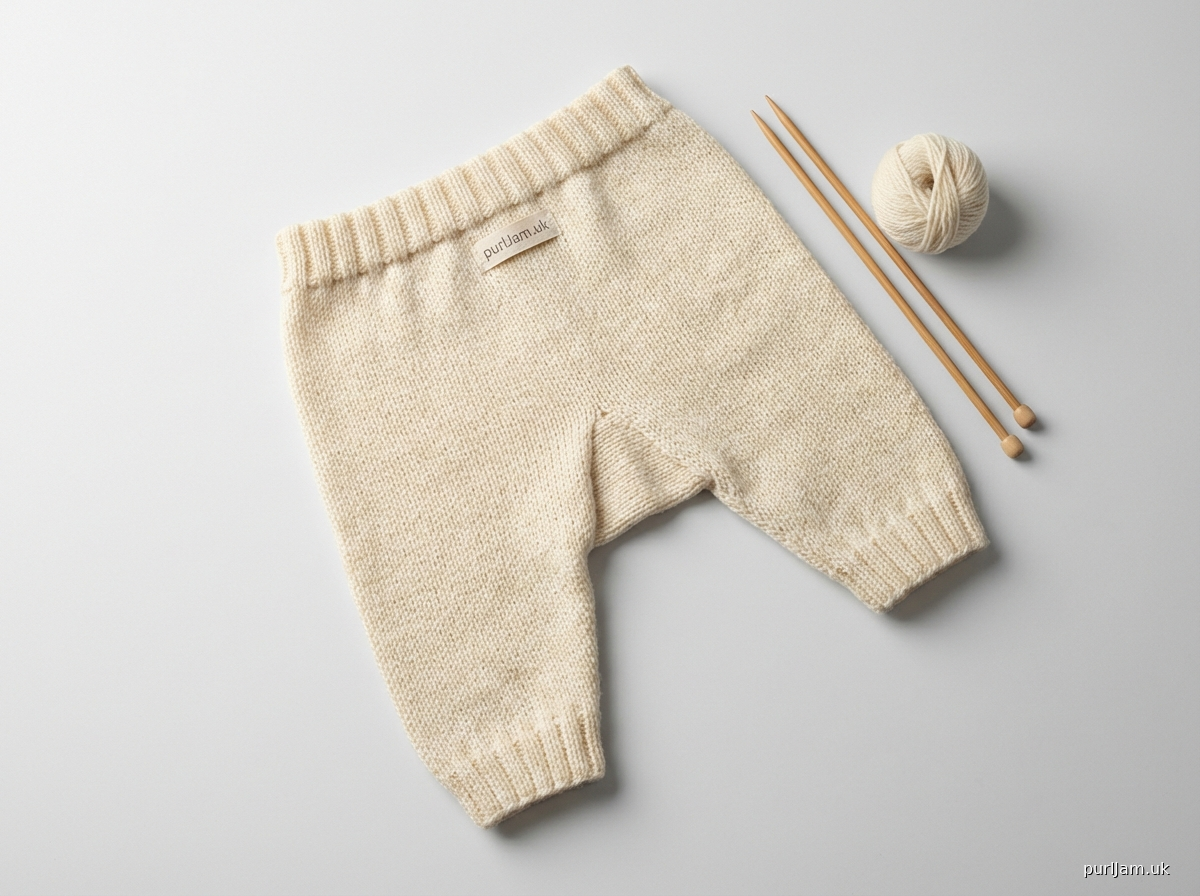
This beginner-friendly pants pattern is worked seamlessly from the waist down, perfect for keeping a little one cozy. The design includes a gentle back rise for a comfortable fit over diapers, and a well-shaped crotch gusset for ease of movement.

**Skill Level:** Beginner

**Size:** Newborn

**Finished Measurements:**
*   **Waist Circumference:** Approximately 16.8 inches (42.5 cm), unstretched.
*   **Total Length (waist to ankle):** Approximately 12 inches (30.5 cm).
*   **Inseam:** Approximately 5 inches (12.5 cm).

**Materials:**
*   **Yarn:** Worsted weight yarn, approximately 250-300 yards (229-274 meters). (Shown in a soft merino blend.)
*   **Needles:**
    *   US 6 (4 mm) 16-inch (40 cm) circular needle, or size needed to obtain ribbing gauge.
    *   US 7 (4.5 mm) 16-inch (40 cm) circular needle, or size needed to obtain stockinette gauge.
    *   US 7 (4.5 mm) Double-Pointed Needles (DPNs) or a longer circular needle for Magic Loop method, for legs.
*   **Notions:** Stitch markers, tapestry needle, waste yarn or stitch holder.

---

**Gauge:**
4.5 stitches and 6 rounds = 1 inch (2.5 cm) in Stockinette stitch on larger needles, after blocking.
_It is crucial to check your gauge. A different gauge will result in a different size garment._

---

**Abbreviations:**
*   **BOR:** Beginning of Round
*   **GSR:** German Short Row
*   **k:** knit
*   **k2tog:** knit 2 stitches together
*   **kfb:** knit into front and back of stitch (increase)
*   **M:** marker
*   **M1:** Make 1 (left-leaning increase, lift bar between stitches from front to back, knit into back loop)
*   **p:** purl
*   **pm:** place marker
*   **rnd(s):** round(s)
*   **ssk:** slip, slip, knit (slip 2 stitches knitwise, insert left needle into front of both slipped stitches from left to right and knit them together)
*   **st(s):** stitch(es)
*   **WS:** wrong side
*   **RS:** right side

**Special Techniques:**

**German Short Rows (GSR):**
*   **Making a wrap on a RS row:** Bring yarn to front, slip next stitch purlwise from left to right needle, bring yarn to back, slip stitch back to left needle. The stitch now has two "legs" appearing as one. Turn work.
*   **Making a wrap on a WS row:** Bring yarn to back, slip next stitch purlwise from left to right needle, bring yarn to front, slip stitch back to left needle. The stitch now has two "legs" appearing as one. Turn work.
*   **Resolving a wrap:** When you come to a wrapped stitch, insert your needle into both legs of the stitch (the main stitch and its wrap) and knit them together as one (on a RS row) or purl them together as one (on a WS row).

**Magic Loop Method:** If using Magic Loop for working in the round, divide stitches onto a long circular needle (e.g., 32-40 inch / 80-100 cm) and pull out a loop of cable between the two halves of your stitches. Knit with the active needle, then rotate, pull out another loop, and knit the next half. Tutorials are available online for this method.

---

**Instructions:**

**1. Waistband**
Using smaller circular needle (US 6 / 4 mm), cast on 76 stitches using the long-tail cast-on method. Place a marker and join to work in the round, being careful not to twist stitches. (76 stitches)

Work in K2P2 ribbing for 1 inch (2.5 cm).

**2. Body**
Change to larger circular needle (US 7 / 4.5 mm).
Work every round in Stockinette stitch (knit every round) until the Stockinette portion measures 4.75 inches (12 cm) from the end of the waist ribbing.

**3. Back Rise Shaping (German Short Rows)**
*This section creates a higher back for a better fit over diapers. We will temporarily shift the Beginning of Round (BOR) to make the short rows easier.*

**Next Round:** Knit 18 stitches (right front panel), then knit 2 stitches (right gusset area), then knit 18 stitches (half of back panel). Place a temporary marker for the new BOR (BOR-temp) here. You are now at the center back.

**German Short Rows:**
*   **Row 1 (RS):** Knit 18 stitches (working over the second half of the back panel). Turn work.
*   **Row 2 (WS):** Make wrap (MW). Purl 36 stitches (you are purling across the entire back panel, including the 18 stitches just worked and 18 stitches from the first half of the back panel). Turn work.
*   **Row 3 (RS):** MW. Knit 30 stitches. Turn work. (This leaves 3 stitches unworked at each end of the back panel for this row.)
*   **Row 4 (WS):** MW. Purl 24 stitches. Turn work. (This leaves 6 stitches unworked at each end.)
*   **Row 5 (RS):** MW. Knit 18 stitches. Turn work. (This leaves 9 stitches unworked at each end.)
*   **Row 6 (WS):** MW. Purl 12 stitches. Turn work. (This leaves 12 stitches unworked at each end.)
*   **Final Row (RS):** MW. Knit to BOR-temp marker, resolving all wraps as you encounter them by knitting the wrap together with its stitch. Do not turn.
*   Remove BOR-temp marker. You are now at the original starting point of the current round (the stitch before the original "knit 18 (right front panel)").
*   Continue in the round: Knit the remaining 38 stitches (the last 18 stitches of the back panel, the 2 stitches of the left gusset area, and the 18 stitches of the left front panel), resolving any remaining wraps as you encounter them. (76 stitches)

**4. Crotch Gusset Setup**
*This round places markers to define the crotch gusset sections for increasing.*

**Next Round:**
Knit 18 stitches (Front Right Panel). Place Marker 1 (M1).
Knit 2 stitches (Right Gusset Stitches). Place Marker 2 (M2).
Knit 36 stitches (Back Panel). Place Marker 3 (M3).
Knit 2 stitches (Left Gusset Stitches). Place Marker 4 (M4).
Knit 18 stitches (Front Left Panel). You are now at the BOR. (76 stitches total between markers: [18] M1 [2] M2 [36] M3 [2] M4 [18])

**5. Crotch Gusset Shaping**
*This section increases stitches at the crotch to create space for the legs.*

**Round 1:** *Knit to M1. Slip M1, Knit in FB of next stitch, Knit in FB of next stitch. Slip M2. Repeat from * around. (80 stitches total: 20 stitches between M1 and M2, and between M3 and M4. The gusset sections now have 4 stitches between M1 and M2, and M3 and M4 respectively.)

**Round 2:** *Knit to M1. Slip M1, Knit in FB of next stitch, knit to 1 stitch before M2, knit in FB of this stitch. Slip M2. Repeat from * around. (84 stitches total: 22 stitches between M1 and M2, and between M3 and M4. The gusset sections now have 6 stitches between M1 and M2, and M3 and M4 respectively.)

Repeat Round 2, increasing 2 stitches inside each of the 2 sets of markers each round, until there are 14 stitches between M1 and M2, and between M3 and M4. This will require 4 more repetitions of Round 2. (After 4 more repeats of Round 2: 6 + (4 * 2) = 14 stitches between markers. Total of 100 stitches: 76 initial + (6 rounds * 4 stitches/round) = 100 stitches.)

**6. Divide for Legs**
*You now have 100 stitches total. You will divide these stitches to create the two legs.*

**Next Round:**
Knit 18 stitches (Front Right Panel).
Slip the next 14 stitches (between M1 and M2) onto a piece of waste yarn or a stitch holder for the right gusset. Remove M1 and M2.
Knit 36 stitches (Back Panel).
Slip the next 14 stitches (between M3 and M4) onto another piece of waste yarn or a stitch holder for the left gusset. Remove M3 and M4.
Knit 18 stitches (Front Left Panel).

You now have 18 (front right) + 36 (back) + 18 (front left) = 72 live stitches remaining on your needle.
The round now begins at the center of the crotch area where the stitches were divided.

**Right Leg:**
The 18 stitches of the Front Right Panel and the 18 stitches of the Front Left Panel now form the stitches for the Right Leg.

Using DPNs or Magic Loop, continue with the 18 stitches (Front Right) and then knit the 18 stitches (Front Left). This brings the right and left front panels together to form one leg. (36 stitches total for this leg).
You will now need to pick up stitches from the crotch area. Pick up and knit 7 stitches along the side of the 14 gusset stitches you just placed on hold. (Total 36 + 7 = 43 stitches).
Place marker for new BOR.
Work in Stockinette stitch in the round on these 43 stitches.

**(Self-correction for Leg Division):**
The instruction "Divide for Legs" is generally for separating the body into two tubes.
Total 100 stitches.
The 18 front right + 14 gusset (right) + 36 back + 14 gusset (left) + 18 front left.
The gusset stitches are usually *not* carried into the legs but used to create the crotch depth.
A simpler division:
Stitches remaining after gusset shaping: 100.
Front Panel = 18 + 18 = 36 stitches.
Back Panel = 36 stitches.
Gusset sections = 14 + 14 = 28 stitches.
36 (front) + 36 (back) + 28 (gussets) = 100 stitches.

**Revised Divide for Legs:**
*   **Next Round:**
    Knit 18 stitches (Front Right Panel).
    Place the next 14 stitches (Right Gusset stitches, between M1 and M2) onto waste yarn or a stitch holder. Remove M1 and M2.
    Knit 36 stitches (Back Panel).
    Place the next 14 stitches (Left Gusset stitches, between M3 and M4) onto waste yarn or a stitch holder. Remove M3 and M4.
    Knit 18 stitches (Front Left Panel).
*   You now have 18 (Front Right) + 36 (Back) + 18 (Front Left) = 72 stitches remaining on your needle.
*   **Forming First Leg (Right Leg):**
    Using DPNs or Magic Loop for working in the round:
    Knit the first 18 stitches (Front Right Panel).
    Place the next 36 stitches (Back Panel) onto waste yarn or a stitch holder for the Left Leg.
    Knit the next 18 stitches (Front Left Panel) to join with the first 18. (You now have 18 + 18 = 36 stitches on your needles for the Right Leg).
    **Closure for Crotch:** Cast on 8 stitches using the backward loop method in the space between the front and back panel stitches you just separated (this creates the bottom of the crotch and replaces the gusset stitches for the leg opening).
    Place marker and join to work in the round for the Right Leg. (36 + 8 = 44 stitches for Right Leg).
*   **Work Right Leg:**
    Work in Stockinette stitch (knit every round) until the leg measures 5 inches (12.5 cm) from the crotch cast-on, or desired length for newborn.
*   **Right Leg Cuff:**
    Change to smaller needles (US 6 / 4 mm).
    Work in K2P2 ribbing for 0.75 inch (2 cm).
    Bind off loosely in K2P2 rib.
*   **Forming Second Leg (Left Leg):**
    Return to the 36 stitches on the stitch holder for the Back Panel.
    Pick up and knit 8 stitches along the same 8 cast-on stitches created for the first leg. (36 + 8 = 44 stitches for Left Leg).
    Place marker and join to work in the round for the Left Leg.
*   **Work Left Leg:**
    Work in Stockinette stitch (knit every round) until the leg measures 5 inches (12.5 cm) from the crotch cast-on, or desired length.
*   **Left Leg Cuff:**
    Change to smaller needles (US 6 / 4 mm).
    Work in K2P2 ribbing for 0.75 inch (2 cm).
    Bind off loosely in K2P2 rib.

**7. Finishing**
Weave in all loose ends using your tapestry needle. Gently block to measurements if desired.

---
Disclaimer: This pattern was generated by AI and should be reviewed for accuracy before use. While we strive for quality, AI-generated content may contain errors. Please verify measurements, stitch counts, and instructions before beginning your project. Generated by purlJam.uk
Access your pattern anytime
Bookmark this page to access your pattern anytime