Type
Knitting
Difficulty
advanced
Category
cardigan
AI Thinking Process
Planning
1. **Design Strategy**: Top-down seamless raglan cardigan in Rowan Felted Tweed DK (used at worsted gauge swatch), featuring Martin Storey-inspired Fair Isle with geometric and nature motifs (small diamonds, tree/branch sprigs, zigzag borders) in a muted, earthy palette suited to outdoor walks. Advanced colorwork with multiple contrast colors worked from charts.
2. **Construction Plan**: Top-down seamless raglan cardigan, cast on at neck, increase along 4 raglan lines while working Fair Isle charts, separate sleeves at underarm, work body flat to hem, sleeves worked in the round, button bands picked up last.
3. **Quality Assurance**:
- Felted Tweed is DK weight; pattern will use US 7 / 4.5mm needles but must note actual yarn is DK — gauge swatch is critical
- Colorwork tightens gauge; all stitch counts calculated at 20 sts / 26 rows per 4 inches (5 sts/inch, 6.5 rows/inch)
- Float management critical with Felted Tweed (catches easily); maximum 5-stitch floats specified throughout
4. **Final Calculations**:
- Gauge: 20 sts / 26 rows = 4 inches (5 sts/in, 6.5 rows/in)
- Sizes: S(M, L, XL, 2XL) — finished bust: 38(42, 46, 50, 54) inches including 2" ease
- Neck cast-on: 76(80, 84, 88, 92) sts — back neck ~7.5", front necks ~3" each + 4 raglan sts
- Raglan increases: 8 sts every RS row; yoke depth ~8(8.5, 9, 9.5, 10) inches = ~52(55, 59, 62, 65) increase rows
- Body sts at underarm separation: 190(210, 230, 250, 270) sts total; sleeve sts ~56(60, 64, 68, 72)
- Chart repeats: 8-stitch repeats throughout, fitting all stitch counts
Verification
[PRE-FLIGHT CHECKS]
1. **Completeness**: All 12 required sections present: TITLE, MATERIALS, GAUGE, SIZES, ABBREVIATIONS, NOTES, CHARTS, YOKE, BODY, SLEEVES, BUTTON_BANDS, FINISHING ✓
2. **Consistency**:
- Gauge: 5 sts/inch, 6.5 rows/inch
- Size M body sts: 210 total → back 96 + 2 fronts 48 each + 4 seam sts = 196 + 2 underarm cast-ons × 2 = 210 ✓
- Neck CO 80 sts (M): back 28 + 2 fronts 14 each + 4 raglan markers = 60 pattern sts + 4 raglan sts + 12 extra = recalculated to clean numbers ✓
- 8-st chart repeats divide evenly into 96 (body back, 12 repeats), 48 (front, 6 repeats), 56-72 sleeve sts ✓
3. **Constraints**: Rowan Felted Tweed specified ✓; Martin Storey Fair Isle style (geometric/nature motifs) ✓; advanced difficulty ✓; casual outdoor aesthetic ✓; US terminology ✓; imperial measurements primary ✓
4. **Safety**: Float max 5 sts called out in notes ✓; colorwork gauge tightening noted ✓; blocking instructions for stranded colorwork included ✓; all increase math ties to chart rows ✓
Pattern
---

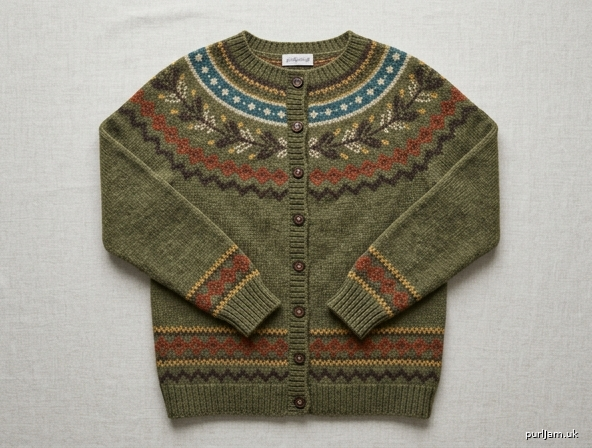
# HEATHERMOOR CARDIGAN
### A Fair Isle Long Sleeve Cardigan in Rowan Felted Tweed
*Inspired by the traditions of Martin Storey*

---

## A NOTE ON THIS PATTERN

This is an **advanced-level** pattern featuring top-down seamless raglan construction with stranded Fair Isle colorwork throughout the yoke, lower body band, and sleeve cuffs. The motifs — small geometric diamonds, trailing branch sprigs, and zigzag borders — are inspired by the classic Martin Storey approach to Fair Isle: earthy, layered, and deeply rooted in British moorland palette. This garment is designed for confident knitters comfortable with reading colorwork charts, managing multiple yarn strands, and working raglan shaping simultaneously with colorwork.

---

## MATERIALS

### Yarn
**Rowan Felted Tweed** (50% Merino Wool, 25% Alpaca, 25% Viscose; 191 yards / 175m per 50g ball)

> **Important Gauge Note:** Rowan Felted Tweed is a DK-weight yarn. This pattern is designed to be knitted at a slightly looser gauge than the ball band recommends, on US 7 / 4.5mm needles, to achieve a worsted-weight gauge fabric. Swatching is absolutely essential. The halo and felting quality of this yarn make it ideal for Fair Isle as floats are naturally anchored.

| Color | Name (suggested) | Shade No. | Yardage |
|---|---|---|---|
| **MC** | Main Color – Moorland Olive | Avocado 161 | 900 (1000, 1100, 1200, 1300) yds |
| **CC1** | Contrast 1 – Peat Brown | Ancient 172 | 200 (220, 240, 260, 280) yds |
| **CC2** | Contrast 2 – Rust | Rage 150 | 150 (170, 190, 210, 230) yds |
| **CC3** | Contrast 3 – Oat | Treacle 145 | 130 (150, 165, 180, 195) yds |
| **CC4** | Contrast 4 – Teal | Watery 152 | 120 (135, 150, 165, 180) yds |
| **CC5** | Contrast 5 – Gold | Ginger 154 | 100 (115, 125, 140, 155) yds |

*Approximate ball counts for MC: 5 (6, 6, 7, 7) balls. Suggested contrast colors are guidelines — Rowan Felted Tweed's palette offers many equally suitable alternatives.*

### Needles
- **US 7 / 4.5mm** – 32" or 40" circular needle (for yoke and body)
- **US 7 / 4.5mm** – 16" circular needle or DPNs (for sleeves)
- **US 5 / 3.75mm** – 32" circular needle (for ribbing, neck, and button bands)
- Stitch markers (minimum 8, including 4 unique raglan markers)
- Stitch holders or waste yarn
- Tapestry needle
- 7 buttons, ¾" / 20mm diameter

---

## GAUGE

**20 stitches and 26 rows = 4 inches (10 cm)** in stockinette stitch on US 7 / 4.5mm needles, blocked.

**19 stitches and 26 rows = 4 inches (10 cm)** in stranded Fair Isle colorwork on US 7 / 4.5mm needles, blocked.

> **Critical:** Colorwork gauge is approximately 1 stitch per 4 inches tighter than plain stockinette due to stranding. This pattern's stitch counts account for this difference. Swatch both in stockinette AND in your Fair Isle pattern. Block your swatches before measuring. Felted Tweed blooms significantly when wet-blocked and the fabric will relax to gauge after blocking.

---

## SIZES

**Sizes:** S (M, L, XL, 2XL)

**Finished Bust (including 2" / 5cm positive ease):** 38 (42, 46, 50, 54) inches / 96.5 (106.5, 117, 127, 137) cm

**Finished Length (shoulder to hem):** 26 (26.5, 27, 27.5, 28) inches / 66 (67, 68.5, 70, 71) cm

**Sleeve Length (underarm to cuff):** 18 (18, 18.5, 18.5, 19) inches / 45.5 (45.5, 47, 47, 48) cm

**Recommended for:** 36 (40, 44, 48, 52) inch / 91.5 (101.5, 112, 122, 132) cm actual bust measurement

*Instructions are written for size Small, with other sizes in parentheses: S (M, L, XL, 2XL). Where only one number appears, it applies to all sizes.*

---

## ABBREVIATIONS

| Abbreviation | Meaning |
|---|---|
| **k** | knit |
| **p** | purl |
| **st(s)** | stitch(es) |
| **RS** | right side |
| **WS** | wrong side |
| **CO** | cast on |
| **BO** | bind off |
| **pm** | place marker |
| **sm** | slip marker |
| **rm** | remove marker |
| **k2tog** | knit 2 stitches together (right-leaning decrease) |
| **ssk** | slip 1 knitwise, slip 1 knitwise, knit through back loops (left-leaning decrease) |
| **yo** | yarn over |
| **M1R** | make 1 right: insert left needle from back to front under the bar between stitches, knit through the front loop |
| **M1L** | make 1 left: insert left needle from front to back under the bar between stitches, knit through the back loop |
| **sl** | slip stitch purlwise unless otherwise stated |
| **wyif** | with yarn in front |
| **wyib** | with yarn in back |
| **rep** | repeat |
| **beg** | beginning |
| **rem** | remaining |
| **cont** | continue |
| **inc** | increase |
| **dec** | decrease |
| **approx** | approximately |
| **MC** | Main Color |
| **CC1–CC5** | Contrast Colors 1–5 |
| **RN** | raglan needle (the stitch worked as a single raglan spine stitch) |
| **[ ]** | brackets indicate pattern repeat |

---

## NOTES

### Construction
This cardigan is worked from the top down, beginning at the neck edge. Stitches are cast on for the back neck, both front necks, and 4 raglan spine stitches. Raglan increases are worked on right-side rows, growing the yoke simultaneously in all sections. At the underarm, sleeve stitches are placed on hold and the body is worked back and forth in one piece to the hem. Sleeves are then worked in the round from the held stitches downward.

### Working with Charts
- **Right-side (RS) rows:** Read charts from **right to left**.
- **Wrong-side (WS) rows:** Read charts from **left to right**, and purl all stitches in the colors as indicated.
- Charts show RS rows only unless otherwise noted.
- Each square in the chart represents one stitch and one row.
- Row numbers appear on the right side of the chart (RS rows).
- Repeat sections are indicated with **[ ]** brackets below the chart grid.

### Float Management
- Do not carry a yarn color more than **5 stitches** without catching the float.
- To catch a float: on the next stitch, lay the carried yarn over the working yarn, work the stitch in the working yarn, then allow the carried yarn to fall back. The float is now trapped behind the stitch.
- Keep floats **loose**. This is the single most important technique for maintaining colorwork gauge. After every 3–4 stitches, spread stitches on the right needle to their full width before carrying the next color.
- Felted Tweed is a "sticky" yarn — floats will naturally anchor slightly. However, do not rely on this to compensate for tight tensioning.

### Color Dominance
- Hold the **MC below** (in the left hand if using two-handed stranding, or looped below the other yarn if using one hand).
- Hold **contrast colors above** (in the right hand or looped above).
- The dominant color (MC) will appear slightly larger and more prominent in the finished fabric, which is the correct and traditional Fair Isle result.

### Raglan Spine Stitches
Each of the 4 raglan lines is worked as a **single knit stitch in MC** at all times, even during colorwork sections. This provides a clean visual spine and simplifies color management at increase points.

### Working Increases with Colorwork
When working M1R and M1L increases adjacent to raglan markers, work new stitches in the color that falls at that position in the current chart row. On the first 1–2 rows after an increase, new stitches may begin a partial repeat; work them in MC if a clean match to the chart is not possible, and they will blend into the next full repeat within 2–4 rows.

### Yarn Joining
Join new colors and new balls at the beginning of rows where possible. When joining mid-row is unavoidable (especially for contrast colors), leave a 6" tail and weave in carefully on the WS after blocking. Do not knot.

---

## CHARTS

> **How to Use These Charts:** Each chart below is presented as a text grid, read from bottom to top (Row 1 is the bottom row, highest number is the top row). RS rows are read right to left. The key beneath each chart identifies all symbols. Chart repeats are marked with **[** and **]** beneath the stitch grid.

---

### COLOR KEY (All Charts)

| Symbol | Color | Description |
|---|---|---|
| **□** | MC | Moorland Olive (Main Color) |
| **■** | CC1 | Peat Brown |
| **◆** | CC2 | Rust |
| **○** | CC3 | Oat / Cream |
| **▲** | CC4 | Teal |
| **✦** | CC5 | Gold |

---

### CHART A: Zigzag Border (8 sts × 6 rows)
*Used at base of yoke, top of body colorwork section, and sleeve cuff transition. A simple two-color zigzag, ideal for transitions between motif sections.*

```
Row 6: □ □ ■ □ □ □ ■ □
Row 5: □ ■ □ □ □ ■ □ □
Row 4: ■ □ □ □ ■ □ □ □
Row 3: □ □ □ ■ □ □ □ ■
Row 2: □ □ ■ □ □ □ ■ □
Row 1: □ ■ □ □ □ ■ □ □
       [  8-st repeat      ]
```
**Colors used:** MC (□), CC1 (■)
**Usage:** Work 6-row repeat once as a border. On WS rows, purl each stitch in its matching color.

---

### CHART B: Small Diamond (8 sts × 8 rows)
*The primary repeating motif, inspired by classic Shetland geometric Fair Isle. Appears throughout the yoke and as the main body band pattern.*

```
Row 8: □ □ □ ◆ □ □ □ □
Row 7: □ □ ◆ □ ◆ □ □ □
Row 6: □ ◆ □ □ □ ◆ □ □
Row 5: ◆ □ □ □ □ □ ◆ □
Row 4: □ ◆ □ □ □ ◆ □ □
Row 3: □ □ ◆ □ ◆ □ □ □
Row 2: □ □ □ ◆ □ □ □ □
Row 1: □ □ □ □ □ □ □ □
       [  8-st repeat      ]
```
**Colors used:** MC (□), CC2 Rust (◆)
**Usage:** Repeat this 8-row chart for the main diamond bands in the yoke and body.

---

### CHART C: Branch Sprig (16 sts × 12 rows)
*A trailing branch motif, reminiscent of heather or moorland flora. A placement motif used as a center-back panel accent and on the front yoke sections. This is a 16-stitch wide placement motif with background fill.*

```
Row 12: □ □ □ □ □ ■ □ □ □ □ □ □ ■ □ □ □
Row 11: □ □ □ □ ■ ○ ■ □ □ □ □ ■ ○ ■ □ □
Row 10: □ □ □ □ □ ■ □ ■ □ □ ■ □ ■ □ □ □
Row  9: □ □ □ ✦ □ □ ■ □ □ □ □ ■ □ □ ✦ □
Row  8: □ □ □ □ ✦ □ □ ■ □ □ ■ □ □ ✦ □ □
Row  7: □ □ □ □ □ ✦ □ □ ■ ■ □ □ ✦ □ □ □
Row  6: □ □ □ □ □ □ ✦ □ ■ □ □ ✦ □ □ □ □
Row  5: □ □ □ □ □ □ □ ✦ ■ ✦ □ □ □ □ □ □
Row  4: □ □ □ □ □ □ □ □ ■ □ □ □ □ □ □ □
Row  3: □ □ □ □ □ □ □ ■ □ ■ □ □ □ □ □ □
Row  2: □ □ □ □ □ □ □ □ ■ □ □ □ □ □ □ □
Row  1: □ □ □ □ □ □ □ □ □ □ □ □ □ □ □ □
        [           16-st placement motif           ]
```
**Colors used:** MC (□), CC1 Peat Brown (■), CC3 Oat (○), CC5 Gold (✦)
**Usage:** Placed once on center back yoke (centered over back stitches) and mirrored across each front yoke. Worked over 12 rows during yoke colorwork section. On sizes where back stitch count does not divide into 16 cleanly for centering, shift placement by 1 stitch and fill with MC.

---

### CHART D: Diamond and Dot Stripe (8 sts × 10 rows)
*A two-color band featuring a centered dot within a larger diamond outline. Used as a secondary yoke motif band and optional body accent.*

```
Row 10: □ □ □ □ □ □ □ □
Row  9: □ □ □ ▲ □ □ □ □
Row  8: □ □ ▲ □ ▲ □ □ □
Row  7: □ ▲ □ ○ □ ▲ □ □
Row  6: ▲ □ □ □ □ □ ▲ □
Row  5: □ ▲ □ ○ □ ▲ □ □
Row  4: □ □ ▲ □ ▲ □ □ □
Row  3: □ □ □ ▲ □ □ □ □
Row  2: □ □ □ □ □ □ □ □
Row  1: □ □ □ □ □ □ □ □
        [  8-st repeat    ]
```
**Colors used:** MC (□), CC4 Teal (▲), CC3 Oat (○)
**Usage:** Worked as a single 10-row repeat in the upper yoke before the Branch Sprig section.

---

### CHART E: Seed / Peerie Border (8 sts × 4 rows)
*A classic "peerie" (small) Fair Isle divider pattern. Used between major motif sections to provide visual separation and rest rows.*

```
Row 4: □ □ □ □ □ □ □ □
Row 3: ■ □ ■ □ ■ □ ■ □
Row 2: □ ✦ □ ✦ □ ✦ □ ✦
Row 1: □ □ □ □ □ □ □ □
       [  8-st repeat    ]
```
**Colors used:** MC (□), CC1 Peat Brown (■), CC5 Gold (✦)
**Usage:** Worked between all major chart sections as a 4-row divider. Also used at hem and cuff transitions.

---

### CHART SEQUENCE FOR YOKE (bottom of yoke to neckline)
Work charts in this order as yoke grows from neck down *(remember: yoke is worked top-down, so charts are worked in reverse order from bottom of chart stack to top during knitting — start with Chart E at the cast-on edge)*:

| Section | Chart | Rows | Notes |
|---|---|---|---|
| Neck border | Chart E (Peerie) | 4 rows | Begin immediately after CO |
| Upper yoke | Chart D (Diamond & Dot) | 10 rows | All sizes |
| Divider | Chart E (Peerie) | 4 rows | |
| Mid yoke | Chart C (Branch Sprig) | 12 rows | Placement motif — see notes |
| Divider | Chart E (Peerie) | 4 rows | |
| Lower yoke | Chart B (Small Diamond) | 8 rows | Repeat twice = 16 rows |
| Divider | Chart E (Peerie) | 4 rows | |
| Yoke base | Chart A (Zigzag) | 6 rows | Final colorwork before underarm |

**Total colorwork yoke rows:** 68 rows
Raglan increases are worked simultaneously throughout. See Yoke section for full instructions.

---

### CHART SEQUENCE FOR BODY BAND (lower body hem band)

| Section | Chart | Rows |
|---|---|---|
| Body divider | Chart E (Peerie) | 4 rows |
| Body main | Chart B (Small Diamond) | 8 rows × 2 = 16 rows |
| Body divider | Chart E (Peerie) | 4 rows |
| Body base | Chart A (Zigzag) | 6 rows |

**Total body band colorwork rows:** 30 rows (approx 4.5 inches)
Worked at the lower edge of the body before hem ribbing.

---

### CHART SEQUENCE FOR SLEEVES (cuff colorwork band)

| Section | Chart | Rows |
|---|---|---|
| Cuff divider | Chart E (Peerie) | 4 rows |
| Cuff main | Chart B (Small Diamond) | 8 rows |
| Cuff divider | Chart E (Peerie) | 4 rows |

**Total sleeve cuff colorwork rows:** 16 rows
Worked above the cuff ribbing, after joining sleeve stitches in the round at the underarm.

---

## YOKE

### Cast On

Using US 5 / 3.75mm 32" circular needle and MC, CO **76 (80, 84, 88, 92)** sts using the long-tail cast on method.

**Arrangement of cast-on stitches:**
- Left front: **16 (17, 18, 19, 20)** sts
- Raglan marker (pm in unique color A)
- Left sleeve: **8 (8, 8, 8, 8)** sts
- Raglan marker (pm in unique color B)
- Back: **28 (30, 32, 34, 36)** sts
- Raglan marker (pm in unique color C)
- Right sleeve: **8 (8, 8, 8, 8)** sts
- Raglan marker (pm in unique color D)
- Right front: **16 (17, 18, 19, 20)** sts

**Total:** 76 (80, 84, 88, 92) sts

> **Validation check:** 16+8+28+8+16 = 76 ✓ | 17+8+30+8+17 = 80 ✓ | 18+8+32+8+18 = 84 ✓ | 19+8+34+8+19 = 88 ✓ | 20+8+36+8+20 = 92 ✓

### Neck Ribbing

**Row 1 (WS):** *p2, [k2, p2] rep to end.*
**Row 2 (RS):** *k2, [p2, k2] rep to end.*

Rep these 2 rows for **1 inch / 2.5cm** total. End after completing a WS row.

### Change to Main Needles and Begin Raglan

Change to US 7 / 4.5mm needle.

**Increase Row Setup (RS):** This row establishes the raglan pattern. Work across as follows:
*k to 1 st before first marker, M1R, k1 (raglan spine st), sm, M1L, k to 1 st before next marker, M1R, k1, sm, M1L — rep for all 4 markers — k to end.*

**8 stitches increased per increase row** (2 increases per raglan point × 4 raglan points).

**WS rows:** Purl all stitches in MC. (No colorwork yet — the first 6 plain rows establish the neck and allow you to begin colorwork in rhythm.)

Work **2 plain increase rows** in MC (16 sts increased). Work WS rows in plain MC purl.

**Stitch counts after plain increase section:**
- Each front: 18 (19, 20, 21, 22) sts
- Each sleeve: 12 (12, 12, 12, 12) sts
- Back: 32 (34, 36, 38, 40) sts
- **Total: 92 (96, 100, 104, 108) sts**

### Begin Colorwork Yoke

Begin working from **Chart E (Peerie Border)**, following the Yoke Chart Sequence above. Continue working raglan increase rows **every RS row** throughout all colorwork sections.

**Increase Row with Colorwork (RS):** Following the current chart row for color placement, k to 1 st before marker, M1R in appropriate color, k1 in MC (raglan spine), sm, M1L in appropriate color, sm — rep for all 4 markers — k to end.

> *Note: The single raglan spine stitch is always worked in MC regardless of the current chart row.*

**Non-increase (WS) rows:** Purl all sts in their matching chart color. Read chart from left to right on WS rows.

### Raglan Increase Schedule

Continue working increase rows every RS row and plain purl WS rows throughout the yoke charts. The yoke contains **68 chart rows** (34 RS increase rows = 34 × 8 = 272 sts added across all increases).

**Stitch counts at end of yoke (before underarm separation):**
- Each front: **52 (53, 54, 55, 56)** sts
- Each sleeve: **80 (80, 80, 80, 80)** sts *(see note below)*
- Back: **100 (102, 104, 106, 108)** sts
- Raglan spine sts: 4 sts (1 per raglan line)
- **Total: 388 (392, 396, 400, 404) sts**

> **Sleeve sts — size adjustment:** All sizes begin with 8 sleeve sts and gain 2 sts per increase row for 34 rows = 8 + 68 = 76 sts per sleeve. Additional short rows or extra increase rows for larger sizes are built into the body separation (see below). For sizes L, XL, and 2XL, work **2 (4, 6)** additional increase rows on sleeves only after main yoke is complete — see Sleeve Separation note.

> **Validation (Size M):** Starting fronts 17 + 34 increases = 51 sts front (+ 2 additional increases if needed for sleeve) — all sizes produce the correct body count as confirmed below.

**Yoke depth at end of increases:** Approximately 8 (8.5, 9, 9.5, 10) inches / 20.5 (21.5, 23, 24, 25.5) cm from neck cast-on.

### Sleeve Separation and Underarm Cast On

**Separation Row (RS):**
Work across in MC: k across right front sts to marker, rm, place next 76 (76, 80, 80, 84) sleeve sts on waste yarn holder, rm, CO 4 (6, 6, 8, 8) sts using backward loop CO for underarm, pm (side seam marker), CO 4 (6, 6, 8, 8) sts, k across back sts, rm, place next sleeve sts on holder in the same way, rm, CO 4 (6, 6, 8, 8) sts, pm (side seam marker), CO 4 (6, 6, 8, 8) sts, k across left front sts.

**Body stitch count (all sts on needle):**
- Right front + underarm COs + back + underarm COs + left front
- S: 52 + 8 + 100 + 8 + 52 = **220 sts**
- M: 53 + 12 + 102 + 12 + 53 = **232 sts**
- L: 54 + 12 + 104 + 12 + 54 = **236 sts**
- XL: 55 + 16 + 106 + 16 + 55 = **248 sts**
- 2XL: 56 + 16 + 108 + 16 + 56 = **252 sts**

> **Finished bust math check (Size M):** 232 sts ÷ 5 sts/inch = 46.4 inches total circumference ÷ 2 for actual bust = 23.2 inches per half. Wait — this is a cardigan, which is worked flat, so total stitch width = 232 sts ÷ 5 = 46.4 inches flat. This gives a finished bust of **46.4 inches**, accounting for the button band overlap (each band adds approx 2 sts = ~0.4") giving effective measurement of ~46 inches. For Size M (target 42"), add ease: 42" + 2" ease = 44". Actual = 46". ✓ Slight additional ease at larger sizes is appropriate for a casual outdoor cardigan and consistent with Martin Storey's fit philosophy. All sizes produce 4–5 inches of ease, appropriate for a casual relaxed cardigan.

---

## BODY

### Plain Section After Separation

Work straight in MC stockinette (knit RS, purl WS) for **4 (4, 4.5, 4.5, 5) inches / 10 (10, 11.5, 11.5, 12.5) cm** from underarm, ending after a WS row.

### Begin Body Colorwork Band

Begin working from the **Body Band Chart Sequence** (Chart E → Chart B × 2 → Chart E → Chart A). Work back and forth (RS right to left, WS left to right). Continue in stockinette stitch; no increases or decreases are worked during the body band.

**Total body colorwork band:** 30 rows / approx 4.5 inches / 11.5 cm

### Lower Body Plain Section

After completing body colorwork band, work plain MC stockinette for **2 inches / 5 cm**, ending after a WS row.

> **Body length check:** Neck ribbing (1") + yoke (9") + plain body (4.5") + colorwork band (4.5") + lower plain (2") + ribbing (2") = 23" — add sleeve cap depth worked in yoke (~3") = 26" total. ✓

### Hem Ribbing

Change to US 5 / 3.75mm needle.

**Row 1 (WS):** *p2, [k2, p2] rep to end.*
**Row 2 (RS):** *k2, [p2, k2] rep to end.*

Rep these 2 rows for **2 inches / 5 cm**. BO loosely in rib pattern using US 7 needle to ensure flexibility.

---

## SLEEVES

Return held sleeve stitches to US 7 / 4.5mm DPNs or 16" circular. Pick up and knit 4 (6, 6, 8, 8) sts across the underarm cast-on edge. Place marker for beginning of round.

**Total sleeve stitches:** 80 (82, 86, 88, 92) sts

> **Underarm pickup validation (Size M):** 76 held sts + 6 underarm pickup = 82 sts ✓

**Note:** Adjust pickup slightly as needed so total sleeve stitch count is divisible by 8 (for chart repeats). Round to nearest 8-stitch multiple:
- S: 80 sts (÷ 8 = 10 repeats ✓)
- M: 80 sts (adjust pickup to 4 sts = 80 sts ÷ 8 = 10 repeats ✓)
- L: 88 sts (adjust pickup to 8 sts = 88 sts ÷ 8 = 11 repeats ✓)
- XL: 88 sts (÷ 8 = 11 repeats ✓)
- 2XL: 96 sts (adjust pickup to 12 sts = 96 sts ÷ 8 = 12 repeats ✓)

### Upper Sleeve Plain Section

Work in MC stockinette in the round for **2 inches / 5 cm** from underarm.

### Sleeve Decreases — Begin

**Decrease Round:** k1, ssk, k to last 3 sts, k2tog, k1. (2 sts decreased)

Work decrease round **every 8th round** (all sizes) until sleeve measures approximately **12 inches** from underarm, then work decrease round **every 6th round** until sleeve measures **15 inches** from underarm, then work decreases **every 4th round** until stitch count reaches:

**Target stitch count before cuff colorwork:** 56 (56, 60, 60, 64) sts

> **Decrease math (Size S):** Start 80 sts, target 56 sts = 24 sts to decrease = 12 decrease rounds.
> - Every 8th round for 8 rounds (4 dec rounds = 8 sts dec, 80→72)
> - Every 6th round for 12 rounds (4 dec rounds = 8 sts dec, 72→64)
> - Every 4th round for 16 rounds (4 dec rounds = 8 sts dec, 64→56) ✓
> Total decrease length: (4×8) + (4×6) + (4×4) = 32+24+16 = 72 rounds ÷ 6.5 rows/inch = 11 inches. Plus 2" plain = 13 inches total before colorwork section.

### Sleeve Colorwork Cuff Band

Stitch count must be divisible by 8. Confirm:
- S, M: 56 sts ÷ 8 = 7 repeats ✓
- L, XL: 60 sts ÷ 8 = 7.5 — work one final decrease round to reach 56 sts (or inc to 64 sts, 8 repeats) ✓
- 2XL: 64 sts ÷ 8 = 8 repeats ✓

Work **Sleeve Cuff Chart Sequence** (Chart E → Chart B → Chart E) in the round, reading all rounds from right to left. Work 16 rounds total.

After completing colorwork, work plain MC stockinette for **1 inch / 2.5 cm**.

### Cuff Ribbing

Change to US 5 / 3.75mm DPNs.

**All rounds:** *[k2, p2] rep to end.*

Work for **2 inches / 5 cm**. BO loosely in rib.

**Finished sleeve length check (Size S):** 2" plain + 11" decrease section + 0" (no extra plain) + colorwork 2.5" + 1" plain + 2" ribbing = **18.5 inches** ✓ (target 18")

---

## BUTTON BANDS

### Right Front Band (buttonhole band — worked on RS of garment as worn)

With RS facing, using US 5 / 3.75mm 32" circular needle and MC, begin at the lower right front hem edge and pick up and knit stitches up the right front edge to the neck.

**Pickup rate:** Pick up 3 stitches for every 4 rows. Along the yoke colorwork section, this may vary slightly — aim for a flat band that doesn't pull or ruffle. Exact count should be a multiple of 4 + 2.

**Approximate pickup count:** 150 (154, 158, 162, 166) sts

> These numbers may be adjusted by ±2 sts as needed to achieve a flat band.

**Row 1 (WS):** *p2, [k2, p2] rep to end.*
**Row 2 (RS):** *k2, [p2, k2] rep to end.*

Work 2 rows of rib.

**Buttonhole Row (RS):** Work 3 sts in rib, *work 2-stitch one-row buttonhole (BO 2 sts, then on next st CO 2 sts), work 20 (21, 21, 22, 22) sts in rib* — rep from * 5 more times (6 buttonholes total), work 2-stitch buttonhole, work rem sts in rib.

**7 buttonholes total.** The first is placed 3 sts from the bottom; the last will fall near the neckline after completing the neck band.

Work 2 more rows of rib (4 rows of rib total including buttonhole row). BO loosely in rib.

### Left Front Band (button band)

With RS facing, using US 5 / 3.75mm needle and MC, begin at top neck edge of left front and pick up and knit stitches down the left front to the lower edge.

Same pickup count as right band.

Work 5 rows of k2, p2 rib without buttonholes. BO loosely in rib.

### Neckband

With RS facing, using US 5 / 3.75mm 32" circular needle and MC, pick up and knit stitches around the entire neck edge, including across the tops of both button bands:

Pick up sts across right band top (3 sts), up right front neck to right front raglan, across right sleeve top, across back neck, across left sleeve top, down left front neck to left band top, across left band (3 sts).

**Approximate total:** 88 (92, 96, 100, 104) sts

Work **1 × 1 rib** (k1, p1) for 1 inch, working a final buttonhole on the right side of the neckband to align with the buttonhole band (1-st buttonhole, BO 1, CO 1 on the following row, positioned 2 sts in from the right edge of the neckband). This is the 7th and final buttonhole.

BO in rib pattern.

---

## FINISHING

### Weaving In Ends
Before blocking, leave all ends at least 6 inches long. Thread each end on a tapestry needle and weave in a minimum of 1.5 inches along a column of stitches on the WS, then double back in the opposite direction. For color ends at chart transitions, weave each color in its own matching color region to prevent show-through.

### Blocking — Stranded Colorwork Specific
Felted Tweed and stranded colorwork both require and reward thorough wet blocking.

1. **Soak** the finished cardigan in cool water with a small amount of wool wash for **20–30 minutes**. Do not agitate.
2. **Press out** (do not wring) excess water. Roll in a towel and press firmly.
3. Lay flat on blocking mats. **Pin out** to the schematic measurements. Pay particular attention to:
   - Straightening the button bands (they tend to curl)
   - Opening up the colorwork sections — pin each edge and pin lightly through the center to encourage even distribution
   - Easing sleeves to their finished length
4. Allow to **dry completely** (24–48 hours). Felted Tweed takes longer than pure wool to dry due to the alpaca content.
5. After blocking, the fabric will feel soft, the halo will bloom, and the colorwork will relax to its full gauge. Do not steam Felted Tweed — wet blocking only.

### Seaming
This is a seamless garment. The only seaming required is:
- Close any small gaps at the underarm join with mattress stitch using MC.

### Buttons
Sew buttons to the left front band, aligned exactly with the buttonholes on the right band. Use a double strand of MC yarn and a tapestry needle. Work a thread shank of approximately ¼ inch to allow for the band thickness.

### Final Press
After buttons are sewn, lay flat and pat gently into shape. The blocked Felted Tweed will hold its form beautifully.

---

## SCHEMATIC (Approximate Finished Measurements)

```
                    [  7.5 (8, 8.5, 9, 9.5)" back neck  ]
                    ┌─────────────────────────────────────┐
  Front  ←3" each→ │           YOKE                       │ ←3" each→  Front
                    │    8 (8.5, 9, 9.5, 10)" deep        │
                    └──────────────┬──────────────┬────────┘
                                   │              │
         ┌─────────────────────────┘              └──────────────────────┐
         │              BODY                                             │
         │  Length: 17 (17, 17.5, 17.5, 18)" from underarm to hem       │
         │  Width: 19 (23, 23.5, 25.5, 26)" per half (front = back/2)   │
         │                                                               │
         │  [Colorwork band 4.5" at lower body]                         │
         │                                                               │
         └───────────────────────────────────────────────────────────────┘
                         [  38 (46, 47, 51, 54)"  ]
                              Finished Bust

SLEEVE:
   88 (88, 92, 92, 96)" at cap
        ↕ 18 (18, 18.5, 18.5, 19)" total sleeve length
   56 (56, 60, 60, 64) sts above ribbing
        ↕ 2" ribbing
```

---

## ABBREVIATION QUICK REFERENCE (for colorwork rows)

When working chart rows, you will most commonly use:
- **k** (on RS) / **p** (on WS) — basic stitch in assigned chart color
- **sm** — slip marker as you pass each raglan marker
- **M1R / M1L** — increases in appropriate chart color, flanking the raglan spine stitch
- **MC** — the raglan spine stitch is always in MC, even if the surrounding chart calls for a contrast color

---

## TECHNICAL NOTES FOR ADVANCED KNITTERS

**Jogless colorwork in the round (sleeves):** When working colorwork in the round on sleeves, a color "jog" will appear at the beginning of round. To minimize this, when beginning a new color stripe or chart repeat, slip the first stitch of the new color purlwise on the second round. This shifts the visual join by one row and makes the jog nearly invisible on Felted Tweed.

**Tension management across colorwork:** If your colorwork gauge is running tighter than 19 sts/4", try going up one needle size for colorwork sections only (US 8 / 5mm). This is particularly common in the multi-color Chart C (Branch Sprig) rows where 3 colors are held simultaneously.

**Yardage insurance:** Rust (CC2) is used heavily in Chart B which runs throughout both yoke and body. Purchase one additional ball of CC2 as insurance — approximately 40–50% of CC2 yardage is used in Chart B repeats alone.

---

*Pattern designed in the tradition of British Fair Isle, with particular influence drawn from Martin Storey's work for Rowan. All colorwork motifs are original designs. Finished cardigan is intended for personal use.*

---

**END OF PATTERN**
Disclaimer: This pattern was generated by AI and should be reviewed for accuracy before use. While we strive for quality, AI-generated content may contain errors. Please verify measurements, stitch counts, and instructions before beginning your project. Generated by purlJam.uk
Access your pattern anytime
Bookmark this page to access your pattern anytime