Type
Knitting
Difficulty
advanced
Category
cardigan
AI Thinking Process
Planning
Verification
Pattern
Hillside Flock
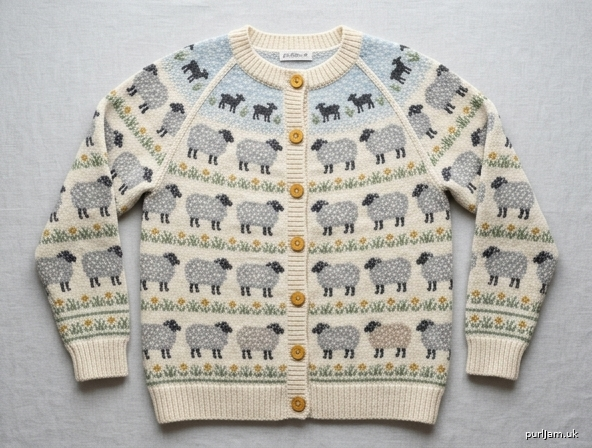
Top-down raglan colourwork cardigan with repeating sheep
Skill level: Advanced. You should be confident with stranded colourwork worked both flat and in the round, chart reading, float catching, raglan shaping inside a pattern, and button bands.
A worsted-weight cardigan worked from the neck down, covered in a grazing flock. Plump sheep in profile repeat across yoke, body and sleeves; smaller lambs fill the upper yoke until each section is wide enough for a full sheep. Sage grass and tiny mustard flowers run between the rows of ewes. The fabric is true stranded colourwork (Fair Isle style), not intarsia.
Sizes
XS (S, M, L, XL, 2X)
To fit bust: 76–81 (86–91, 96–101, 106–111, 116–121, 126–131) cm / 30–32 (34–36, 38–40, 42–44, 46–48, 50–52) in
Finished bust at underarm (body only, excluding bands): 90 (100, 110, 120, 130, 140) cm / 35½ (39½, 43¼, 47¼, 51¼, 55) in
Finished bust buttoned (bands overlapping): approx. 93 (103, 113, 123, 133, 143) cm / 36½ (40½, 44½, 48½, 52½, 56¼) in
Intended ease: 12–16 cm / 4¾–6¼ in positive ease. Colourwork has little stretch — choose by finished bust, not by “to fit” alone.
Yoke depth (neck CO to underarm): approx. 21 (22.5, 24, 25.5, 27, 28.5) cm / 8¼ (8¾, 9½, 10, 10¾, 11¼) in
Length, underarm to hem (including rib): 40 (41, 42, 42, 43, 43) cm / 15¾ (16¼, 16½, 16½, 17, 17) in
Upper arm: 32 (36, 40, 44, 48, 54) cm / 12½ (14¼, 15¾, 17¼, 19, 21¼) in
Sleeve length, underarm to cuff (including rib): 44 (45, 45, 46, 46, 47) cm / 17¼ (17¾, 17¾, 18, 18, 18½) in
Shown in size M on a 96 cm bust.
Yarn
Worsted-weight wool (or wool-rich blend), approx. 200 m / 100 g. Smooth, light-coloured yarns show the flock most clearly. Five contrast colours are used; a sixth is optional for darker sheep.
MC — Cream / natural (background): 730 (820, 910, 1000, 1100, 1200) m / 800 (900, 995, 1095, 1205, 1310) yd
CC1 — Light grey (sheep fleece): 160 (180, 200, 230, 260, 290) m / 175 (195, 220, 250, 285, 315) yd
CC2 — Charcoal (faces, ears, legs, tails): 80 (90, 100, 110, 125, 140) m / 87 (98, 110, 120, 137, 153) yd
CC3 — Sage green (grass, meadow bands): 70 (80, 90, 100, 110, 125) m / 77 (87, 98, 110, 120, 137) yd
CC4 — Soft sky blue (upper-yoke atmosphere): 60 (70, 80, 90, 100, 110) m / 66 (77, 87, 98, 110, 120) yd
CC5 — Mustard (tiny flowers): 30 (35, 40, 45, 50, 55) m / 33 (38, 44, 49, 55, 60) yd
CC6 — Oatmeal / fawn (optional darker sheep): 50 (55, 60, 70, 80, 90) m / 55 (60, 66, 77, 87, 98) yd
Yardages are generous for stranded knitting. Weigh leftover balls as you go if substituting.
Needles
- Main fabric: 4.5 mm circular needle, 80 cm, and 4.5 mm circular 40 cm or double-pointed needles for sleeves
- Ribbing: 3.75 mm circular needle, 80 cm, and 3.75 mm double-pointed needles for cuffs
Change needle length or use the magic-loop method as you prefer. Shift up or down a size to match tension, not the needle number.
Notions
- 4 stitch markers (plus 1 unique marker for sleeve beginning if wished)
- Waste yarn or extra holders for sleeves
- Tapestry needle
- 7 (7, 8, 8, 9, 9) buttons, 18 mm diameter
- Blocking mats and pins
Tension (gauge)
20 stitches and 26 rows = 10 cm / 4 in over stranded colourwork in stocking stitch on 4.5 mm needles, after blocking.
Work a swatch at least 15 × 15 cm using Chart A (or a stranded two-colour pattern of similar density). Wash and dry it as you will the garment. Do not swatch in plain stocking stitch — stranded fabric is typically denser.
If you have too many stitches per 10 cm, go up a needle size; too few, go down. Row tension affects yoke depth; if your row count is tighter than 26, the yoke will be shorter than written and you may add plain MC rows before separating the sleeves.
Abbreviations
| beg | beginning |
| CC | contrast colour |
| CO | cast on |
| k | knit |
| k2tog | knit 2 together |
| M1L | make 1 left: lift strand between sts from front to back, k through back |
| M1R | make 1 right: lift strand between sts from back to front, k through front |
| MC | main colour |
| p | purl |
| pm | place marker |
| rem | remain(ing) |
| rep | repeat |
| rnd(s) | round(s) |
| RS | right side |
| slm | slip marker |
| ssk | slip, slip, knit those 2 sts together through the back |
| st(s) | stitch(es) |
| st st | stocking stitch (RS k, WS p; in the round, k every rnd) |
| WS | wrong side |
| yo | yarn over |
Pattern notes
Construction
Worked flat from the neck down through yoke and body (the cardigan opening is at the centre front). Sleeves are joined and worked in the round. Button bands and neckband are picked up last.
Stocking stitch, flat and in the round
Yoke and body: RS knit, WS purl. Sleeves: knit every round.
Selvedges
Work the first and last stitch of every yoke/body row in MC. These stitches are not part of the motifs; they give a firm, even edge for picking up bands and a place to carry unused colours up the side.
Raglan markers
Four markers divide Left Front | Left Sleeve | Back | Right Sleeve | Right Front. There is no extra raglan stitch. Increases are worked as M1R before each marker and M1L after each marker, always in MC, even in the middle of a motif row.
Colourwork and raglan increases
New stitches are background (MC) on the row they are made. On following rows, fold them into the established motif. Begin a new sheep only when a section is wide enough to hold a complete sheep as drawn on Chart A. Until then, work Chart D (lambs and grass) in that section. Never start a sheep that would be cut in half by a raglan line; keep a clear MC column of 1–2 sts beside each marker.
Float management
Do not leave a float longer than 5 stitches. Catch the unused yarn every 3–5 sts, catching at different points on neighbouring rows so the catches do not stack. The sheep fleece is drawn with small MC stitches breaking the grey, which keeps most floats short; you must still catch within any solid charcoal run (legs, faces) and within grass bands.
Colour dominance
Hold the motif yarn (CC1, and CC2 when it forms the face) in the left hand (or below the background if both yarns are in one hand) so the sheep sit visually in front of the cream. Hold MC in the right hand (or above). Keep this assignment for the whole garment. Do not swap hands mid-motif.
Carrying colours
On the flat pieces, unused colours may be twisted up the MC selvedge for short stretches (a few rows). For longer gaps, break yarn and rejoin. In the round, break and rejoin, or carry up at the underarm if the gap is only a few rounds.
Chart reading
- Flat, RS rows: read from right to left, knit.
- Flat, WS rows: read from left to right, purl, matching each stitch to the colour shown. Floats lie on the side facing you.
- In the round: every round is RS; read from right to left, knit. Each chart has a key matching MC and CC1–CC6 to the motif parts described below. Work selvedge sts outside the chart.
Charts
Work all colourwork from Charts A–E. Motifs, placement and colours are described here so the garment can be knitted from the text alone. If a visual chart panel is supplied with your copy, use it for stitch-by-stitch colour; if it is not, follow the descriptions and keep floats to 5 sts or fewer.
Chart A — Repeating ewe (main flock)
A plump sheep in profile, facing to the right (towards the left-hand side of a RS row as you knit). A cloud-like fleece in CC1, broken with single MC stitches so the wool looks textured and floats stay short. A small CC2 head with one ear, a tiny eye (MC or CC2), four short CC2 legs, and a small CC2 tail. Optional CC6 may replace CC1 on every third or fourth sheep for a mixed flock. Work as an all-over repeat across any section wide enough for a complete animal, with at least one MC stitch between neighbouring sheep.
Chart B — Ewe facing left
The same sheep mirrored, facing left. Use on the Left Front if you want both fronts to face towards the buttons; otherwise Chart A may be used everywhere.
Chart C — Meadow peerie
A narrow band of CC3 grass tufts (short vertical marks and tiny hills) with occasional CC5 four-stitch flowers. Used between rows of sheep, just above the hem, and just above the cuffs. Typically only a few rows deep.
Chart D — Upper-yoke lambs
A much smaller lamb silhouette and scattered grass blades, designed to fit the narrow front and sleeve sections at the neck. CC4 may tint the background on the first several yoke rows for a hint of sky, fading to full MC before Chart A begins.
Chart E — Hem / cuff meadow
A slightly deeper grass band than Chart C, filling the last centimetres of colourwork before ribbing: denser CC3, a few CC5 flowers, no full-size sheep.
Placement summary
- Neck to mid-yoke: Chart D in all sections, with MC raglan columns.
- Once a section fits a full Chart A sheep: switch that section to Chart A (and Chart B on the Left Front if using the mirror). Other sections may still be on Chart D.
- Body after underarm: Chart A/B all over, with a Chart C band between sheep rows as drawn.
- Lower body: Chart E, then rib.
- Sleeves: continue the same sequence as the body (Chart A with Chart C separators, Chart E, then rib), decreasing as instructed.
Centre the first full sheep on the Back. On the fronts, let partial background fill the space next to the selvedge rather than cropping an animal.
Instructions
Yoke
With 3.75 mm circular needle and MC, using a long-tail (or German-twisted) cast-on, CO 84 (92, 104, 112, 124, 132) sts.
Set-up row (WS): Purl, placing markers as follows:
12 (14, 16, 18, 20, 22) Left Front, pm, 14 (14, 16, 16, 18, 18) Left Sleeve, pm, 32 (36, 40, 44, 48, 52) Back, pm, 14 (14, 16, 16, 18, 18) Right Sleeve, pm, 12 (14, 16, 18, 20, 22) Right Front.
(12+14+32+14+12 = 84 ✓; 14+14+36+14+14 = 92 ✓; 16+16+40+16+16 = 104 ✓; 18+16+44+16+18 = 112 ✓; 20+18+48+18+20 = 124 ✓; 22+18+52+18+22 = 132 ✓)
Change to 4.5 mm circular needle.
Row 1 (RS) — first raglan increase, MC only: K1 (selvedge), k to marker, M1R, slm, M1L; [k to marker, M1R, slm, M1L] three times, k to last st, k1 (selvedge). (8 sts increased)
Row 2 (WS): P1, p to last st, p1.
92 (100, 112, 120, 132, 140) sts.
Begin colourwork on the next RS row. Work Chart D across each section (selvedges always MC). At the same time, shape the raglan as follows.
Raglan increase row (RS)
K1, work in chart pattern to marker, M1R in MC, slm, M1L in MC; [work in pattern to marker, M1R in MC, slm, M1L in MC] three times, work in pattern to last st, k1.
8 sts increased.
Body increase row (RS)
K1, work in pattern to first marker, M1R in MC, slm; work in pattern to second marker, slm, M1L in MC; work in pattern to third marker, M1R in MC, slm; work in pattern to fourth marker, slm, M1L in MC; work in pattern to last st, k1.
4 sts increased (Left Front +1, Back +2, Right Front +1; sleeves unchanged).
WS rows
P1, purl in chart pattern to last st (reading the chart from left to right), p1. Slip markers.
Work Raglan Increase Row every RS row 20 (23, 25, 28, 30, 35) more times — that is 21 (24, 26, 29, 31, 36) raglan increase rows in total, counting Row 1.
Stitch count after all raglan increases:
- Left Front: 33 (38, 42, 47, 51, 58)
- Each sleeve: 56 (62, 68, 74, 80, 90)
- Back: 74 (84, 92, 102, 110, 124)
- Right Front: 33 (38, 42, 47, 51, 58)
- Total: 252 (284, 312, 344, 372, 420)
Check: 84 + (21 × 8) = 84 + 168 = 252 ✓; 92 + 192 = 284 ✓; 104 + 208 = 312 ✓; 112 + 232 = 344 ✓; 124 + 248 = 372 ✓; 132 + 288 = 420 ✓.
Then work Body Increase Row every RS row 6 (5, 5, 4, 4, 1) time(s), continuing charts on WS rows.
Stitch count after body increases:
- Left Front: 39 (43, 47, 51, 55, 59) (33+6 = 39 ✓; 38+5 = 43 ✓; 42+5 = 47 ✓; 47+4 = 51 ✓; 51+4 = 55 ✓; 58+1 = 59 ✓)
- Each sleeve: 56 (62, 68, 74, 80, 90) (unchanged)
- Back: 86 (94, 102, 110, 118, 126) (74+12 = 86 ✓; 84+10 = 94 ✓; 92+10 = 102 ✓; 102+8 = 110 ✓; 110+8 = 118 ✓; 124+2 = 126 ✓)
- Right Front: 39 (43, 47, 51, 55, 59)
- Total: 276 (304, 332, 360, 388, 424)
Check: 252 + (6 × 4) = 276 ✓; 284 + 20 = 304 ✓; 312 + 20 = 332 ✓; 344 + 16 = 360 ✓; 372 + 16 = 388 ✓; 420 + 4 = 424 ✓.
AT THE SAME TIME — chart sequence: After the first 8–12 rows of Chart D, change any section that can hold a complete sheep to Chart A (Back will usually change first, then sleeves, then fronts). Use Chart B on the Left Front if you want mirrored animals. Work a Chart C grass band between sheep rows as drawn. Keep 1–2 MC sts beside every marker.
End after a WS row. Yoke measures approx. 21 (22.5, 24, 25.5, 27, 28.5) cm from the cast-on edge.
Separate sleeves
Next row (RS): K1, work 38 (42, 46, 50, 54, 58) sts in pattern (Left Front now worked except selvedge already made), place the next 56 (62, 68, 74, 80, 90) sleeve sts on waste yarn, removing markers; cable-cast-on 8 (10, 12, 14, 16, 18) sts in MC; work 86 (94, 102, 110, 118, 126) Back sts in pattern; place the next 56 (62, 68, 74, 80, 90) sleeve sts on waste yarn, removing markers; cable-cast-on 8 (10, 12, 14, 16, 18) sts in MC; work in pattern to last st, k1.
Body: 180 (200, 220, 240, 260, 280) sts.
Check: 39+8+86+8+39 = 180 ✓; 43+10+94+10+43 = 200 ✓; 47+12+102+12+47 = 220 ✓; 51+14+110+14+51 = 240 ✓; 55+16+118+16+55 = 260 ✓; 59+18+126+18+59 = 280 ✓.
Work the new underarm stitches in MC for the rest of this row and the following WS row, then ease them into Chart A/C as background on subsequent rows (do not place a sheep across the underarm join).
Body
Working flat in stocking stitch colourwork as established (Charts A/B with Chart C separators; selvedges MC), continue until the body measures 34 (35, 36, 36, 37, 37) cm / 13½ (13¾, 14¼, 14¼, 14½, 14½) in from the underarm, or 6 cm / 2¼ in less than the desired total length to the hem, ending after a WS row.
Work Chart E (meadow) across the next 6–10 rows, still including MC selvedges.
Next row (RS), MC only: Knit. If needed, decrease 0 (0, 0, 0, 0, 0) sts — all sizes are already a multiple of 4 (180 ÷ 4 = 45 ✓).
Change to 3.75 mm needle.
Hem rib (2×2), RS: K2, *p2, k2; rep from * to end.
WS: P2, *k2, p2; rep from * to end.
Work in rib until hem measures 6 cm / 2¼ in. Cast off loosely in rib in MC.
Sleeves
Place the 56 (62, 68, 74, 80, 90) held sleeve sts on a 4.5 mm short circular needle or DPNs. With RS facing and MC, beginning at the centre of the underarm cast-on, pick up and knit 4 (5, 6, 7, 8, 9) sts along the first half of the underarm, knit the held sts in pattern, pick up and knit 4 (5, 6, 7, 8, 9) sts along the remaining underarm. Pm for beginning of round.
64 (72, 80, 88, 96, 108) sts. (56+8 = 64 ✓; 62+10 = 72 ✓; 68+12 = 80 ✓; 74+14 = 88 ✓; 80+16 = 96 ✓; 90+18 = 108 ✓)
Join to work in the round. Work 1 round in established colourwork, knitting the picked-up underarm sts in MC. On the next rounds, treat those sts as background and resume Chart A, centred on the sleeve, with Chart C separators as on the body.
Work even in pattern until the sleeve measures 4 cm / 1½ in from the underarm.
Decrease round: K1, ssk, work in pattern to 3 sts before marker, k2tog, k1. (2 sts decreased)
Work the decrease stitches in MC; keep the motifs centred as the sleeve narrows, dropping a sheep repeat when it no longer fits, and filling with Chart C or MC.
Repeat the decrease round every 8th (7th, 5th, 5th, 4th, 3rd) round 11 (13, 17, 19, 23, 27) more times — 12 (14, 18, 20, 24, 28) decrease rounds in total.
40 (44, 44, 48, 48, 52) sts. (64 − 24 = 40 ✓; 72 − 28 = 44 ✓; 80 − 36 = 44 ✓; 88 − 40 = 48 ✓; 96 − 48 = 48 ✓; 108 − 56 = 52 ✓)
Continue even in pattern until the sleeve measures 38 (39, 39, 40, 40, 41) cm / 15 (15¼, 15¼, 15¾, 15¾, 16¼) in from the underarm, or 6 cm / 2¼ in less than desired length. Work Chart E for 6–8 rounds.
Change to 3.75 mm needles. Knit 1 round in MC, decreasing 0 (0, 0, 0, 0, 0) sts as needed so the count remains a multiple of 4 (already true).
Cuff: *K2, p2; rep from * to end. Work in 2×2 rib for 6 cm / 2¼ in. Cast off loosely in rib.
Work the second sleeve to match.
Button bands
Bands are worked in MC on 3.75 mm needles, in 2×2 rib, 8 rows deep (about 3 cm / 1¼ in). Pick up at 3 stitches for every 4 rows along the front edge, including the hem rib, keeping the pick-up just inside the MC selvedge.
Aim for a multiple of 4 plus 2 (so the band begins and ends with k2 on the RS). Suggested counts, which you should confirm against your actual row count:
approx. 122 (126, 134, 138, 146, 150) sts.
If your row gauge differed, pick up 3-in-4 and then increase or decrease 1–3 sts on the first rib row to reach a multiple of 4 + 2.
Left Front band (buttons — no buttonholes)
With RS facing, beginning at the neck edge of the Left Front and working towards the hem, pick up the sts as above.
Row 1 (WS): P2, *k2, p2; rep from * to end.
Row 2 (RS): K2, *p2, k2; rep from * to end.
Rep Rows 1–2 until the band measures 3 cm / 1¼ in, ending after a WS row. Cast off in rib.
Sew 7 (7, 8, 8, 9, 9) buttons to this band after the Right Front band is complete, matching the buttonholes.
Right Front band (buttonholes)
This is the band on the wearer’s right (the Left Front of the work as you look at the RS of the body — i.e. the front that was at the end of RS yoke/body rows). For a traditionally masculine closure, swap the two bands.
With RS facing, beginning at the hem of the Right Front and working towards the neck, pick up the same number of sts as the Left Front band.
Work Row 1 (WS) as for the Left Front.
Place 7 (7, 8, 8, 9, 9) buttonhole markers on this WS row:
- First buttonhole 2 cm / ¾ in from the hem edge of the band.
- Last buttonhole 2 cm / ¾ in from the neck edge of the band.
- Remaining 5 (5, 6, 6, 7, 7) markers spaced evenly between them.
Row 2 (RS) — buttonhole row, 2-st cast-off method: Rib to the first marker, cast off 2 sts, [rib to next marker, cast off 2 sts] to last marker, rib to end.
Row 3 (WS): Rib to each 2-st gap and cable-cast-on 2 sts over the gap, keeping the 2×2 sequence as well as you can (k or p the new sts to match).
Continue in rib until the band matches the Left Front in width, ending after a WS row. Cast off in rib.
Neckband
With 3.75 mm circular needle, MC, and RS facing, beginning at the Right Front band’s cast-off edge, pick up and knit:
- 6–8 sts across the top of the Right Front band,
- 1 st in each cast-on stitch along the original neck edge 84 (92, 104, 112, 124, 132) sts, picking up an extra st at each raglan join if a hole wants to form,
- 6–8 sts across the top of the Left Front band.
Adjust on the next row if needed so the total is a multiple of 4.
Work 2×2 rib (k2, p2) back and forth for 3 cm / 1¼ in. Cast off loosely in rib.
If the neck sits too wide, pick up slightly tighter along the back neck (about 3 sts for every 4 cast-on sts) and work the same depth.
Finishing
Weave in ends on the wrong side, following the colour of each motif so they do not show through. Close any small gaps at the underarm with the yarn tail.
Steam or wet-block before sewing on buttons, so the bands lie flat and you can mark exact button positions through the buttonholes.
Sew buttons to the Left Front band opposite the buttonholes.
Blocking (stranded colourwork)
- Soak the cardigan in lukewarm water with a little wool wash for 15–20 minutes. Do not agitate.
- Lift out, support the weight, and press (do not wring) water out between towels until just damp.
- Lay flat on blocking mats. Gently pat to the finished measurements. Do not stretch until the floats show. Stranded fabric should be eased, not hauled. Pin the fronts straight, the hem even, and the sleeves to length.
- Leave until completely dry.
- A light steam on the wrong side, with the iron never resting on the knitting, will settle any remaining unevenness.
- If the fabric still pulls at motif edges, check that floats were caught and that dominance was consistent; a second block after wearing once often evens the flock.
Schematic measurements (blocked)
| XS | S | M | L | XL | 2X | |
|---|---|---|---|---|---|---|
| Bust, body only | 90 cm | 100 cm | 110 cm | 120 cm | 130 cm | 140 cm |
| Bust, buttoned | 93 cm | 103 cm | 113 cm | 123 cm | 133 cm | 143 cm |
| Yoke depth | 21 cm | 22.5 cm | 24 cm | 25.5 cm | 27 cm | 28.5 cm |
| Underarm to hem | 40 cm | 41 cm | 42 cm | 42 cm | 43 cm | 43 cm |
| Upper arm | 32 cm | 36 cm | 40 cm | 44 cm | 48 cm | 54 cm |
| Sleeve length | 44 cm | 45 cm | 45 cm | 46 cm | 46 cm | 47 cm |
| Neck (CO edge) | 42 cm | 46 cm | 52 cm | 56 cm | 62 cm | 66 cm |
Neck width is the original cast-on; the ribbed neckband will sit slightly smaller. The larger sizes have a more open crew neck, which suits a colourwork yoke; pick up the back neck more firmly if you prefer it closer.
Designer’s notes
The flock reads most clearly in a pale MC with a mid-grey fleece and a charcoal several shades darker than the grey. If your CC1 and CC2 are too close, the faces disappear; if CC1 is too close to MC, the sheep vanish.
Because the yoke grows inside the charts, no two sizes place the first full ewe on exactly the same row. That is expected. What matters is that every sheep is complete, the raglan lines stay in cream, and the grass bands run continuously across fronts, back and sleeves at the same row level after the underarm.
Try the yoke on before separating the sleeves. Colourwork raglans can feel deep; if you have extra row tension and the underarm is still high after the written increases, work a few even rows in pattern before the separation row. Do not add extra increase rows or the stitch counts for body and sleeves will no longer match the hem and cuff maths.
Disclaimer: This pattern was generated by AI and should be reviewed for accuracy before use. While we strive for quality, AI-generated content may contain errors. Please verify measurements, stitch counts, charts, and instructions before beginning your project. Generated by purlJam.uk
Love this pattern?
Save this pattern to your free PurlJam libraryAccess your pattern anytime
Bookmark this page to access your pattern anytime