Type
Crochet
Difficulty
intermediate
Category
amigurumi
AI Thinking Process
Planning
Verification
Pattern
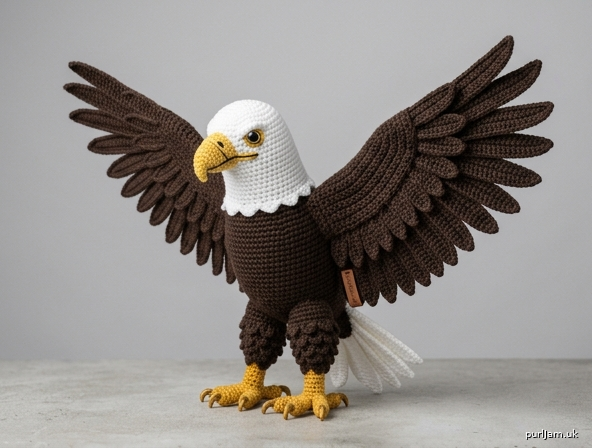
Majestic Bald Eagle
Open-Wing Amigurumi with Layered Feathers
An intermediate stuffed bald eagle worked in tight single crochet, with paddle-shaped open wings and three overlapping ranks of pointed feathers. Adult plumage: white head and tail, dark brown body and wings, gold beak and talons.
Skill level: Intermediate
Skills used: Magic ring, invisible decrease, working in a spiral, working both sides of a chain, multi-piece assembly, optional light wiring
Finished measurements
- Height: about 7½" (19 cm) from feet to crown, stuffed
- Wingspan: about 14" (36 cm) with feathers fanned
- Size will change if gauge differs; proportions stay the same
Gauge
5 sc and 5 rnds = 1" (2.5 cm) in sc worked tightly in the round.
Work a 2" (5 cm) swatch in continuous sc and measure the center. If you have fewer than 5 sc per inch, go down a hook size. Tight fabric is required so stuffing does not show.
Materials
- Worsted weight (4) yarn
- Color A (dark brown): 200 yd (183 m) — body, wings, thighs, coverts
- Color B (white): 80 yd (73 m) — head, tail
- Color C (gold / yellow): 40 yd (37 m) — beak, eye rings, lower legs, feet, talons
- Color D (black): small amount — nostrils, beak edge, optional embroidered eyes
- Hook: US E-4 / 3.5 mm (or size needed for gauge; typically one size smaller than the yarn label)
- 9 mm safety eyes (1 pair), preferably with a yellow/gold iris; or embroider eyes
- Polyester fiberfill
- Yarn needle
- Stitch marker
- Straight pins
- Optional for posed wings: 16–18 gauge floral wire, 2 lengths of 8" (20 cm); wire cutters; tape to cap the cut ends
- Optional: small piece of gold felt for eye rings if you prefer not to crochet them
Abbreviations (US)
- ch — chain
- sc — single crochet
- hdc — half double crochet
- dc — double crochet
- inc — 2 sc in the same stitch
- dec — invisible decrease: insert hook in FLO of next 2 sts, yo, pull through both, yo, pull through all 3 loops
- FLO — front loop only
- MR — magic ring (adjustable ring)
- sl st — slip stitch
- st(s) — stitch(es)
- rnd — round
- FO — fasten off
- yo — yarn over
- [ ] — stitch count at end of round or row
Pattern notes
- Work in a continuous spiral unless a join is written. Do not join or turn at the end of a round. Mark the first stitch of every round and move the marker up.
- Keep gauge tight. Stuff the head and body firmly; stuff the wings very lightly so they stay flat paddles, not tubes.
- Insert safety eyes before the head opening becomes smaller than the washer.
- Parenthetical repeats are worked around the whole round.
- Invisible decrease is used on every
dec. - Feathers are worked around both sides of a starting chain and need no stuffing.
- Make two of every paired piece before assembly so left and right match.
- Optional wire is not for children under 3. Embroider eyes instead of using safety eyes for the same age group.
Head
Color B (white). Worked from crown to neck.
Rnd 1: 6 sc in MR. [6]
Rnd 2: inc in each st around. [12] (6 increases → 6 + 6 = 12 ✓)
Rnd 3: (sc, inc) around. [18] (6 increases → 12 + 6 = 18 ✓)
Rnd 4: (2 sc, inc) around. [24] (6 increases → 18 + 6 = 24 ✓)
Rnd 5: (3 sc, inc) around. [30] (6 increases → 24 + 6 = 30 ✓)
Rnd 6: (4 sc, inc) around. [36] (6 increases → 30 + 6 = 36 ✓)
Rnd 7–11: sc around. [36] (5 rounds even)
Place eyes: Using Color C, make the eye rings first (see below). Insert a 9 mm safety eye through the center of each ring, then through the head between rnds 9 and 10, 7 sts apart, centered on the face. Snap washers on the inside. The rings sit on the outside of the fabric like a gold iris.
Rnd 12: (4 sc, dec) around. [30] (6 decreases → 36 − 6 = 30 ✓)
Rnd 13: sc around. [30]
Rnd 14: (3 sc, dec) around. [24] (6 decreases → 30 − 6 = 24 ✓)
Stuff the head firmly, filling the crown.
Rnd 15: (2 sc, dec) around. [18] (6 decreases → 24 − 6 = 18 ✓)
Rnd 16: sc around. [18]
FO, leaving a 18" (46 cm) tail for sewing. Do not close. The [18] neck matches the body.
Eye rings (make 2)
Color C.
Rnd 1: 10 sc in MR, sl st to first sc to join. Pull the ring only tight enough that the safety-eye post fits through the center hole. FO and weave the short tail into the ring.
(Child-safe option: skip safety eyes and rings. With Color D, embroider a ¼" (6 mm) oval pupil; with Color C, satin-stitch a thin gold ring around it.)
Beak
Worked from the tip toward the face.
Upper mandible
Color C.
Rnd 1: 4 sc in MR. [4]
Rnd 2: (sc, inc) twice. [6] (2 increases → 4 + 2 = 6 ✓)
Rnd 3: sc around. [6]
Rnd 4: (2 sc, inc) twice. [8] (2 increases → 6 + 2 = 8 ✓)
Rnd 5: sc around. [8]
Rnd 6: (3 sc, inc) twice. [10] (2 increases → 8 + 2 = 10 ✓)
Rnd 7: 4 sc, hdc, dc, hdc, 3 sc. [10]
Rnd 8: 4 sc, hdc, 2 dc, hdc, 2 sc. [10]
Stuff firmly all the way into the tip, using the blunt end of the hook. FO, leaving a 12" (30 cm) tail.
The stacked dc stitches form a raised ridge. That ridge is the top of the beak; the stuffed tip will be curved down into a hook when sewn.
Lower mandible
Color C.
Rnd 1: 4 sc in MR. [4]
Rnd 2: (sc, inc) twice. [6] (2 increases → 4 + 2 = 6 ✓)
Rnd 3–4: sc around. [6]
Stuff lightly. FO, leaving a 10" (25 cm) tail.
Body
Color A (dark brown). Worked from the bottom (standing base) up to the neck.
Rnd 1: 6 sc in MR. [6]
Rnd 2: inc in each st around. [12] (6 increases → 6 + 6 = 12 ✓)
Rnd 3: (sc, inc) around. [18] (6 increases → 12 + 6 = 18 ✓)
Rnd 4: (2 sc, inc) around. [24] (6 increases → 18 + 6 = 24 ✓)
Rnd 5: (3 sc, inc) around. [30] (6 increases → 24 + 6 = 30 ✓)
Rnd 6: (4 sc, inc) around. [36] (6 increases → 30 + 6 = 36 ✓)
Rnd 7: (5 sc, inc) around. [42] (6 increases → 36 + 6 = 42 ✓)
Rnd 8–17: sc around. [42] (10 rounds even)
Rnd 18: (5 sc, dec) around. [36] (6 decreases → 42 − 6 = 36 ✓)
Rnd 19–20: sc around. [36]
Rnd 21: (4 sc, dec) around. [30] (6 decreases → 36 − 6 = 30 ✓)
Rnd 22: sc around. [30]
Rnd 23: (3 sc, dec) around. [24] (6 decreases → 30 − 6 = 24 ✓)
Stuff very firmly, with extra fill in the lower third (standing base) and in the chest.
Rnd 24: (2 sc, dec) around. [18] (6 decreases → 24 − 6 = 18 ✓)
Rnd 25: sc around. [18]
FO, leaving an 18" (46 cm) tail. Do not close. Neck opening is [18] to match the head.
Wings (make 2)
Color A. Worked from the tip to the shoulder in a continuous spiral, then flattened into a paddle.
Rnd 1: 4 sc in MR. [4]
Rnd 2: inc in each st around. [8] (4 increases → 4 + 4 = 8 ✓)
Rnd 3: sc around. [8]
Rnd 4: (sc, inc) around. [12] (4 increases → 8 + 4 = 12 ✓)
Rnd 5–6: sc around. [12]
Rnd 7: (2 sc, inc) around. [16] (4 increases → 12 + 4 = 16 ✓)
Rnd 8–9: sc around. [16]
Rnd 10: (3 sc, inc) around. [20] (4 increases → 16 + 4 = 20 ✓)
Rnd 11–13: sc around. [20]
Rnd 14: (4 sc, inc) around. [24] (4 increases → 20 + 4 = 24 ✓)
Rnd 15–18: sc around. [24]
Rnd 19: (5 sc, inc) around. [28] (4 increases → 24 + 4 = 28 ✓)
Rnd 20–24: sc around. [28]
Rnd 25: (6 sc, inc) around. [32] (4 increases → 28 + 4 = 32 ✓)
Rnd 26–32: sc around. [32] (7 rounds even)
Flatten the piece into a long paddle (tip pointed, shoulder ~3¼" / 8 cm wide). Stuff very lightly — just enough to keep the two layers from collapsing, never enough to make a tube.
Optional wire: Cap both cut ends of an 8" (20 cm) floral wire with tape. Slide it inside along one long edge (the leading edge, which will face forward in flight). Keep the wire below the stuffing.
FO, leaving a 20" (51 cm) tail for sewing. Leave the shoulder end open; it is sewn to the body.
Mark the upper surface of each wing with a pin (the surface that will show the feathers) so you do not layer feathers on the underside.
Layered feathers
All feathers are worked the same way: chain, then stitch down one side, put 3 sc in the last chain (the rounded tip), and stitch back along the other side of the chain. Do not stuff. Leave a 8" (20 cm) tail on each feather for sewing.
Work them in batches; each feather is one short round-trip and they add up quickly.
Primary feathers (make 10 — 5 per wing)
Color A. Long outer flight feathers.
Ch 16.
Working in the 2nd ch from the hook: sl st, sc, hdc, dc in next 9 ch, hdc, sc (14 sts on this side), 3 sc in last ch.
Rotate and work along the opposite side of the chain: sc, hdc, dc in next 9 ch, hdc, sc, sl st.
FO.
(Chain check: 1 skipped + 14 side sts + 1 tip chain = 16 ✓)
Secondary feathers (make 8 — 4 per wing)
Color A. Mid-wing feathers.
Ch 12.
Working in the 2nd ch from the hook: sl st, sc, hdc, dc in next 5 ch, hdc, sc (10 sts), 3 sc in last ch.
Opposite side: sc, hdc, dc in next 5 ch, hdc, sc, sl st.
FO.
(Chain check: 1 skipped + 10 side sts + 1 tip chain = 12 ✓)
Covert feathers (make 10 — 5 per wing)
Color A. Small upper-wing feathers.
Ch 8.
Working in the 2nd ch from the hook: sl st, sc, hdc, dc, hdc, sc (6 sts), 3 sc in last ch.
Opposite side: sc, hdc, dc, hdc, sc, sl st.
FO.
(Chain check: 1 skipped + 6 side sts + 1 tip chain = 8 ✓)
Attaching feathers to each wing
Work on the upper surface only. Sew like roof shingles, starting at the tip and working toward the shoulder, so each new rank hides the quill ends of the rank below. Stitch only the inner third (the quill end) of each feather; leave the pointed tip free.
Rank 1 — primaries (bottom layer, 5 feathers):
Fan 5 primary feathers along the outer half of the wing, tips pointing toward and slightly past the wingtip and trailing edge. Overlap each feather over its neighbor by about one-third of its width. The longest visual line should be the trailing (back) edge of the wing. The outermost two primaries may extend 1–1½" (2.5–4 cm) past the crocheted tip.
Rank 2 — secondaries (middle layer, 4 feathers):
Lay 4 secondary feathers over the quill ends of the primaries, covering the mid-wing. Tips point toward the trailing edge, slightly offset from the primaries so the points do not stack in a single line.
Rank 3 — coverts (top layer, 5 feathers):
Lay 5 covert feathers over the quill ends of the secondaries, clustered toward the shoulder and leading edge. They should hide all remaining raw quill ends and the start of the wing fabric.
Repeat on the second wing as a mirror image so the trailing edges both face backward when the eagle is viewed from above.
Tail
Tail feathers (make 7)
Color B (white).
Ch 14.
Working in the 2nd ch from the hook: sl st, sc, hdc, dc in next 7 ch, hdc, sc (12 sts), 3 sc in last ch.
Opposite side: sc, hdc, dc in next 7 ch, hdc, sc, sl st.
FO, leaving a 10" (25 cm) tail.
(Chain check: 1 skipped + 12 side sts + 1 tip chain = 14 ✓)
Upper tail coverts (make 3)
Color A. Same pattern as the small covert feathers (ch 8). These brown feathers sit over the base of the white tail, as on a real eagle.
Shoulder patches (make 2)
Color A. Hide the wing-to-body join and read as shoulder feathers.
Rnd 1: 6 sc in MR. [6]
Rnd 2: inc in each st around. [12] (6 increases → 6 + 6 = 12 ✓)
Rnd 3: (sc, inc) around. [18] (6 increases → 12 + 6 = 18 ✓)
Rnd 4: sc around. [18]
FO, leaving a 12" (30 cm) tail. Flatten into an oval. Do not stuff.
Legs
Thighs (make 2)
Color A. Feathered upper leg.
Rnd 1: 6 sc in MR. [6]
Rnd 2: inc in each st around. [12] (6 increases → 6 + 6 = 12 ✓)
Rnd 3: (sc, inc) around. [18] (6 increases → 12 + 6 = 18 ✓)
Rnd 4–6: sc around. [18]
Rnd 7: (sc, dec) around. [12] (6 decreases → 18 − 6 = 12 ✓)
Stuff moderately.
Rnd 8: sc around. [12]
FO, leaving a 12" (30 cm) tail. Leave open.
Lower legs (make 2)
Color C.
Rnd 1: 6 sc in MR. [6]
Rnd 2: (sc, inc) 3 times. [9] (3 increases → 6 + 3 = 9 ✓)
Rnd 3–10: sc around. [9] (8 rounds even)
Stuff lightly. FO, leaving a 10" (25 cm) tail. Leave open.
Feet (make 2)
Color C.
Rnd 1: 6 sc in MR. [6]
Rnd 2: inc in each st around. [12] (6 increases → 6 + 6 = 12 ✓)
Rnd 3: (sc, inc) around. [18] (6 increases → 12 + 6 = 18 ✓)
Rnd 4: sc around. [18]
Rnd 5: (sc, dec) around. [12] (6 decreases → 18 − 6 = 12 ✓)
Flatten into a small oval pad. Do not stuff. FO, leaving a 10" (25 cm) tail. Sew the opening closed through both layers.
Talons (make 8)
Color C. Three forward and one hind talon per foot.
Ch 6.
Working in the 2nd ch from the hook: sl st, sc in next 2 ch, hdc, 3 hdc in last ch.
FO, leaving a 6" (15 cm) tail. The 3-hdc end is the attached base; the sl-st end is the claw tip.
Assembly
Use matching yarn and a yarn needle. Pin every piece and check symmetry from the front and from above before sewing. Whip stitch or ladder stitch, taking small stitches through both layers.
1. Face
- Pin the upper beak on the center front of the head, covering rnds 11–16, with the dc ridge on top and the stuffed tip pointing down. Sew around the base.
- With the leftover Color C tail (or a new length), take 2–3 tight stitches through the beak tip into the head just below it so the tip curves into a hook.
- Sew the lower mandible directly under the upper beak, slightly recessed, so the hook overhangs it.
- With Color D, embroider two short nostrils on the sides of the upper beak near the head (the cere). Optionally run one thin stitch along the cutting edge between upper and lower beak.
2. Head to body
- Add a last pinch of stuffing at both neck openings so the neck is thick and does not dent.
- Align the face forward. Whip stitch the head’s rnd 16 to the body’s rnd 25, [18] to [18] (18 sts + 18 sts matched ✓).
- Go around twice if needed. The white head should sit cleanly on the brown body with a sharp color line.
3. Legs and feet
- Sew 3 talons along the front edge of each foot pad and 1 talon at the back (anisodactyl: three forward, one back), points curving slightly downward.
- Sew the open end of each lower leg to the top of a foot.
- Sew the open end of each thigh over the top of a lower leg, brown overlapping gold by about ¼" (6 mm).
- Pin the thighs to the lower body at rnds 4–8, slightly forward of center and about 1" (2.5 cm) apart. The eagle must stand on these two feet; if it tips, move the legs a stitch or two farther apart or farther forward, then sew.
4. Tail
- On the back of the body, around rnds 4–10, pin the 7 white tail feathers in a flat fan, center feather on the spine, three on each side, overlapping by about one-third.
- Sew each feather at the quill end only.
- Sew the 3 brown upper tail coverts over the quill ends where the tail meets the body, hiding the join.
5. Open wings (the critical step)
Orientation: leading edge (optional wire) faces forward; trailing feathered edge faces back; upper (feathered) surface faces up.
- Pin one wing to each side of the body at rnds 16–22, just below the neck, shoulder opening against the body. Spread the wings straight out, or in a very slight upward V (dihedral). Tips should be level with each other.
- From above, the wingspan should read as one continuous line. Adjust until the bird looks balanced left to right.
- Sew the open shoulder [32] to the body along 10–12 sts. Close the remaining shoulder sts as you sew so stuffing cannot escape.
- Tacking (do not skip): On the underside of each wing, take 3–4 hidden stitches from the inner third of the wing into the body, ½–1" (1–2.5 cm) out from the shoulder. These stitches carry the weight of the open wing so it will not droop.
- If you inserted wire, bend a gentle curve: slightly raised at the wrist, tip level or a touch up. Do not make a sharp angle.
6. Shoulder patches
Flatten each patch over the wing-to-body seam on the upper side and sew around the edge. This hides the join and reads as the shoulder covert.
7. Optional hanging loop
For a flight display, with Color A join at the center back between the wings at rnd 20, ch 12, sl st in the same stitch. FO and weave in. Hang from the loop; the open wings will read as soaring.
Finishing
- Weave in every remaining tail on the inside or under a feather layer.
- Smooth the head stuffing so the crown is round and the face is not dented around the eyes.
- Steam-block the free feather tips lightly from the wrong side if they curl (hover the iron; do not press stuffing).
- Check standing: both feet flat, tail fan just clearing the table, wings level. Add a little extra stuffing through a closed seam only if the body has softened.
Expression (optional)
With Color B, a few tiny surface stitches above each eye create a shallow brow ridge and a fiercer profile. Keep it subtle.
Safety
- Safety eyes and optional wire are not suitable for children under 3. Embroider the eyes and skip the wire for that age group.
- Sew the beak, talons, and every feather through several times so nothing can be pulled off.
- Tug-test wings, legs, and head. If a piece shifts, restitch before gifting.
Troubleshooting
- Wings droop: add more underside tacking stitches, or insert wire if you skipped it. Do not add more stuffing — that makes tubes, not wings.
- Eagle tips forward: restitch the legs farther back, or add a little stuffing to the rear of the lower body.
- Eagle tips sideways: one wing is heavier or sewn higher than the other. Unpin the higher wing and match rnds to the first wing.
- Feathers flop: you sewed too far toward the tip. Remove those stitches and catch only the inner third.
- Neck wrinkles: the join is under-stuffed. Open a few sts, pack more fill in, and restitch.
Yarn amounts are generous for worsted-weight scrap management. One 200 yd (183 m) skein of dark brown plus leftovers of white and gold will complete the eagle.
Disclaimer: This pattern was generated by AI and should be reviewed for accuracy before use. While we strive for quality, AI-generated content may contain errors. Please verify measurements, stitch counts, charts, and instructions before beginning your project. Generated by purlJam.uk
Love this pattern?
Save this pattern to your free PurlJam libraryAccess your pattern anytime
Bookmark this page to access your pattern anytime