Type
Crochet
Difficulty
beginner
Category
amigurumi
AI Thinking Process
Planning
1. **Design Strategy**: Beginner-friendly mini car using a simple rectangular body (oval-based) with a smaller top cabin, two pieces sewn together, plus four wheels. UK crochet terminology throughout.
2. **Construction Plan**: Two flat-bottomed oval tubes (body and cabin) worked in continuous rounds, stuffed and assembled; four small wheel discs sewn on.
3. **Quality Assurance**:
- Keep tension tight to hide stuffing
- Ensure body and cabin proportions align (cabin ~60% of body length)
- Wheels must be symmetrical and aligned
4. **Final Calculations**: Tension 20 dc x 22 rnds = 10 cm. Body: oval starting ch 8, ~12 cm long. Cabin: oval ch 5, ~7 cm long. Wheels: flat circles 3 cm diameter. Finished car approx 12 cm L x 5 cm W x 6 cm H.
Verification
1. **Completeness**: Materials, tension, abbreviations, instructions, assembly all included ✓
2. **Consistency**: Oval stitch counts verified (8→14→20→26); cabin (10→16→22); wheels (6→12→18) ✓
3. **Constraints**: UK terminology (dc, tr), metric first, worsted yarn, beginner level ✓
4. **Safety**: Math checked - all increases distribute evenly ✓
Pattern
# Mini Car — Beginner Crochet Pattern

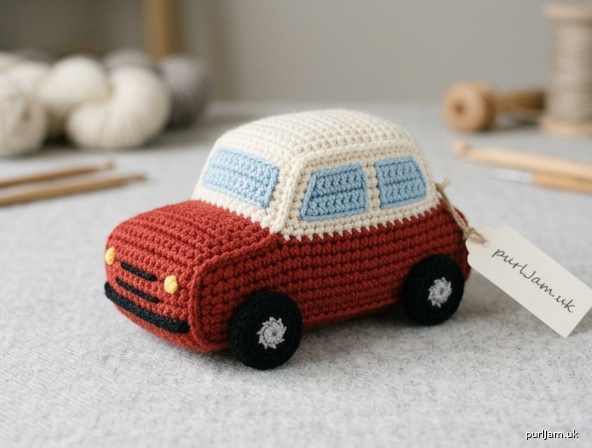
A charming little crocheted car, perfect as a baby toy, desk companion, or party favour. Worked in simple basic shapes using UK crochet terminology.

**Skill Level:** Beginner
**Finished Size:** Approximately 12 cm long × 5 cm wide × 6 cm tall (4¾" × 2" × 2⅜")

---

## Materials

- **Yarn:** Worsted weight (Aran/10-ply), approximately:
  - 30 g Main Colour (MC) — e.g. red, blue, or your favourite colour
  - 10 g Contrast Colour (CC) — for the cabin/roof (e.g. cream or grey)
  - 10 g Black — for the wheels
  - Small amount of grey or light blue — for windows (optional)
- **Hook:** 3.5 mm (UK 9 / US E-4)
- **Notions:**
  - Polyester fibrefill stuffing
  - Yarn needle (tapestry needle)
  - Stitch marker
  - Scissors
  - Optional: 2 small black safety eyes (6 mm) for headlights, or embroider with yarn

---

## Tension (Gauge)

20 dc × 22 rounds = 10 cm (4") square worked in the round.
Exact tension is not critical — just keep stitches tight enough that stuffing does not show through.

---

## Abbreviations (UK Terms)

- **ch** — chain
- **dc** — double crochet (= US single crochet)
- **dc2tog** — double crochet 2 stitches together (decrease)
- **inc** — 2 dc into the same stitch (increase)
- **sl st** — slip stitch
- **st(s)** — stitch(es)
- **MR** — magic ring
- **rnd** — round
- **[ ]** — stitch count at end of round
- **( ) x N** — repeat instructions in brackets N times

**Note:** Work in continuous spirals unless otherwise stated. Use a stitch marker in the first stitch of each round and move it up as you go.

---

## Construction Overview

The car is made in **4 separate pieces**:
1. Car Body (1 piece — oval base/chassis)
2. Cabin/Roof (1 piece — smaller oval top)
3. Wheels (4 pieces)

All pieces are then sewn together.

---

## PART 1 — Car Body (Make 1 in MC)

Worked as a flat-based oval tube.

**Foundation:** With MC, ch 8.

**Rnd 1:** Starting in 2nd ch from hook: 2 dc in first ch, dc in next 5 ch, 3 dc in last ch; rotate to work along opposite side of foundation chain: dc in next 5 ch, inc in last ch (same as starting ch). [16 sts]

*Math check: 2 + 5 + 3 + 5 + 1 = 16 ✓*

**Rnd 2:** inc, dc in next 5, (inc) x 3, dc in next 5, (inc) x 2. [22 sts]

*Math check: 16 + 6 = 22 ✓*

**Rnd 3:** (inc, dc in next 6, inc, inc, dc in next 6, inc, inc). Worked as: inc, dc 6, inc, inc, dc 6, inc, inc. [28 sts]

*Math check: 22 + 6 = 28 ✓*

**Rnd 4:** Working in **back loops only** (this creates a crisp edge for the chassis): dc in each st around. [28 sts]

**Rnds 5–8:** dc in each st around (both loops). [28 sts]

**Rnd 9:** dc2tog, dc in next 12, dc2tog, dc2tog, dc in next 10, dc2tog. [24 sts]

*Math check: 28 − 4 = 24 ✓*

**Rnd 10:** Begin stuffing firmly. dc2tog, dc in next 10, dc2tog, dc2tog, dc in next 8, dc2tog. [20 sts]

Finish stuffing the body firmly. Press into a neat brick shape with your fingers.

**Rnd 11:** Fold the opening flat (top edge to top edge) and dc through both layers across to close. (10 sts worked through both layers.)

Fasten off, leaving a 15 cm tail for any adjustments. Weave in end.

---

## PART 2 — Cabin / Roof (Make 1 in CC)

A smaller flat-based oval that sits on top of the body.

**Foundation:** With CC, ch 5.

**Rnd 1:** Starting in 2nd ch from hook: 2 dc in first ch, dc in next 2 ch, 3 dc in last ch; rotate: dc in next 2 ch, inc in last ch. [10 sts]

*Math check: 2 + 2 + 3 + 2 + 1 = 10 ✓*

**Rnd 2:** inc, dc 2, (inc) x 3, dc 2, (inc) x 2. [16 sts]

*Math check: 10 + 6 = 16 ✓*

**Rnd 3:** dc in each st around. [16 sts]

**Rnd 4:** dc in each st around. [16 sts]

**Rnd 5:** dc in each st around. [16 sts]

Sl st to next st to finish neatly. Fasten off, leaving a long tail (approx 40 cm) for sewing.

Lightly stuff the cabin (do not over-fill — it should remain slightly flexible to sit on the body).

**Optional windows:** With grey/light blue yarn and yarn needle, embroider a small rectangle of satin stitch on each long side of the cabin to suggest windows.

---

## PART 3 — Wheels (Make 4 in Black)

Worked as flat discs.

**Rnd 1:** 6 dc in MR. [6 sts]

**Rnd 2:** inc in each st around. [12 sts]

*Math check: 6 × 2 = 12 ✓*

**Rnd 3:** (dc, inc) around. [18 sts]

*Math check: 6 increases added = 12 + 6 = 18 ✓*

Sl st to next st. Fasten off, leaving a 30 cm tail for sewing.

**Optional:** With a scrap of grey or silver yarn, work a small French knot or "X" in the centre of each wheel for a hubcap detail.

---

## Assembly

**1. Attach the Cabin to the Body:**
- Centre the cabin on top of the body, slightly toward the back (about ⅓ of the way from the rear). The cabin should occupy roughly the middle-to-rear half of the car.
- Using the long CC tail and a yarn needle, whip stitch the cabin in place all the way around. Add a little more stuffing through any gap before closing the last side.
- Weave in ends.

**2. Attach the Wheels:**
- Lay the car on its side. Mark wheel positions on each long side:
  - Front wheels: about 2 cm from the front edge
  - Back wheels: about 2 cm from the back edge
  - Both wheels should sit flush with the bottom edge of the body
- Using the long black tail, whip stitch each wheel to the body around its full circumference. Make sure all four wheels align so the car sits level.
- Weave in ends.

**3. Finishing touches (optional):**
- **Headlights:** Embroider two small white or yellow French knots on the front of the car, or attach 6 mm safety eyes (only if the toy is for a child over 3 years).
- **Bumper / grille:** Work a short row of surface slip stitch in black or silver across the front.
- **Number plate:** Embroider a small white rectangle on the rear.

---

## Care Instructions

Hand wash in cool water with mild detergent. Squeeze gently (do not wring) and reshape while damp. Lay flat to dry.

**Safety note:** If gifting to a child under 3 years, omit safety eyes and embroider all details with yarn. Ensure all ends are securely woven in.

---

## Tips for Success

- **Keep it tight:** Tight tension prevents stuffing from showing through and helps the car hold its shape.
- **Stuff as you go:** It is much harder to add stuffing once the body is partly closed.
- **Use stitch markers:** Continuous spiral rounds are easy to lose track of — mark the first stitch every round.
- **Customise:** Try stripes, polka dots embroidered on after, or a contrasting bonnet (front section) in a different colour.

Enjoy your little crocheted mini car! 🚗
Disclaimer: This pattern was generated by AI and should be reviewed for accuracy before use. While we strive for quality, AI-generated content may contain errors. Please verify measurements, stitch counts, and instructions before beginning your project. Generated by purlJam.uk
Access your pattern anytime
Bookmark this page to access your pattern anytime