Type
Knitting
Difficulty
advanced
Category
cardigan
AI Thinking Process
Planning
Verification
Pattern
Monarch
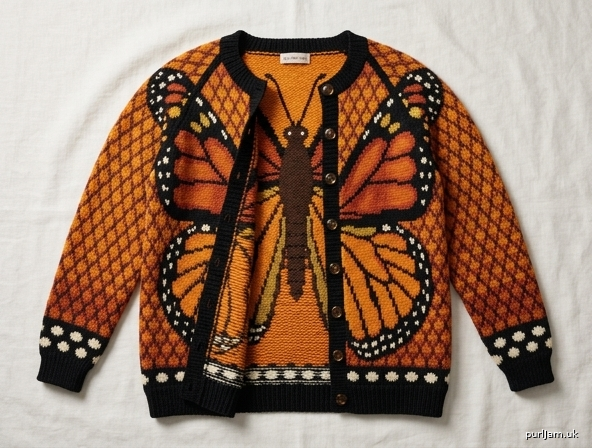
Stranded colourwork butterfly cardigan
Difficulty: Advanced
Construction: Top-down raglan, worked flat through the body; sleeves worked in the round
Yarn weight: Worsted
A hip-length, buttoned cardigan in stranded colourwork inspired by the monarch butterfly. A black neck and raglan “veins” read as thorax and wing structure; the fabric then opens into orange and rust wing scales, cream spots and gold lights. The pattern is written for worsted-weight wool so the motifs sit large and graphic.
This is an advanced project: stranded colourwork worked flat on the body (including purl rows), compound raglan shaping inside the colourwork, float management, and charted motif placement. Sleeves are worked in the round, which is more restful.
Sizes
XS (S, M, L, XL, 2XL, 3XL, 4XL)
To fit bust: 76 (86, 96, 106, 117, 127, 137, 147) cm / 30 (34, 38, 41¾, 46, 50, 54, 58) in
Intended ease: approximately 10–16 cm / 4–6¼ in positive ease at the bust, buttoned.
Sample shown in size M. Choose the size closest to your bust plus the ease you prefer; colourwork fabric has less drape than plain stocking stitch, so do not size down.
Finished measurements
Measured after blocking, cardigan buttoned, bands overlapping by about 2.5 cm.
| XS | S | M | L | XL | 2XL | 3XL | 4XL | |
|---|---|---|---|---|---|---|---|---|
| Bust | 92 cm (36¼ in) | 102 cm (40¼ in) | 112 cm (44 in) | 122 cm (48 in) | 132 cm (52 in) | 142 cm (56 in) | 152 cm (59¾ in) | 162 cm (63¾ in) |
| Length from back neck | 56.5 cm (22¼ in) | 58.5 cm (23 in) | 61 cm (24 in) | 63.5 cm (25 in) | 66 cm (26 in) | 69 cm (27¼ in) | 72 cm (28¼ in) | 75 cm (29½ in) |
| Yoke depth (neckband to underarm) | 21.5 cm (8½ in) | 22.5 cm (8¾ in) | 24 cm (9½ in) | 25.5 cm (10 in) | 27 cm (10¾ in) | 29 cm (11½ in) | 31 cm (12¼ in) | 33 cm (13 in) |
| Body from underarm (incl. hem) | 35 cm (13¾ in) | 36 cm (14¼ in) | 37 cm (14½ in) | 38 cm (15 in) | 39 cm (15¼ in) | 40 cm (15¾ in) | 41 cm (16¼ in) | 42 cm (16½ in) |
| Upper arm | 32 cm (12½ in) | 34 cm (13½ in) | 38 cm (15 in) | 42 cm (16½ in) | 46 cm (18 in) | 50 cm (19¾ in) | 54 cm (21¼ in) | 58 cm (22¾ in) |
| Cuff circumference (unstretched rib) | 17 cm (6¾ in) | 17 cm (6¾ in) | 18.5 cm (7¼ in) | 18.5 cm (7¼ in) | 20 cm (8 in) | 20 cm (8 in) | 21.5 cm (8½ in) | 21.5 cm (8½ in) |
| Sleeve length from underarm | 44 cm (17¼ in) | 45 cm (17¾ in) | 46 cm (18 in) | 46 cm (18 in) | 47 cm (18½ in) | 47 cm (18½ in) | 48 cm (19 in) | 48 cm (19 in) |
Body stitch counts after the underarm cast-on are 180 (200, 220, 240, 260, 280, 300, 320) sts at 20 sts / 10 cm = 90 (100, 110, 120, 130, 140, 150, 160) cm of fabric. Button bands add width; they overlap when fastened to reach the finished bust above.
Yarn
Smooth, round worsted-weight wool (not a fluffy or heavily haloed yarn), approx. 200 m / 100 g. Non-superwash wool blooms in blocking and hides floats; a firm superwash will also work but gives a crisper, less “filled” fabric.
MC — Black (thorax, raglan veins, ribbing, wing outlines)
600 (680, 760, 850, 950, 1060, 1180, 1300) m / 655 (745, 830, 930, 1040, 1160, 1290, 1420) yd
3 (4, 4, 5, 5, 6, 6, 7) × 100 g
CC1 — Vivid monarch orange (main wing)
320 (360, 410, 460, 520, 580, 650, 720) m / 350 (395, 450, 505, 570, 635, 710, 785) yd
2 (2, 3, 3, 3, 3, 4, 4) × 100 g
CC2 — Burnt orange / rust (wing shading)
140 (160, 180, 200, 230, 260, 290, 320) m / 155 (175, 195, 220, 250, 285, 315, 350) yd
1 (1, 1, 1, 2, 2, 2, 2) × 100 g
CC3 — Cream / off-white (spots on the wing margin)
80 (90, 100, 120, 140, 160, 180, 200) m / 85 (100, 110, 130, 155, 175, 195, 220) yd
1 × 100 g all sizes
CC4 — Antique gold (inner-wing glow)
70 (80, 90, 100, 110, 130, 150, 170) m / 75 (85, 100, 110, 120, 140, 165, 185) yd
1 × 100 g all sizes
CC5 — Warm chocolate brown (body of the butterfly, antennae)
50 (60, 70, 80, 90, 100, 110, 130) m / 55 (65, 75, 85, 100, 110, 120, 140) yd
1 × 100 g all sizes
Yardage is generous for stranded fabric (two yarns travel on every colourwork row). If you substitute, match both tension and metreage.
Needles
- 3.75 mm circular needle, 80 cm, for ribbing (neck, hem, cuffs, bands)
- 4.5 mm circular needle, 80 cm, for the body colourwork
- 4.5 mm circular needle, 40 cm, or double-pointed needles, for sleeves
- 3.75 mm needles in the same lengths for sleeve cuffs
Use the needle size you need to obtain tension. Colourwork is often tighter than plain stocking stitch — swatch in the round and flat.
Notions
- 8 stitch markers, 4 of them distinctive for the raglan lines
- Waste yarn or extra cables for holding sleeves
- Tapestry needle
- 8 (8, 8, 8, 9, 9, 9, 9) buttons, 18 mm diameter (black, dark tortoise, or gold)
- Optional: blocking wires and T-pins
Tension (gauge)
20 stitches and 26 rows = 10 cm over stranded colourwork on 4.5 mm needles, after blocking.
Ribbing on 3.75 mm will pull in to roughly 22–24 sts / 10 cm; this is intended.
Swatch a 15 cm square in two-colour stranding, knit flat (RS knit, WS purl) and a second swatch in the round. Block both. If your flat swatch is tighter than your in-the-round swatch, go up a needle size for the body only.
Abbreviations
CC contrast colour
k knit
k2tog knit 2 together (right-leaning decrease)
m1L make 1 left (lift the strand between stitches from front to back, knit through the back loop)
m1Lp make 1 left purlwise (lift from front to back, purl through the back loop)
m1R make 1 right (lift the strand between stitches from back to front, knit through the front loop)
m1Rp make 1 right purlwise (lift from back to front, purl through the front loop)
MC main colour
p purl
pm place marker
RS right side
rnd round
sm slip marker
ssk slip, slip, knit (left-leaning decrease)
st(s) stitch(es)
WS wrong side
yo yarn over
Pattern notes
Construction
Worked flat from the neck down as a cardigan (do not join in the round). Raglan increases shape the yoke. Sleeves are placed on hold at the underarm; the body continues flat. Sleeves are then worked in the round from the underarm to the cuff. Button bands are picked up along the front edges; a neckband is picked up last.
Colourwork
No more than two colours are worked in any single row or round. Additional colours appear on later rows. Cream spots (CC3) and small gold lights (CC4) may be stranded where they sit on a two-colour row, or added afterwards in duplicate stitch — the latter is cleaner for isolated spots.
Chart reading (flat — body and yoke):
- RS rows: read from right to left; knit.
- WS rows: read from left to right; purl. Both yarns stay on the WS (towards you as you purl).
- Work the written motif descriptions if a separate chart panel is not to hand; when a chart is used, it overrides only the stitch-by-stitch colour placement, not the shaping or stitch counts.
Chart reading (in the round — sleeves): every round is a knit round; read every round from right to left.
Raglan and selvedge in colourwork: the 2 stitches of each raglan line, the increase stitches on the row they are made, and the first and last stitch of every row (front selvedges) are worked in MC. On the following row, new increase stitches are absorbed into the motif.
Float management: catch or twist floats at least every 5 stitches. Catch at different points on neighbouring rows so the catches do not stack. Do not pull floats tight — the fabric should lie flat, not corrugate.
Colour dominance: hold CC1 (orange) in the left hand (dominant / pattern yarn) so the wings sit slightly proud; hold MC (black) in the right hand so the veins recede. Keep this throughout the garment. If you strand both colours in one hand, keep orange consistently above black on the WS.
Compound raglan: larger sizes increase on every row for a short black “thorax” section, then on every RS row, then on the body sides of the raglan only. This adds bust width without an oversized sleeve cap or a yoke that falls to the waist.
Motifs (colourwork)
Work the following motifs as stranded colourwork. Keep raglan stitches, increase stitches (on the increase row) and front selvedges in MC.
Chart A — Wing scale (all-over ground)
A small tessellated scale: offset oval cells in CC1, shaded at the lower edge with CC2, separated by thin MC veins. Scatter a few CC3 spots inside cells near the wing margin. Use this as the background on yoke, body and sleeves wherever a larger motif is not sitting. Never more than 5 stitches of one colour between changes; if a cell would be wider, split it with an MC vein.
Chart B — Open-wing monarch (placement motif)
A single butterfly, wings open, viewed from above. Black body and antennae (MC + CC5), forewings in CC1 with CC2 along the trailing edge, a CC4 glow near the body, and a chain of CC3 spots on the black outer margin. Centre this on the back once the yoke is deep enough to hold it (about 8–12 cm from the neckband). On each front, work a half-butterfly or inner-wing panel facing the button band, mirroring so the two fronts complete a butterfly when the cardigan is closed.
Chart C — Body wing panel
After the divide, continue the scale ground and grow it into larger wing panels: elongated CC1/CC2 cells running towards the hem, with MC veins radiating from the underarm like a monarch’s discal veins. Keep at least one full vertical MC vein in line with each raglan so the yoke structure continues down the body.
Chart D — Wing margin (lower border)
A solid MC band broken by a row of CC3 oval spots, with a scalloped inner edge in CC1/CC2. Work this for the last 4 cm of the body before the hem, and for the last 3 cm of each sleeve before the cuff.
Place motifs so they remain clear of the 2-stitch MC raglan lines. Where a repeat does not fill a section, work the leftover stitches as MC veins or as partial scales — do not stretch or squash a butterfly.
Special techniques
Full raglan increase (RS) — 8 sts increased
Work in pattern to 1 st before the raglan marker, m1R in MC, k1 MC, sm, k2 raglan MC, sm, k1 MC, m1L in MC; repeat at each of the four raglan lines; work in pattern to end.
Full raglan increase (WS) — 8 sts increased
Work in pattern to 1 st before the raglan marker, m1Rp in MC, p1 MC, sm, p2 raglan MC, sm, p1 MC, m1Lp in MC; repeat at each of the four raglan lines; work in pattern to end.
Body-only raglan increase (RS) — 4 sts increased
Increase only on the body side of each raglan line (right front, both sides of the back, left front). Do not increase on the sleeve side:
- Right front: to 1 st before marker, m1R MC, k1 MC, sm, k2 MC, sm, k1 MC (no increase), work sleeve.
- Right back: to 1 st before marker, k1 MC (no increase), sm, k2 MC, sm, k1 MC, m1L MC, work back.
- Left back: to 1 st before marker, m1R MC, k1 MC, sm, k2 MC, sm, k1 MC (no increase), work sleeve.
- Left front: to 1 st before marker, k1 MC (no increase), sm, k2 MC, sm, k1 MC, m1L MC, work to end.
Yarn-over buttonhole: yo, k2tog. On the following row, work the yo in rib as it presents (knit or purl through the back loop if it looks loose).
Instructions
Numbers are given as XS (S, M, L, XL, 2XL, 3XL, 4XL). When only one number appears, it applies to all sizes. Stitch counts are confirmed at each shaping stage.
Neckband
With 3.75 mm circular needle and MC, cast on 72 (76, 84, 84, 92, 96, 100, 104) sts using a long-tail or cable cast-on.
Row 1 (RS): *k1, p1; repeat from * to end.
Row 2 (WS): *k1, p1; repeat from * to end.
Continue in 1×1 rib until the neckband measures 3 cm, ending with a WS row.
Change to 4.5 mm circular needle.
Yoke setup
Setup row (RS), MC only:
k6 (7, 8, 8, 9, 10, 10, 12), pm, k2 (raglan), pm,
k10 (10, 12, 12, 14, 14, 16, 16), pm, k2 (raglan), pm,
k32 (34, 36, 36, 38, 40, 40, 40), pm, k2 (raglan), pm,
k10 (10, 12, 12, 14, 14, 16, 16), pm, k2 (raglan), pm,
k6 (7, 8, 8, 9, 10, 10, 12).
72 (76, 84, 84, 92, 96, 100, 104) sts, distributed as
Right front 6 (7, 8, 8, 9, 10, 10, 12) · raglan 2 · sleeve 10 (10, 12, 12, 14, 14, 16, 16) · raglan 2 · back 32 (34, 36, 36, 38, 40, 40, 40) · raglan 2 · sleeve 10 (10, 12, 12, 14, 14, 16, 16) · raglan 2 · left front 6 (7, 8, 8, 9, 10, 10, 12). ✓
Next row (WS): purl, slipping markers, keeping the 2 raglan stitches and both selvedge stitches in MC.
Keep the first and last stitch of every subsequent row in MC as a selvedge (knit on RS, purl on WS). Pick up the button bands through this chain later.
Thorax — every-row raglan (MC only)
Work this section in MC stocking stitch (knit RS, purl WS). It is the black thorax before the wings open. Size XS skips this section and goes straight to Colourwork yoke.
Sizes S–4XL only:
Work full raglan increases on every row (RS and WS) 6 (8, 14, 16, 19, 21, 22) times.
6 (8, 14, 16, 19, 21, 22) × 8 sts = 48 (64, 112, 128, 152, 168, 176) sts increased → 76 + 48 = 124 (84 + 64 = 148, 84 + 112 = 196, 92 + 128 = 220, 96 + 152 = 248, 100 + 168 = 268, 104 + 176 = 280) sts. ✓
If the last of these rows was a RS row (2XL and 3XL), work 1 WS row even so the next increase falls on a RS row.
Stitches after this section (XS still at setup count):
72 (124, 148, 196, 220, 248, 268, 280) sts.
Colourwork yoke — full raglan on RS
Join CC1. Begin Chart A (wing scale) on all five sections between the raglan lines. Keep raglan stitches, selvedges and the stitches of each increase in MC.
Work full raglan increases on RS rows only, purling WS rows even in pattern, 23 (19, 19, 17, 17, 18, 18, 20) times.
23 (19, 19, 17, 17, 18, 18, 20) × 8 sts = 184 (152, 152, 136, 136, 144, 144, 160) sts increased → 72 + 184 = 256 (124 + 152 = 276, 148 + 152 = 300, 196 + 136 = 332, 220 + 136 = 356, 248 + 144 = 392, 268 + 144 = 412, 280 + 160 = 440) sts. ✓
Distribution:
Right/left front 29 (32, 35, 39, 42, 47, 49, 54)
Each sleeve 56 (60, 66, 74, 80, 88, 94, 100)
Back 78 (84, 90, 98, 104, 114, 118, 124)
plus 8 raglan sts. ✓
When the yoke measures about 8 (9, 10, 11, 12, 13, 14, 15) cm from the cast-on, centre Chart B on the back and work the mirrored half-wings on each front. Continue Chart A as the ground around them. Introduce CC2 for shading, CC5 for the butterfly body, and CC3/CC4 as spots or duplicate stitch later. Still only two colours on any one row.
Colourwork yoke — body-only increases
Keeping sleeve stitch counts unchanged, work body-only raglan increases on RS rows 5 (7, 8, 9, 10, 10, 12, 12) times, WS rows even in pattern.
5 (7, 8, 9, 10, 10, 12, 12) × 4 sts = 20 (28, 32, 36, 40, 40, 48, 48) sts increased → 256 + 20 = 276 (276 + 28 = 304, 300 + 32 = 332, 332 + 36 = 368, 356 + 40 = 396, 392 + 40 = 432, 412 + 48 = 460, 440 + 48 = 488) sts. ✓
Distribution at end of increases:
Right/left front 34 (39, 43, 48, 52, 57, 61, 66)
Each sleeve 56 (60, 66, 74, 80, 88, 94, 100)
Back 88 (98, 106, 116, 124, 134, 142, 148)
plus 8 raglan sts. ✓
Work even in pattern, if needed, until the yoke measures 21.5 (22.5, 24, 25.5, 27, 29, 31, 33) cm from the cast-on edge, ending with a WS row. Do not stretch the yoke to measure; colourwork fabric is dense.
Divide body and sleeves
Next row (RS):
Work 34 (39, 43, 48, 52, 57, 61, 66) right-front sts, k2 raglan,
place the next 56 (60, 66, 74, 80, 88, 94, 100) sleeve sts on waste yarn,
cast on 8 (8, 10, 10, 12, 12, 14, 16) underarm sts in MC, k2 raglan,
work 88 (98, 106, 116, 124, 134, 142, 148) back sts, k2 raglan,
place the next 56 (60, 66, 74, 80, 88, 94, 100) sleeve sts on waste yarn,
cast on 8 (8, 10, 10, 12, 12, 14, 16) underarm sts in MC, k2 raglan,
work 34 (39, 43, 48, 52, 57, 61, 66) left-front sts.
Body: 180 (200, 220, 240, 260, 280, 300, 320) sts.
(34 + 2 + 8 + 2 + 88 + 2 + 8 + 2 + 34 = 180, and equivalently for the other sizes.) ✓
Work the newly cast-on underarm stitches in MC on this row, then absorb them into Chart C on the following rows as extra vein/scale stitches.
Body
Continue flat in stranded colourwork on the 180 (200, 220, 240, 260, 280, 300, 320) body stitches.
Work Chart C (body wing panels) over Chart A ground. Keep both selvedges in MC. Maintain the four MC raglan veins as they travel down from the yoke (they no longer increase).
Work until the body measures 26 (27, 28, 29, 30, 31, 32, 33) cm from the underarm, ending with a WS row.
Work Chart D (wing margin) for 4 cm, ending with a WS row.
Total from underarm: 30 (31, 32, 33, 34, 35, 36, 37) cm.
Hem
Change to 3.75 mm needle and MC only.
Next row (RS): work 1×1 rib, increasing 1 st at the centre back — 181 (201, 221, 241, 261, 281, 301, 321) sts (odd count so the rib can begin and end with k1). ✓
Continue in 1×1 rib, beginning and ending RS rows with k1, until the hem measures 5 cm.
Cast off loosely in rib.
Body from underarm including hem: 35 (36, 37, 38, 39, 40, 41, 42) cm. ✓
Sleeves
Work both sleeves alike.
Return the held 56 (60, 66, 74, 80, 88, 94, 100) sleeve stitches to 4.5 mm needles for working in the round. With RS facing and MC, beginning at the centre of the underarm, pick up and knit 4 (4, 5, 5, 6, 6, 7, 8) sts along the first half of the underarm cast-on, pick up 1 st in the gap, knit the held stitches, pick up 1 st in the other gap, pick up and knit 4 (4, 5, 5, 6, 6, 7, 8) sts along the remaining underarm.
66 (70, 78, 86, 94, 102, 110, 118) sts.
Next round: knit, decreasing 2 sts at the underarm (k2tog after the first picked-up half, ssk before the last) to close the gaps.
64 (68, 76, 84, 92, 100, 108, 116) sts. ✓
Place a marker for the beginning of the round at the underarm.
Join contrast colours and work Chart A (then Chart C/E scale elongated towards the cuff) in the round. Read every round from right to left; knit every round. Keep 2–4 underarm stitches in MC as a continuation of the vein.
Decrease round: k1, k2tog, work in pattern to 3 sts before marker, ssk, k1. (2 sts decreased.) Work the decreased stitches into the motif on following rounds; do not break a butterfly across the underarm.
Work a decrease round every 8th (7th, 6th, 5th, 4th, 4th, 3rd, 3rd) round 12 (14, 16, 20, 22, 26, 28, 32) times.
12 × 2 = 24 sts decreased → 64 − 24 = 40
(14 × 2 = 28 → 68 − 28 = 40; 16 × 2 = 32 → 76 − 32 = 44; 20 × 2 = 40 → 84 − 40 = 44; 22 × 2 = 44 → 92 − 44 = 48; 26 × 2 = 52 → 100 − 52 = 48; 28 × 2 = 56 → 108 − 56 = 52; 32 × 2 = 64 → 116 − 64 = 52) sts. ✓
40 (40, 44, 44, 48, 48, 52, 52) sts remain.
Work even in pattern until the sleeve measures 36 (37, 38, 38, 39, 39, 40, 40) cm from the underarm. Work Chart D for 3 cm. Sleeve colourwork measures 39 (40, 41, 41, 42, 42, 43, 43) cm.
Cuff
Change to 3.75 mm needles and MC. Knit 1 round, decreasing 0 (0, 0, 0, 0, 0, 0, 0) sts — counts already suit 1×1 rib.
Work 1×1 rib (*k1, p1; repeat from * to end) until the cuff measures 5 cm.
Cast off loosely in rib.
Sleeve length from underarm including cuff: 44 (45, 46, 46, 47, 47, 48, 48) cm. ✓
Button bands
With 3.75 mm needle, MC, and RS facing, pick up stitches along the front edges at 3 stitches for every 4 rows (about 19.5 sts / 10 cm). Adjust on the following row if needed so you have the counts below. Pick up through the MC selvedge chain.
Right front band (buttonholes — as worn)
Beginning at the right front hem, pick up and knit 109 (115, 121, 127, 133, 139, 145, 151) sts up to the top of the neckband.
Rows 1–5: 1×1 rib, beginning RS with k1.
Row 6 (RS) — buttonhole row: work 8 (8, 8, 8, 9, 9, 9, 9) yarn-over buttonholes (yo, k2tog), placed as follows:
- XS (109 sts, 8 buttonholes): rib 5, [yo, k2tog, rib 12] 7 times, yo, k2tog, rib 4.
(5 + 7 × 14 + 2 + 4 = 109 ✓) - S (115 sts, 8 buttonholes): rib 4, [yo, k2tog, rib 13] 7 times, yo, k2tog, rib 4.
(4 + 7 × 15 + 2 + 4 = 115 ✓) - M (121 sts, 8 buttonholes): rib 7, [yo, k2tog, rib 13] 7 times, yo, k2tog, rib 7.
(7 + 7 × 15 + 2 + 7 = 121 ✓) - L (127 sts, 8 buttonholes): rib 10, [yo, k2tog, rib 13] 7 times, yo, k2tog, rib 10.
(10 + 7 × 15 + 2 + 10 = 127 ✓) - XL (133 sts, 9 buttonholes): rib 6, [yo, k2tog, rib 13] 8 times, yo, k2tog, rib 5.
(6 + 8 × 15 + 2 + 5 = 133 ✓) - 2XL (139 sts, 9 buttonholes): rib 9, [yo, k2tog, rib 13] 8 times, yo, k2tog, rib 8.
(9 + 8 × 15 + 2 + 8 = 139 ✓) - 3XL (145 sts, 9 buttonholes): rib 8, [yo, k2tog, rib 14] 8 times, yo, k2tog, rib 7.
(8 + 8 × 16 + 2 + 7 = 145 ✓) - 4XL (151 sts, 9 buttonholes): rib 11, [yo, k2tog, rib 14] 8 times, yo, k2tog, rib 10.
(11 + 8 × 16 + 2 + 10 = 151 ✓)
This puts the first hole about 1.5–2 cm from the neck and the last about 1.5–2 cm from the hem.
Rows 7–11: 1×1 rib, working each yo through the back loop if it is loose.
Cast off in rib.
(Alternative: a 2-stitch one-row cast-off buttonhole in the same positions, if you prefer a firmer hole for 18 mm buttons.)
Left front band (buttons)
With RS facing, beginning at the top of the left neckband, pick up and knit 109 (115, 121, 127, 133, 139, 145, 151) sts down to the hem.
Work 11 rows of 1×1 rib with no buttonholes.
Cast off in rib.
The left band carries the buttons. The right band (as worn) carries the buttonholes — women’s placement.
Neckband
With 3.75 mm needle, MC, and RS facing, beginning at the top of the right button band, pick up and knit 8 sts across the band end, pick up 1 st in each original neck cast-on stitch — 72 (76, 84, 84, 92, 96, 100, 104) sts — then 8 sts across the left band end.
88 (92, 100, 100, 108, 112, 116, 120) sts.
Next row (WS): work 1×1 rib, decreasing 8 sts evenly across the original neck stitches (k2tog at even intervals).
80 (84, 92, 92, 100, 104, 108, 112) sts. ✓
Work 6 more rows in 1×1 rib. Cast off loosely in rib.
Finishing
- Weave in ends on the WS, following the same colour so they disappear into the stranding. Do not weave a dark end across a pale spot.
- Add any remaining CC3 cream spots and CC4 gold lights in duplicate stitch, following the monarch margin: a broken chain of cream ovals on black, denser towards the lower body and cuff.
- Sew 8 (8, 8, 8, 9, 9, 9, 9) buttons to the left band, opposite the buttonholes.
- Close any underarm gaps with the tail from the sleeve pickup.
Blocking (stranded colourwork)
Soak the cardigan in lukewarm water with a little wool wash for 20 minutes. Do not agitate. Press out water in a towel — do not wring. Lay flat to the finished measurements.
Pin firmly enough to even the stitches and open the motifs, but do not drag the fabric: stranded colourwork has less recovery than plain stocking stitch and can grow 5–10 % if overstretched. Align the butterfly on the back so both wings are the same width; pin the front half-wings so they meet as one insect when the cardigan is buttoned. Pin the black raglan veins as straight lines.
Leave until completely dry. A light steam (iron hovering, never pressing) can settle remaining puckers. Avoid high heat, which can felt non-superwash wool.
After blocking, the fabric should feel cohesive, with floats invisible from the RS and spots sitting round rather than square.
Knitting checklist
- Neck CO 72 (76, 84, 84, 92, 96, 100, 104) ✓
- After thorax (every-row inc): 72 (124, 148, 196, 220, 248, 268, 280) ✓
- After RS raglan inc: 256 (276, 300, 332, 356, 392, 412, 440) ✓
- After body-only inc: 276 (304, 332, 368, 396, 432, 460, 488) ✓
- Body after divide: 180 (200, 220, 240, 260, 280, 300, 320) ✓
- Sleeve after underarm: 64 (68, 76, 84, 92, 100, 108, 116) ✓
- Sleeve at cuff: 40 (40, 44, 44, 48, 48, 52, 52) ✓
- Each button band: 109 (115, 121, 127, 133, 139, 145, 151) ✓
- Buttons / buttonholes: 8 (8, 8, 8, 9, 9, 9, 9) ✓
Disclaimer: This pattern was generated by AI and should be reviewed for accuracy before use. While we strive for quality, AI-generated content may contain errors. Please verify measurements, stitch counts, charts, and instructions before beginning your project. Generated by purlJam.uk
Love this pattern?
Save this pattern to your free PurlJam libraryAccess your pattern anytime
Bookmark this page to access your pattern anytime