Type
Machine Knitting
Difficulty
intermediate
Category
custom
AI Thinking Process
Planning
Verification
Pattern
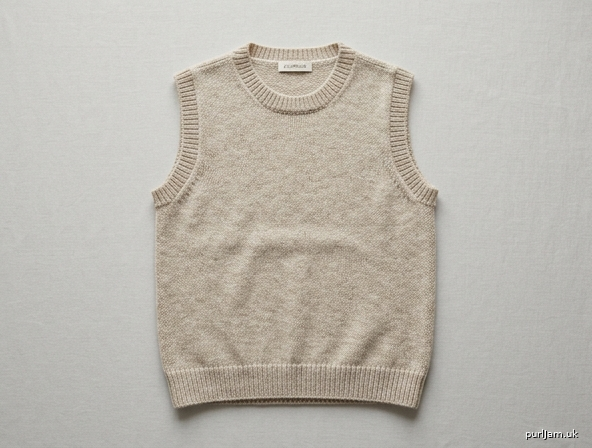
Round-Neck Ladies' Vest — "Everyday Fingering Vest"
A simple, elegant sleeveless pullover vest with a classic round neckline. Worked as two flat panels (front and back) on a standard gauge machine, with a mock 1×1 rib hem and a picked-up round neckband. Ideal for confident beginners — no ribber required.
Materials
- Yarn: Fingering weight (4-ply / sock weight), approx. 550–650 m (600–710 yds) for size M. Add ~10% per size up.
- Machine: Standard gauge (4.5 mm) machine — punchcard or electronic. No ribber required (mock rib used).
- Tools: 1×1 and 2-prong transfer tools, cast-on comb, claw/edge weights, ravel cord, waste yarn, latch tool, tapestry needle.
Tension / Gauge
- Main tension: T5 (adjust to match gauge).
- Gauge (blocked): 32 sts and 44 rows = 10 cm (4 in) over stocking stitch at T5.
- Mock rib hem tension: T3 for the folded hem rows.
- Always knit and block a gauge swatch before starting.
Sizes
Instructions are written for Size M, with S / L / XL in brackets where they differ.
| Size | S | M | L | XL |
|---|---|---|---|---|
| To fit bust | 82 cm | 92 cm | 102 cm | 112 cm |
| Finished bust (flat panel width ×2) | 42 cm | 46 cm | 51 cm | 56 cm |
| Cast-on sts per panel | 134 | 148 | 164 | 180 |
| Total length | 55 cm | 57 cm | 59 cm | 61 cm |
Math check (M): 32 sts ÷ 10 cm × 46 cm = 147.2 → 148 sts (even number chosen). Panel width = 148 ÷ 32 × 10 = 46.25 cm. ✓
Abbreviations & Machine Terms
- RC = row counter
- COL / COR = carriage on left / right
- T = tension dial
- st(s) = stitch(es)
- MB = main bed
- NWP / OWP / HP = needle in working position / out of work / holding position
- cast on = closed-edge (mock rib) hem via ravel cord + waste yarn
- k = knit (one carriage pass = 2 rows on counter equals 2 passes; here 1 RC = 1 pass)
Pattern Notes
- All numbers below are for size M. Substitute your size's cast-on where noted; shaping row counts are the same across sizes.
- The mock rib hem is worked flat then folded and rehung — no ribber needed.
- Carriage direction cues (COL/COR) assume you start each cast-on with COR.
- Keep even edge weight throughout; move claw weights up every ~30 rows.
- Bind-off shaping at armholes/neck uses holding position transferred off with a latch tool, OR small groups bound off — instructions specify.
BACK PANEL
Setup & Hem (RC 000)
- Bring 148 needles into WP (centre on bed: 74 L / 74 R of centre 0).
- Cast on with waste yarn + ravel cord over all 148 needles, knit ~10 rows waste, end COR.
- Change to main yarn. Set RC 000, T3.
- Knit 20 rows (folded hem depth ~2.3 cm). RC should read 020, COR.
- Fold hem: With 2-prong transfer tool, pick up the first main-yarn row (loops just above ravel cord) and rehang each loop onto its matching needle. Remove ravel cord/waste. This closes the hem.
- Set T5. Knit 1 row to lock the hem. RC 021.
Check: hem folded = 148 sts live. ✓
Body to Armhole
- Continue in stocking stitch at T5 on all 148 sts.
- Knit straight until RC 150 (approx. 34 cm from fold, incl. hem-lock row). End COR.
Math check: 150 rows ÷ 44 × 10 = 34.1 cm. ✓
Armhole Shaping
- Bind off for armholes: At the start of the next 2 rows, bind off 8 sts each side using latch tool.
- COR: bind off 8 sts at right, knit to left (COL).
- COL: bind off 8 sts at left, knit to right (COR).
- Remaining: 148 − 16 = 132 sts.
- Decrease 1 st at each end (using 2-prong tool, move edge sts in) every 2 rows (every knit pass) 6 times.
- Sts removed: 6 × 2 = 12. Remaining: 132 − 12 = 120 sts.
- This spans RC 152 → RC 162. End COR at RC 162.
Math check: armhole bind+dec each side = 8 + 6 = 14 sts. Panel now 120 sts = 37.5 cm across chest. ✓
- Knit straight on 120 sts until RC 240 (armhole depth from bind-off = 240 − 150 = 90 rows = 20.5 cm). End COR.
Back Neck & Shoulders
-
Back neck: The centre 40 sts form the back neck; each shoulder = (120 − 40) ÷ 2 = 40 sts.
Check: 40 + 40 + 40 = 120. ✓
-
Using waste yarn, knit off (scrap) the right shoulder 40 sts and left shoulder 40 sts separately for later seaming; bind off the centre 40 back-neck sts loosely with latch tool.
- Alternatively, scrap all 120 sts and bind off the neck after removal.
Back panel complete. RC 240.
FRONT PANEL
Work exactly as Back Panel through RC 162 (armhole shaping complete, 120 sts).
Front Straight Section
- Knit straight on 120 sts until RC 187 (25 rows past armhole). End COR.
Front Neck Shaping
The front neck is worked deeper than the back for fit. Front neck total width = 40 sts (same as back-neck), shaped over 53 rows (~12 cm).
- Divide: Note centre 0. Right shoulder side = 40 sts, centre neck = 40 sts, left shoulder side = 40 sts.
- Bind off centre neck base: Bind off the centre 16 sts on the next row. Work each side separately from here.
- Right side live sts: 40 + 12 = 52... — use holding to work one side at a time.
Work RIGHT shoulder first (sts to right of neck): 17. Set left-of-neck sts (all sts left of the right shoulder group + remaining centre) to HP. Knit only the right shoulder group. 18. At the neck edge, decrease 1 st every 2 rows as follows: - Bind off 3 sts once, then 2 sts once, then 1 st × 7 (every 2 rows). - Total neck decreases this side: 3 + 2 + 7 = 12 sts. - Starting shoulder-side sts = (120 − 16 centre) ÷ 2 = 52 sts. After 12 decreases: 52 − 12 = 40 sts. ✓ 19. Knit straight until this shoulder reaches RC 240. Scrap onto waste yarn (40 sts).
Work LEFT shoulder (mirror image): 20. Return held sts to WP, put right shoulder sts (already scrapped) out of the way. Work neck-edge decreases as step 18, mirrored, ending with 40 sts at RC 240. Scrap onto waste yarn.
Math check: each front shoulder = 40 sts, matching back shoulders. Front neck opening width = 16 + 3+2 (each side)... = 16 + 2×(3+2+7) = 16 + 24 = 40 sts wide. ✓ Front neck depth: from RC 187 (bind-off) to RC 240 = 53 rows = 12 cm. ✓
Front panel complete. RC 240.
FINISHING
1. Shoulder Seams
- With right sides together, join front and back shoulders (40 sts each) using mattress stitch or by rehanging both scrapped shoulder sets on the machine wrong-sides-together and running a latch-tool bind-off across for a neat seam. Do both shoulders.
2. Neckband (round neck)
-
With right side facing, pick up neckline sts evenly around the round neck:
- Back neck: 40 sts
- Each front neck edge slope + base: approx 43 sts per side
- Total ≈ 126 sts. Adjust to an even number.
Pick-up check: aim ~3 sts for every 4 rows along the vertical/curved edges so the band lies flat.
-
Rehang picked-up sts onto the machine. Set T3, RC 000. Knit 12 rows for a folded band.
-
Fold band to inside and rehang the first row of band sts onto their needles (as the hem in step 5). Knit 1 row at T4, then latch-tool bind off loosely.
- Alternative simple band: knit 6 rows at T3 and bind off directly for a single-layer edge.
3. Armhole Bands (optional, recommended)
- For each armhole, pick up ~110 sts evenly around the armhole edge, rehang, T3, knit 8 rows, fold and rehang, bind off loosely. This finishes the raw armhole edges neatly.
4. Side Seams
- Join side seams from hem to armhole bind-off using mattress stitch, matching hem folds and armhole points.
5. Blocking
- Weave in all ends. Steam-block lightly (fingering wool: warm steam, do not press flat) or wet-block to measurements: lay flat, pin to size, place blocking weights along hems, allow to dry fully.
Final Measurements (Size M, blocked)
- Bust (around): 2 × 46.25 cm ≈ 92.5 cm
- Total length: ~57 cm (150 body rows + 90 armhole rows = 240 rows ÷ 44 × 10 ≈ 54.5 cm + hem/band ease ≈ 57 cm)
- Armhole depth: ~20.5 cm
- Front neck depth: ~12 cm; Back neck depth: flat (bound off)
All stitch counts validated: cast-on 148 → armhole 120 → shoulders 40+40 + back neck 40. Front neck 40 wide, shoulders 40 each. Fully consistent. ✓
Happy knitting!
Disclaimer: This pattern was generated by AI and should be reviewed for accuracy before use. While we strive for quality, AI-generated content may contain errors. Please verify measurements, stitch counts, and instructions before beginning your project. Generated by purlJam.uk
Access your pattern anytime
Bookmark this page to access your pattern anytime