Type
Crochet
Difficulty
intermediate
Category
amigurumi
AI Thinking Process
Planning
Verification
Pattern
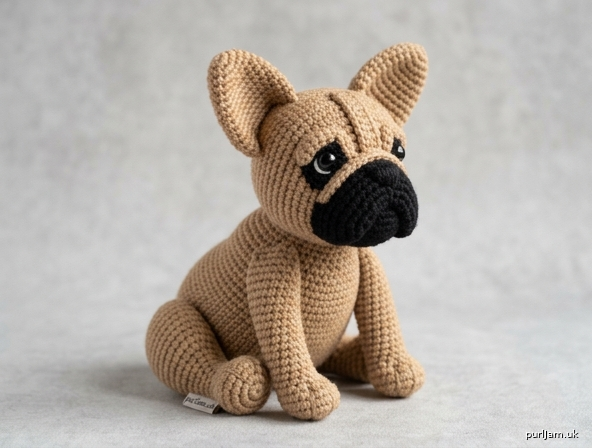
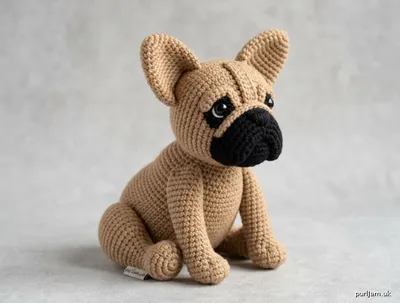
Sitting French Bulldog Amigurumi
A stocky, bat-eared Frenchie worked in continuous spirals. Intermediate: magic ring, invisible decreases, an oval muzzle, cupped ears and multi-piece assembly.
Skill level: Intermediate
Finished size: Approx. 16 cm (6¼ in) tall sitting and 12 cm (4¾ in) from chest to tail, using Aran (worsted) yarn and a 3.5 mm hook.
Terminology: UK crochet terms throughout. UK dc = US sc. UK htr = US hdc.
Materials
- Aran / worsted / 10-ply yarn (category 4), approx. 80–100 m per 50 g:
- MC (fawn, cream or brindle base): 60 g (approx. 110–120 m)
- CC (black or dark brown) for muzzle and nose: 15 g
- Small amount of black (if CC is brown) for nose and mouth
- Optional scrap of white for eye highlights
- 3.5 mm crochet hook (US E-4) — one size smaller than the yarn band, for a dense fabric
- 2 × 10 mm safety eyes
- Polyester fibre filling
- Tapestry needle
- Stitch marker
- Pins
- Optional: pale pink yarn or dry pastel for cheeks; black embroidery thread
Colour notes: Classic fawn with a black mask (muzzle in CC, body in MC). For brindle, hold two close shades of MC together or alternate every few stitches. For pied, work the body in white and add CC patches when sewing.
Tension (gauge)
11 dc × 12 rounds = 5 × 5 cm (2 × 2 in) in spiral dc with a 3.5 mm hook.
Tension is not critical for fit, but the fabric must be dense: stuffing should not show through. If the fabric is loose, drop to 3.25 mm.
Abbreviations (UK)
| Abbreviation | Meaning |
|---|---|
| MR | magic ring (adjustable ring) |
| ch | chain |
| dc | double crochet (US single crochet) |
| inc | 2 dc in the same stitch |
| inv-dec | invisible decrease: insert hook in FLO of next 2 sts, yarn over, pull through both, yarn over, pull through 3 loops |
| sl st | slip stitch |
| BLO | back loop only |
| FLO | front loop only |
| st(s) | stitch(es) |
| rnd | round |
| FO | fasten off |
| MC / CC | main colour / contrast colour |
| [ ] | stitch count at end of round |
Pattern notes
- Work in a continuous spiral unless stated. Do not join rounds. Mark the first stitch of every round and move the marker up.
- Always use inv-dec (not dc2tog through both loops) so decreases stay smooth.
- Stuff as you go, and stuff the body and head firmly. Limbs are stuffed firmly at the paws and only moderately in the upper legs.
- Insert safety eyes before the head opening is too small.
- Leave long tails (30–40 cm / 12–16 in) on pieces that will be sewn.
- Pin every piece and check the sitting pose before sewing.
Head (MC)
Worked from the crown down.
Rnd 1: 6 dc in MR. [6]
Rnd 2: inc in each st around. [12] (6 increases → 6 + 6 = 12 ✓)
Rnd 3: (1 dc, inc) 6 times. [18] (6 increases → 12 + 6 = 18 ✓)
Rnd 4: (2 dc, inc) 6 times. [24] (6 increases → 18 + 6 = 24 ✓)
Rnd 5: (3 dc, inc) 6 times. [30] (6 increases → 24 + 6 = 30 ✓)
Rnd 6: (4 dc, inc) 6 times. [36] (6 increases → 30 + 6 = 36 ✓)
Rnd 7: (5 dc, inc) 6 times. [42] (6 increases → 36 + 6 = 42 ✓)
Rnds 8–14: dc in each st around. [42] (7 even rounds)
Place eyes between rnds 11 and 12, 6 sts apart, on the front of the head (not on the sides). Do not fix the washers until the muzzle has been trial-fitted.
Rnd 15: (5 dc, inv-dec) 6 times. [36] (6 decreases → 42 − 6 = 36 ✓)
Rnd 16: (4 dc, inv-dec) 6 times. [30] (6 decreases → 36 − 6 = 30 ✓)
Rnd 17: (3 dc, inv-dec) 6 times. [24] (6 decreases → 30 − 6 = 24 ✓)
Stuff the head firmly, keeping the face slightly flatter than the back of the skull.
Rnd 18: (2 dc, inv-dec) 6 times. [18] (6 decreases → 24 − 6 = 18 ✓)
Rnd 19: (1 dc, inv-dec) 6 times. [12] (6 decreases → 18 − 6 = 12 ✓)
Finish stuffing.
Rnd 20: inv-dec 6 times. [6] (6 decreases → 12 − 6 = 6 ✓)
FO, thread tail through remaining 6 FLO, pull closed, weave in.
Muzzle (CC)
A wide, short oval — the Frenchie’s flat face.
Ch 6.
Rnd 1: dc in 2nd ch from hook, dc in next 3 ch, 3 dc in last ch; rotate and work along the other side of the foundation ch: dc in next 3 ch, 2 dc in remaining ch. [12] (1 + 3 + 3 + 3 + 2 = 12 ✓)
Rnd 2: inc in first st, 3 dc, inc in each of next 3 sts, 3 dc, inc in each of last 2 sts. [18] (2 + 3 + 6 + 3 + 4 = 18 ✓)
Rnd 3: (1 dc, inc), 3 dc, (1 dc, inc) 3 times, 3 dc, (1 dc, inc) 2 times. [24] (3 + 3 + 9 + 3 + 6 = 24 ✓)
Rnds 4–5: dc in each st around. [24]
FO, leaving a long tail. Do not overstuff — a thin pancake of filling is enough so the muzzle stays flat and wide.
Nose (before sewing on): With black yarn, embroider a wide rounded triangle or rounded rectangle over the top centre of the muzzle, covering about 4 sts across and 3 rnds deep. Add two tiny vertical sts at the lower edge for nostrils. Fasten off on the wrong side.
Ears (make 2, MC or CC)
Cupped bat ears. Do not stuff. Increases sit in three panels so the ear forms a triangle when flattened.
Rnd 1: 6 dc in MR. [6]
Rnd 2: (1 dc, inc) 3 times. [9] (3 increases → 6 + 3 = 9 ✓)
Rnd 3: (2 dc, inc) 3 times. [12] (3 increases → 9 + 3 = 12 ✓)
Rnd 4: (3 dc, inc) 3 times. [15] (3 increases → 12 + 3 = 15 ✓)
Rnd 5: (4 dc, inc) 3 times. [18] (3 increases → 15 + 3 = 18 ✓)
Rnd 6: (5 dc, inc) 3 times. [21] (3 increases → 18 + 3 = 21 ✓)
Rnds 7–9: dc in each st around. [21]
Rnd 10: (5 dc, inv-dec) 3 times. [18] (3 decreases → 21 − 3 = 18 ✓)
FO, leaving a long tail. Flatten each ear into a bat shape (wide base, gently pointed tip). The open edge is the base that will be sewn to the head.
Forehead wrinkle (MC, optional)
Ch 10.
Row 1: dc in 2nd ch from hook and in each ch across. [9]
FO, leaving a tail. This small strip is sewn as a roll between the eyes.
Body (MC)
Worked from the sitting base up to the neck, so the bottom can be stuffed very firmly.
Rnd 1: 6 dc in MR. [6]
Rnd 2: inc in each st around. [12]
Rnd 3: (1 dc, inc) 6 times. [18]
Rnd 4: (2 dc, inc) 6 times. [24]
Rnd 5: (3 dc, inc) 6 times. [30]
Rnd 6: (4 dc, inc) 6 times. [36]
Rnd 7: (5 dc, inc) 6 times. [42]
Rnd 8: (6 dc, inc) 6 times. [48] (6 increases → 42 + 6 = 48 ✓)
Rnd 9: (7 dc, inc) 6 times. [54] (6 increases → 48 + 6 = 54 ✓)
Rnd 10: dc BLO in each st around. [54]
This BLO round makes a neat crease so the base sits flat.
Rnds 11–18: dc in each st around. [54] (8 even rounds)
Rnd 19: (7 dc, inv-dec) 6 times. [48] (6 decreases → 54 − 6 = 48 ✓)
Rnd 20: (6 dc, inv-dec) 6 times. [42] (6 decreases → 48 − 6 = 42 ✓)
Rnd 21: (5 dc, inv-dec) 6 times. [36] (6 decreases → 42 − 6 = 36 ✓)
Rnd 22: (4 dc, inv-dec) 6 times. [30] (6 decreases → 36 − 6 = 30 ✓)
Rnd 23: (3 dc, inv-dec) 6 times. [24] (6 decreases → 30 − 6 = 24 ✓)
Stuff the base very firmly and keep stuffing as you decrease, shaping a broad chest and a flattened bottom.
Rnd 24: (2 dc, inv-dec) 6 times. [18] (6 decreases → 24 − 6 = 18 ✓)
FO, leaving a long tail for sewing to the head. Top up the stuffing through the neck so the chest is barrel-solid.
Front legs (make 2, MC)
Rnd 1: 6 dc in MR. [6]
Rnd 2: inc in each st around. [12]
Rnd 3: (1 dc, inc) 6 times. [18] (6 increases → 12 + 6 = 18 ✓)
Rnd 4: dc in each st around. [18]
Rnd 5: (1 dc, inv-dec) 6 times. [12] (6 decreases → 18 − 6 = 12 ✓)
Rnds 6–11: dc in each st around. [12] (6 even rounds)
Stuff the paw firmly and the upper leg only moderately (so the legs drape). FO, leaving a long tail. Leave the top open.
Hind legs (make 2, MC)
Shaped as a thick thigh tapering to a short lower leg, for a sitting pose.
Rnd 1: 6 dc in MR. [6]
Rnd 2: inc in each st around. [12]
Rnd 3: (1 dc, inc) 6 times. [18]
Rnd 4: (2 dc, inc) 6 times. [24] (6 increases → 18 + 6 = 24 ✓)
Rnds 5–8: dc in each st around. [24] (4 even rounds — thigh)
Rnd 9: (2 dc, inv-dec) 6 times. [18] (6 decreases → 24 − 6 = 18 ✓)
Rnd 10: (1 dc, inv-dec) 6 times. [12] (6 decreases → 18 − 6 = 12 ✓)
Rnds 11–13: dc in each st around. [12] (3 even rounds — lower leg)
Stuff the thigh firmly and the lower leg moderately. FO, leaving a long tail. Leave the top open.
Tail (MC)
Frenchies have a very short, often slightly screwed tail.
Rnd 1: 4 dc in MR. [4]
Rnd 2: (1 dc, inc) 2 times. [6] (2 increases → 4 + 2 = 6 ✓)
Rnd 3: dc in each st around. [6]
Rnd 4: (1 dc, inv-dec) 2 times. [4] (2 decreases → 6 − 2 = 4 ✓)
FO, leaving a tail. Stuff lightly or not at all. Curve it into a tiny hook as you sew.
Assembly
Use matching yarn and a tapestry needle. Pin first, sew second. Ladder stitch or whip stitch, taking small stitches and pulling snug so joins sit flush. Secure every end with several hidden knots — no loose parts.
1. Muzzle. Centre the muzzle on the lower face, covering approx. rnds 13–18, with the top edge sitting just below the eyes. The wide axis of the oval runs left–right. Pin, then sew all around, adding a pinch of filling just before closing so the muzzle is padded but still flat. Fix the safety-eye washers on the inside now, if you have not already.
2. Eyes and expression. Eyes should look slightly large and forward-set, about 6 sts apart. With black yarn, add a short straight mouth or a tiny underbite “U” under the nose. Optional: one small white highlight stitch at the outer corner of each eye.
3. Wrinkles. Sew the forehead strip as a shallow roll between and just above the eyes. With MC or a slightly darker yarn, backstitch 2–3 short curved lines on the muzzle beside the nose, and one short line above each eye.
4. Ears. Flatten each ear. Pin the bases to the top of the head over rnds 5–9, set well apart (bat-ear stance) and angled slightly outward. The inner edges should not touch. Sew the open edge closed as you attach it, catching both layers. Tack the lower inner corner with one extra stitch so the ears stand.
5. Head to body. The body neck is 18 sts and the head close is 18 sts — they match. Pin the head on so the muzzle points slightly down (a typical Frenchie sit). Add extra filling through the neck if the join looks hollow, then sew all the way around twice.
6. Hind legs (sitting). Place the thighs against the lower sides of the body, just above the BLO sitting crease, with the lower legs pointing forward along the base. The feet should rest on the same plane as the body bottom so the toy sits. Sew the open thigh edge and a good portion of the inner thigh to the body so the legs cannot swing.
7. Front legs. Sew the open tops to the upper chest, just below the neck join, about 4–5 sts apart, hanging down so the paws rest on the ground in front of the hind feet. A sitting Frenchie has short, almost straight front legs.
8. Tail. Sew to the lower back, centred, just above the sitting crease, curved to one side.
9. Cheeks (optional). Brush a tiny amount of pink pastel or use a few light pink stitches on the muzzle sides.
Finishing
- Weave in every remaining end.
- Roll the body on a table so the BLO crease sits flat. If the toy rocks, add a little more filling through a small gap at a leg join, then close.
- Check that ears, eyes and legs cannot be pulled off.
Safety: Safety eyes are not toys in themselves — if the dog is for a child under 3 years, embroider the eyes with yarn instead of using plastic eyes, and sew every piece on extra firmly. This pattern is not a teething toy.
Stitch-count summary
| Piece | Max sts | Closing / open |
|---|---|---|
| Head | 42 | closed to 6 |
| Muzzle | 24 | sewn on |
| Ear | 21 | flattened, 18 at base |
| Body | 54 | left open at 18 |
| Front leg | 18 (paw) / 12 | left open |
| Hind leg | 24 (thigh) / 12 | left open |
| Tail | 6 | closed to 4 |
Head even section 42 sts × 7 rnds; body even section 54 sts × 8 rnds after the BLO crease. Neck 18 = head rnd 18. All increase/decrease rounds change by 6 sts (ears by 3).
Disclaimer: This pattern was generated by AI and should be reviewed for accuracy before use. While we strive for quality, AI-generated content may contain errors. Please verify measurements, stitch counts, charts, and instructions before beginning your project. Generated by purlJam.uk
Love this pattern?
Save this pattern to your free PurlJam libraryAccess your pattern anytime
Bookmark this page to access your pattern anytime