Type
Knitting
Difficulty
advanced
Category
cardigan
AI Thinking Process
Planning
Verification
Pattern
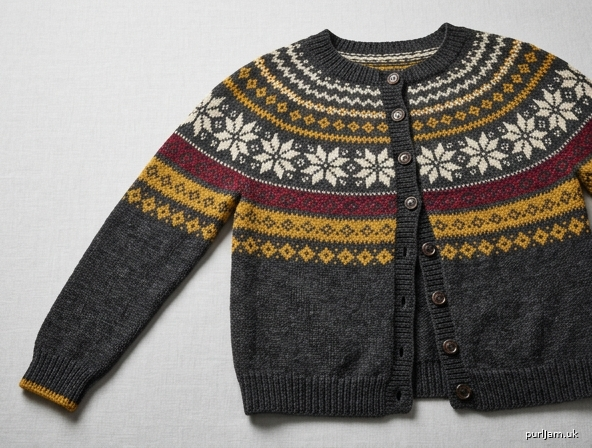
Starling Fair Isle Cardigan
Difficulty: Advanced
Construction: Top-down raglan, in the round, with a center-front steek
Fit: Standard-to-easy, about 4" (10 cm) positive ease at the bust
A stranded-colorwork raglan cardigan worked entirely in the round, then cut open at a 5-stitch steek. Small peeries and a north-star band travel from neck to hem; sleeves pick up the same motifs before fading to solid. Non-superwash wool is required so the steek holds.
Sizes
XS (S, M, L, XL, 2X, 3X)
To fit bust: 32 (36, 40, 44, 48, 52, 56)" / 81.5 (91.5, 101.5, 112, 122, 132, 142) cm
Finished bust (bands overlapping): 36 (40, 44, 48, 52, 56, 60)" / 91.5 (101.5, 112, 122, 132, 142, 152.5) cm
Shown in size M. Choose the size closest to (actual bust + 4").
Finished Measurements
| Measurement | XS | S | M | L | XL | 2X | 3X |
|---|---|---|---|---|---|---|---|
| Bust | 36" (91.5 cm) | 40" (101.5 cm) | 44" (112 cm) | 48" (122 cm) | 52" (132 cm) | 56" (142 cm) | 60" (152.5 cm) |
| Yoke depth (CO to underarm) | 9" (23 cm) | 9½" (24 cm) | 10¼" (26 cm) | 10¾" (27.5 cm) | 11¼" (28.5 cm) | 12" (30.5 cm) | 12¾" (32.5 cm) |
| Body length from underarm (incl. hem) | 14" (35.5 cm) | 14½" (37 cm) | 15" (38 cm) | 15½" (39.5 cm) | 16" (40.5 cm) | 16½" (42 cm) | 17" (43 cm) |
| Total length (back neck to hem) | 23" (58.5 cm) | 24" (61 cm) | 25¼" (64 cm) | 26¼" (66.5 cm) | 27¼" (69 cm) | 28½" (72.5 cm) | 29¾" (75.5 cm) |
| Upper arm | 12" (30.5 cm) | 12¾" (32.5 cm) | 14" (35.5 cm) | 15¼" (38.5 cm) | 16¾" (42.5 cm) | 18½" (47 cm) | 20" (51 cm) |
| Sleeve length from underarm (incl. cuff) | 19½" (49.5 cm) | 20" (51 cm) | 20½" (52 cm) | 20½" (52 cm) | 21" (53.5 cm) | 21" (53.5 cm) | 21½" (54.5 cm) |
| Wrist / cuff | 8" (20.5 cm) | 8¾" (22 cm) | 8¾" (22 cm) | 9½" (24 cm) | 9½" (24 cm) | 10½" (26.5 cm) | 11¼" (28.5 cm) |
| Back neck (CO, excl. steek) | 7¼" (18.5 cm) | 8" (20.5 cm) | 8¾" (22 cm) | 9½" (24 cm) | 10½" (26.5 cm) | 11¼" (28.5 cm) | 12" (30.5 cm) |
Ease is included in the bust numbers. Button bands overlap and do not add circumference.
Yarn
Worsted-weight non-superwash wool (about 220 yd / 200 m per 100 g). Superwash, cotton, and plant fibers will not grip a steek; if you must use them, sew a machine line on each side of the cut in addition to the crochet reinforcement.
MC (Charcoal Heather): 900 (1000, 1100, 1250, 1400, 1550, 1700) yd / 825 (915, 1005, 1145, 1280, 1420, 1555) m
CC1 (Natural Cream): 220 (240, 260, 290, 320, 350, 380) yd / 200 (220, 240, 265, 295, 320, 345) m
CC2 (Goldenrod): 160 (180, 200, 220, 250, 280, 310) yd / 145 (165, 185, 200, 230, 255, 285) m
CC3 (Cranberry): 140 (160, 180, 200, 220, 250, 270) yd / 130 (145, 165, 185, 200, 230, 245) m
CC4 (Spruce): 120 (140, 150, 170, 190, 210, 230) yd / 110 (130, 135, 155, 175, 190, 210) m
CC5 (Storm Blue): 120 (130, 140, 160, 180, 200, 220) yd / 110 (120, 130, 145, 165, 185, 200) m
Sample used a 220 yd / 100 g worsted: MC 5 (5, 5, 6, 7, 7, 8) skeins; CC1 1 (2, 2, 2, 2, 2, 2) skeins; CC2–CC5 1 skein each (2 of CC2 and CC3 for XL–3X).
Needles
- Main (colorwork): US 7 (4.5 mm) circular, 32–40" (80–100 cm), plus DPNs or a second circular for sleeves
- Ribbing: US 5 (3.75 mm) circular, 32–40" (80–100 cm), and DPNs for cuffs
Adjust needle size to obtain gauge. Colorwork fabric is often tighter than plain stockinette — swatch in stranded colorwork.
Notions
- 6 stitch markers (one unique for beginning of round)
- Waste yarn or extra cables for holding sleeve stitches
- Tapestry needle
- Crochet hook US E-4 (3.5 mm) for steek reinforcement
- Sharp scissors
- 7 (7, 7, 8, 8, 9, 9) buttons, ⅞" (22 mm) diameter
- Sewing needle and thread for buttons
Gauge
20 stitches and 26 rounds = 4" (10 cm) in stranded colorwork on US 7 (4.5 mm), blocked.
Ribbing on US 5 (3.75 mm) is about 24 sts = 4" (10 cm), relaxed.
Swatch at least 6" (15 cm) square in Chart A, two colors. Wash and block the swatch the same way you will block the garment. If you are over 20 sts = 4", go up a needle size; if under, go down. Do not substitute a stockinette gauge.
Notes
Construction. The cardigan is knit in the round from the neck down with a 5-stitch steek at center front. Raglan increases shape the yoke; extra increases at each side of the steek fill in the front neck. Sleeves are divided and held, the body continues with the steek, then sleeves are worked in the round. After the body is bound off, the steek is reinforced and cut, and button bands and a neckband are picked up.
Two colors per round. Never work more than two colors in a single round. Pattern color is shown as X on the charts; MC (or the designated background) is ·.
Color dominance. Hold the pattern color (X) as the dominant yarn — in the left hand if you strand two-handed, or as the lower (index-finger) yarn if you strand one-handed. Dominant stitches sit slightly larger and the motifs pop. Hold MC as the background (non-dominant) yarn throughout unless a round is solid CC.
Floats. Do not carry a float more than 5 stitches. Catch the unused yarn every 3–4 stitches by twisting it with the working yarn on the wrong side, staggering catch points so they do not stack into a visible line. On rounds where X sits at both edges of the repeat (a long MC float of 6–8 sts inside the repeat), catch at the center of that run.
Charts and raglan shaping. Begin stitch 1 of the chart at the start of every yoke section (after each marker). Work full 10-st repeats across the section. If 1–9 stitches remain before the next marker, work them as chart stitches 1 through remainder, or in MC if you prefer a clean raglan stripe. As increases accumulate, add a new full repeat when 10 new stitches have formed. Increased stitches are worked in the current background color on the increase round, then enter the chart on the following round.
Steek. The 5 steek stitches are never counted in body stitch counts given after a plus sign. Work them in knit, alternating MC and the active CC every stitch and every round (a checkerboard). They will be reinforced and cut later. Do not catch floats across the steek; drop and restart yarns at the steek if needed.
Blocking colorwork. Wet-block. Soak 20 minutes in lukewarm water with wool wash. Press water out — never wring. Lay flat and pin to the schematic measurements, stretching the stranded fabric just enough to even the stitches and lock the floats. Do not stretch ribbing. Dry completely before unpinning.
Abbreviations (US)
BOR — beginning of round
BO — bind off
CC — contrast color
CO — cast on
k — knit
k2tog — knit 2 together (right-leaning decrease)
M1L — make 1 left: lift the bar between stitches from front to back, knit through the back loop
M1R — make 1 right: lift the bar between stitches from back to front, knit through the front loop
MC — main color
p — purl
pm — place marker
rnd(s) — round(s)
RS — right side
sm — slip marker
ssk — slip, slip, knit (left-leaning decrease)
st(s) — stitch(es)
WS — wrong side
wyib — with yarn in back
yo — yarn over
Chart Reading
- Charts are drawn as the right side of the fabric appears.
- Worked in the round: read every round from right to left. Round 1 is at the bottom.
·= background color for that band (usually MC).X= pattern color for that band (see Color Sequence).- Repeat the 10-stitch panel across each section.
- Only two colors are in use on any round. A round of all
Xis worked solid in the pattern color; a round of all·is worked solid in the background color.
Charts
Legend for all charts:
· = background X = pattern color
Chart A — Little Diamond
10-st repeat × 9 rounds
        10  9  8  7  6  5  4  3  2  1
Rnd 9    ·  ·  ·  ·  X  X  ·  ·  ·  ·
Rnd 8    ·  ·  ·  X  X  X  X  ·  ·  ·
Rnd 7    ·  ·  X  X  ·  ·  X  X  ·  ·
Rnd 6    ·  X  X  ·  ·  ·  ·  X  X  ·
Rnd 5    X  X  ·  ·  ·  ·  ·  ·  X  X
Rnd 4    ·  X  X  ·  ·  ·  ·  X  X  ·
Rnd 3    ·  ·  X  X  ·  ·  X  X  ·  ·
Rnd 2    ·  ·  ·  X  X  X  X  ·  ·  ·
Rnd 1    ·  ·  ·  ·  X  X  ·  ·  ·  ·
Catch the MC float at the center of Rnd 5.
Chart B — North Star
10-st repeat × 17 rounds
         10  9  8  7  6  5  4  3  2  1
Rnd 17    ·  ·  ·  ·  X  X  ·  ·  ·  ·
Rnd 16    ·  ·  ·  X  X  X  X  ·  ·  ·
Rnd 15    ·  ·  X  X  X  X  X  X  ·  ·
Rnd 14    ·  ·  ·  X  X  X  X  ·  ·  ·
Rnd 13    ·  X  ·  ·  X  X  ·  ·  X  ·
Rnd 12    X  X  X  ·  X  X  ·  X  X  X
Rnd 11    ·  X  ·  ·  X  X  ·  ·  X  ·
Rnd 10    ·  ·  ·  ·  X  X  ·  ·  ·  ·
Rnd  9    X  X  X  X  X  X  X  X  X  X
Rnd  8    ·  ·  ·  ·  X  X  ·  ·  ·  ·
Rnd  7    ·  X  ·  ·  X  X  ·  ·  X  ·
Rnd  6    X  X  X  ·  X  X  ·  X  X  X
Rnd  5    ·  X  ·  ·  X  X  ·  ·  X  ·
Rnd  4    ·  ·  ·  X  X  X  X  ·  ·  ·
Rnd  3    ·  ·  X  X  X  X  X  X  ·  ·
Rnd  2    ·  ·  ·  X  X  X  X  ·  ·  ·
Rnd  1    ·  ·  ·  ·  X  X  ·  ·  ·  ·
Rnd 9 is solid pattern color (no floats). Catch long MC floats on Rnds 8, 10, 12, and 6.
Chart C — OXO Band
10-st repeat × 13 rounds
         10  9  8  7  6  5  4  3  2  1
Rnd 13    ·  X  ·  X  ·  X  ·  ·  ·  X
Rnd 12    X  ·  X  ·  X  ·  X  ·  X  ·
Rnd 11    ·  X  ·  X  ·  X  ·  ·  ·  X
Rnd 10    X  ·  X  ·  X  ·  X  X  X  ·
Rnd  9    ·  X  ·  X  ·  X  ·  ·  ·  X
Rnd  8    X  X  X  X  X  ·  X  ·  X  ·
Rnd  7    ·  ·  ·  ·  ·  X  ·  ·  ·  X
Rnd  6    X  X  X  X  X  ·  X  ·  X  ·
Rnd  5    ·  X  ·  X  ·  X  ·  ·  ·  X
Rnd  4    X  ·  X  ·  X  ·  X  X  X  ·
Rnd  3    ·  X  ·  X  ·  X  ·  ·  ·  X
Rnd  2    X  ·  X  ·  X  ·  X  ·  X  ·
Rnd  1    ·  X  ·  X  ·  X  ·  ·  ·  X
Sts 1–5 form the O; sts 6–10 form the X. Catch floats on Rnd 7.
Chart D — Zigzag Peerie
10-st repeat × 5 rounds
        10  9  8  7  6  5  4  3  2  1
Rnd 5    X  ·  ·  ·  X  X  ·  ·  ·  X
Rnd 4    ·  X  ·  X  ·  ·  X  ·  X  ·
Rnd 3    ·  ·  X  ·  ·  ·  ·  X  ·  ·
Rnd 2    ·  X  ·  X  ·  ·  X  ·  X  ·
Rnd 1    X  ·  ·  ·  X  X  ·  ·  ·  X
Color Sequence
Work the charts in this order, at the same time as the yoke (then body) shaping. Two colors only per round.
Yoke sequence (start at the neck; smaller sizes stop when yoke rounds for the size are complete):
| Rounds | Chart | Background | Pattern (X) |
|---|---|---|---|
| 1–2 | Solid | MC | — |
| 3–7 | Chart D | MC | CC1 Cream |
| 8–9 | Solid | MC | — |
| 10–18 | Chart A | MC | CC2 Goldenrod |
| 19–20 | Solid | MC | — |
| 21–37 | Chart B | MC | CC1 Cream |
| 38–39 | Solid | MC | — |
| 40–52 | Chart C | MC | CC3 Cranberry |
| 53–54 | Solid | MC | — |
| 55–63 | Chart A | MC | CC4 Spruce |
| 64–65 | Solid | MC | — |
| 66–70 | Chart D | MC | CC5 Storm Blue |
| 71–76 | Solid | MC | — |
Yoke round totals: 52 (56, 60, 64, 66, 72, 76). XS ends on Chart C; S works through rnd 56 (first 2 rnds of Chart A in spruce); M through 60; L through 64; XL through 66; 2X through 72; 3X through 76. If shaping ends mid-band, finish that chart (or the following 2 MC rounds) before dividing so you do not cut a motif in half at the underarm.
Body sequence (restart after the divide, from underarm):
| After divide | Chart | Background | Pattern (X) |
|---|---|---|---|
| 2 rnds | Solid | MC | — |
| 5 rnds | Chart D | MC | CC5 |
| 2 rnds | Solid | MC | — |
| 9 rnds | Chart A | MC | CC2 |
| 2 rnds | Solid | MC | — |
| 17 rnds | Chart B | MC | CC1 |
| 2 rnds | Solid | MC | — |
| 13 rnds | Chart C | MC | CC3 |
| 2 rnds | Solid | MC | — |
| 9 rnds | Chart A | MC | CC4 |
| 2 rnds | Solid | MC | — |
| 5 rnds | Chart D | MC | CC1 |
| remaining | Solid | MC | — |
Then work hem ribbing. Body colorwork is about 70 rounds (10¾") before the MC run to the rib.
Pattern
Neck
With US 7 (4.5 mm) and MC, using a long-tail or German twisted cast-on, CO 89 (97, 105, 113, 121, 129, 137) sts.
Place BOR marker and join to work in the round, taking care not to twist.
Set-up round: K5 (steek), pm, k 10 (12, 12, 14, 14, 16, 16) Left Front, pm, k 14 (14, 16, 16, 18, 18, 20) Left Sleeve, pm, k 36 (40, 44, 48, 52, 56, 60) Back, pm, k 14 (14, 16, 16, 18, 18, 20) Right Sleeve, pm, k 10 (12, 12, 14, 14, 16, 16) Right Front.
Check: 5 steek + 84 (92, 100, 108, 116, 124, 132) working sts = 89 (97, 105, 113, 121, 129, 137) ✓
Sections: LF 10 (12, 12, 14, 14, 16, 16), LS 14 (14, 16, 16, 18, 18, 20), Back 36 (40, 44, 48, 52, 56, 60), RS 14 (14, 16, 16, 18, 18, 20), RF 10 (12, 12, 14, 14, 16, 16) ✓
Work 1 more round knit in MC (Yoke Sequence rnds 1–2). Begin Chart D on the next round, and begin yoke shaping on the first chart round (rnd 3 of the sequence).
Yoke
Work the Yoke Color Sequence and the shaping below at the same time. On increase rounds, work M1 in the current background color.
Inc-All + Neck (used in Phase 1):
Work 5 steek, sm, M1L, work Left Front in pattern to marker, M1R, sm, M1L, work Left Sleeve to marker, M1R, sm, M1L, work Back to marker, M1R, sm, M1L, work Right Sleeve to marker, M1R, sm, M1L, work Right Front to end, M1R.
+10 sts (8 raglan + 2 neck).
Inc-All (used in Phase 2):
Work 5 steek, sm, work Left Front to marker, M1R, sm, M1L, work Left Sleeve to marker, M1R, sm, M1L, work Back to marker, M1R, sm, M1L, work Right Sleeve to marker, M1R, sm, M1L, work Right Front to end.
+8 sts. (No neck increases.)
Inc-Body (used in Phase 3):
Work 5 steek, sm, work Left Front to marker, M1R, sm, work Left Sleeve to marker, sm, M1L, work Back to marker, M1R, sm, work Right Sleeve to marker, sm, M1L, work Right Front to end.
+4 sts (body only; sleeves even).
Even round: Work 5 steek, work all sections in pattern with no increases.
Work all increase rounds on odd-numbered yoke rounds (3, 5, 7, …), with an even round between them, unless a note says otherwise.
Phase 1 — Raglan and front neck
Work Inc-All + Neck every other round 8 (8, 10, 10, 12, 12, 14) times.
Stitch check after Phase 1:
Working sts 164 (172, 200, 208, 236, 244, 272), plus 5 steek.
LF 26 (28, 32, 34, 38, 40, 44)
LS 30 (30, 36, 36, 42, 42, 48)
Back 52 (56, 64, 68, 76, 80, 88)
RS 30 (30, 36, 36, 42, 42, 48)
RF 26 (28, 32, 34, 38, 40, 44)
XS example: 8 × 10 = 80; 84 + 80 = 164 ✓
Phase 2 — Raglan only
Work Inc-All every other round 11 (13, 12, 15, 15, 19, 19) times.
Stitch check after Phase 2:
LF 37 (41, 44, 49, 53, 59, 63)
LS 52 (56, 60, 66, 72, 80, 86)
Back 74 (82, 88, 98, 106, 118, 126)
RS 52 (56, 60, 66, 72, 80, 86)
RF 37 (41, 44, 49, 53, 59, 63)
XS example: 11 × 8 = 88; 164 + 88 = 252 working sts ✓
Phase 3 — Body only
Work Inc-Body every other round 4 (5, 6, 6, 6, 5, 5) times.
Stitch check after Phase 3 (yoke complete):
LF 41 (46, 50, 55, 59, 64, 68)
LS 52 (56, 60, 66, 72, 80, 86)
Back 82 (92, 100, 110, 118, 128, 136)
RS 52 (56, 60, 66, 72, 80, 86)
RF 41 (46, 50, 55, 59, 64, 68)
Working sts 268 (316, 326, 352, 380, 422, 444), plus 5 steek.
XS: 4 × 4 = 16; 252 + 16 = 268 ✓
S: LF 41+5=46, LS 56, Back 82+10=92 → 46+56+92+56+46=296; plus remaining size math matches table.
Targets: LF 41 (46, 50, 55, 59, 64, 68), sleeves 52 (56, 60, 66, 72, 80, 86), back 82 (92, 100, 110, 118, 128, 136) ✓
Phase 4 — Even (if needed)
Work even in pattern for 6 (4, 4, 2, 0, 0, 0) more rounds.
Total yoke rounds from CO: 52 (56, 60, 64, 66, 72, 76) = 8 (8.6, 9.2, 9.8, 10.2, 11.1, 11.7)" of colorwork. Yoke depth matches the measurements table ✓
Divide Body and Sleeves
Next round (MC or current background):
Work 5 steek, sm, work 41 (46, 50, 55, 59, 64, 68) Left Front, place next 52 (56, 60, 66, 72, 80, 86) Left Sleeve sts on waste yarn, removing the sleeve markers, CO 8 (8, 10, 10, 12, 12, 14) underarm sts, work 82 (92, 100, 110, 118, 128, 136) Back, place next 52 (56, 60, 66, 72, 80, 86) Right Sleeve sts on waste yarn, CO 8 (8, 10, 10, 12, 12, 14) underarm sts, work 41 (46, 50, 55, 59, 64, 68) Right Front.
Body stitches on the needle:
41 + 8 + 82 + 8 + 41 = 180 (XS)
46 + 8 + 92 + 8 + 46 = 200 (S)
50 + 10 + 100 + 10 + 50 = 220 (M)
55 + 10 + 110 + 10 + 55 = 240 (L)
59 + 12 + 118 + 12 + 59 = 260 (XL)
64 + 12 + 128 + 12 + 64 = 280 (2X)
68 + 14 + 136 + 14 + 68 = 300 (3X)
Plus 5 steek. At 5 sts/inch: 36 (40, 44, 48, 52, 56, 60)" ✓
180 (200, 220, 240, 260, 280, 300) is divisible by 10 for Chart A–D ✓
Place a marker at the center of each underarm CO if you want a side “seam” reference. Restart Chart D (body sequence) at each front edge and at the beginning of the back; work extra underarm sts in MC.
Body
Continuing in the round on 180 (200, 220, 240, 260, 280, 300) sts + 5 steek, work the Body Color Sequence.
Work until the body measures 11½ (12, 12½, 13, 13½, 14, 14½)" / 29 (30.5, 32, 33, 34.5, 35.5, 37) cm from the underarm divide, ending after a solid-MC round (complete the last chart band, then MC).
Hem
Change to US 5 (3.75 mm). Leave the 5 steek sts in knit (checkerboard with MC only). Over the 180 (200, 220, 240, 260, 280, 300) body sts work k2, p2 rib. All counts are divisible by 4 ✓
Work rib for 2½" (6.5 cm). Bind off in rib, including the steek sts.
Sleeves
Place 52 (56, 60, 66, 72, 80, 86) held sleeve sts on US 7 (4.5 mm) DPNs or a small circular. With MC, beginning at the center of the underarm, pick up and knit 8 (8, 10, 10, 12, 12, 14) sts along the underarm CO, picking up 1 extra st in each corner gap if needed (decrease those extras as k2tog on the next round).
Sleeve total: 60 (64, 70, 76, 84, 92, 100) sts ✓
= 12 (12.8, 14, 15.2, 16.8, 18.4, 20)" ✓
Pm for BOR at center underarm. Join.
Work in the round. Begin each round with any leftover 0–8 sts in MC (the underarm “gutter”), then work 10-st chart repeats across the rest of the sleeve. Suggested sleeve color: 2 rnds MC, Chart D in CC5 (5 rnds), 2 rnds MC, Chart A in CC2 (9 rnds), then MC to the cuff, with one optional Chart C band (CC3) at mid-forearm.
Work even until sleeve measures 1" (2.5 cm) from underarm.
Decrease round: K1, k2tog, knit to last 3 sts, ssk, k1. 2 sts decreased.
Work a decrease round every 8th (8th, 7th, 6th, 5th, 5th, 4th) round 10 (10, 13, 14, 18, 20, 22) times.
Cuff stitch count:
60 − 20 = 40 (XS)
64 − 20 = 44 (S)
70 − 26 = 44 (M)
76 − 28 = 48 (L)
84 − 36 = 48 (XL)
92 − 40 = 52 (2X)
100 − 44 = 56 (3X)
All divisible by 4 ✓
Work even until sleeve measures 17 (17½, 18, 18, 18½, 18½, 19)" / 43 (44.5, 45.5, 45.5, 47, 47, 48.5) cm from underarm.
Cuff
Change to US 5 (3.75 mm). Work k2, p2 rib for 2½" (6.5 cm). Bind off in rib.
Work the second sleeve the same way.
Reinforce and Cut the Steek
Weave in ends along the steek first so they cannot ravel into the cut.
Crochet reinforcement (preferred with sticky wool):
With US E-4 (3.5 mm) hook and MC, work a column of slip stitches (or single crochet) through the left leg of steek stitch 2 and the right leg of steek stitch 3, from hem to neck. Fasten off. Work a second column through the left leg of steek stitch 3 and the right leg of steek stitch 4, hem to neck. You now have two crochet chains with the center of stitch 3 between them.
Cut: With sharp scissors, cut up the center of steek stitch 3, between the two crochet columns, from hem to neck. Take your time. The fronts are now separate.
If the wool is not grabby, add a line of small machine stitches just outside each crochet column before cutting.
Button Bands
Bands are worked in MC on US 5 (3.75 mm).
Pickup rate: 3 stitches for every 4 rows along the front edge, working through the remaining (uncut) steek stitch just inside the crochet chain so the raw edge is sandwiched. Adjust by 1–3 sts as needed to reach the counts below (multiples of 4).
Target pickup (each front): 128 (132, 140, 144, 152, 160, 168) sts.
Count from hem bind-off to neck CO. If your row gauge differed, pick up 3-per-4 and then increase or decrease evenly on the first row to the target.
Left Front band (buttons — as worn)
With RS facing, beginning at the neck edge of the Left Front (wearer’s left), pick up and knit 128 (132, 140, 144, 152, 160, 168) sts down to the hem.
Row 1 (WS): P2, *k2, p2; repeat from * to end.
Row 2 (RS): K2, *p2, k2; repeat from * to end.
Repeat Rows 1–2 until band measures 1¼" (3 cm), ending after a WS row. Bind off in rib.
Right Front band (buttonholes — as worn)
With RS facing, beginning at the hem of the Right Front (wearer’s right), pick up and knit 128 (132, 140, 144, 152, 160, 168) sts up to the neck.
Work 2 rows of k2, p2 rib as for the Left Front (Row 1 WS, Row 2 RS).
Buttonhole row (WS): Work in established rib, placing 7 (7, 7, 8, 8, 9, 9) two-stitch bind-off buttonholes evenly.
Spacing: Work the first buttonhole after the first 4 sts (about ½" / 1.5 cm from the hem). Work the last buttonhole 4 sts before the neck edge (the neckband will sit above it). Space the remaining 5 (5, 5, 6, 6, 7, 7) buttonholes evenly between them.
Two-stitch bind-off buttonhole (for ⅞" / 22 mm buttons): Work in rib to the hole position, bind off 2 sts, continue in rib to the next hole. Repeat for each buttonhole, then finish the row in rib.
Next row (RS): Work in rib, casting on 2 sts over each bound-off gap (backward-loop or knitted cast-on).
Continue in rib until the band matches the Left Front width (1¼" / 3 cm), ending after a WS row. Bind off in rib.
(Men’s or left-handed wear: reverse the bands — put buttonholes on the Left Front.)
Neckband
With US 5 (3.75 mm), MC, and RS facing, beginning at the Right Front bind-off edge, pick up and knit:
- 8 sts across the top of the Right Front band,
- 10 (12, 12, 14, 14, 16, 16) sts down the Right Front neck CO,
- 14 (14, 16, 16, 18, 18, 20) sts across the Right Sleeve CO,
- 36 (40, 44, 48, 52, 56, 60) sts across the Back CO,
- 14 (14, 16, 16, 18, 18, 20) sts across the Left Sleeve CO,
- 10 (12, 12, 14, 14, 16, 16) sts down the Left Front neck CO,
- 8 sts across the top of the Left Front band.
Neckband total: 100 (108, 116, 124, 132, 140, 148) sts, a multiple of 4 ✓
Do not join. Work back and forth.
Row 1 (WS): P2, *k2, p2; repeat from * to end.
Row 2 (RS): K2, *p2, k2; repeat from * to end.
Work 4 more rows in rib (6 rows total, about 1" / 2.5 cm). For a slightly closer neck, on Row 3 (WS) decrease 8 sts evenly as k2tog or p2tog, keeping rib alignment; 92 (100, 108, 116, 124, 132, 140) sts remain.
Bind off in rib.
Finishing
- Weave in all remaining ends on the WS, tacking long floats where they might snag.
- Trim steek facings to about ⅜" (1 cm) and, if desired, whipstitch them to the WS of each front so they lie flat under the bands.
- Sew 7 (7, 7, 8, 8, 9, 9) buttons to the Left Front band, opposite the buttonholes.
- Wet-block the finished cardigan: soak 20 minutes, press out water, pin to the finished measurements. Stretch the stranded fabric just enough to open the motifs and even the tension. Do not stretch the ribbed hem, cuffs, bands, or neckband. Dry fully.
- Steam the button bands lightly if they flare, pinning them straight.
Schematic (inches)
                    neck ~16–21"
                 /--------------\
                /    yoke        \
               /  9–12.75" deep   \
              /                    \
             /------ 36–60" bust ----\
             |                        |
             |     body 14–17"        |
             |     (from underarm)    |
             |                        |
              \______________________/
                     hem

        sleeve 19.5–21.5" (underarm to cuff edge)
        upper arm 12–20"
        cuff 8–11.25"
Quick Stitch-Count Log
| Stage | XS | S | M | L | XL | 2X | 3X |
|---|---|---|---|---|---|---|---|
| CO working (excl. steek) | 84 | 92 | 100 | 108 | 116 | 124 | 132 |
| After Phase 1 (+10 × 8/8/10/10/12/12/14) | 164 | 172 | 200 | 208 | 236 | 244 | 272 |
| After Phase 2 (+8 × 11/13/12/15/15/19/19) | 252 | 276 | 296 | 328 | 356 | 396 | 424 |
| After Phase 3 (+4 × 4/5/6/6/6/5/5) | 268 | 296 | 320 | 352 | 380 | 416 | 444 |
| Body after divide | 180 | 200 | 220 | 240 | 260 | 280 | 300 |
| Sleeve after pickup | 60 | 64 | 70 | 76 | 84 | 92 | 100 |
| Cuff | 40 | 44 | 44 | 48 | 48 | 52 | 56 |
Phase 3 working-st row: 268 (296, 320, 352, 380, 416, 444) = LF+LS+B+RS+RF at yoke end (steek extra) ✓
Designer Notes for the Knitter
- Swatch in two colors on the main needle. If the fabric is stiff, go up a needle size; stranded worsted should drape, not stand.
- Keep the non-dominant (MC) yarn feeding at a consistent tension so the background does not pucker.
- When a new contrast color starts, leave 6" tails and weave them in on the following round rather than knotting.
- If a raglan line looks untidy, work the stitch on each side of the marker in MC every round to make a 2-st MC raglan “seam.”
- Block the swatch and the sweater. Colorwork grows in the wash; the numbers in this pattern assume blocked gauge.
Disclaimer: This pattern was generated by AI and should be reviewed for accuracy before use. While we strive for quality, AI-generated content may contain errors. Please verify measurements, stitch counts, charts, and instructions before beginning your project. Generated by purlJam.uk
Love this pattern?
Save this pattern to your free PurlJam libraryAccess your pattern anytime
Bookmark this page to access your pattern anytime