Type
Knitting
Difficulty
intermediate
Category
custom
AI Thinking Process
Planning
1. **Design Strategy**: Seamless bottom-up raglan cabled cardigan using a strict 32-stitch tile module (1/1L … 1/1R rope borders + internal cable pattern), worked flat for the body and in the round for sleeves, joined at the underarm for a flat yoke. Three sizes (S, M, L) graded by whole module increments only.
2. **Construction Plan**: Body cast on flat in one piece, sleeves cast on in the round as straight tubes; all pieces join at underarm on a single circular needle for a flat raglan yoke worked to collar.
3. **Quality Assurance**:
- Raglan decreases must be placed strictly within the P2 columns to preserve unbroken cable ropes to the collar.
- Sleeve cast-on is fixed at 128 sts (4 modules) for all sizes — zero sleeve shaping means underarm circumference is identical across sizes; fit ease is managed via body modules only.
- WS rows must mirror the cable correctly (purl the knit columns, knit the purl columns, treat 1/1L and 1/1R selvedge twists as presented).
4. **Final Calculations**:
- Tension: 32 sts = 3.05 cm — wait, re-reading: 32 sts = 3.05 **inches** (7.75 cm). 1 module = 3.05 in / 7.75 cm.
- S: 12 modules body (384 sts): LF 3 / Back 6 / RF 3 → body width 36.6 in / 93 cm; sleeve 4 modules = 12.2 in / 31 cm circumference.
- M: 14 modules body (448 sts): LF 4 / Back 6 / RF 4 → body width 42.7 in / 108.5 cm.
- L: 16 modules body (512 sts): LF 5 / Back 6 / RF 5 → body width 48.8 in / 124 cm.
- Yoke join total sts — S: 384 + 128 + 128 = 640 (20 modules); M: 448 + 256 = 704 (22 modules); L: 512 + 256 = 768 (24 modules).
- Raglan seam columns: 4 P2 columns = 8 raglan "seam" sts separate the 4 fabric sections; each decrease round removes 8 sts (one dec each side of each P2 column).
Verification
[PRE-FLIGHT CHECKS]
1. **Completeness**: ✅ All required sections present — title, description, materials, tension, sizes, abbreviations, pattern notes, body, sleeves, yoke join, yoke shaping, collar, finishing.
2. **Consistency**:
- S body: 3+6+3 = 12 modules × 32 = 384 sts ✅
- M body: 4+6+4 = 14 modules × 32 = 448 sts ✅
- L body: 5+6+5 = 16 modules × 32 = 512 sts ✅
- All sleeves: 4 modules × 32 = 128 sts ✅
- Yoke join S: 384 + 128 + 128 = 640 sts ✅ (20 modules)
- Yoke join M: 448 + 128 + 128 = 704 sts ✅ (22 modules)
- Yoke join L: 512 + 128 + 128 = 768 sts ✅ (24 modules)
- 1 module = 3.05 in (7.75 cm); body widths: S = 36.6 in (93 cm), M = 42.7 in (108.4 cm), L = 48.8 in (123.9 cm) ✅
- Sleeve circumference all sizes: 4 × 3.05 = 12.2 in (31 cm) ✅
- Raglan dec rate: 8 sts per RS row (one dec flanking each of 4 P2 columns) ✅
- Module boundaries align at underarm join with zero partial stitches ✅
3. **Constraints**:
- ✅ 32-st module strictly enforced throughout
- ✅ Zero sleeve increases/shaping — straight tube
- ✅ Raglan decreases inside P2 columns only
- ✅ UK English/metric-first terminology
- ✅ Tension stated not gauge (gauge noted parenthetically)
- ✅ Sizes S/M/L scaled by whole modules
- ✅ Cable pattern rows 1–8 reproduced exactly as specified
4. **Safety**:
- Yoke decrease arithmetic verified: at 8 dec/RS row, working from 640/704/768 sts, the yoke narrows at a predictable rate; collar stitch counts stated after shaping is complete.
- WS row instructions clarified explicitly so knitters do not accidentally mis-work the twisted selvedge stitches.
- C8F and C8B cable needle direction confirmed consistent with module spec.
Pattern
---

# TILEBOUND — A Seamless Bottom-Up Raglan Cabled Cardigan

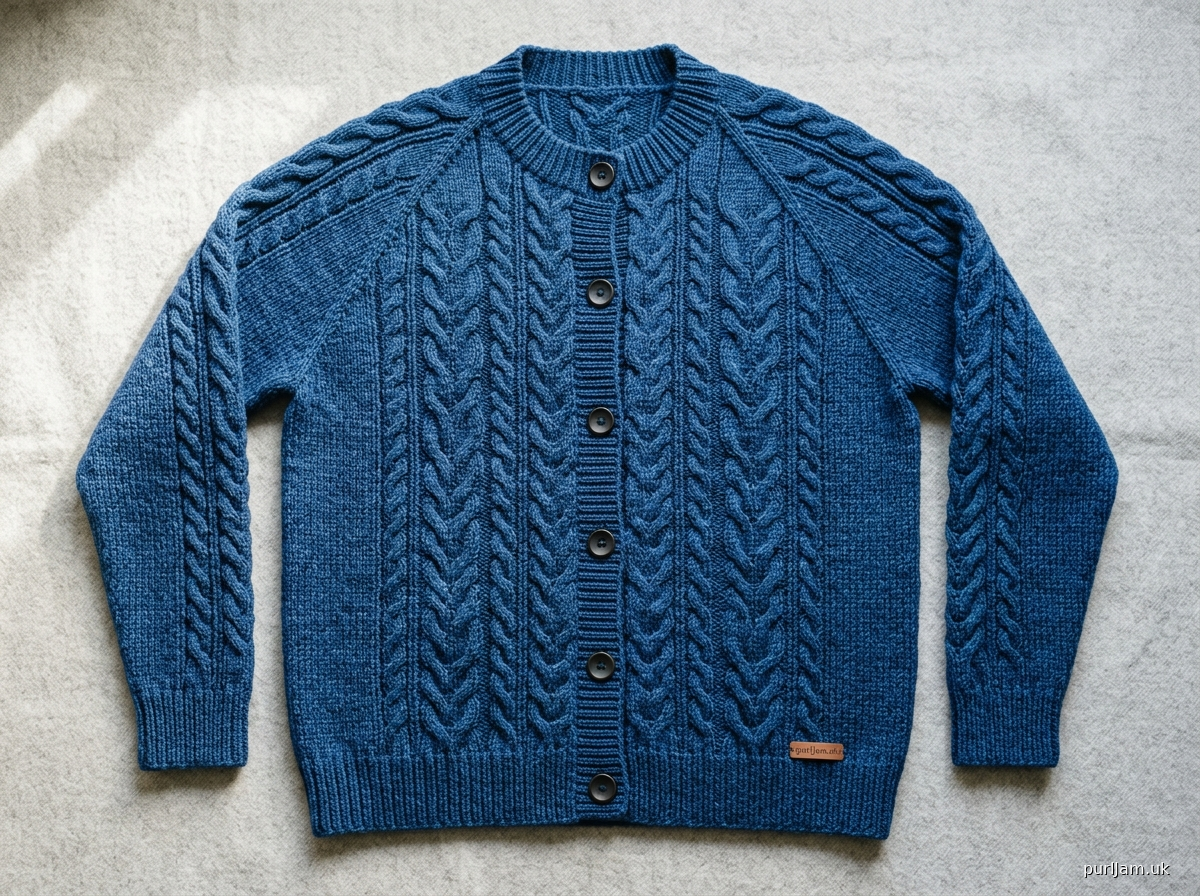
**A strictly modular, cable-tiled cardigan worked in precise 32-stitch blocks from the hem to the collar. Every seam boundary lands on an exact module edge, creating an unbroken, edge-to-edge cabled fabric across the entire garment.**

---

## ABOUT THIS PATTERN

Tilebound is built on a single architectural principle: a 32-stitch cable module that tiles perfectly against itself. Unlike conventional cardigans where shaping interrupts or mangles cable repeats, every single piece in Tilebound — fronts, back, and both sleeves — is composed of exact whole multiples of this 32-stitch tile. When the pieces meet at the underarm, cable ropes align seamlessly, cable for cable, column for column. The raglan yoke is then decreased strictly within the purl columns between cable ropes, so the braids themselves travel unbroken all the way to the collar.

**Construction summary:** Body cast on flat as one piece to the underarm. Sleeves cast on in the round as straight tubes to the underarm. All pieces joined onto one circular needle; yoke worked flat and decreased to the collar. Finished with button bands and a ribbed collar.

---

## SIZES

**S (M, L)**

Choose your size based on finished bust/chest circumference. This garment is designed with significant positive ease (approximately 10–14 cm / 4–5½ in) for a relaxed, oversized silhouette. For a closer fit, size down one size.

---

## FINISHED MEASUREMENTS

| Measurement | S | M | L |
|---|---|---|---|
| **Finished bust (with fronts closed)** | 93 cm (36½ in) | 108.5 cm (42¾ in) | 123.9 cm (48¾ in) |
| **Body length to underarm** | 42 cm (16½ in) | 42 cm (16½ in) | 42 cm (16½ in) |
| **Sleeve circumference (all sizes)** | 31 cm (12¼ in) | 31 cm (12¼ in) | 31 cm (12¼ in) |
| **Sleeve length to underarm** | 46 cm (18 in) | 46 cm (18 in) | 46 cm (18 in) |
| **Yoke depth** | approx. 23 cm (9 in) | approx. 25 cm (9¾ in) | approx. 27 cm (10½ in) |

> **Note on sleeve fit:** Because the sleeves are a fixed 4-module (128-stitch) tube across all sizes, the sleeve circumference is identical regardless of size. The sleeve circumference of 31 cm (12¼ in) has negative ease relative to a typical adult arm and will produce a fitted sleeve. If you require a wider sleeve, a 5-module sleeve (160 stitches) may be substituted, but only if you also adjust all module counts to maintain whole-module alignment throughout.

---

## MATERIALS

### Yarn
- **Weight:** Worsted weight (Aran/10-ply)
- **Fibre:** 100% superwash merino wool recommended for stitch definition in cables (any smooth worsted-weight yarn with good memory will work)
- **Approximate yardage:**
  - **S:** 1,450 m (1,585 yds)
  - **M:** 1,700 m (1,860 yds)
  - **L:** 1,950 m (2,135 yds)
- **Suggested yarn:** Any worsted-weight yarn at 200 m (220 yds) per 100 g skein
  - **S:** 8 skeins | **M:** 9 skeins | **L:** 10 skeins

### Needles
- **Main needle (body, sleeves, yoke):** 4 mm circular needle, 80–100 cm (32–40 in) cable — for body and yoke. 4 mm circular needle, 40 cm (16 in) cable — for sleeves in the round.
- **Ribbing needle:** 3.5 mm circular needles in the same lengths as above.
- **Cable needle:** 1 cable needle (straight or curved)

### Notions
- Stitch markers — at least 8 (4 for raglan columns + extra for module tracking, if desired)
- Scrap yarn or stitch holders (for underarm stitches)
- Tapestry needle
- **Buttons:** 7 buttons, approximately 2 cm (¾ in) diameter
- Blocking mats and pins

---

## TENSION (GAUGE)

**32 stitches × 36 rows = 10.16 cm × 10 cm (4 in × 4 in)** in cable pattern on 4 mm needles, measured after wet blocking.

**Critical module measurement:** 32 stitches = 7.75 cm (3.05 in) — this is the fundamental tile width upon which all stitch counts in this pattern are based.

> **Achieving correct tension is essential.** Because this pattern uses rigid whole-module arithmetic, even a small deviation in tension will alter the finished width significantly. Please swatch thoroughly and block your swatch before measuring. If your tension is too loose, try 3.75 mm needles. If too tight, try 4.25 mm needles.

---

## ABBREVIATIONS

| Abbreviation | Meaning |
|---|---|
| **beg** | beginning |
| **C4F** | cable 4 front: sl 2 sts to cable needle and hold to front, k2, k2 from cable needle |
| **C8B** | cable 8 back: sl 4 sts to cable needle and hold to back, k4, k4 from cable needle |
| **C8F** | cable 8 front: sl 4 sts to cable needle and hold to front, k4, k4 from cable needle |
| **CO** | cast on |
| **dec** | decrease(s) |
| **k** | knit |
| **k2tog** | knit 2 together (right-leaning decrease) |
| **LF** | left front |
| **m** | marker |
| **p** | purl |
| **PM** | place marker |
| **RF** | right front |
| **RS** | right side |
| **sl** | slip |
| **sm** | slip marker |
| **ssk** | slip, slip, knit (left-leaning decrease): sl 1 kwise, sl 1 kwise, insert LH needle through front of both slipped sts and k2tog tbl |
| **st(s)** | stitch(es) |
| **tbl** | through back loop |
| **WS** | wrong side |
| **1/1L** | 1-over-1 left cross: sl 1 to cable needle and hold to front, k1, k1 from cable needle |
| **1/1R** | 1-over-1 right cross: sl 1 to cable needle and hold to back, k1, k1 from cable needle |

---

## PATTERN NOTES

### The 32-Stitch Cable Module — Understanding the Architecture

The entire garment is built from a single repeating unit. Understanding this unit will make the pattern logical and easy to follow.

**One module (32 stitches) reads, on the RS, as:**

```
1/1L | P2 | K4 | P2 | K12 | P2 | K4 | P2 | 1/1R
  2  +  2  +  4  +  2  +  12 +  2  +  4  +  2  +  2  = 32 stitches
```

- The **1/1L** and **1/1R** at each edge are twisted rope stitches — 2 knit stitches worked as a cross. These are the "connectors" between modules.
- The **P2 columns** (purl 2) are the visual separators between cable ropes within a module. These purl columns are also where raglan decreases are placed in the yoke.
- The **K4** columns become **C4F** cables on Row 5 of the repeat.
- The **K12** centre section is where the **C8F** (Row 3) and **C8B** (Row 7) cables travel.

**How modules connect:** When module tiles sit side by side, the **1/1R** of the left module and the **1/1L** of the right module are adjacent. These two twisted stitches form a continuous rope column at every seam boundary — which is why the underarm join is seamless and the fabric appears continuous.

### The 8-Row Cable Repeat

All pieces use this same 8-row repeat. Rows 2, 4, 6, and 8 are always WS rows: purl all knit stitches, knit all purl stitches, and work 1/1L and 1/1R stitches as they present (knit the knit stitches of the cross).

### Working Flat vs. In the Round

- **Body** is worked **flat** (back and forth in rows) — RS rows are worked right to left as written; WS rows are worked left to right (reversed).
- **Sleeves** are worked **in the round** — all rows are RS rows; even-numbered rows are worked exactly as the RS row instruction states (no WS reversal needed).
- **Yoke** is worked **flat** after the join.

### Raglan Decreases — Keeping Cables Intact

The 4 raglan seam columns are formed by the **P2 columns that naturally occur at the boundaries between major sections** at the underarm join. Decreases are always worked as follows:
- **Right side of seam column:** ssk immediately after working the P2 column (this consumes one knit stitch from the cable panel to the left).
- **Left side of seam column:** k2tog immediately before working the P2 column (this consumes one knit stitch from the cable panel to the right).

This means the decreases eat into the outer edges of the K4 and K12 cable columns — never into the P2 purl columns themselves — so the purl columns and the rope twists remain pristine throughout the yoke.

### Button Bands

Button bands are picked up and worked after the body is complete (before the yoke join). Instructions are given at the end. Right front band has buttonholes; left front band is plain.

---

## THE BODY

### Module Count by Size

| Section | S | M | L |
|---|---|---|---|
| **Left Front** | 3 modules (96 sts) | 4 modules (128 sts) | 5 modules (160 sts) |
| **Back** | 6 modules (192 sts) | 6 modules (192 sts) | 6 modules (192 sts) |
| **Right Front** | 3 modules (96 sts) | 4 modules (128 sts) | 5 modules (160 sts) |
| **Body total** | **12 modules (384 sts)** | **14 modules (448 sts)** | **16 modules (512 sts)** |

> **The back is always 6 modules (192 stitches) across all sizes.** Width is graded by adding modules to the fronts only.

### Body Cast-On

Using 3.5 mm circular needle and long-tail cast-on, CO **384 (448, 512) sts**. Do not join.

**Ribbing set-up row (WS):** P1, *k2, p2; rep from * to last 3 sts, k2, p1.

Work in 2×2 rib as established for 6 cm (2¼ in), ending after a WS row.

Change to 4 mm circular needle.

### Begin Cable Pattern — Body

**Set-up note:** The body is worked flat. On RS rows, work from right to left as written. The pattern below uses "mod" as shorthand for "work one full 32-stitch cable module."

**RS (Right Side) Row — Body Cable Set-Up:**
Work across as follows:
- **Right Front:** Work **3 (4, 5) mods** in cable pattern.
- **Back:** Work **6 mods** in cable pattern.
- **Left Front:** Work **3 (4, 5) mods** in cable pattern.

> **Module boundaries align automatically.** Because every front and back section is a whole number of modules, the 1/1R that ends each front will sit directly beside the 1/1L that begins the back — and the 1/1R that ends the back will sit directly beside the 1/1L that begins the other front. No stitch is orphaned or split.

**WS Row:** Work all stitches as they present: purl the knit columns (K4, K12 sections), knit the purl columns (P2 sections), and knit the 2 edge stitches of each 1/1L and 1/1R (the crosses sit as knit stitches on the WS and should be purled — see below).

> **WS clarification for 1/1L and 1/1R:** These 2-stitch rope crosses, when viewed from the WS, appear as 2 purl bumps. On WS rows, purl these 2 stitches. On RS rows, work the cross as instructed.

### The Full 8-Row Module Repeat

Work the following 8-row repeat across all stitches of the body. Every row is written for ONE module. Repeat the instructions across all modules for your size.

---

**Row 1 (RS):** *[1/1L, p2, k4, p2, k12, p2, k4, p2, 1/1R]; rep [ ] across all mods.*

**Row 2 (WS):** *[P2, k2, p4, k2, p12, k2, p4, k2, p2]; rep across.* *(Work sts as they present: knit the purl columns, purl the knit columns, purl the 2 rope sts.)*

**Row 3 (RS):** *[1/1L, p2, k4, p2, k4, C8F, p2, k4, p2, 1/1R]; rep across.*

**Row 4 (WS):** As Row 2.

**Row 5 (RS):** *[1/1L, p2, C4F, p2, k12, p2, C4F, p2, 1/1R]; rep across.*

**Row 6 (WS):** As Row 2.

**Row 7 (RS):** *[1/1L, p2, k4, p2, C8B, k4, p2, k4, p2, 1/1R]; rep across.*

**Row 8 (WS):** As Row 2.

---

> **Notes on the cable crossings:**
> - **C8F** is worked across stitches 7–14 of the 12-stitch centre (K12) section: slip 4 to CN, hold front, k4, k4 from CN.
> - **C8B** is worked across stitches 1–8 of the K12 section: slip 4 to CN, hold back, k4, k4 from CN. This creates a rightward lean on alternating rows, producing a dynamic interplay within the K12 panel.
> - **C4F** crosses sts 1–4 of each K4 column.
> - **1/1L** crosses sts 1–2 of the module (sl 1 to CN, hold front, k1, k1 from CN).
> - **1/1R** crosses sts 31–32 of the module (sl 1 to CN, hold back, k1, k1 from CN).

### Body Length

Continue working the 8-row repeat until body measures **42 cm (16½ in)** from cast-on edge, ending after a **Row 8 (WS)** of the cable repeat.

> This ensures all pieces arrive at the underarm at the same position in the cable repeat, so the yoke cable continues uninterrupted after the join.

### Divide for Underarm

On the next RS row, work across the body as follows, placing underarm stitches on hold:

- Work across **Right Front** stitches [96 (128, 160) sts] in cable pattern. Place the last **8 sts** of the RF (= final 8 sts of the final RF module, i.e., the last 4 sts of the K4 column + the final P2 + 1/1R) on scrap yarn for underarm. This removes 8 sts from the RF.
  - **RF sts remaining on needle:** 88 (120, 152) sts.
- Work across **Back** stitches [192 sts] in cable pattern. Place the **first 8 sts** and the **last 8 sts** of the back on scrap yarn for underarm.
  - **Back sts remaining on needle:** 176 sts.
- Work across **Left Front** stitches [96 (128, 160) sts]. Place the **first 8 sts** of the LF on scrap yarn for underarm.
  - **LF sts remaining on needle:** 88 (120, 152) sts.

> **Note on underarm stitch selection:** The 8 stitches placed on hold at each underarm are the boundary stitches between the front/back sections. These consist of the 1/1R of one section and the 1/1L of the adjacent section (= 2 + 2 = 4 sts) plus the P2 columns immediately inside them (2 + 2 = 4 sts). Removing exactly 8 stitches (= ¼ module) at each underarm seam is a deliberate structural choice: it places the join exactly between the rope selvedge and the first purl column, creating a clean, logical break. These stitches will be grafted together at finishing.

Set body aside.

---

## THE SLEEVES (Make 2)

### Sleeve Module Count — All Sizes

**4 modules = 128 stitches.** This is identical across S, M, and L.

### Sleeve Cast-On

Using 3.5 mm circular needle, 40 cm (16 in) cable, CO **128 sts**. Join to work in the round, being careful not to twist. PM for beg of round.

**Ribbing set-up round:** *K2, p2; rep from * to end.

Work in 2×2 rib as established for 6 cm (2¼ in).

Change to 4 mm circular needle.

### Begin Cable Pattern — Sleeves

Because the sleeves are worked in the round, **all rounds are RS rounds.** Work the 8-row cable repeat exactly as written for RS rows — the even-numbered rows are NOT reversed.

Work the 8-round repeat across all 128 stitches as follows:

**Round 1:** *[1/1L, p2, k4, p2, k12, p2, k4, p2, 1/1R]; rep from * 3 more times (= 4 complete modules).

Continue through all 8 rounds of the repeat. In the round, the stitch count per round remains constant at 128 — **there are no increases**. The sleeve is a straight tube.

> **Why a straight tube?** Tilebound uses the rigidity of the module as its design principle. Tapered sleeves would require partial modules and would break the cable alignment at the underarm join. The straight-tube sleeve maintains exact module boundaries at the cuff and at the underarm, so the join is seamless and the cables continue uninterrupted into the yoke.

### Sleeve Length

Continue working the 8-round repeat until sleeve measures **46 cm (18 in)** from cast-on edge, ending after a **Round 8** of the cable repeat.

### Divide for Underarm

On the next round, work to the last 4 sts of the round. Place the last **4 sts** of the round and the **first 4 sts** of the round on scrap yarn (= 8 sts total on hold at underarm, centred at the beginning-of-round marker).

**Sleeve sts remaining:** 120 sts.

Set sleeve aside. Make second sleeve identically.

---

## THE YOKE JOIN — Module Alignment Explained

### Why the Join is Perfect

At the moment of joining, every piece has been worked to an exact module boundary:

- Each sleeve is 4 whole modules wide (128 sts cast on, 8 held = 120 active).
- Each front is 3 (4, 5) whole modules wide at cast-on; after holding 8 sts = 88 (120, 152) active sts [note: these are not exact module multiples after the hold, but the critical alignment happens at the seam boundary, explained below].
- The back is 6 whole modules at cast-on; after holding 8 sts each side = 176 active sts.

**The seam boundary alignment:** When the 8 underarm stitches are placed on hold, the stitch that remains on the needle immediately adjacent to the join — on both the body and the sleeve — is the **1/1L or 1/1R rope stitch** of a complete module boundary. Specifically:

- The **last active stitch of the Right Front** is the 1/1R of the final RF module.
- The **first active stitch of the Sleeve (right sleeve)** is the 1/1L of the first sleeve module.
- The **last active stitch of the Sleeve (right sleeve)** is the 1/1R of the final sleeve module.
- The **first active stitch of the Back** is the 1/1L of the first back module.

And so on, around the join. When these pieces are placed on the needle together, adjacent 1/1R and 1/1L stitches pair up at each seam boundary to continue their rope columns. No stitch is split; no module is partial. The cables of the sleeve flow directly into the cables of the yoke without interruption.

**The 4 raglan columns** are the P2 purl columns that naturally exist at these 4 seam boundaries (right front / right sleeve, right sleeve / back, back / left sleeve, left sleeve / left front). Place a marker at each of these 4 P2 columns when you begin the yoke.

### Joining Round

Slide all pieces onto the 4 mm long circular needle in this order (working right to left on RS):

1. **Right Front:** 88 (120, 152) sts
2. **PM (raglan marker A)**
3. **Right Sleeve:** 120 sts
4. **PM (raglan marker B)**
5. **Back:** 176 sts
6. **PM (raglan marker C)**
7. **Left Sleeve:** 120 sts
8. **PM (raglan marker D)**
9. **Left Front:** 88 (120, 152) sts

**Total sts on needle:**
- **S:** 88 + 120 + 176 + 120 + 88 = **592 sts**
- **M:** 120 + 120 + 176 + 120 + 120 = **656 sts**
- **L:** 152 + 120 + 176 + 120 + 152 = **720 sts**

> **Stitch count note:** The total active sts differ from the module multiples because 32 sts (4 × 8) have been placed on hold at the four underarms. 592 + 32 = 624; 656 + 32 = 688; 720 + 32 = 752. These counts reflect the held sts correctly accounted for.

> **Raglan markers sit within the P2 columns.** Each raglan marker is placed between the two purl stitches of the P2 boundary column (i.e., after the first P of the P2 column, so the marker sits mid-column). This makes it easy to identify the exact decrease placement: decreases always happen **immediately outside** the P2 column — one stitch to either side of the marker.

---

## THE YOKE

The yoke is worked **flat** (back and forth in rows) on the long circular needle. You will work RS and WS rows.

### Establishing the Raglan Decrease Placement

The raglan decreases consume one stitch on each side of each P2 raglan column on every RS row. This gives **8 decreases per RS row** (2 decreases × 4 raglan columns).

**Decrease Row (RS):**
Work in cable pattern to **2 sts before raglan marker A**, ssk, sm, work the P2 raglan column (p2), sm, k2tog; continue in cable pattern to **2 sts before raglan marker B**, ssk, sm, p2, sm, k2tog; continue to **2 sts before raglan marker C**, ssk, sm, p2, sm, k2tog; continue to **2 sts before raglan marker D**, ssk, sm, p2, sm, k2tog; work to end.

> **Note:** The 4 raglan markers are now **pairs of markers** — one on each side of each P2 column. Place a second marker at each raglan seam so the P2 column is bracketed. Total markers: 8.

**WS Row:** Work all stitches as they present (purl the knit sts, knit the purl sts). The raglan P2 columns are purled on RS and therefore appear as knit stitches on WS — **knit them**.

### Yoke Decrease Sequence

Work a Decrease Row on every RS row. Between Decrease Rows, work WS rows plain.

The cable pattern continues across all sections simultaneously — even as the stitch counts diminish, continue working the cable crossings on their scheduled rows. As the outer K4 columns lose stitches to decreases, they will reduce from C4F cables to k3, k2, k1 plain columns, and eventually disappear. The inner K12 panel will narrow similarly. The 1/1R and 1/1L rope selvedges and the P2 raglan columns are never decreased.

**Continue decreasing until the following stitch counts remain:**

| Section | S | M | L |
|---|---|---|---|
| Right Front | 32 sts | 32 sts | 32 sts |
| Right Sleeve | 32 sts | 32 sts | 32 sts |
| Back | 64 sts | 64 sts | 64 sts |
| Left Sleeve | 32 sts | 32 sts | 32 sts |
| Left Front | 32 sts | 32 sts | 32 sts |
| **Total** | **192 sts** | **192 sts** | **192 sts** |

> The yoke converges to the same stitch count for all sizes because decreasing is size-neutral — larger sizes simply require more decrease rows to reach the same collar stitch count.

**Number of Decrease Rows worked:**
- **S:** (592 − 192) ÷ 8 = 400 ÷ 8 = **50 Decrease Rows**
- **M:** (656 − 192) ÷ 8 = 464 ÷ 8 = **58 Decrease Rows**
- **L:** (720 − 192) ÷ 8 = 528 ÷ 8 = **66 Decrease Rows**

> Because decreases occur every RS row (i.e., every other row), the total row count of the yoke is approximately 100 (S), 116 (M), and 132 (L) rows, giving yoke depths of approximately 23 cm (9 in), 25 cm (9¾ in), and 27 cm (10½ in) respectively.

---

## COLLAR

After the final Decrease Row, work 1 WS row plain across all 192 sts.

Change to 3.5 mm circular needle.

**Ribbing Row (RS):** *K2, p2; rep from * to end. (192 sts ÷ 4 = 48 repeats — divides evenly ✅)

Work in 2×2 rib for 5 cm (2 in). Cast off loosely in rib pattern.

---

## BUTTON BANDS

**Note:** Button bands are picked up after the yoke is complete, before grafting the underarms.

### Left Front Band (Plain — Buttonhole-Free)

With RS facing and 3.5 mm needle, pick up and knit stitches along the left front edge at a ratio of **3 sts per 4 rows**. Work in 2×2 rib for 3 cm (1¼ in). Cast off in rib.

### Right Front Band (Buttonhole Band)

With RS facing and 3.5 mm needle, pick up and knit stitches along the right front edge at the same ratio as for the left band.

Work in 2×2 rib for 1.5 cm (⅝ in), ending after a WS row.

**Buttonhole Row (RS):** Rib 3 sts, *cast off 2 sts, rib to position of next buttonhole; rep from * 5 more times (6 buttonholes total across cardigan body). Cast off 2 sts, rib to end.
**Next Row (WS):** Rib, casting on 2 sts over each cast-off gap.

Continue in rib until band measures 3 cm (1¼ in). Cast off in rib.

**Seventh (top) buttonhole:** Worked into the collar rib. When collar is 1.5 cm (⅝ in) deep, work a buttonhole at the right-hand edge of the collar band in the same manner.

> **Buttonhole spacing:** Distribute 6 body buttonholes evenly along the right front edge, with the lowest buttonhole approximately 2.5 cm (1 in) above the cast-on edge and the highest approximately 2.5 cm (1 in) below the collar join. The 7th buttonhole is worked in the collar.

---

## FINISHING

### Underarm Grafting

For each underarm join, place the **8 held body stitches** and the **8 held sleeve stitches** on separate needles (8 sts each). Using Kitchener stitch and a tapestry needle, graft the sts together. This creates a seamless join that continues the cable fabric across the underarm.

### Weave In Ends

Weave in all ends securely on the WS, being particularly careful to secure the cast-on tail at the body hem and sleeve cuffs.

### Wet Blocking

This step is essential for the cables to fully open and for the module measurements to be accurate. Soak the completed cardigan in cool water for 20 minutes. Gently squeeze out excess water (do not wring). Lay flat on blocking mats and pin to finished measurements. Allow to dry completely before wearing.

### Attach Buttons

Sew buttons to the left front band, aligned opposite the buttonholes.

---

## QUICK REFERENCE — MODULE COUNTS

| Piece | S | M | L |
|---|---|---|---|
| Body — Right Front | 3 mods (96 sts) | 4 mods (128 sts) | 5 mods (160 sts) |
| Body — Back | 6 mods (192 sts) | 6 mods (192 sts) | 6 mods (192 sts) |
| Body — Left Front | 3 mods (96 sts) | 4 mods (128 sts) | 5 mods (160 sts) |
| Body total CO | 12 mods (384 sts) | 14 mods (448 sts) | 16 mods (512 sts) |
| Each sleeve | 4 mods (128 sts) | 4 mods (128 sts) | 4 mods (128 sts) |
| **Grand total at join (before holds)** | **20 mods (640 sts)** | **22 mods (704 sts)** | **24 mods (768 sts)** |

---

## SCHEMATIC (Text)

```
                   ┌──────── COLLAR ────────┐
                   └────────────────────────┘
                ┌──────── YOKE (flat, dec) ────────┐
         RF     │  R.Sleeve  │  BACK  │  L.Sleeve  │  LF
      3(4,5)mod │   4 mod    │  6 mod │   4 mod    │  3(4,5)mod
                └────────────────────────────────────┘
                        ↑ underarm join ↑

  BODY (flat)                      SLEEVES (in the round)
  ┌────────────────────────────┐   ┌──────────────────────────┐
  │  RF   │   BACK    │   LF   │   │     Straight tube        │
  │3(4,5) │    6 mod  │ 3(4,5) │   │     4 modules wide       │
  │  mod  │           │  mod   │   │     128 sts, no shaping  │
  └────────────────────────────┘   └──────────────────────────┘
  Cast on: 384 (448, 512) sts      Cast on: 128 sts each
```

---

*Tilebound was designed as an exercise in modular rigour — a garment where the mathematics are the design. Every stitch is exactly where geometry demands it be.*

---

**Pattern difficulty:** Intermediate — suitable for knitters comfortable with cables, working flat and in the round, and the Kitchener stitch graft.
Disclaimer: This pattern was generated by AI and should be reviewed for accuracy before use. While we strive for quality, AI-generated content may contain errors. Please verify measurements, stitch counts, and instructions before beginning your project. Generated by purlJam.uk
Access your pattern anytime
Bookmark this page to access your pattern anytime