Type
Knitting
Difficulty
intermediate
Category
custom
AI Thinking Process
Planning
Verification
Pattern
Twilight Forest Cowl
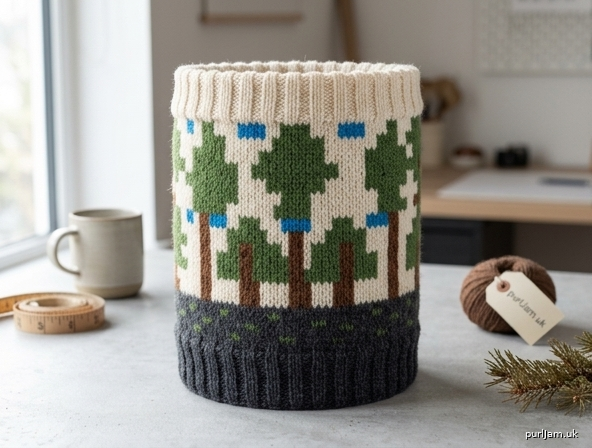
A snug, seamless cowl in worsted-weight stranded colorwork (jacquard). The fabric shows a quiet pine forest at dusk: dark ground and trunks below, evergreen canopies in the middle, and evening sky through the treetops. Knit entirely in the round so every colorwork stitch is a knit stitch — a gentle first colorwork project.
Sizes
Adult S/M (L/XL)
Finished circumference: 24 (28)" / 61 (71) cm
Finished height: 9" / 23 cm
Shown in S/M. Choose S/M for a closer neck, L/XL to wear over a coat. Instructions are written for S/M with L/XL in parentheses. When only one number is given, it applies to both sizes.
Gauge
20 stitches and 26 rounds = 4" (10 cm) in stranded stockinette stitch in the round on larger needles, after blocking.
Swatch in the round in two-color stranded knitting, not flat stockinette. If your swatch is tighter than 20 sts = 4", go up a needle size so the cowl does not cling. Circumference is calculated from this gauge: 120 sts ÷ 5 sts per inch = 24" ✓; 140 sts ÷ 5 sts per inch = 28" ✓.
Materials
Yarn: Worsted weight (CYC 4), wool or wool-blend preferred so the strands bloom and stay put.
Three colors; no more than two are used in any round:
- Color A (sky / background): mist gray, cream, or twilight blue — 175 (210) yd / 160 (192) m
- Color B (foliage): deep forest green — 120 (145) yd / 110 (133) m
- Color C (ground / trunks): bark brown or charcoal — 80 (95) yd / 73 (87) m
Needles:
- US 7 / 4.5 mm, 16" (40 cm) circular, for ribbing
- US 8 / 5 mm, 16" (40 cm) circular for S/M or 24" (60 cm) circular for L/XL, for colorwork
(Magic loop on a longer circular is fine for either size.)
Notions: 1 stitch marker; tapestry needle; scissors. Optional: row counter.
Abbreviations (US)
| Abbr. | Meaning |
|---|---|
| BO | bind off |
| CO | cast on |
| k | knit |
| p | purl |
| rnd(s) | round(s) |
| st(s) | stitch(es) |
| WS | wrong side |
Pattern Notes
- The cowl is worked bottom up in the round. There is no shaping: you will have 120 (140) stitches on every round from cast-on to bind-off.
- Stranded colorwork: carry the unused color loosely across the WS. Catch (trap) a float at least every 3–5 stitches so rings do not snag. Do not pull floats tight — the fabric should lie as wide as your gauge swatch.
- Two colors only per round. Work the forest in horizontal bands (ground, trunks, canopy, sky) so you never hold a third yarn.
- If a colourwork chart is provided with your pattern materials, work the forest motif from that chart over the colorwork section, keeping the stitch count at 120 (140). If no chart is available, work the woodland bands described below — the written bands are the complete motif.
- Join a new color at the beginning of a round, leaving a 6" tail to weave in later.
- Colorwork often looks uneven until it is washed and blocked. Trust the blocking.
Beginner float tip: Hold Color A in your left hand (or as your “background”) and Color B or C in your right. Keep the background yarn below the motif yarn so trees sit neatly on the sky.
Forest Motif (worked in words)
The picture is a dusk woodland, read from the cast-on edge upward:
- Forest floor — mostly Color C, with a scatter of Color B for moss and undergrowth.
- Trunks — slender vertical columns of Color C on a Color A (or still-dark) ground, spaced evenly around the cowl. Trunks are a few stitches wide and of slightly different heights so the stand of trees does not look mechanical.
- Canopy — evergreen silhouettes in Color B on Color A. Think simple pine shapes: narrower at the top, broader through the middle, irregular skyline, a little open sky between trees.
- Sky — mostly Color A, with only a few Color B stitches as distant treetops.
Keep the scene continuous around the tube. Vary tree height and spacing by eye; a real forest is not a perfect repeat.
Instructions
1. Lower ribbing
With smaller needles and Color C, CO 120 (140) sts. Place marker and join to work in the round, taking care not to twist.
Rib rnd: *K2, p2; repeat from * to end of rnd.
(120 and 140 are both divisible by 4, so the ribbing closes evenly ✓.)
Repeat Rib rnd 7 more times — 8 rib rnds total. Piece measures about 1¼" / 3 cm from the cast-on edge.
2. Forest colorwork
Change to larger needles.
Work 42 rounds of stranded stockinette (knit every stitch) in the forest motif, using two colors per round as follows. Stitch count remains 120 (140) ✓.
Rounds 1–10 — Forest floor (Colors B and C)
Knit every stitch, using Color C as the main ground and Color B for small mossy marks. Keep Color B floats short. These 10 rnds measure about 1½" / 4 cm (10 × 4 / 26 ≈ 1.5" ✓).
Rounds 11–20 — Trunks (Colors A and C)
Introduce Color A as the background. Knit vertical trunk columns in Color C, spaced evenly around. Let some trunks start in the floor band and some rise a little higher so the tree line is uneven. These 10 rnds measure about 1½" / 4 cm ✓.
Rounds 21–36 — Canopy (Colors A and B)
Drop Color C. Knit pine silhouettes in Color B on Color A. Widen and narrow the green areas as you go up so each tree reads as a triangle or stacked triangle; leave irregular gaps of sky. Catch Color B floats behind large sky areas and Color A floats behind wide canopies. These 16 rnds measure about 2½" / 6.5 cm (16 × 4 / 26 ≈ 2.5" ✓).
Rounds 37–42 — Sky (Colors A and B)
Work mostly Color A. Add only a few Color B stitches for far treetops. These 6 rnds measure about 1" / 2.5 cm (6 × 4 / 26 ≈ 0.9" ✓).
Colorwork section: 10 + 10 + 16 + 6 = 42 rnds ✓, about 6½" / 16.5 cm (42 × 4 / 26 ≈ 6.5" ✓).
If you are working from a supplied forest chart instead, work it over these 42 rounds (or the chart’s full height, then extra Color A rounds) until the colorwork measures 6½" / 16.5 cm, still on 120 (140) sts.
3. Upper ribbing
Change to smaller needles and Color A only.
Rib rnd: *K2, p2; repeat from * to end of rnd.
Work 8 rib rnds. Piece measures about 1¼" / 3 cm of ribbing.
Full height check: 1¼" rib + 6½" colorwork + 1¼" rib = 9" / 23 cm ✓.
4. Bind off
Bind off in rib pattern (k the knits, p the purls) with a medium hand — firm enough to match the lower edge, not so tight that the top will not stretch over the head. Cut yarn, leaving a 8" / 20 cm tail, and pull through the last stitch.
Finishing
- Weave in all ends on the WS with a tapestry needle. Where two colors meet, weave each tail under its own color so it does not show on the front.
- Soak the cowl in lukewarm water with a drop of wool wash for 15–20 minutes. Roll in a towel to remove excess water.
- Lay flat. Pat into a tube 24 (28)" around and 9" tall, easing the colorwork open until trees look even and the fabric is not corrugated. Do not stretch the ribbing wider than the body. Dry completely.
- If any floats are tight, you will feel a pinch; next time catch more loosely. After blocking, a slightly tight float usually relaxes.
Wear with the forest floor at the bottom and the sky at the top.
Quick reference
| Section | Color(s) | Rounds | Stitches |
|---|---|---|---|
| Lower rib | C | 8 | 120 (140) |
| Floor | B + C | 10 | 120 (140) |
| Trunks | A + C | 10 | 120 (140) |
| Canopy | A + B | 16 | 120 (140) |
| Sky | A + B | 6 | 120 (140) |
| Upper rib | A | 8 | 120 (140) |
| Total | — | 58 | 120 (140) throughout ✓ |
Disclaimer: This pattern was generated by AI and should be reviewed for accuracy before use. While we strive for quality, AI-generated content may contain errors. Please verify measurements, stitch counts, charts, and instructions before beginning your project. Generated by purlJam.uk
Love this pattern?
Save this pattern to your free PurlJam libraryAccess your pattern anytime
Bookmark this page to access your pattern anytime