Type
Knitting
Difficulty
intermediate
Category
cardigan
AI Thinking Process
Planning
Verification
Pattern
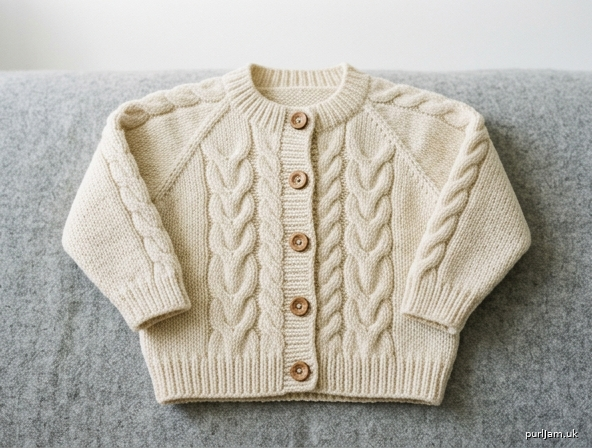
Wee Aran Cardigan
Seamless top-down raglan baby cardigan with cables
A classic Aran-style baby cardigan worked in one piece from the neck down. Reverse stocking stitch sets off 6-stitch rope cables on the fronts and sleeves, with a centred back panel of two ropes flanking a honeycomb. Sleeves are knitted in the round from held stitches. Ribbed button bands are picked up along the front edges.
Skill level: Intermediate (cables, raglan shaping, picking up stitches, working in the round).
Sizes
0–3 (3–6, 6–12, 12–18, 18–24) months
Figures are given in that order. Where only one figure appears, it applies to all sizes.
To fit chest: 42 (46, 50, 52, 56) cm [16½ (18, 19¾, 20½, 22) in]
Finished measurements (after blocking, buttoned)
| 0–3 m | 3–6 m | 6–12 m | 12–18 m | 18–24 m | |
|---|---|---|---|---|---|
| Chest | 48 cm (19 in) | 54 cm (21¼ in) | 61 cm (24 in) | 66 cm (26 in) | 70 cm (27½ in) |
| Length (back neck to hem) | 25 cm (9¾ in) | 28 cm (11 in) | 32 cm (12½ in) | 35 cm (13¾ in) | 38 cm (15 in) |
| Yoke depth | 11 cm (4¼ in) | 12.5 cm (5 in) | 14 cm (5½ in) | 15.5 cm (6 in) | 17 cm (6¾ in) |
| Underarm to hem | 13 cm (5 in) | 14 cm (5½ in) | 16 cm (6¼ in) | 17.5 cm (7 in) | 19 cm (7½ in) |
| Upper sleeve | 19 cm (7½ in) | 21 cm (8¼ in) | 24 cm (9½ in) | 26 cm (10¼ in) | 28 cm (11 in) |
| Sleeve length (underarm to cuff edge) | 13 cm (5 in) | 15 cm (6 in) | 18 cm (7 in) | 20 cm (8 in) | 23 cm (9 in) |
Ease is generous, as is usual for Aran baby knits (layering and growing room). Choose the size by the child’s chest, not age.
Yarn
Aran-weight yarn (10-ply / worsted-aran); approx. 180 m per 100 g. A machine-washable wool or wool-blend is recommended for baby wear.
Metres: 280 (340, 420, 500, 580) m Grams: 160 (190, 240, 280, 330) g
Allow 200 (250, 300, 350, 400) g so that you have yarn for a tension square and a little spare.
Buttons: 4 (4, 5, 5, 6) buttons, 15–18 mm diameter. Sew them on very firmly.
Needles & notions
- 4.5 mm (UK 7) circular needle, 60 cm, and matching double-pointed needles (or a long circular for magic loop) for ribbing
- 5 mm (UK 6) circular needle, 60 cm, and matching DPNs / magic loop for the main fabric
- Cable needle
- 4 stitch markers (plus 2 optional markers for sleeve cables)
- Waste yarn or stitch holders
- Tapestry needle
- 4 (4, 5, 5, 6) buttons
Use the needle size you need to match tension; the sizes above are typical for Aran yarn.
Tension (gauge)
18 stitches and 24 rows = 10 cm (4 in) in stocking stitch on 5 mm needles, after blocking.
Work a tension square of at least 22 sts × 30 rows. Measure the inner 10 cm.
Cables draw the fabric in. The finished measurements assume this stocking-stitch tension and moderate blocking. If your square has too many stitches per 10 cm, change to a larger needle; if too few, change to a smaller needle. Matching tension is essential for fit.
Abbreviations
C4B – slip 2 sts to cn, hold at back, k2, k2 from cn C4F – slip 2 sts to cn, hold at front, k2, k2 from cn C6B – slip 3 sts to cn, hold at back, k3, k3 from cn C6F – slip 3 sts to cn, hold at front, k3, k3 from cn cn – cable needle CO – cast on dec – decrease inc – increase k – knit k2tog – knit 2 together M1P – make 1 purlwise: lift the bar between the needles from front to back with the left needle and purl it through the back loop (a closed increase) p – purl p2tog – purl 2 together patt – pattern pm – place marker rem – remain(ing) rep – repeat rev st st – reverse stocking stitch (purl on RS, knit on WS; purl every round in the round) rnd(s) – round(s) RS – right side slm – slip marker ssk – slip, slip, knit (or slip 1 knitwise, slip 1 knitwise, knit them together through the back loop) st(s) – stitch(es) st st – stocking stitch WS – wrong side yo – yarn over
Pattern notes
- The cardigan is worked flat (back and forth) from the neck to the underarm, then the body continues flat. Sleeves are worked in the round.
- RS rows begin at the Right Front (as worn).
- Raglan lines are 2 knit stitches (one either side of each marker). Increases sit just outside these stitches and are worked as M1P so they join the reverse-stocking background.
- Selvedge: knit the first and last stitch of every row after the neck rib. This garter edge makes picking up the bands even.
- Cables are established once each section is wide enough. Further raglan stitches are worked in reverse stocking stitch, so the front cables stay next to the opening and the back and sleeve cables stay centred.
- On WS rows (and on even sleeve rounds) work stitches as they present: knit the knits, purl the purls, and knit the selvedge stitches.
- Buttonholes are given on the Right Front (as worn), traditional for a girls’/unisex cardigan. Work them on the Left Front instead if you prefer a boys’ closing.
- When a size has 0 repeats of a step, skip that step for that size.
Stitch patterns
2×2 rib (flat, over a multiple of 4 sts + 2)
Row 1 (RS): k2, *p2, k2; rep from * to end. Row 2 (WS): p2, *k2, p2; rep from * to end. Rep rows 1–2.
2×2 rib (in the round, over a multiple of 4 sts)
Every rnd: *k2, p2; rep from * to end.
Rope cable Right (over 6 sts) — 8-row/rnd repeat
Row/rnd 1 (RS): C6B. Row 2 (WS): p6. (In the round: k6.) Row/rnd 3: k6. Row 4: as row 2. Row/rnd 5: k6. Row 6: as row 2. Row/rnd 7: k6. Row 8: as row 2. Rep rows/rnds 1–8.
Rope cable Left (over 6 sts) — 8-row/rnd repeat
As Rope cable Right, but work C6F on row/rnd 1.
Honeycomb (over 8 sts) — 8-row repeat
Row 1 (RS): C4B, C4F. Row 2 (WS): p8. Row 3: k8. Row 4: p8. Row 5: C4F, C4B. Row 6: p8. Row 7: k8. Row 8: p8. Rep rows 1–8.
Front / sleeve panel (10 sts)
p2, Rope cable (Right or Left as directed), p2.
Back panel (26 sts)
Worked over the centre back: Row 1 (RS): p1, C6B, p2, C4B, C4F, p2, C6F, p1. Row 2 (WS): k1, p6, k2, p8, k2, p6, k1. Row 3: p1, k6, p2, k8, p2, k6, p1. Row 4: as row 2. Row 5: p1, k6, p2, C4F, C4B, p2, k6, p1. Row 6: as row 2. Row 7: p1, k6, p2, k8, p2, k6, p1. Row 8: as row 2. Rep rows 1–8.
The ropes cross every 8 rows; the honeycomb crosses every 4 rows. Keep a row counter so all panels stay in step.
Neckband
With 4.5 mm circular needle, cast on 42 (46, 54, 58, 66) sts.
Work 8 rows in 2×2 rib, beginning with a RS row and ending with a WS row. (Cast-on 42 (46, 54, 58, 66) is 4n+2, so each rib RS row starts and ends with k2 ✓.)
Change to 5 mm circular needle.
Marker set-up (WS)
Work 1 WS row as follows, placing 4 raglan markers (the 2 raglan stitches of each line sit one either side of the marker):
p5 (6, 7, 8, 9), pm, p2, pm, p4 (4, 6, 6, 8), pm, p2, pm, p16 (18, 20, 22, 24), pm, p2, pm, p4 (4, 6, 6, 8), pm, p2, pm, p5 (6, 7, 8, 9).
Check: 5+2+4+2+16+2+4+2+5 = 42; 6+2+4+2+18+2+4+2+6 = 46; 7+2+6+2+20+2+6+2+7 = 54; 8+2+6+2+22+2+6+2+8 = 58; 9+2+8+2+24+2+8+2+9 = 66 ✓.
You now have: Right Front | raglan | Sleeve | raglan | Back | raglan | Sleeve | raglan | Left Front.
On the next row the first and last stitch become the garter selvedge. The stitch either side of each marker is the raglan knit stitch.
Yoke
The yoke is shaped with 8 increases on every RS row (M1P either side of each of the 4 raglan lines) until the body and sleeves reach their stitch counts, then worked even to the underarm.
Reverse-stocking set-up (no cables yet)
Increase row (RS): k1 (selvedge), purl to 1 st before marker, M1P, k1, slm, k1, M1P, purl to 1 st before marker, M1P, k1, slm, k1, M1P, purl to 1 st before marker, M1P, k1, slm, k1, M1P, purl to 1 st before marker, M1P, k1, slm, k1, M1P, purl to last st, k1. (8 sts increased ✓.)
WS row: k1 (selvedge), work sts as they present to last st (knit the reverse-stocking sts, purl the raglan knit sts), k1.
Work the Increase row, then a WS row, 5 (4, 3, 2, 1) times.
Stitch count after these rows:
- Right/Left Front: 10 (10, 10, 10, 10) sts each
- Each sleeve (between raglan knits): 14 (12, 12, 10, 10) sts
- Back (between raglan knits): 26 (26, 26, 26, 26) sts
- Plus 8 raglan knit sts
- Total: 82 (78, 78, 74, 74) sts
Check size 0–3: start 42 + (8 × 5) = 82 ✓. Check size 3–6: 46 + (8 × 4) = 78 ✓. Check size 6–12: 54 + (8 × 3) = 78 ✓. Check size 12–18: 58 + (8 × 2) = 74 ✓. Check size 18–24: 66 + (8 × 1) = 74 ✓.
The back now holds the 26-st panel, each front holds the 10-st panel, and each sleeve has at least 10 sts.
Establish cables (RS — also an increase row)
Work as follows, keeping the 8 raglan increases:
k1, work Front/sleeve panel with C6F over the next 10 sts (p2, C6F, p2), purl any remaining front sts (there are none on this row) to 1 st before marker, M1P, k1, slm, k1, M1P, purl to the centre 10 sts of the sleeve, work Front/sleeve panel with C6B (p2, C6B, p2), purl to 1 st before marker, M1P, k1, slm, k1, M1P, purl 0 (0, 0, 0, 0) sts, work Back panel row 1 over the next 26 sts, purl 0 sts, M1P, k1, slm, k1, M1P, purl to the centre 10 sts of the sleeve, work Front/sleeve panel with C6B, purl to 1 st before marker, M1P, k1, slm, k1, M1P, purl any remaining front sts, work Front/sleeve panel with C6B over the last 10 sts before the selvedge (p2, C6B, p2), k1.
WS: k1, work sts as they present (this is row 2 of all cable panels), k1.
Cables are now in step on row 2 of their 8-row repeats. The two front ropes mirror each other (C6F on the Right Front, C6B on the Left Front) so they twist towards the centre body. Sleeve ropes both use C6B. Back panel: C6B, honeycomb, C6F.
Continue raglan increases with cables
Keeping cables in their 8-row repeats and working all new stitches in reverse stocking stitch:
Increase row (RS): k1, work in established patt to 1 st before marker, M1P, k1, slm, k1, M1P; repeat from the pattern-to-1-st-before-marker sequence at each of the remaining 3 raglan lines; work in patt to last st, k1. (8 sts increased ✓.)
WS row: k1, work sts as they present, k1.
Continue in this manner until you have worked a total of 12 (13, 15, 16, 17) Increase rows from the beginning of raglan shaping (including the reverse-stocking rows and the cable set-up row). End after the WS row that follows the last Increase row.
Stitch count after all increases:
- Right/Left Front (between selvedge/raglan, excluding the 2 raglan knits that sit on the markers): 17 (19, 22, 24, 26) sts each
- Each sleeve (between raglan knits): 28 (30, 36, 38, 42) sts
- Back (between raglan knits): 40 (44, 50, 54, 58) sts
- Plus 8 raglan knit sts
- Total: 138 (150, 174, 186, 202) sts
Check: 42 + (8 × 12) = 138; 46 + (8 × 13) = 150; 54 + (8 × 15) = 174; 58 + (8 × 16) = 186; 66 + (8 × 17) = 202 ✓.
Fronts: 5+12=17; 6+13=19; 7+15=22; 8+16=24; 9+17=26 ✓. Sleeves: 4+24=28; 4+26=30; 6+30=36; 6+32=38; 8+34=42 ✓. Back: 16+24=40; 18+26=44; 20+30=50; 22+32=54; 24+34=58 ✓.
Work even
Continue in established pattern without increasing, until the yoke measures 11 (12.5, 14, 15.5, 17) cm [4¼ (5, 5½, 6, 6¾) in] from the first Increase row, ending with a WS row. Maintain the cable repeats and the 2 knit stitches of each raglan line.
Divide body and sleeves
Divide row (RS): Work in patt across the Right Front including the first raglan knit stitch — 18 (20, 23, 25, 27) sts.
Place the next 30 (32, 38, 40, 44) sts on waste yarn for the right sleeve (remaining raglan knit + sleeve + following raglan knit). Check: 1 + 28 + 1 = 30; 1+30+1=32; 1+36+1=38; 1+38+1=40; 1+42+1=44 ✓.
Using the backward-loop (or knitted) method, cast on 4 (6, 6, 6, 6) underarm sts.
Work in patt across the Back including 1 raglan knit at each side — 42 (46, 52, 56, 60) sts. Check: 1+40+1=42; 1+44+1=46; 1+50+1=52; 1+54+1=56; 1+58+1=60 ✓.
Place the next 30 (32, 38, 40, 44) sts on waste yarn for the left sleeve.
Cast on 4 (6, 6, 6, 6) underarm sts.
Work in patt across the Left Front including the remaining raglan knit — 18 (20, 23, 25, 27) sts.
Body on the needle: 86 (98, 110, 118, 126) sts. Check: 18+4+42+4+18=86; 20+6+46+6+20=98; 23+6+52+6+23=110; 25+6+56+6+25=118; 27+6+60+6+27=126 ✓. Chest: 86 (98, 110, 118, 126) sts ÷ 1.8 = 47.8 (54.4, 61.1, 65.6, 70) cm, published as 48 (54, 61, 66, 70) cm ✓.
Next row (WS): k1, work sts as they present, knitting the underarm cast-on stitches (they join the reverse-stocking background), k1.
Body
Continue in established pattern on these 86 (98, 110, 118, 126) sts, working the underarm stitches in reverse stocking stitch and keeping the cable panels in step:
RS rows: k1, work Right Front panel (p2, C6F on cable-cross rows / k6 on plain rows, p2), purl the remaining Right Front stitches, purl 4 (6, 6, 6, 6) underarm sts, purl to the 26-st Back panel, work Back panel, purl to the next underarm, purl 4 (6, 6, 6, 6) underarm sts, purl the Left Front stitches before the panel, work Left Front panel (p2, C6B on cable-cross rows / k6 on plain rows, p2), k1.
Placement check, Right Front 18 (20, 23, 25, 27): k1 + 10-st panel + p7 (9, 12, 14, 16) = 18 (20, 23, 25, 27) ✓. Back 42 (46, 52, 56, 60): p8 (10, 13, 15, 17) + 26-st panel + p8 (10, 13, 15, 17) = 42 (46, 52, 56, 60) ✓.
Work until the body measures 10 (11, 13, 14.5, 16) cm [4 (4¼, 5, 5¾, 6¼) in] from the underarm, ending with a WS row. If you are within 1–2 rows of completing a cable repeat, finish the repeat so the cables close neatly before the rib.
Hem
Change to 4.5 mm needle.
Work 8 rows in 2×2 rib, beginning with a RS row (k2, *p2, k2; rep from * to end). (86 (98, 110, 118, 126) = 4n+2, so the rib starts and ends with k2 ✓.)
Cast off loosely in rib.
Sleeves
Work both sleeves alike.
Return the 30 (32, 38, 40, 44) held sleeve stitches to 5 mm DPNs (or a long circular for magic loop). With RS facing, beginning at the centre of the underarm, pick up and knit 4 (6, 6, 6, 6) sts along the underarm cast-on (pick up 1 extra stitch in each corner if a hole wants to form; decrease any extra stitches on the next round).
34 (38, 44, 46, 50) sts. Check: 30+4=34; 32+6=38; 38+6=44; 40+6=46; 44+6=50 ✓.
Join to work in the round. Place a marker for the beginning of the round at the centre underarm. The 10-st cable panel sits at the top of the sleeve (opposite the underarm).
Next rnd: purl to the 10-st cable panel, work the panel (p2, k6, p2 — continuing the 8-row cable repeat already established on the yoke; on a cross round work C6B), purl to end.
This is reverse stocking stitch in the round (purl every round) with the rope cable on top of the sleeve.
Sleeve shaping
Work 3 (4, 3, 4, 4) rounds even in pattern.
Decrease round: k1, k2tog, work in patt to 3 sts before the marker, ssk, k1. (2 sts decreased ✓.) If a decrease would land inside the 10-st cable panel, move that decrease 1 stitch toward the underarm so the panel stays intact. On a reverse-stocking background you may work the decreases as p2tog / p2tog tbl instead, to keep the fabric smooth; the two stitches either side of the underarm marker are the intended decrease sites.
Work 3 (4, 3, 4, 4) rounds even, then 1 Decrease round. Continue in this way, decreasing every 4th (5th, 4th, 5th, 5th) round, until 5 (5, 8, 7, 9) decrease rounds have been worked.
24 (28, 28, 32, 32) sts remain. Check: 34 − (2 × 5) = 24; 38 − 10 = 28; 44 − 16 = 28; 46 − 14 = 32; 50 − 18 = 32 ✓.
Continue even in pattern (if needed) until the sleeve measures 9 (11, 14, 16, 19) cm [3½ (4¼, 5½, 6¼, 7½) in] from the underarm, ending with round 8 of the cable if possible so the rope closes before the cuff.
Cuff
Change to 4.5 mm DPNs.
If you are not already on a multiple of 4, decrease 0 (0, 0, 0, 0) sts evenly on the first cuff round — counts are already 24 (28, 28, 32, 32), all multiples of 4 ✓.
Work 8 rounds in 2×2 rib (*k2, p2; rep from * to end).
Cast off loosely in rib.
Work the second sleeve the same way.
Button bands
Left Front band (button band)
With 4.5 mm needle and RS facing, beginning at the Left Front neck edge (top of the neckband) and working down to the hem, pick up and knit 50 (54, 66, 70, 74) sts along the selvedge.
Guide: pick up 3 sts for every 4 rows, adjusting to the stated count. 50 (54, 66, 70, 74) = 4n+2 so the rib will start and end with k2 ✓.
Work 8 rows in 2×2 rib, beginning with a WS row (p2, *k2, p2; rep from * to end).
Cast off loosely in rib.
Right Front band (buttonhole band)
With 4.5 mm needle and RS facing, beginning at the Right Front hem and working up to the neck, pick up and knit 50 (54, 66, 70, 74) sts along the selvedge.
Work 3 rows in 2×2 rib, beginning with a WS row.
Buttonhole row (RS): Work in rib, placing 4 (4, 5, 5, 6) buttonholes evenly along the band. Make the first buttonhole 4 sts from the neck edge and the last 4 sts from the hem edge; space the remaining holes evenly between them.
1-row buttonhole: on a k2 column work yo, k2tog; if a hole would fall on a p2 column, work yo, p2tog instead.
Work 4 more rows in 2×2 rib (8 band rows in total).
Cast off loosely in rib.
Finishing
- Weave in all ends, using the underarm tails to close any small gaps at the sleeve joins.
- Wet-block the cardigan to the finished measurements. Pin the chest and length; do not stretch the cables so hard that they look pulled. Allow to dry completely.
- Sew the buttons to the Left Front band, opposite the buttonholes. Use a doubled thread and sew very firmly — buttons are a choking hazard if they come off.
- Optional: add a small snap fastener at the top of the neckband on the inside for a neater close on the smallest sizes.
Schematic measurements (blocked)
- A Chest (buttoned): 48 (54, 61, 66, 70) cm
- B Total length: 25 (28, 32, 35, 38) cm
- C Yoke depth (first increase to underarm): 11 (12.5, 14, 15.5, 17) cm
- D Underarm to hem: 13 (14, 16, 17.5, 19) cm
- E Sleeve length: 13 (15, 18, 20, 23) cm
- F Upper sleeve: 19 (21, 24, 26, 28) cm
- G Cuff: approx. 13 (15.5, 15.5, 18, 18) cm around, pulling in with 2×2 rib
Stitch-count summary
| Stage | 0–3 m | 3–6 m | 6–12 m | 12–18 m | 18–24 m |
|---|---|---|---|---|---|
| Cast on | 42 | 46 | 54 | 58 | 66 |
| After all raglan increases | 138 | 150 | 174 | 186 | 202 |
| Each sleeve on hold | 30 | 32 | 38 | 40 | 44 |
| Body after divide | 86 | 98 | 110 | 118 | 126 |
| Sleeve in the round | 34 | 38 | 44 | 46 | 50 |
| Cuff | 24 | 28 | 28 | 32 | 32 |
| Each button band | 50 | 54 | 66 | 70 | 74 |
Work a tension square, read the yoke through once before you begin, and keep a row counter on the 8-row cable repeat. That is the whole cardigan.
Disclaimer: This pattern was generated by AI and should be reviewed for accuracy before use. While we strive for quality, AI-generated content may contain errors. Please verify measurements, stitch counts, charts, and instructions before beginning your project. Generated by purlJam.uk
Love this pattern?
Save this pattern to your free PurlJam libraryAccess your pattern anytime
Bookmark this page to access your pattern anytime