Type
Machine Knitting
Difficulty
intermediate
Category
custom
AI Thinking Process
Planning
Verification
Pattern
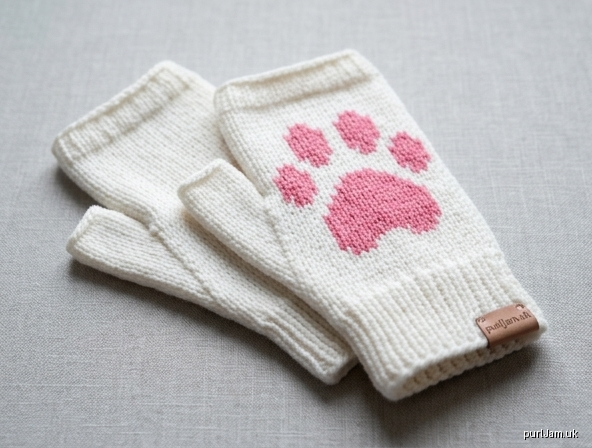
White Fingerless Mittens with Pink Cat Paw Pads
Standard-gauge machine knitting pattern (intermediate)
Simple adult fingerless mittens in white worsted, with a pink cat-paw motif on the palm. Knit as two identical flat panels on the main bed, seamed after blocking. Open thumb slit; no ribber required.
Materials
- MC (white): worsted / 10-ply, approx. 70 g / 140 m for the pair
- CC (pink): worsted, approx. 10 g / 20 m for paw pads
- Waste yarn (smooth contrast) and ravel cord
- Standard-gauge machine (4.5 mm needle pitch), punchcard or electronic; ribber not required
- Transfer tool, latch tool, claw weights, cast-on comb, tapestry needle, steam iron
Yardage note: Two mittens; leftover CC is ample for both palms.
Tension / Gauge
- Main tension: T7 (MC and CC)
- Gauge: 20 sts and 28 rows = 10 cm (4 in) in stocking stitch, measured after light steam
- Waste / ravel: T10
Always knit a 40-st × 40-row swatch and steam before starting. Adjust tension dial if your fabric is denser or looser than 20 sts / 10 cm.
Sizes
Adult Medium (one size written; see notes to scale)
| Stitches | Rows | Finished (after seaming & steam) | |
|---|---|---|---|
| Panel | 40 sts | 56 rows | 20 cm wide × 20 cm long |
| Circumference | — | — | ~20 cm (fits ~18–21 cm hand) |
| Thumb opening | 8 sts held | 16 rows | ~4 cm high |
To size: ±2 sts per 1 cm circumference change; ±3 rows per 1 cm length. Keep the paw motif centred on the palm half of the 40-st panel (sts 21–40 if you treat st 1 as the little-finger edge).
Abbreviations & machine terms
- MC / CC — main / contrast colour
- COR / COL — carriage on right / left
- RC — row counter
- NWP / WP / HP — non-working / working / holding position
- T# — tension dial
- e-wrap — e-wrap cast-on
- ss — stocking stitch (knit every row; purl side is reverse)
- intarsia — separate CC yarn for isolated motif (no floats across the palm)
Pattern notes
- Knit two identical panels. After seaming, one becomes left, one right; paw faces the palm.
- Colourwork is a cat paw pad: one large central pad plus four smaller oval “toes” in CC pink on white. Place the motif on the palm half of the panel, roughly centred between RC 24 and RC 44 so it sits in the middle of the palm, not at the cuff or fingers.
- Use intarsia (separate short lengths of CC, no long floats) or duplicate stitch after knitting if you prefer a plain white fabric. Do not rely on a punchcard all-over repeat; the motif is a single isolated paw.
- If a separate colourwork chart is provided later, centre it on the palm half; the written placement still works without a chart.
- Weights: hang claw weights on both edges and the cast-on comb; move them up every 10–12 rows.
- Carriage: stockinette, both part buttons out, cam set for knit. No slip/tuck unless you choose a decorative cuff (not used here).
Machine setup
- Main bed only. Bring 40 needles to WP (every needle). Remaining needles NWP.
- Thread MC. Carriage COR. Tension T10.
- Cast on with waste yarn using e-wrap or closed cast-on; knit 8–10 rows waste. Hang comb and weights.
- Knit 1 row ravel cord. RC 000. Change to T7. COR.
Panel (make 2)
Cuff (optional rolled edge)
- With MC, knit 6 rows ss. RC 006. COL after last row if you started COR.
- (Optional: transfer every other stitch for 1×1 mock rib for 8 rows, then return all needles to WP — skip if you want a plain roll.)
Hand to thumb opening
- Continue MC ss.
- RC 006–020: Knit 14 rows. RC 020. COR (or COL — note your carriage).
- Thumb slit (hold): Decide which 8 needles form the thumb. For a right-palm panel, hold needles 9–16 from the right edge of the 40 (adjust so the slit sits on the thumb side after seaming). Bring those 8 needles to HP. Set carriage to hold (Russell levers / holding cam as for your machine).
- Knit across remaining 32 needles.
- RC 020–036: Knit 16 rows on 32 needles, wrapping the first held needle each pass if your machine requires wraps to avoid holes (or pick up a wrap later). RC 036.
- Return 8 held needles to WP. Knit 1 row across all 40 sts to close the top of the slit. RC 037.
Paw motif zone (palm)
- RC 037–044: Continue MC. Begin CC paw as intarsia on the palm half (approximately stitches 22–38 of the 40, depending on how you oriented the thumb).
- Large pad: a rounded oval of CC, about 10–12 sts wide and 10–12 rows tall, sitting just below the four toes.
- Four toes: four small ovals of CC (about 3–4 sts × 4–5 rows each) arranged in an arc above the large pad, toward the finger edge (higher RC).
- Work CC only on motif stitches; MC on all other stitches. Twist yarns at colour changes (intarsia). No need for a punchcard program unless your electronic machine is set for a single motif.
- RC 044–056: Finish remaining rows in MC ss after the motif is complete. RC 056. COR.
Bind off
- Tension T8. Latch-tool bind off all 40 stitches, or transfer to a waste yarn and graft later. Remove from machine. Pull ravel cord to drop waste.
Repeat for second panel, mirroring the thumb hold if you want a distinct left/right (or knit identical and flip one when seaming so both paws face in).
Inline check: 40 sts throughout except 32 during RC 020–036 (8 in HP). 56 rows total. 6 + 14 + 16 + 1 + (motif within remaining) + finish = 56 ✓.
Finishing
- Steam panels flat, paw side up, without stretching the thumb slit.
- Fold each panel so the little-finger edges meet (sts 1 and 40). Mattress-stitch the side seam from cuff to bind-off, leaving the 8-st / 16-row slit open for the thumb.
- If you used duplicate stitch instead of intarsia, embroider the paw on the palm now.
- Weave in MC and CC ends on the wrong side. Light steam seams.
- Optional: single-crochet or latch-tool a round of MC around the thumb opening and finger edge for a tidy finish.
Wear with the pink paw on the palm.
Disclaimer: This pattern was generated by AI and should be reviewed for accuracy before use. While we strive for quality, AI-generated content may contain errors. Please verify measurements, stitch counts, charts, and instructions before beginning your project. Generated by purlJam.uk
Love this pattern?
Save this pattern to your free PurlJam libraryAccess your pattern anytime
Bookmark this page to access your pattern anytime